
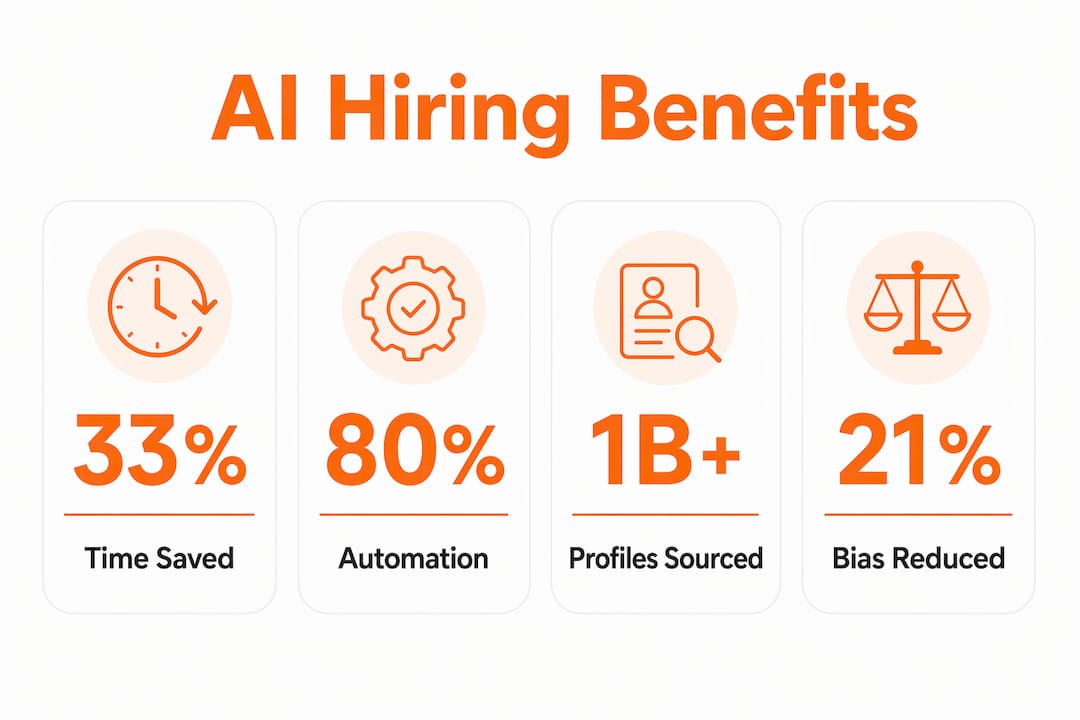
AI-driven talent discovery is defined as the automated identification and matching of candidates using natural language processing (NLP) and machine learning, replacing manual resume screening with signal-based evaluation. Platforms like Eightfold.ai, SeekOut, and Ema AI represent the current standard in this category. The technology reduces time-to-hire by up to 33% and automates 80% of manual recruiter tasks. For HR professionals evaluating AI talent acquisition in 2026, understanding how these systems work, what they deliver, and where they fall short is the foundation of any sound implementation decision.
What is AI-driven talent discovery and how does it differ from keyword screening?
Traditional recruitment relies on Boolean keyword searches. A recruiter types "Python AND AWS AND 5 years experience" into an applicant tracking system (ATS) and filters out anyone whose resume does not contain those exact strings. This method is fast to set up but structurally limited. It misses candidates who describe the same skills differently, excludes career changers with transferable experience, and rewards resume keyword stuffing over actual competence.
AI-driven talent discovery operates differently. NLP and machine learning parse both job descriptions and candidate profiles for intent and context, not just literal word matches. A system trained on thousands of software engineering roles understands that "built distributed systems" and "designed microservices architecture" describe overlapping competencies, even without shared keywords.

Signal-based matching goes further. Rather than evaluating a static resume, AI systems assess dynamic candidate data: open-source contributions on GitHub, published articles, professional activity patterns, and skills endorsements. Shifting from resumes to signals means the system evaluates what a candidate has actually done, not just what they have written about themselves.
| Dimension | Keyword-based screening | AI-driven discovery |
|---|---|---|
| Matching method | Exact string match | Semantic intent and context |
| Candidate data used | Static resume text | Dynamic signals and activity |
| Coverage | Only applicants | Applicants plus passive candidates |
| Bias risk | High (keyword gaming) | Lower, but requires active auditing |
| Speed | Fast setup, slow review | Automated ranking at scale |
Pro Tip: Before switching to AI sourcing, audit your current job descriptions for vague language. AI systems trained on poorly written job requirements will scale those problems, not fix them.
What are the measurable benefits of AI in hiring?
The operational case for AI talent acquisition is well documented. AI-powered sourcing platforms access over 1 billion candidate profiles from more than 100 sources and deliver interview-ready candidates within two weeks at 70% lower cost than traditional recruiting agencies. That cost differential alone justifies serious evaluation for any organization running high-volume technical hiring.
Efficiency gains are consistent across implementations. Research confirms AI adoption in recruitment improves efficiency with a strong statistical correlation (β=0.61) and candidate experience (β=0.38). The bias mitigation effect is more modest (β=0.21). That last number matters. Teams that adopt AI expecting it to solve bias will be disappointed. Teams that use it to reduce administrative load while keeping humans in the decision seat will see real returns.
The benefits of AI in hiring also extend to candidate communication. Personalized, automated outreach based on candidate profile data shortens response times and improves engagement rates. Candidate experience mediates the relationship between AI adoption and hiring quality, meaning faster, more relevant communication directly affects the quality of hires you close.
Key operational benefits include:
- Reduced time-to-hire. Up to 33% faster hiring cycles through automated screening and ranking.
- Lower sourcing costs. Access to passive candidate pools at a fraction of agency fees.
- Broader candidate coverage. AI surfaces qualified candidates who would never appear in a Boolean search.
- Faster communication. Automated personalized outreach keeps candidates engaged without recruiter bandwidth.
- Consistent evaluation. Standardized scoring models reduce variability across hiring managers.
How should HR professionals implement AI-driven talent discovery?
Implementation quality determines whether AI talent acquisition delivers results or creates new problems at scale. The starting point is not the AI platform. It is your job architecture.
Clean your job data first
AI systems learn from the role definitions you feed them. Over-specifying job requirements creates unnecessary candidate exclusion, and AI will scale that exclusion automatically. Before deployment, audit every active role for vague language, inflated requirements, and skills that are developable on the job versus truly required at hire. IBM's research on hiring efficiency confirms that AI helps teams distinguish essential from developable skills, but only when the underlying role data is structured and accurate.
Use human-in-the-loop workflows
Agentic AI systems can autonomously handle sourcing, screening, and scheduling by learning from continuous recruiter feedback. That capability is real. The risk is treating it as a reason to remove humans from the process entirely. The most effective implementations use AI to generate ranked candidate pools and automate outreach, while keeping recruiters responsible for final screening decisions and offer conversations.
Build continuous feedback loops
AI models improve through feedback. When a recruiter rejects a candidate the system ranked highly, that signal should feed back into the model. When a hire succeeds at 12 months, that outcome should inform future scoring. Coaching the AI through consistent feedback is not optional. It is the mechanism that separates a system that gets better over time from one that repeats the same errors at scale.
Prioritize explainability
Hiring managers will not trust recommendations they cannot understand. Systems that provide reasoning packets explaining why a candidate ranked highly outperform opaque fit-score systems in stakeholder adoption. When your AI platform surfaces a candidate, it should show which competencies matched, which signals drove the ranking, and where gaps exist. That transparency is also a legal and ethical requirement in many jurisdictions.
Pro Tip: Run a parallel test for the first 60 days. Have your AI system rank candidates alongside your existing process, then compare outcomes. This builds recruiter confidence and generates early feedback data for model improvement.
How does AI-driven talent discovery integrate with existing ATS systems?
Integration is where many AI talent acquisition projects stall. The technology works in isolation but creates friction when it does not connect cleanly with existing ATS and CRM systems. The core integration challenge is pipeline unification.
AI-powered talent systems unify inbound applicants and externally sourced candidates into a single, rank-ordered pool. This eliminates the common problem of parallel pipelines where sourced candidates live in one spreadsheet and applicants live in the ATS, with no systematic way to compare them. A unified pool means every candidate, regardless of source, is evaluated against the same scoring model.
Automated job description parsing is another integration function. The AI reads a new job posting, identifies required competencies, and builds a custom scoring model without recruiter input. Candidates are then ranked on role-specific competencies rather than keyword frequency. This process works best when the ATS exports clean, structured job data, which returns to the job architecture point from the implementation section.
Workflow automation extends to outreach. AI platforms pull candidate contact data, generate personalized messages based on profile signals, and schedule follow-ups based on response behavior. Tools like AI-optimized resume features on the candidate side complement this by ensuring candidate profiles contain the structured data AI sourcing systems need to evaluate fit accurately.
The table below outlines common integration points between AI sourcing platforms and standard recruitment infrastructure:
| Integration point | Function | Outcome |
|---|---|---|
| ATS data sync | Imports active roles and applicant records | Unified candidate pool |
| Job description parsing | Extracts competencies automatically | Role-specific scoring models |
| CRM connection | Tracks candidate engagement history | Personalized outreach sequences |
| Feedback loop API | Sends recruiter decisions back to AI | Continuous model improvement |
| Reporting dashboard | Aggregates pipeline metrics | Real-time hiring performance data |
Key takeaways
AI-driven talent discovery delivers measurable hiring efficiency gains when implemented with clean job data, human oversight, and continuous model feedback.
| Point | Details |
|---|---|
| Definition and scope | AI-driven talent discovery uses NLP and machine learning to match candidates on signals, not keywords. |
| Efficiency gains | Platforms reduce time-to-hire by up to 33% and cut sourcing costs by up to 70% versus agencies. |
| Bias mitigation limits | AI shows only modest bias reduction (β=0.21); active human auditing remains required. |
| Implementation priority | Clean job architecture before AI deployment to avoid scaling poor-fit hiring at speed. |
| Integration requirement | Unified pipelines and explainable AI recommendations drive recruiter adoption and model accuracy. |
Why I think most teams are implementing AI talent discovery backwards
Most HR teams I have observed start with the platform. They evaluate vendors, negotiate contracts, and then discover their job descriptions are inconsistent, their ATS data is incomplete, and their recruiters do not trust the system's recommendations. The technology becomes the problem when the real problem was always the data underneath it.
AI is not a replacement for a well-structured recruiting function. It is a multiplier of whatever structure already exists. Feed it clean role definitions, consistent feedback, and transparent workflows, and it performs well. Feed it vague job postings and ignore its outputs when they are inconvenient, and it learns nothing useful.
The bias conversation also needs recalibration. Ethical AI in recruitment requires active human management, not passive trust in algorithmic fairness. A system trained on historical hiring data will reflect historical hiring patterns. That is not a technology failure. It is a data reality that requires ongoing auditing, not a one-time configuration.
The teams seeing real returns from automated talent sourcing are the ones that treat AI as a junior recruiter that needs coaching, not a black box that delivers answers. They review its recommendations critically, correct it when it is wrong, and build the feedback loops that make it smarter over time. That approach is slower to set up but produces compounding returns. The teams that skip that work are the ones writing disappointed case studies 18 months later.
— Diego
How Plucktalent approaches AI-driven talent discovery
Plucktalent combines 17 years of IT and cybersecurity recruiting expertise with Plucky AI, a dedicated sourcing co-pilot built for technical hiring. The platform connects hiring managers directly with pre-evaluated candidates whose profiles are structured, ATS-ready, and matched to active roles. Plucktalent bypasses generic job board noise by sourcing from targeted candidate pools and applying signal-based evaluation to surface qualified IT and cybersecurity professionals faster. HR teams looking to improve candidate pipeline quality without adding recruiter headcount can explore Plucktalent's recruitment services or review available technical candidate resources to see how the platform supports both sides of the hiring process.
FAQ
What is AI-driven talent discovery in simple terms?
AI-driven talent discovery is the use of NLP and machine learning to automatically identify, evaluate, and rank candidates based on skills and signals rather than resume keywords. It replaces manual Boolean searches with context-aware matching at scale.
How does AI improve recruitment speed?
AI automates up to 80% of manual recruiter tasks and reduces time-to-hire by up to 33% by handling candidate screening, ranking, and outreach without human input at each step.
Does AI eliminate bias in hiring?
AI shows only a modest effect on bias reduction (β=0.21 in published research). Active human auditing and transparent AI recommendations are required to prevent historical hiring patterns from being replicated at scale.
What data sources do AI sourcing platforms use?
Platforms like SeekOut access over 1 billion candidate profiles from more than 100 sources, including professional networks, open-source repositories, and public activity signals, not just resume databases.
What should HR teams do before deploying AI talent discovery?
Teams should audit and clean their job architecture first. AI systems trained on vague or over-specified job descriptions will scale those problems. Structured role definitions and clear competency frameworks are the prerequisite for accurate AI matching.