
AI job matching for tech roles is defined as the automated process of connecting candidates to positions by analyzing verified skills, experience, and career preferences rather than scanning resumes for keyword frequency. Platforms like Jobright.ai, Hired.com, and LinkedIn have moved well beyond basic applicant tracking systems. They now use machine learning, semantic embeddings, and multi-dimensional scoring to surface roles that fit your actual capabilities. For IT and cybersecurity professionals tired of submitting applications into a void, understanding how these tools work is the first step toward using them effectively.
How does AI job matching for tech roles actually work?
The core technology behind modern automated job matching is skills-first profiling. Instead of relying on a static resume, platforms pull verified data from sources like GitHub, LinkedIn, and Stack Overflow to build a richer picture of what you can actually do. Atalef's DeepMatch™ engine, for example, evaluates candidates across over 400 technical and soft skill dimensions, including cultural fit and predictive success models. That depth of analysis is what separates modern AI matching from a simple keyword filter.
Semantic embeddings are the second major technology at work. Traditional applicant tracking systems match the word "Python" on a resume to the word "Python" in a job description. Semantic AI goes further. It differentiates context, recognizing that "Python for data science" and "Python for web development" represent different skill sets. This prevents false positive matches that waste your time and a recruiter's attention.

Multi-agent architectures take the process further still. Systems like CareerAgent AI orchestrate resume parsing, semantic ranking, skill gap analysis, and cover letter generation inside a single automated pipeline. The result is a match score, typically expressed as a 0–100% figure, that reflects genuine role fit rather than surface-level text overlap.
Key capabilities to look for in any AI matching engine:
- Skills-first profiling that pulls from verified sources, not just your uploaded resume
- Semantic matching that understands skill context, not just skill names
- Multi-dimensional scoring across hard skills, soft skills, and cultural fit
- Skill gap analysis that tells you exactly what a role requires that you do not yet have
- Automated application features including resume tailoring and cover letter generation
Pro Tip: Connect your GitHub and Stack Overflow profiles to any platform that supports them. Verified project data carries more weight in AI scoring than self-reported skills on a resume.
What should you look for in an AI matching platform?
Choosing among the best AI job matching platforms for tech requires evaluating features against your specific career stage and goals. A mid-level software engineer pivoting into cybersecurity has different needs than a senior DevOps engineer looking for a lateral move. The table below compares five platforms commonly used by tech professionals.
| Platform | Core Strength | Best For |
|---|---|---|
| Jobright.ai | Automated resume tailoring and application autofill | Active job seekers who want speed |
| Hired.com | Employer-initiated outreach for tech talent | Senior engineers who prefer inbound offers |
| Wellfound | Startup-focused matching with equity data | Engineers targeting early-stage companies |
| Broad network with AI-powered recommendations | Passive candidates open to opportunities | |
| Joblet.ai | Precision matching via NLP and personalized feeds | Tech professionals wanting context-aware results |
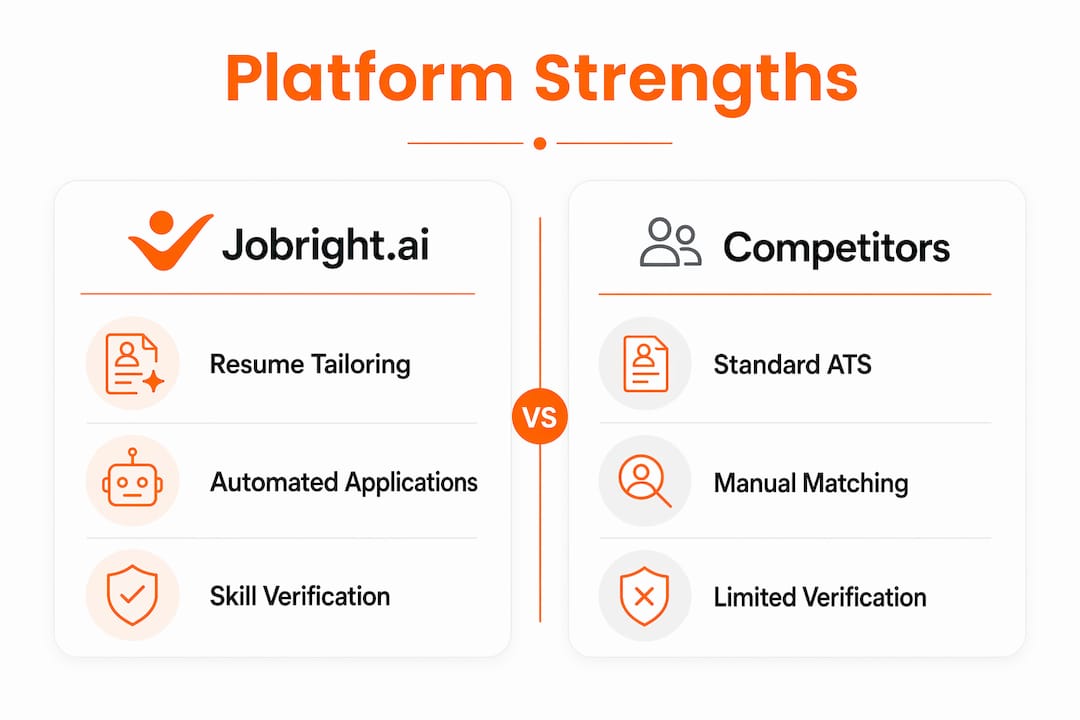
The most important distinction between platforms is their philosophy. Some prioritize volume, helping you apply to as many roles as possible. Others are discovery-first, focusing on aligning opportunities with your career trajectory rather than maximizing application count. For senior tech roles, the discovery-first approach produces better results. Quality signals matter to hiring managers at that level, and a flood of generic applications does not.
Beyond philosophy, evaluate these practical features before committing to a platform:
- Real-time job updates so you are not applying to roles already filled
- ATS compatibility checks that confirm your profile will parse correctly
- Skill gap feedback that is specific enough to act on, not just a percentage score
- Direct employer access that bypasses generic job board queues
AI-driven platforms that integrate verified skills and career context deliver more precise matches and a better candidate experience overall. That precision is what makes the difference between a platform that saves you time and one that just adds noise.
How to set up and use an AI job matching platform step by step
Getting real value from these tools requires more than creating an account and uploading a resume. Follow this sequence to build a profile that the matching algorithms can work with effectively.
-
Connect verified data sources first. Link your GitHub, LinkedIn, and Stack Overflow accounts before filling in any manual fields. Verified project data outweighs self-reported skills in most scoring models.
-
Define your career goals explicitly. Set target roles, preferred industries, salary range, and location preferences. Platforms like Jobright.ai use these inputs to calibrate their recommendation engine. Vague preferences produce vague matches.
-
Review your match scores critically. A high score does not automatically mean a good opportunity. Read the reasoning behind the score. Tools like JobMatch AI provide detailed match reasoning alongside the score, including which skills drove the result and which gaps exist.
-
Act on skill gap analysis. When a platform flags a missing skill, treat it as a specific signal. If three separate matches flag the same gap, that skill is worth prioritizing in your development plan. Platforms that use LLMs for skill gap identification give you the most specific feedback.
-
Use automated cover letter generation as a starting point, not a final draft. AI-generated letters are accurate but generic. Add one specific detail about the company or role that only a human who researched the position would know. That detail is what gets you noticed.
-
Track applications through the platform dashboard. Centralized tracking prevents duplicate applications and helps you identify which match score thresholds actually produce interview callbacks over time.
Pro Tip: Set a weekly review cadence. Spend 20 minutes each week updating your profile with new projects, certifications, or skills. Stale profiles drift down in recommendation rankings as the algorithm favors recently active candidates.
What are the most common AI matching pitfalls for tech professionals?
Even well-designed platforms produce problems when used incorrectly. The most common issue is over-application. When a platform makes applying easy, the temptation is to apply to every role with a match score above a certain threshold. This approach degrades your signal to recruiters and reduces the quality of your pipeline.
A second common problem is misreading skill gap analysis. A gap report that says you are missing "cloud architecture experience" is not useful on its own. The best platforms specify which cloud provider, which services, and at what level of depth. If your platform does not provide that specificity, cross-reference the gap against the actual job description manually.
Keyword mismatch is a subtler issue. Semantic AI reduces false positives compared to keyword-only systems, but no algorithm is perfect. A match for "security engineer" might surface roles that require a clearance you do not hold, or a specialization in OT security that differs from your IT security background. Always read the full job description before applying, regardless of the match score.
Profile staleness is the most preventable problem. An AI matching engine scores you based on the data it has. If your last project was added six months ago, the platform does not know about the skills you have built since then.
Balancing AI automation with human judgment and networking remains essential for landing senior tech roles despite advances in AI matching. (Source)
The practical implication: use AI tools to identify and prioritize opportunities, then use your professional network to get a warm introduction wherever possible. The two approaches are not competing strategies. They work best together.
Key takeaways
AI job matching for tech roles produces the best results when candidates combine verified skills profiling, platform-specific features, and active profile maintenance with direct networking.
| Point | Details |
|---|---|
| Skills-first profiling wins | Connect GitHub, LinkedIn, and Stack Overflow to give the algorithm verified data to work with. |
| Semantic matching beats keyword search | Platforms using semantic embeddings reduce false positives by understanding skill context, not just skill names. |
| Discovery-first beats mass applying | Prioritize platforms that align roles to your career trajectory rather than maximizing application volume. |
| Act on skill gap data | Treat repeated skill gaps across multiple matches as a specific signal for your development plan. |
| Combine AI with networking | AI identifies opportunities; a warm introduction from your network still improves conversion at senior levels. |
What i have learned after watching AI reshape tech recruiting
The conversation around AI job matching tends to focus on the candidate side. What I find more interesting is what these tools reveal about how tech hiring has always been broken. Recruiters have been matching on keywords for decades, and the result has been a system where a DevOps engineer with eight years of Kubernetes experience gets screened out because their resume uses "container orchestration" instead of "Kubernetes." Semantic matching does not just make job searching faster. It corrects a structural flaw.
That said, I have seen tech professionals over-rely on match scores in ways that hurt them. A 92% match score is a signal, not a guarantee. The algorithm does not know that the hiring manager at that company only promotes from within, or that the team just lost its lead engineer and is in a difficult transition. Human intelligence fills those gaps. Tools like AI resume builders for developers can sharpen your materials, but they cannot replace the judgment call of whether a company is worth your time.
My honest observation for 2026: the professionals getting the most out of these platforms are not the ones who automate everything. They are the ones who use AI to do the research and filtering, then apply human judgment to the shortlist. They treat the match score as a starting point for a conversation, not a final answer. That combination is what actually moves the needle.
— Diego
How Plucktalent connects tech professionals to the right roles
Plucktalent combines 17 years of IT and cybersecurity recruiting expertise with Plucky AI, a dedicated job search co-pilot built specifically for high-level tech talent. The platform bypasses generic job board queues to connect candidates directly with hiring managers at companies actively seeking their specific skills.
For IT and cybersecurity professionals who want a profile that is ATS-ready, skills-verified, and positioned in front of the right decision-makers, Plucktalent delivers that without the noise. The platform's approach aligns directly with the discovery-first philosophy described in this article. Explore the job seeker platform to see how Plucktalent's AI-driven matching works for your specific tech background. You can also review the full range of career services available for tech professionals at every career stage.
FAQ
What is AI job matching for tech roles?
AI job matching for tech roles is the process of using machine learning and semantic algorithms to connect candidates with positions based on verified skills, experience, and career preferences rather than keyword frequency. Platforms like Hired.com, Jobright.ai, and Wellfound use this approach to surface high-fit roles for tech professionals.
How do AI matching algorithms differ from standard ATS?
Standard applicant tracking systems scan for exact keyword matches, while AI matching engines use semantic embeddings to understand skill context and multi-dimensional scoring across hard skills, soft skills, and cultural fit. This reduces false positives and improves shortlist quality for both candidates and employers.
Which platforms are best for AI job matching in tech?
Jobright.ai, Hired.com, Wellfound, LinkedIn, and Joblet.ai are among the leading platforms for tech professionals in 2026. The best choice depends on your career stage: Hired.com suits senior engineers who prefer inbound outreach, while Jobright.ai works well for active applicants who want automated application support.
How do i improve my match scores on AI platforms?
Connect verified data sources like GitHub and Stack Overflow, define your career goals explicitly within the platform, and update your profile regularly with new projects and certifications. Stale profiles rank lower in recommendation feeds as algorithms favor recently active candidates.
Should i use AI job matching tools alongside networking?
Yes. AI tools identify and prioritize opportunities efficiently, but human networking improves conversion rates at senior levels. The two approaches work best in combination, with AI handling research and filtering and your network providing warm introductions to the roles that matter most.