
AI job search is the process of using artificial intelligence tools and workflows to automate and improve the matching, tailoring, and application steps in finding a job. For tech and cybersecurity professionals, this means moving beyond generic job boards and into a system that reads job descriptions, scores your fit, and generates tailored application materials at scale. AI tools accelerate resume tailoring by surfacing relevant keywords and drafting personalized content mapped to each role. The result is fewer wasted applications and a faster path to hiring managers who are actively looking for your specific skills.
What is AI job search and how does it work?
AI job search is a technology-driven method where software agents handle the repetitive, analytical work of finding and applying to jobs. The system reads a job posting, extracts required skills and qualifications, compares them against your profile, and scores the match. That score tells you whether a role is worth pursuing before you spend an hour tailoring your resume manually.
The core mechanism relies on natural language processing. The AI parses a job description the same way a recruiter would, pulling out hard skills like Python or SIEM tools, soft skills like cross-functional communication, and implicit signals like company culture or team size. It then maps those signals against your work history, certifications, and stated preferences.

For cybersecurity roles specifically, this matters more than in most fields. A SOC analyst posting and a penetration tester posting can look similar on the surface but require completely different skill sets. AI fit scoring catches that distinction. Insider-built pipelines include scoring fit, company research, and role-specific interview preparation, going well beyond basic keyword overlap.
Key tasks AI handles in the analysis phase:
- Extracting required certifications (CISSP, CEH, CompTIA Security+) from job descriptions
- Scoring your profile against both stated and implied requirements
- Flagging roles where your experience exceeds or falls short of the target level
- Ranking open positions by match quality across multiple job boards simultaneously
Pro Tip: Set your AI tool to flag roles where your match score falls below 70%. Applying to low-match postings wastes time and lowers your response rate over time.
How does AI tailor resumes and cover letters automatically?
AI resume tailoring works by taking your master resume and rewriting or reordering it to match the language and priorities of a specific job description. The output is an ATS-ready document that mirrors the exact terminology a recruiter or applicant tracking system expects to see. Indeed describes AI streamlining job search with personalized recommendations and tailored resumes as a core capability.
The process runs in a loop. You submit your base profile once. The AI generates a tailored version for each role, scores it against the job description, and flags gaps. You review, approve, and submit. That loop takes minutes instead of hours.
Here is how a standard AI tailoring workflow runs for a cybersecurity application:
- Upload your master resume and LinkedIn profile to the AI platform.
- Paste or import the target job description.
- The AI identifies missing keywords, reorders bullet points by relevance, and rewrites your summary to match the role.
- It generates a cover letter that references the company's specific tech stack or security framework.
- You review both documents, make any personal edits, and submit.
ATS compatibility is not optional in tech hiring. Most enterprise companies run applications through platforms like Workday, Greenhouse, or iCIMS before a human ever reads them. AI tools that understand ATS formatting rules prevent your resume from being filtered out on a technicality.
Pro Tip: Always read the AI-generated cover letter before submitting. AI can miss context about your career story that only you can supply. A two-minute review prevents a generic submission from reaching a hiring manager.
What AI job search platforms and pipelines are available?
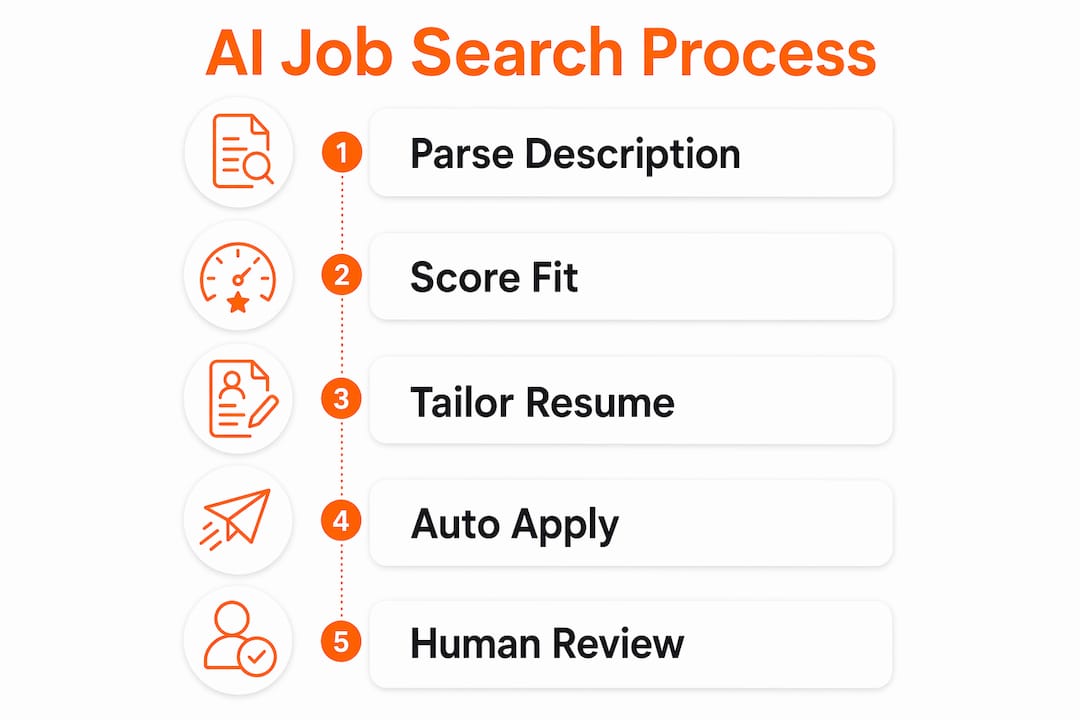
The AI job search tool category has grown into a full pipeline category, not just a resume editor. The five-stage AI agent pipeline processes each job posting in roughly 30 seconds, covering parsing, scoring, tailoring, company research, and application submission. That speed changes the math on how many quality applications a job seeker can realistically manage per week.
Automated application engines can fill forms, handle multi-step application wizards, and submit applications autonomously while learning from past errors. These tools integrate with major ATS platforms and track submission success rates by platform, adjusting their approach over time.
The table below compares the core capabilities across common AI job search workflow types:
| Capability | Basic AI Tools | Full Pipeline Agents |
|---|---|---|
| Job description parsing | Yes | Yes |
| Fit scoring | Keyword-based | Multi-dimensional scoring |
| Resume tailoring | Template-based | Role-specific rewriting |
| Cover letter generation | Generic | Tailored to company and role |
| Auto-apply | No | Yes, with ATS support |
| Interview prep | No | Role-specific question banks |
| Application tracking | Manual | Automated with logs |
| Company research | No | Yes, integrated |
Effective AI pipelines combine parallel and sequential agent workflows to scale evaluation and application processes. In practice, that means one agent scans job boards while another scores fit and a third drafts materials, all running at the same time.
Human oversight remains the critical variable. Human-in-the-loop designs ensure quality and authenticity in applications. The best platforms flag applications for your review before submission rather than sending everything automatically. For senior tech and cybersecurity roles, where a single well-placed application outperforms 50 generic ones, that review step is not optional.
What are the limits of AI job search tools?
AI job search tools solve a real problem, but they introduce new ones if used without discipline. The biggest risk is losing your personal voice. An AI-generated resume reads like a template unless you edit it. Hiring managers at cybersecurity firms read hundreds of applications. A generic summary gets filtered out just as fast as a poorly formatted one.
Data privacy is a genuine concern. Most AI job search platforms require you to upload your full resume, work history, and sometimes salary expectations. Read the privacy policy before uploading. Understand where your data goes and whether it is used to train the platform's models.
Common pitfalls to avoid:
- Submitting AI-generated materials without reviewing them for accuracy
- Over-applying to low-match roles because automation makes it easy
- Relying on AI for networking, which still requires direct human contact
- Ignoring platform-specific formatting requirements that AI tools sometimes miss
"AI coaching delivers career advice and development support at scale, but the most effective use combines AI recommendations with human judgment at every decision point." — Lattice on AI career coaching
Personalized AI coaching that adapts recommendations based on ongoing career data produces the best long-term results. That means using AI not just for one job search but as a continuous tool for skill gap identification, goal setting, and interview practice. For cybersecurity professionals, where certifications and threat landscapes shift constantly, that ongoing feedback loop has real value.
Networking still closes more senior roles than any automated tool. AI can research a company and draft an outreach message. You still have to send it and build the relationship. The professionals who get the most from AI job search tools treat them as preparation engines, not replacement strategies.
Key Takeaways
AI job search tools deliver the most value when job seekers combine automated fit scoring and tailoring with direct human review before every submission.
| Point | Details |
|---|---|
| AI job search defined | AI automates job description parsing, fit scoring, resume tailoring, and application submission. |
| Fit scoring beats keywords | Multi-dimensional scoring catches role distinctions that basic keyword matching misses, especially in cybersecurity. |
| Tailoring runs in a loop | AI rewrites your resume per role, but human review before submission prevents generic or inaccurate applications. |
| Full pipelines save time | Five-stage agent pipelines process a job posting in roughly 30 seconds, covering research through submission. |
| Human oversight is required | Human-in-the-loop designs maintain application quality and authenticity at senior tech and cybersecurity levels. |
AI job search in practice: what actually works
I have spent time watching tech and cybersecurity professionals use AI job search tools, and the pattern is consistent. The ones who get results fast are not the ones who automate everything. They are the ones who use AI to do the analysis work and then apply their own judgment to the output.
The fit scoring feature is underrated. Most job seekers skip it and go straight to resume tailoring. That is a mistake. Knowing your match score before you invest time in an application tells you where to focus. A 60% match on a senior cloud security role is a signal to move on, not a challenge to overcome with a better cover letter.
Interview prep modules that build role-specific question banks and STAR method story banks are genuinely useful for cybersecurity roles. Incident response scenarios and compliance questions are predictable. AI can generate a solid practice set in minutes. The professionals who use these tools walk into interviews more prepared than those who rely on generic prep guides.
The honest reality is that AI job search tools are most powerful for mid-to-senior level professionals who already have a strong profile. The AI has more material to work with. The fit scores are more accurate. The tailored resumes are more specific. If your base profile is thin, fix that first.
— Diego
Plucktalent and AI-powered job search for tech professionals
Plucktalent combines 17 years of IT and cybersecurity recruiting expertise with Plucky AI, a dedicated job search co-pilot built for tech professionals who want direct access to hiring managers, not more job board noise.
The platform connects candidates directly with companies that are actively hiring for their specific skills. Plucky AI handles fit analysis, ATS-ready profile optimization, and application tailoring so you spend time on the roles that match, not the ones that waste your week. For IT and cybersecurity professionals ready to move through the pipeline faster, Plucktalent's job seeker tools are built for exactly that outcome. A full overview of available career services is listed on the Plucktalent website.
FAQ
What is an AI job search agent?
A job search AI agent is a software program that automates one or more steps in the job search process, including parsing job descriptions, scoring fit, tailoring resumes, and submitting applications. Full pipeline agents coordinate multiple tasks simultaneously and can process a job posting in roughly 30 seconds.
What is an AI career recommendation?
An AI career recommendation is a personalized suggestion generated by an AI system based on your skills, work history, and stated goals. These recommendations can include specific job roles, skill gaps to address, or companies that match your profile.
How does AI job search work for cybersecurity roles?
AI job search tools parse cybersecurity job descriptions for specific certifications, tools, and experience levels, then score your profile against those requirements. Advanced pipelines also generate role-specific interview prep, including incident response scenarios and compliance-focused questions.
Are AI-generated resumes safe to submit?
AI-generated resumes are safe to submit after human review. The risk is submitting unreviewed materials that contain inaccuracies or sound generic. Always read the output before sending, and edit any section that does not accurately reflect your experience.
What are the main benefits of AI job search for tech professionals?
AI job search tools save time on repetitive tasks like form-filling and application tracking, improve resume relevance through keyword alignment, and surface better-matched roles faster. For tech and cybersecurity professionals, the added benefit is role-specific interview preparation tied to actual job requirements.