
The AI job search workflow in 2026 is a structured, multi-stage process that combines AI-powered resume tailoring, targeted role research, assessment preparation, and organized tracking to move tech candidates through competitive hiring pipelines efficiently. This is not about automating your entire search. It is about using AI where it saves time and staying manual where it protects your signal. Tech and AI roles attract hundreds of applicants per posting, and the candidates who land interviews are the ones who apply AI tools with discipline, not volume.
What does an AI job search workflow look like in 2026?
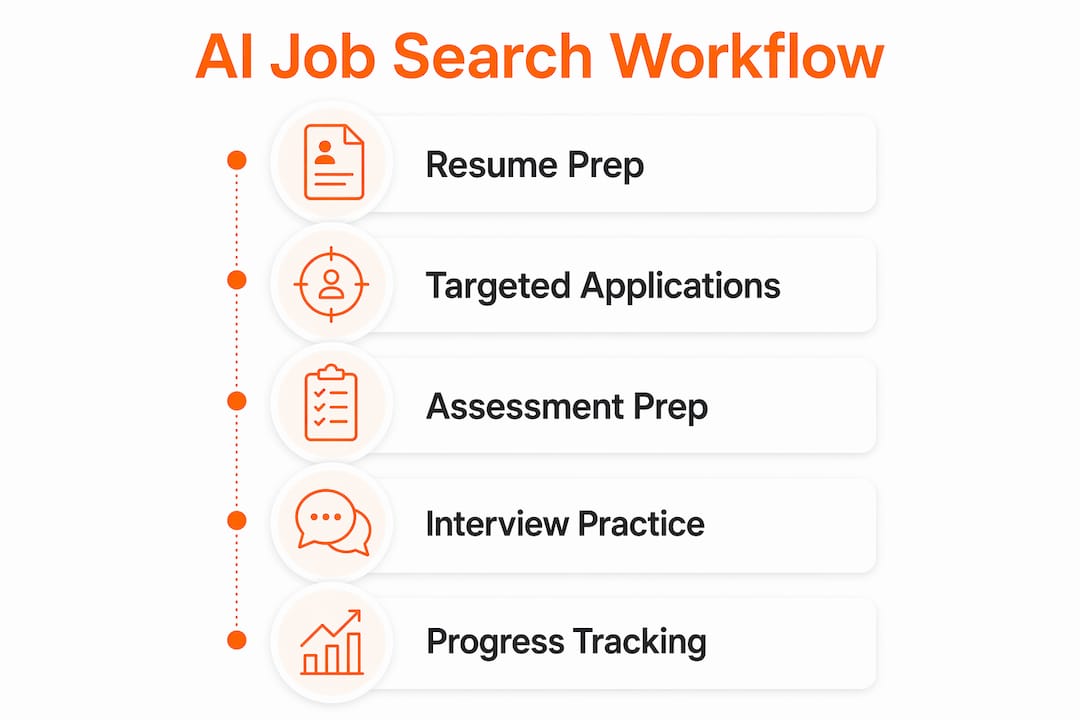
The core framework has four stages: resume preparation, targeted discovery and application, assessment and interview prep, and ongoing tracking. Each stage has specific points where AI adds speed, and specific points where human judgment is non-negotiable. Candidates who use AI strategically across all four stages outperform those who either avoid AI entirely or rely on it blindly. The difference is not the tools. It is the discipline behind them.
AI tools excel at research, resume tailoring, outreach drafts, and interview preparation. They fail when they replace judgment or personal voice. That distinction defines the entire workflow.

How to optimize your resume with AI without losing your voice
AI resume optimization in 2026 means using AI to refine and tailor, not to rewrite from scratch. The foundation is a master library of your actual work achievements, written in your own words, with real metrics and context. AI then helps you reorder, align keywords, and match the language of each job description without inventing anything.
The step-by-step process looks like this:
- Build your master library first. Write out every significant project, outcome, and technical contribution you have made in the last five years. Include numbers where you have them. This library is your source of truth. AI cannot fabricate credibility, and it should not try.
- Analyze the job description. Paste the posting into an AI tool and ask it to extract the top technical requirements, preferred skills, and recurring language patterns. This takes two minutes and tells you exactly which bullets to surface.
- Tailor by reordering and keyword alignment. Resume tailoring combined with ATS score checks improves interview chances significantly. Pull the relevant bullets from your master library and reorder them to match the role's priorities. Do not rewrite. Reorder and align.
- Run an ATS score check. Tools that simulate Applicant Tracking System parsing show you whether your resume will survive automated screening. Fix gaps before submitting.
- Edit the final draft manually. Remove any AI-generated filler phrases. If a sentence sounds like it could describe anyone, rewrite it to describe only you.
Pro Tip: Keep a "brag file" updated monthly. Every time you ship a feature, close a ticket, or lead a project, add one bullet to your master library. Your resume stays current without a quarterly scramble.
AI should be treated as a junior assistant, not an autopilot. Maintain a master library of achievements and tailor applications by reordering and keyword alignment. That approach keeps your voice intact while still passing automated screening.
What are the best AI-enabled strategies for targeted job discovery?
The biggest mistake in an automated job search is submitting high-volume, low-signal applications. Employers rate generic AI-submitted applications negatively, and volume without quality actively damages your reputation with hiring teams. The goal is precision, not throughput.
Effective AI career search strategies for tech roles in 2026 follow these principles:
- Use AI for company and role research, not for listing jobs. Ask AI tools to summarize a company's recent engineering blog posts, product launches, or hiring patterns. That research feeds your cover letter and interview prep with specific, credible detail.
- Analyze multiple job descriptions together. Paste five to ten postings for your target role into an AI tool and ask it to identify the skills that appear in at least 80% of them. Those are your non-negotiable keywords. Skills that appear in fewer than half the postings are differentiators worth highlighting.
- Segment your applications into tiers. Tier A roles are your top targets. Write every word of those applications manually, with full research behind them. Tier B roles are strong fits but not dream jobs. Use AI to draft the initial cover letter, then edit it to add one specific, company-relevant paragraph.
- Avoid mass applications entirely. Sending 50 generic applications produces fewer callbacks than sending 10 tailored ones. The math is counterintuitive but consistent.
- Match the company's language. If a job posting says "distributed systems" rather than "microservices," use their phrasing. AI can flag these language patterns in seconds.
Pro Tip: Set a weekly application cap. Ten to fifteen tailored applications per week is a sustainable pace that keeps quality high. More than that, and the tailoring starts to slip.
How to prepare for 2026 technical assessments and interviews with AI tools
Technical assessments are the leading elimination point for candidates in 2026. Most tech candidates fail at the MCQ and coding stages before any human ever reviews their profile. AI chat tools alone are not sufficient preparation for these stages.
The recommended preparation process:
- Practice on timed, simulated platforms. Platforms like LeetCode Premium offer timed practice under conditions that mirror real assessments. The $20/month cost delivers high ROI when it moves you past automated screening into human interview pipelines.
- Use AI to generate role-specific interview questions. Prompt an AI tool with the job description and ask it to generate the 20 most likely technical and behavioral questions. Then answer each one out loud, record yourself, and review.
- Debrief your answers with AI. Paste your written answers back into an AI tool and ask it to identify vague claims, missing evidence, or weak structure. This is where AI adds real value in interview prep.
- Stay manual on final answer review. Generic AI-polished answers sound identical to every other candidate's. Keep your specific examples, your actual numbers, and your real reasoning.
Additional preparation habits that separate strong candidates:
- Practice coding problems under a timer, not open-ended
- Review the company's public engineering documentation before technical rounds
- Prepare three to five "evidence stories" using the STAR format (Situation, Task, Action, Result) for behavioral questions
- Simulate proctored conditions by removing distractions during practice sessions
Practitioners recommend Interview Buddy for mock technical interviews that replicate real hiring conditions. Generic AI prompts do not replicate the pressure or format of a live technical screen.
How to organize your AI-augmented job search for real progress
A disciplined tracking system is what separates a 90-day successful search from a six-month unfocused one. The AI recruitment process in 2026 moves fast, and candidates who lose track of where they applied, what stage they are in, and when to follow up lose opportunities to less-organized competitors.
The core system has three components:
| Component | Tool or method | Purpose |
|---|---|---|
| Application tracker | Airtable or Notion database | Log every application, stage, contact, and deadline |
| Weekly schedule | Calendar blocks | Protect time for research, applications, outreach, and prep |
| Outcome analysis | AI-assisted pattern review | Identify which roles, companies, or resume versions generate callbacks |
An 8–12 hour weekly AI-augmented search with protected blocks for top-tier applications drives the majority of positive outcomes. Spreading effort randomly across the week produces far less. Schedule matters as much as effort.
Set four recurring weekly blocks: one for company and role research, one for writing and submitting applications, one for outreach and follow-up messages, and one for assessment and interview preparation. Keep each block focused on a single task type. Mixing tasks in one session reduces quality across all of them.
Pro Tip: At the end of each week, spend 15 minutes reviewing your tracker. Ask an AI tool to help you spot patterns: which industries responded, which resume versions got callbacks, which outreach messages got replies. Adjust the next week's targeting based on real data, not guesses.
Key Takeaways
A disciplined AI job search workflow in 2026 requires tailored applications, structured tracking, and AI used as a research and drafting assistant rather than a replacement for human judgment.
| Point | Details |
|---|---|
| Build a master achievement library | Write your real accomplishments first; AI tailors from that foundation, not from scratch. |
| Prioritize quality over volume | Ten tailored applications outperform fifty generic ones in tech hiring pipelines. |
| Practice assessments on real platforms | Timed tools like LeetCode Premium prepare candidates for the top elimination stage. |
| Track every application in a CRM system | Airtable or Notion databases keep follow-ups timely and outcomes measurable. |
| Use AI for speed, stay manual for voice | AI drafts and researches; you edit, personalize, and make the final call. |
Why over-automation is the fastest way to fail in 2026
The candidates I see struggle most in tech hiring are not the ones avoiding AI. They are the ones who handed the entire process to it. A fully AI-generated application reads like one. Hiring managers in technical roles have seen enough of them to recognize the patterns instantly, and they move on.
The candidates who move through pipelines fastest are the ones who use AI to do the research and drafting work that used to take hours, then spend that saved time on the 20% of the application that only they can write. The specific project that failed and what they learned. The architectural decision they pushed back on and why. The metric that moved because of their work specifically. No AI tool can write that. And that is exactly what gets a callback.
The other trap is inconsistency. A search that runs at full intensity for two weeks and then stalls for three produces worse results than a steady 10-hour-per-week effort maintained for 90 days. AI tools help with consistency because they reduce the friction of research and drafting. Use that reduction in friction to show up every week, not to send more applications in less time.
The future job hunting AI advantage is real. It is also narrow. It lives in the research, the keyword alignment, the practice question generation, and the tracking. Everything else still requires you.
— Diego
Plucktalent supports tech professionals through every search stage
Tech and cybersecurity job seekers who want direct access to hiring managers rather than job board queues have a specific resource available to them.
Plucktalent combines 17 years of IT and cybersecurity recruiting expertise with Plucky AI, a dedicated job search co-pilot built for high-level tech talent. The platform connects candidates directly with companies that are actively hiring for their specific skills, bypassing the generic application process entirely. Profiles are built to pass ATS screening and reach human decision-makers faster. Tech professionals looking to apply the workflow described here with expert support can review Plucktalent's job seeker tools and see how the platform fits their search. A full overview of available services is also listed at Plucktalent's services page.
FAQ
What is an AI job search workflow?
An AI job search workflow is a structured process that uses AI tools for resume tailoring, role research, assessment preparation, and application tracking. The goal is to apply AI where it saves time while keeping human judgment in the decisions that require personal voice and evidence.
How does AI improve resume optimization in 2026?
AI improves resume optimization by extracting keywords from job descriptions, aligning your existing achievements to role requirements, and flagging ATS parsing issues before submission. The candidate still writes the core content; AI refines and aligns it.
What is the biggest risk of using AI in a job search?
The biggest risk is over-automation. Generic AI-submitted applications reduce your signal quality and are rated negatively by employers. Tailored, evidence-backed applications consistently outperform high-volume, generic ones.
Which tools are best for technical assessment preparation?
LeetCode Premium and Interview Buddy are the recommended platforms for timed, realistic technical assessment practice. Generic AI chat tools do not replicate the pressure or format of live coding or MCQ screens.
How many hours per week should a tech job search take?
An 8–12 hour weekly search structured into dedicated blocks for research, applications, outreach, and interview prep produces the strongest results. Consistency across 90–120 days matters more than intensity in any single week.