
A hiring freeze is a temporary pause on recruiting new employees, implemented across all or selected departments to control costs or manage uncertainty. For job seekers, understanding this practice is the difference between wasting months on dead-end applications and targeting companies that are actively hiring. 67% of large employers have deferred hiring and expansion plans as part of cost control in 2026. That figure means most large organizations are not simply slow to hire. They have made a deliberate decision to stop. Knowing how to read those signals, and how to respond, is the core skill this guide covers.
What is a hiring freeze and how does it affect job seekers?
A hiring freeze is the formal suspension of new employee recruitment, either company-wide or limited to specific departments or job levels. HR professionals also call it a "recruitment hold" or "headcount freeze." Both terms describe the same practice. The key distinction for job seekers is whether the freeze is total or partial. A total freeze stops all external hiring. A partial freeze targets specific cost centers, leaving other departments open.

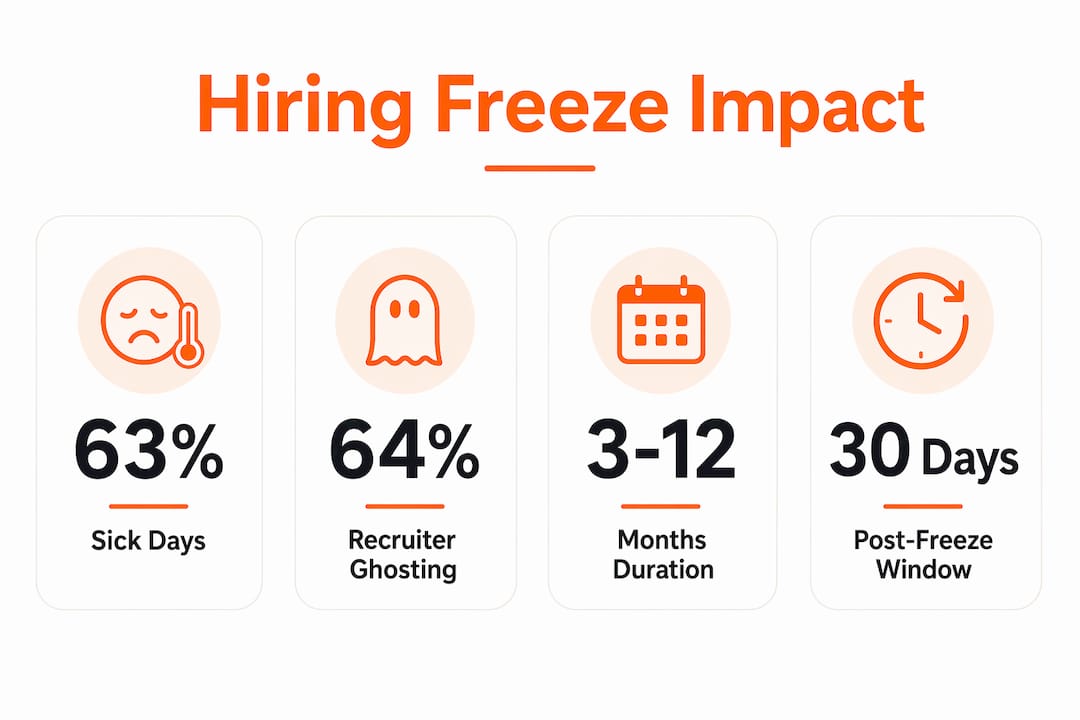
Most hiring freezes last between three and twelve months and typically end with a phased reactivation plan coordinated by finance and HR leadership. That timeline matters because it shapes your response. A freeze announced in january may lift by the third quarter, which means the pipeline you build now determines who gets called first when roles reopen.
The job market hiring freeze of 2026 is not a single event. It is a pattern across industries, driven by AI-driven restructuring, inflation pressure, and economic uncertainty. Job seekers who treat every application rejection as a personal failure miss the structural reality. The market itself has changed.
Why do companies implement hiring freezes?
Companies implement hiring freezes for four primary reasons: cost reduction, strategic uncertainty, AI-driven restructuring, and response to broader economic conditions.
- Cost control. Payroll is typically the largest operating expense. Pausing hiring produces immediate budget relief without the legal and reputational risk of layoffs.
- Strategic uncertainty. When leadership cannot predict revenue for the next two quarters, adding permanent headcount becomes a liability. A freeze buys time.
- AI-driven restructuring. 85% of companies are investing in workforce reskilling as AI changes which roles are needed. Organizations pause external hiring while they determine which positions AI will replace and which will require new skills.
- Internal mobility focus. During a freeze, companies prioritize filling up to 30% of open roles internally. External candidates compete with a pool of known, already-onboarded employees.
The impact on the job market is direct. Fewer open requisitions mean more candidates competing for each posted role. The job requisition process itself slows, as approvals require executive sign-off rather than standard department-level authorization. New and young workers feel this first. Low-hire, low-fire labor market conditions insulate current employees but sharply reduce entry points for new labor market participants.
How does a hiring freeze impact job seekers directly?
The impact of a hiring freeze on job seekers operates on three levels: fewer openings, degraded recruiter communication, and disrupted interview pipelines.
Fewer openings and higher competition. When a company freezes hiring, posted roles either disappear or attract a surge of applicants before closing. Job seekers who rely on job boards see the same listings recycled or removed without explanation.
Recruiter ghosting. 64% fewer candidates apply to employers after experiencing freeze-driven ghosting and lack of communication. That statistic reflects a real reputational cost for employers, but the immediate harm falls on job seekers who invest time in applications and interviews only to receive no response.
Disrupted pipelines. Candidates already in an interview process face sudden silence. Hiring managers who were enthusiastic in week one go quiet in week three. This is not always a rejection. Freezes can pause a process mid-stage, leaving candidates in genuine limbo.
The hidden cost for job seekers is time. Weeks spent waiting on a frozen pipeline are weeks not spent building relationships with companies that are actively hiring.
Pro Tip: If a recruiter goes silent after two or more interviews, send one professional follow-up email referencing the specific role and your last conversation. Ask directly whether the position is still active. A clear answer, even a negative one, is more valuable than waiting.
The vacancy cost angle is worth understanding. Prolonged vacancies cause a 63% increase in sick days among remaining staff and increase voluntary turnover risk by 2.6 times. Employers know this. The cost of not hiring often exceeds the cost of hiring. Job seekers who understand this dynamic can use it in their favor.
What job search strategies work during a hiring freeze?
Effective job search strategies during a freeze require shifting from reactive to proactive. The following approach works for IT and cybersecurity professionals, but the principles apply broadly.
-
Network directly with hiring managers. Companies maintain exceptions for critical roles during total freezes. Revenue-generating and security-critical positions often get executive approval to hire even when all other requisitions are paused. These roles rarely appear on job boards. Direct outreach to hiring managers on LinkedIn or through professional networks is the most reliable way to find them.
-
Stay visible in frozen pipelines. Candidates who communicate proactively during freezes are prioritized when roles reopen. A brief, professional check-in every four to six weeks keeps your name at the top of the recruiter's list without creating friction.
-
Frame your candidacy as a cost solution. Framing job candidacy as a financial solution that addresses vacancy costs shifts employer perception. Instead of "I am looking for a new role," the message becomes "I can reduce the productivity loss your team is absorbing right now." That framing speaks directly to the CFO-level concern driving the freeze.
-
Pursue contingent and freelance work. Contingent workers now represent around 40% of the workforce, and 78% of business leaders value freelancers for filling gaps during hiring pauses. A contract engagement with a frozen company is a direct path to a full-time offer when the freeze lifts.
-
Invest in upskilling. Companies reskilling internally are looking for candidates who already have the skills they are building toward. Certifications in cloud security, AI governance, or data infrastructure signal alignment with where organizations are heading.
Pro Tip: Use job search metrics to track your outreach-to-response rate. If direct messages to hiring managers convert at a higher rate than job board applications, shift your time allocation accordingly.
How do employers manage freezes, and what can job seekers learn from it?
Understanding how employers handle a hiring freeze internally gives job seekers a real advantage. The patterns are consistent across organizations.
- Segmented pipelines. Employers divide active candidates into priority tiers. Tier one candidates, those already in late-stage interviews, receive direct communication. Tier two candidates, those in early stages, often receive generic holds or nothing at all.
- Phased reactivation. Freezes do not end overnight. Finance and HR leadership coordinate a phased return, typically starting with the highest-priority roles. The first wave of reactivation happens quietly, before any public announcement.
- Named recruiter contacts. Well-managed freezes assign a specific recruiter as the point of contact for each candidate. This person is responsible for quarterly check-ins and reactivation outreach.
The communication failure pattern is where most employers lose candidates. Proactive candidate communication during freezes boosts re-engagement by 3.4 times when roles reopen. Employers who fail to communicate lose their talent pipeline entirely.
Pro Tip: Ask your recruiter directly: "Who is the named contact for my candidacy during this pause?" A recruiter who can answer that question is managing the freeze professionally. One who cannot is operating without a plan, and you should adjust your expectations accordingly.
For job seekers, the practical takeaway is timing. The first 30 days after a freeze lifts are the highest-value window. Companies move fast to fill backlogged roles, and candidates who maintained contact get called before any job posting goes live. Exploring alternative hiring channels during the freeze period positions you to respond immediately when that window opens.
What trends are shaping hiring freezes in 2026?
The 2026 job market reflects a structural shift, not a temporary correction. Several converging factors explain why hiring freezes are more frequent and longer-lasting than in previous cycles.
| Trend | Effect on job seekers |
|---|---|
| AI-driven role restructuring | Fewer entry-level openings; higher demand for reskilled candidates |
| Contingent workforce expansion | More contract opportunities during freeze periods |
| Low-hire, low-fire dynamics | Reduced new openings; stable employment for current workers |
| Inflation and budget pressure | Longer freeze durations; stricter headcount approval processes |
The contingent workforce trend is the clearest opportunity. Organizations that cannot hire permanently are still acquiring talent through contract and project-based arrangements. Job seekers who position themselves as flexible, project-ready professionals access a market that is largely invisible on traditional job boards. AI-driven job matching tools are increasingly effective at surfacing these contract opportunities alongside permanent roles.
The low-hire, low-fire dynamic deserves specific attention for new and young workers. Entry points into the labor market are narrowing. The same conditions that protect current employees from layoffs also reduce the number of new positions created. Job seekers entering the market for the first time face a structurally different environment than those who entered five years ago.
Key Takeaways
A hiring freeze does not eliminate hiring. It concentrates it in critical roles, contract arrangements, and post-freeze reactivation windows that reward prepared, well-connected job seekers.
| Point | Details |
|---|---|
| Freeze duration | Most hiring freezes last three to twelve months and end with phased reactivation. |
| Hidden opportunities | Companies maintain exceptions for critical roles even during total freezes. |
| Communication matters | Proactive follow-up during a freeze increases re-engagement by 3.4 times when roles reopen. |
| Contingent work as entry | Contract roles during freezes frequently convert to full-time offers after the freeze lifts. |
| Vacancy cost framing | Positioning your candidacy as a solution to productivity loss shifts the employer's calculus in your favor. |
What I have learned from watching job seekers navigate freezes
The job seekers who come out ahead during a hiring freeze are not the ones who apply to more jobs. They are the ones who apply to fewer jobs and invest the saved time in direct relationships.
The conventional advice is to keep applying and stay positive. That advice is not wrong, but it is incomplete. A freeze changes the rules of the game. The public job posting is the last place a critical exception role will appear. The first place it appears is in a hiring manager's network. Job seekers who are not in that network before the freeze ends will not be in it when the freeze lifts.
The other thing worth stating plainly: freezes reveal which companies invest in their talent pipelines and which ones do not. An employer who ghosts candidates during a freeze will ghost employees during difficult quarters. The communication behavior you see now is the culture you are considering joining.
The 2026 market rewards job seekers who treat their search as a professional practice. That means tracking metrics, maintaining relationships, and building skills that align with where organizations are heading. It does not mean waiting for conditions to improve.
— Diego
Plucktalent connects job seekers to active hiring managers
Hiring freezes hit hardest when job seekers rely on job boards that reflect yesterday's openings. Plucktalent is built for IT and cybersecurity professionals who need a direct line to companies that are actively hiring right now.
Plucktalent combines 17 years of recruiting expertise with Plucky AI, a dedicated job search co-pilot that connects candidates directly with hiring managers, bypassing the noise of generic postings. The platform delivers ATS-ready, tailored profiles that keep job seekers visible even when the market slows. Visit the Plucktalent job seekers page to see how the platform supports your search during any market condition.
FAQ
What is a hiring freeze?
A hiring freeze is a temporary pause on recruiting new employees, implemented by an organization to control costs or manage uncertainty. It can apply company-wide or to specific departments.
How long does a hiring freeze typically last?
Most hiring freezes last between three and twelve months. They typically end with a phased reactivation plan coordinated by finance and HR leadership.
Can companies still hire during a hiring freeze?
Yes. Companies often maintain exceptions for critical, revenue-generating, or security-essential roles during total freezes. These positions are usually filled through executive approval before any public posting.
How should job seekers respond to a hiring freeze?
Job seekers should network directly with hiring managers to find exception roles, follow up professionally with recruiters every four to six weeks, and pursue contract or freelance work as an entry point.
Why do hiring freezes hurt new workers more than experienced ones?
Low-hire, low-fire labor market conditions protect current employees but reduce the number of new positions created. New and young workers face fewer entry points, making the freeze effect more severe for them than for established professionals.