
AI hiring signal detection is the process of identifying and interpreting key business events and data patterns to forecast active recruitment needs before job postings appear. For HR professionals and recruiters, understanding how AI detects active hiring signals is the difference between reactive job board monitoring and proactive outreach that reaches hiring managers first. AI systems synthesize data from funding rounds, leadership changes, job posting velocity, and technographic adoption to produce prioritized signals with predictive lead times of 20 to 30 days before public listings go live. That window is where competitive advantage is built.
How AI detects active hiring signals: the core data sources

AI recruitment signal analysis works by monitoring dozens of concurrent business events across public and proprietary data sources. No single event confirms active hiring. The power comes from cross-source corroboration, where multiple signals appearing together dramatically increase predictive confidence.
The primary signal categories AI monitors include:
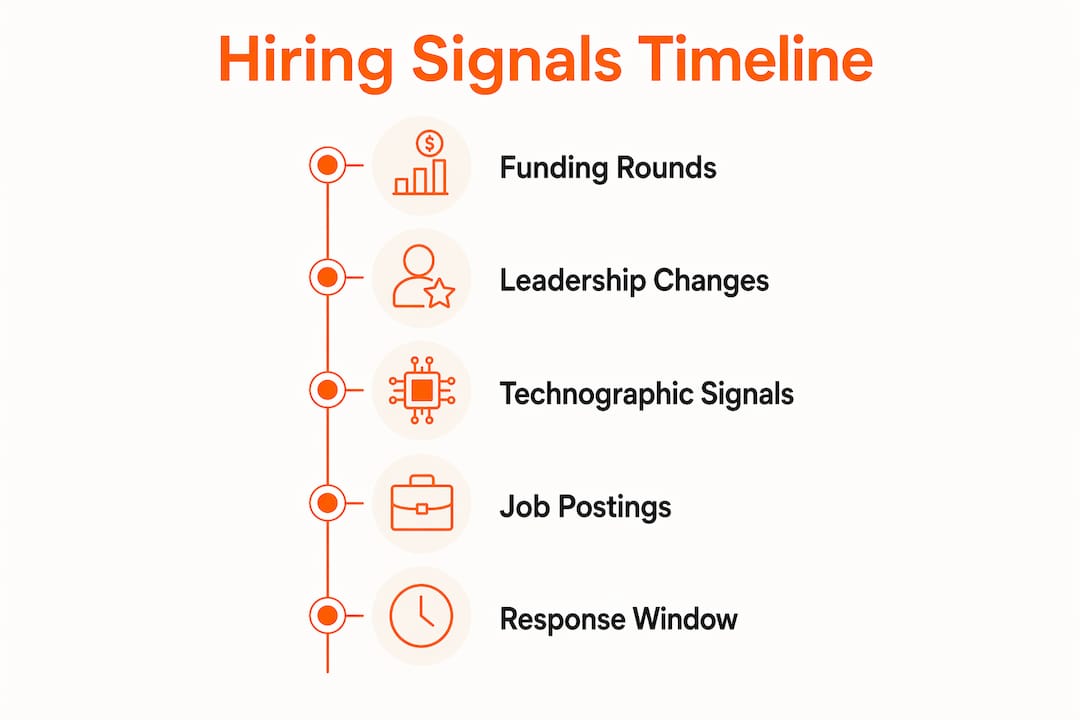
- Funding rounds. New capital injections signal budget availability and headcount expansion. Funding filings and press releases typically surface 60–120 days before recruitment activity begins, giving recruiters one of the longest planning windows available.
- Leadership and executive changes. New executives are three times more likely to make hiring decisions within their first 90 days. A new VP of Engineering or CISO signals an imminent team rebuild, often before any job posting exists.
- Job posting velocity and role mix. AI tracks the rate at which new roles appear on public job boards and applicant tracking systems. A sudden surge in security engineer postings at a company that previously had none is a strong active recruitment signal.
- Technographic data. When a company adopts new software or infrastructure tools, specialist hiring typically follows within 2 to 6 weeks. A firm deploying a new cloud security platform will need certified professionals to manage it.
- Press releases and regulatory filings. Expansion announcements, merger filings, and product launch communications all indicate organizational growth that requires new talent.
- LinkedIn organizational changes. Shifts in department structure, new team pages, or a wave of employee departures visible through professional network data provide 30–60 days of advance notice.
Cross-source corroboration is what separates signal from noise. A single funding announcement might mean nothing. A funding announcement combined with three new executive hires and a spike in job posting velocity is a high-confidence hiring signal that warrants immediate outreach.
How does AI process and prioritize hiring signals effectively?
Raw data from hundreds of sources is noisy. AI converts that noise into ranked, actionable signals through filtering, weighting, and composite scoring.
-
Filtering by relevance. AI systems first filter signals based on company size, industry vertical, and job function. A cybersecurity recruiter does not need signals from retail companies hiring cashiers. Filtering and scoring convert raw data into signals that match a recruiter's specific specialization.
-
Composite scoring with Heat Scores. AI does not add signals together. It multiplies them. Concurrent signals such as funding plus a leadership change significantly boost predictive confidence over any single signal. This multiplicative approach, often called a Heat Score, means a company showing three simultaneous signals ranks far above one showing only one.
-
Signal delta over static snapshots. The rate of change in role counts is a stronger indicator than total open roles. Week-over-week surges in specific departments reveal hiring momentum that a static count of open positions would miss entirely.
-
Natural language processing classification. NLP classifiers read job descriptions to categorize role type, seniority level, and required skills. This allows AI to distinguish between a junior IT support posting and a senior cloud architect role, routing the right signal to the right recruiter.
-
False positive reduction. Not every mention of "growth" in a press release means hiring. AI validation layers cross-check signals against historical patterns to filter out noise before a signal reaches a recruiter's dashboard.
Pro Tip: Set your AI signal filters to your three most placed job categories. A tightly scoped signal stack produces fewer but higher-quality alerts, which means less time triaging and more time on outreach that converts.
The result of this process is a ranked list of companies showing active recruitment intent, ordered by signal strength and recency. Recruiters receive context, not just company names.
What is the predictive timeline AI provides for hiring signals?
Different signal types carry different lead times, and knowing which signals to act on first shapes the entire outreach strategy.
| Signal Type | Typical Lead Time | Strategic Use |
|---|---|---|
| Funding rounds | 60–120 days | Early relationship building with leadership |
| Executive appointments | 30–90 days | Target new decision-makers before team is built |
| LinkedIn org changes | 30–60 days | Identify restructuring and new department needs |
| Technographic adoption | 2–6 weeks | Match specialist candidates to new tool deployments |
| Job posting velocity surge | 1–2 weeks | Confirm active hiring and accelerate outreach |
Funding and leadership signals create the longest planning window. A recruiter who identifies a Series B announcement in week one can build a relationship with the incoming VP of Engineering weeks before that executive posts a single job. By the time the role goes live, the recruiter is already a trusted contact.
The response window after a high-confidence signal is short. Recruiters must act within 24–48 hours of signals like funding announcements or executive hires to convert active hiring opportunities. Missing that window means competitors who monitor the same signals reach the hiring manager first.
AI-based early detection fundamentally changes the recruiter's position. Traditional job board monitoring puts recruiters in a queue with every other agency that reads the same posting. Signal-based outreach puts recruiters in front of hiring managers before the queue forms. That shift from reactive to proactive is the core value of AI hiring signal detection for talent acquisition teams.
How can recruiters integrate AI hiring signal detection into their workflow?
Integrating AI signal detection into a talent acquisition workflow requires structure. The technology surfaces opportunities. The recruiter's process determines whether those opportunities convert.
- Define a signal stack. Identify the two or three signal types most predictive for your specialization. IT and cybersecurity recruiters, for example, prioritize technographic adoption signals and CISO appointments over general funding rounds.
- Assign response roles. Designate who acts on which signal tier. High-confidence signals with Heat Scores above a set threshold go to senior recruiters for immediate outreach. Lower-tier signals enter a nurture sequence.
- Craft signal-referenced outreach. Personalized outreach that references specific signals converts significantly better than generic cold contact. Mentioning a company's recent Series B or a new CTO appointment demonstrates situational awareness that generic messages cannot replicate.
- Connect signals to your CRM. AI tools work best when external signal data feeds into existing conversation intelligence and CRM records. This gives recruiters a full picture of relationship history alongside current hiring intent.
- Monitor ongoing signal changes. A company that showed a weak signal last month may show a strong composite signal this week. Regular signal reviews allow recruiters to reprioritize accounts as hiring momentum builds.
Pro Tip: When a company shows a technographic signal, research the specific tool they adopted before reaching out. Referencing that tool by name in your outreach message signals genuine expertise and separates you from recruiters sending identical messages to the same contact.
AI automates the monitoring of hundreds of sources simultaneously, which frees recruiters to focus on relationship building rather than data gathering. The human role shifts from finding opportunities to acting on them with speed and precision.
Key Takeaways
AI hiring signal detection gives recruiters a predictive advantage by surfacing active recruitment intent weeks before job postings appear, but only when signals are filtered, scored, and acted on within tight response windows.
| Point | Details |
|---|---|
| Multiple signals beat single signals | Composite Heat Scores using concurrent signals predict hiring intent far more accurately than any one data point. |
| Lead times vary by signal type | Funding signals offer 60–120 days of advance notice; technographic signals offer 2–6 weeks. |
| Act within 24–48 hours | High-confidence signals require immediate outreach to reach hiring managers before competitors do. |
| Signal delta outperforms static counts | Week-over-week role count changes reveal hiring momentum that snapshot data misses. |
| Personalized outreach converts better | Referencing specific signals in outreach messages produces higher engagement than generic contact. |
What I've learned from watching recruiters use AI signals
The biggest mistake I see recruiters make with AI signal detection is treating it as a volume play. They set broad filters, receive hundreds of alerts, and burn time triaging noise instead of acting on the two or three signals that actually matter that week.
Signal quality beats signal quantity every time. A recruiter who acts on five high-confidence, well-filtered signals in a week will outperform one who half-processes fifty low-confidence alerts. The technology is only as useful as the discipline behind it.
The second thing I've observed is that timing matters more than message quality. A mediocre outreach message sent within 24 hours of a funding announcement will outperform a polished message sent five days later. The hiring manager is still in planning mode in the first 24 hours. By day five, they may already be in conversations with other agencies.
AI surfaces the signal. The recruiter still has to make the call, read the room, and build the relationship. The tools that work best treat AI as a monitoring and prioritization layer, not a replacement for human judgment. Recruiters who combine real-time signal monitoring with genuine industry expertise are the ones consistently winning mandates before job postings go live.
— Diego
Plucktalent and AI-driven hiring signal detection
Plucktalent combines 17 years of IT and cybersecurity recruiting expertise with Plucky AI, a dedicated job search co-pilot built to cut through job board noise.
For recruiters and HR professionals working in technical hiring, Plucktalent connects candidates directly with hiring managers at companies showing active recruitment signals. The platform is built around the same principle this article describes: reaching the right company at the right moment, before the job posting exists. Explore Plucktalent's recruiting services to see how AI hiring signal detection translates into faster placements and stronger client relationships. The Plucktalent platform is built specifically for IT and cybersecurity professionals who want to move through the pipeline with precision.
FAQ
What are active hiring signals in recruiting?
Active hiring signals are business events, such as funding rounds, executive changes, and job posting surges, that indicate a company is preparing to hire. AI systems monitor these events to predict recruitment activity before job postings appear.
How far in advance can AI detect hiring intent?
AI can detect hiring intent 20 to 30 days before job postings go live on average. Funding and leadership signals provide the longest lead times, ranging from 30 to 120 days.
Why is a 24-hour response window important for recruiters?
Acting within 24–48 hours of a high-confidence signal, such as a funding announcement or executive hire, gives recruiters the best chance of reaching hiring managers before competitors do. Delays reduce conversion rates significantly.
What is a Heat Score in AI hiring signal detection?
A Heat Score is a composite ranking that multiplies concurrent signals rather than adding them. A company showing funding, a new executive hire, and a job posting surge simultaneously scores far higher than one showing only a single signal.
How does technographic data predict specialist hiring needs?
When a company adopts new software or infrastructure tools, it typically needs certified specialists to manage those tools within 2 to 6 weeks. AI correlates technology adoption events with likely hiring categories, giving recruiters early notice of specialist demand.