
Filling IT roles without job boards means proactively sourcing candidates through referrals, direct outreach, and niche communities rather than waiting for applications to arrive. Job boards fill approximately 47% of all positions, but they skew heavily toward active job seekers. The strongest IT candidates are rarely browsing listings. They are working, contributing to open source projects, and waiting to be found. Hiring managers who recruit IT professionals without job boards consistently reach a deeper, more qualified talent pool.
Why job boards fall short for hard-to-fill IT roles
Job boards connect you with candidates who are actively searching. That sounds useful until you realize that passive candidates represent approximately 70% of the workforce and require outbound sourcing to reach. The most skilled engineers, security architects, and DevOps specialists are rarely the ones refreshing job listings on monday morning.
Combining passive sourcing and referrals rather than relying solely on job boards leads to better candidates and faster hiring for hard-to-fill IT roles. That finding reflects what experienced technical recruiters already know: the best hire for a senior cloud engineer role is probably not the person who applied through Indeed.
There are two additional problems with job board dependency:
- Volume without quality. Public postings attract hundreds of applications, most of which do not meet the technical requirements. Screening that volume costs time and delays the process.
- Visibility to competitors. Every role you post publicly signals your hiring plans to competitors, who can then accelerate their own outreach to the same candidates.
"The best candidates often aren't browsing listings. Reaching them requires going where they already are, not waiting for them to come to you." — Scout Talent USA, 2026
Understanding this gap is the first step toward building a sourcing strategy that actually works for specialist IT positions.
How to build an employee referral program for IT hiring
Employee referrals are the single most trusted hiring channel in IT. 90% of U.S. hiring managers say referrals speed up the hiring process, and 80% prioritize interviewing referred candidates over equally qualified non-referred applicants. That is not a marginal advantage. It changes the entire dynamic of a search.

89% of hiring managers trust referred candidates' skills more, and 76% say referred candidates perform better on the job. Referrals are not just faster. They produce better outcomes.
To build a referral program that actually generates results, follow these steps:
- Define the role clearly before asking for referrals. Share a one-paragraph summary of the role, the tech stack, and the type of person who would thrive. Vague requests produce vague referrals.
- Make it easy to refer. Give employees a pre-written message they can send directly to their network. Remove friction from the process.
- Set a referral incentive with a clear timeline. A bonus paid at the 90-day mark of the new hire's tenure works well. Tie the reward to retention, not just the hire.
- Follow up with the referring employee. Tell them what happened with their referral. Silence kills future participation.
- Track referral sources by role type. Some engineers have networks rich in backend developers. Others know security specialists. Map this over time.
Pro Tip: Write two or three ready-to-send LinkedIn messages for your employees. One for a former colleague, one for a conference contact, one for a classmate. Most people want to help but do not know what to say.
The referral channel compounds over time. Each hire who joins through a referral brings their own network into your orbit.
How to use outbound sourcing to reach passive IT candidates
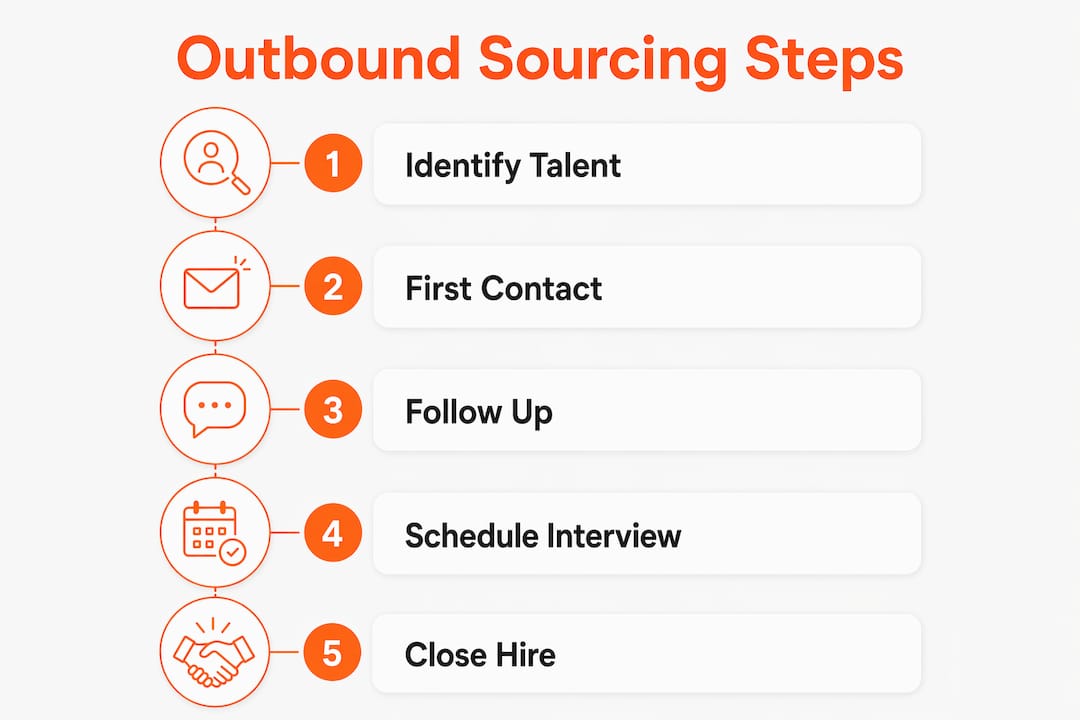
Outbound sourcing is the practice of identifying and contacting candidates who have not applied for a role. It is the primary method for filling tech positions outside job boards, and it works because it targets people based on demonstrated skills rather than job search behavior.
The best technical signals for outbound sourcing include:
- GitHub contributions. Active repositories, commit frequency, and the quality of public code tell you more about a developer than a resume.
- Open source project involvement. Contributors to major projects like Kubernetes, React, or Terraform are identifiable, skilled, and reachable.
- LinkedIn activity. Secondary to GitHub for pure technical roles, but useful for mapping career history and identifying career transition signals.
- Conference speaker lists. Engineers who present at events like AWS re:Invent or DEF CON are typically senior, credible, and open to conversation.
Once you identify candidates, the outreach sequence matters. About 70% of candidate replies come from follow-up messages, not the first contact. A single message is not a strategy.
A proven outbound sequence for IT roles looks like this:
- Day 1. Send a short, specific first message. Reference something real: a project they contributed to, a talk they gave, a tool they built.
- Day 5. Send a brief follow-up. Add one new piece of context about the role or the team.
- Day 10. Send a final message. Keep it short. Acknowledge it is your last outreach and leave the door open.
- Day 20. If no reply, add them to a long-term nurture list for future roles.
| Outreach stage | Message length | Key element |
|---|---|---|
| First contact | 3–5 sentences | Specific reference to their work |
| First follow-up | 2–3 sentences | New context about the role |
| Final follow-up | 2 sentences | Low-pressure close |
| Nurture | Quarterly | Role update or relevant news |
Pro Tip: For senior engineering or cybersecurity roles, have the founder or hiring manager send the first message personally. Founders and hiring managers get 2–5x higher response rates than generic recruiter outreach for senior engineers.
Learning how to identify passive IT talent before you start outreach saves significant time and improves reply rates.
What alternative sourcing channels work for IT roles?
Niche communities, targeted boards, and direct networking reach candidates that neither job boards nor LinkedIn surfaces. Niche communities and targeted job boards complement outbound sourcing by reaching culture-fit and hard-to-find candidates who self-select into specialized spaces.
The most productive alternative channels for IT hiring include:
- Slack communities. Groups like Rands Leadership Slack, Security BSides channels, and local DevOps Slack groups contain active practitioners who discuss real problems.
- Open source communities. GitHub Discussions, mailing lists for major projects, and Discord servers for frameworks like Next.js or FastAPI are full of identifiable contributors.
- Targeted job boards. Platforms like JobsByCulture focus on culture fit and attract candidates who care about more than compensation.
- Tech conferences and meetups. Direct networking at events like Black Hat, KubeCon, or local OWASP chapter meetings produces warm introductions that cold outreach cannot replicate.
| Channel type | Best for | Limitation |
|---|---|---|
| Slack communities | Mid-level to senior practitioners | Requires genuine participation, not just posting |
| Open source communities | Developers with proven technical skills | Slower to build relationships |
| Targeted job boards | Culture-fit candidates | Smaller audience than mainstream boards |
| Conferences and meetups | Senior and specialist roles | Higher time investment per hire |
Your careers page also plays a direct role in alternative sourcing success. When a candidate receives outbound outreach, the first thing they do is check your company page. A careers page that reflects real team culture, current projects, and honest compensation ranges converts outreach into conversations. Understanding talent mapping for IT helps you decide which channels to prioritize before you invest time in any of them.
Common mistakes when hiring outside job boards
The most common mistake in direct sourcing for IT roles is sending generic outreach at scale. A message that could apply to any engineer signals that you did not look at the candidate's actual work. Response rates drop sharply when candidates detect a template.
Four mistakes consistently undermine alternative recruiting methods:
- Over-relying on job descriptions in outreach messages. Candidates do not want to read a job description in a cold message. Lead with what makes the role or team interesting.
- Following up too aggressively. Three to four messages over three weeks is the ceiling. More than that crosses into spam and damages your employer brand.
- Letting referral programs go dormant. A referral program that runs one campaign and then goes quiet produces one wave of candidates. Treat it as an ongoing channel with regular reminders and updated role briefs.
- Failing to measure channel performance. Track where each hire originated. Without data, you cannot tell which channels produce quality hires versus volume.
"Measure every sourcing channel the same way you measure paid acquisition: cost per qualified candidate, time to offer, and offer acceptance rate." — Vamo Talent, 2026
Candidates who go silent after initial contact are often responding to a gap in the process. The reasons IT candidates ghost employers often trace back to slow follow-up or unclear next steps, both of which are fixable.
Key Takeaways
Filling IT roles without job boards requires a structured combination of referrals, outbound sourcing, and niche community engagement to consistently reach passive candidates.
| Point | Details |
|---|---|
| Job boards reach only active candidates | Passive candidates make up approximately 70% of the workforce and require direct outreach to engage. |
| Referrals accelerate and improve hiring | 90% of hiring managers say referrals speed up hiring, and 76% report referred candidates perform better. |
| Outbound sequences need multiple touches | About 70% of candidate replies come from follow-up messages, not the initial contact. |
| Founder-led outreach outperforms recruiter outreach | Founders and hiring managers get 2–5x higher response rates for senior IT roles. |
| Niche communities reach culture-fit candidates | Slack groups, open source projects, and targeted boards surface candidates that mainstream platforms miss. |
The shift I keep seeing in IT recruiting
The hiring managers who fill roles fastest are not the ones with the biggest job board budgets. They are the ones who treat recruiting like sales: they know their ideal candidate profile, they go find those people, and they send a message that proves they did their homework.
I have watched outbound sourcing go from a niche tactic to a standard practice for technical roles over the past several years. The shift happened because job boards became commoditized. Every company posts the same roles, candidates see the same listings, and the signal-to-noise ratio collapsed. The teams that adapted moved to GitHub, open source communities, and direct networking. The ones that did not are still wondering why their applicant pool is thin.
The referral channel is underused in a different way. Most companies have a referral program on paper. Few treat it as a living system with regular communication, updated role briefs, and genuine follow-through with referring employees. The data is clear: referred candidates perform better and stay longer. The investment in maintaining that channel pays off at every stage of the hiring funnel.
Job boards still have a place. A visible posting satisfies compliance requirements, captures the occasional strong active candidate, and keeps your employer brand in circulation. The mistake is treating the posting as the strategy rather than one small part of a larger sourcing system.
The future of IT recruiting is multi-channel by default. Referrals, outbound, niche communities, and targeted boards each reach a different segment of the talent pool. No single channel covers all of them.
— Diego
Plucktalent's approach to IT hiring beyond job boards
Plucktalent combines 17 years of IT and cybersecurity recruiting expertise with Plucky AI, a dedicated job search co-pilot that connects candidates directly with hiring managers at companies actively hiring for their specific skills.
For hiring managers, Plucktalent's employer services support multi-channel sourcing across referrals, direct outreach, and passive candidate identification. The platform bypasses generic job board noise and surfaces candidates whose profiles are already optimized and ATS-ready. For IT professionals ready to move through the pipeline faster, Plucktalent's job seeker resources provide the tools and positioning needed to be found by the right companies before a role is ever publicly posted.
FAQ
Why do job boards miss the best IT candidates?
Job boards reach active job seekers, who represent a minority of the available talent pool. The strongest IT candidates are typically employed and not browsing listings, which means they require direct outreach to engage.
How effective are employee referrals for IT hiring?
Referrals are highly effective. 90% of U.S. hiring managers say referrals speed up the hiring process, and 76% report that referred candidates perform better on the job than non-referred hires.
What is the best outreach sequence for passive IT candidates?
A three to four message sequence spaced over two to three weeks produces the best results. Approximately 70% of candidate replies come from follow-up messages rather than the initial contact.
Which platforms work best for direct sourcing of IT talent?
GitHub is the strongest signal source for developers. LinkedIn works for career history mapping. Niche Slack communities, open source project channels, and targeted boards like JobsByCulture reach specialized candidates that mainstream platforms miss.
How do I measure whether alternative sourcing channels are working?
Track cost per qualified candidate, time to offer, and offer acceptance rate by channel. Without that data, you cannot identify which sourcing methods produce quality hires versus volume.