
AI-powered applications can increase recruiter visibility and advance previously overlooked candidates by 30%, making it the most direct path for tech job seekers to break through automated hiring pipelines. Getting recruiter attention with AI means using intelligent automation and resume optimization tools to improve how your materials rank inside applicant tracking systems, or ATS. Recruiters now spend far less time on manual screening. AI-driven screening compresses recruiter time to hire by up to 80%, which means the window for a human to notice your application is narrowing fast. The job seekers who win are the ones who understand how AI ranks candidates and build their materials accordingly.
Modern ATS platforms no longer rely on simple keyword filters. AI screening ranks candidates based on contextual fit, meaning your trajectory, skill depth, and transferable experience all factor into your ranking. That shift benefits tech professionals who can clearly map their skills to a role's requirements. The standard industry term for this process is AI-assisted candidate ranking, and it is now the default at most enterprise-level hiring organizations.
How to get recruiter attention with AI: tools and prerequisites
The right tools determine how much ground you can cover before a recruiter ever sees your name. Three categories of AI tools matter most for job seekers: resume builders, job description analyzers, and application automation tools.

| Tool category | Primary function | Best used for |
|---|---|---|
| AI resume builders | Generate and reformat resume content | First drafts and ATS formatting |
| Job description analyzers | Extract keywords and skill signals from postings | Tailoring content per application |
| Application automation tools | Auto-fill forms and track submissions | Reducing repetitive manual entry |
| LinkedIn profile optimizers | Rewrite headlines, summaries, and skills sections | Improving recruiter search visibility |
Before any of these tools produce useful output, you need a clear professional baseline. That means a structured profile with measurable achievements, not vague responsibility lists. Application automation tools can reduce submission time from hours to as little as 30 seconds, but only if the underlying content is already strong. Feeding weak content into an AI tool at speed produces weak applications at scale.
The prerequisites are straightforward:
- A master resume with quantified results for each role (numbers, percentages, dollar values)
- A list of 10–15 target job descriptions saved from active postings
- Access to at least one AI writing tool capable of iterative prompting
- A LinkedIn profile with a complete work history and skills section
These inputs are what AI tools process. The quality of your outputs depends entirely on the quality of what you feed in.
How to use AI step by step to optimize your resume and applications
Most AI-generated resumes fail because they rely on a single prompt. Iterative, segmented prompting grounded in real job descriptions produces far better content relevance and recruiter response. The process below works for both resume optimization and LinkedIn profile rewrites.
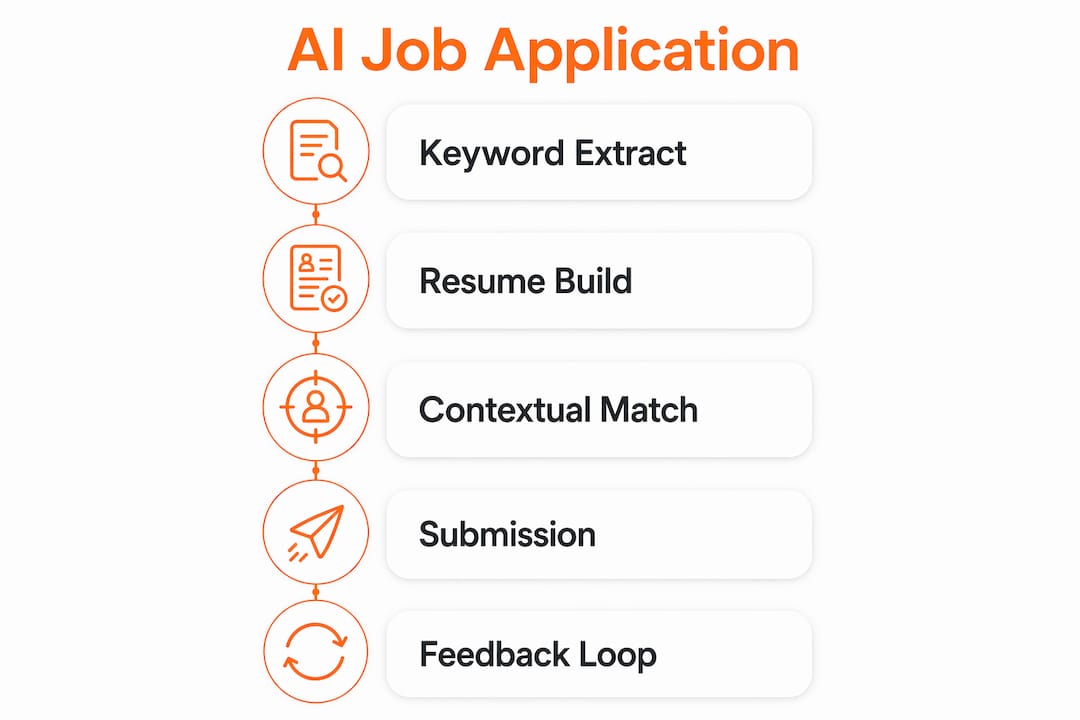
- Collect 10 to 15 job descriptions for roles you are actively targeting. Paste them into a document and note which skills, tools, and phrases appear most often across postings.
- Run a keyword extraction prompt. Ask your AI tool to identify the top 15 skills and phrases that appear across the job descriptions. This is how you reverse-engineer recruiter searches and surface the exact terms ATS platforms prioritize.
- Rewrite each experience bullet point separately. Do not ask AI to rewrite your entire resume at once. Feed one role at a time, include the extracted keywords, and ask for output with specific metrics. "Led a team" becomes "Led a 6-person security engineering team that reduced incident response time by 40%."
- Optimize your LinkedIn headline and featured section. Use the same keyword list to rewrite your headline. The featured section is prime real estate for pinned posts, project links, or certifications that reinforce your fit.
- Use automation tools for form filling only. Let AI handle repetitive fields like address, work history dates, and education. Reserve your manual effort for cover letters and any free-text fields where personalization signals genuine interest.
- Review every AI output before submitting. Read each bullet point aloud. If it does not sound like you, rewrite it. Recruiters and ATS systems both flag generic language.
Pro Tip: Run your revised resume through a plain-text test. Copy the content into a basic text editor and check that formatting, symbols, and bullet characters survive the conversion. Many ATS platforms strip formatting entirely, and a resume that looks clean in Word can become unreadable after parsing.
The LinkedIn headline carries more weight than most tech job seekers realize. Recruiters search by title and skill combination, so a headline like "Senior Cloud Engineer | AWS | Kubernetes | Open to Roles" outperforms "Experienced IT Professional" by a wide margin in search results.
What mistakes should you avoid when using AI for job applications?
Over-automation is the most common failure mode. Generic AI-generated content and mass "Easy Apply" submissions reduce recruiter interest and cause rejection at the ATS stage. Speed without personalization is a liability, not an advantage.
The specific mistakes that cost tech job seekers the most:
- Submitting the same AI-generated resume to every role without tailoring it to each job description
- Using AI to write cover letters without adding any role-specific or company-specific detail
- Relying on one-shot prompts that produce generic summaries with no measurable achievements
- Ignoring ATS formatting requirements and submitting PDFs with tables or graphics that parsers cannot read
- Applying to dozens of roles per day through automation without tracking which applications received any recruiter engagement
"Recruiters can identify AI-generated resumes by lack of personalization and generic language." Personalized AI content, grounded in job-specific details, is the only version that passes both ATS filters and human review. — Michael Page
Human oversight remains critical alongside AI screening. Recruitment organizations use human-in-the-loop review to catch AI-generated content that lacks authenticity. Your job is to use AI for the heavy lifting and then apply your own judgment to every output before it goes out.
Pro Tip: After AI rewrites a bullet point, ask it one follow-up question: "What specific evidence of impact is missing from this statement?" That single prompt forces the tool to flag vague language and pushes you to add the concrete detail that recruiters actually want to see.
How do you measure whether your AI job search strategy is working?
Tracking recruiter engagement is the only way to know if your AI-optimized materials are performing. Without data, you are adjusting blindly.
The key metrics to monitor on LinkedIn and application portals:
| Signal | What it tells you | Action to take |
|---|---|---|
| Profile views from recruiters | Your headline and keywords are surfacing in searches | Note which roles those recruiters fill and refine keywords |
| "Appeared in searches" count | How often your profile shows up in recruiter queries | Increase keyword density in headline and skills section |
| Application viewed status | ATS passed your resume to a human reviewer | Your formatting and content cleared the first filter |
| Interview invite rate | Your materials are generating genuine recruiter interest | Identify which version of your resume produced the result |
| Response rate to outreach | Recruiters are engaging with your direct messages | Refine your message template based on what gets replies |
Treat your job search like a feedback loop. When a version of your resume produces an interview invite, save it as a baseline. When a batch of applications produces no views after two weeks, change the headline, swap in different keywords, and retest. Maintaining candidate control over repetitive tasks while focusing AI on form filling yields stronger outcomes than fully hands-off automation.
Voice-AI screening tools can increase candidate evaluation throughput by 5x, which means some companies are now screening more candidates faster than ever before. That raises the bar for every application in the pipeline. Your materials need to be strong enough to survive both the AI filter and the human review that follows.
Adjust your strategy every two weeks based on what the data shows. Do not wait a month to realize a keyword set is not working.
Key takeaways
AI-assisted candidate ranking is now the default at enterprise hiring organizations, and tech job seekers who use iterative AI prompting grounded in real job descriptions will consistently outperform those who rely on generic one-shot outputs.
| Point | Details |
|---|---|
| AI screening is contextual | ATS platforms rank candidates by skill depth and trajectory, not just keyword presence. |
| Iterative prompting wins | Segmented, job-description-grounded prompts produce far stronger resume content than single prompts. |
| Personalization prevents rejection | Generic AI outputs are detectable by recruiters and ATS alike; tailor every application. |
| Track engagement metrics | Monitor LinkedIn views and application status to identify which materials are working. |
| Human review is non-negotiable | Read every AI output before submitting to catch generic language and missing evidence of impact. |
What I have learned from watching AI reshape tech recruiting
The most common mistake I see tech job seekers make is treating AI as a shortcut rather than a drafting tool. They run one prompt, get a resume that sounds polished, and submit it everywhere. Then they wonder why the response rate is flat.
The job seekers who actually move through the pipeline do something different. They spend time on the inputs. They pull 10 or 15 real job descriptions, run keyword analysis across all of them, and then rewrite each experience section with those signals in mind. The AI does the drafting. The job seeker does the editing. That division of labor is what produces materials that clear both ATS filters and human review.
The other thing worth saying plainly: AI does not replace networking. Recruiters still respond to direct outreach, especially in cybersecurity and infrastructure roles where the talent pool is narrow. An AI-optimized profile gets you found in search. A direct message to a hiring manager gets you remembered. The best results come from doing both.
The candidates I have seen succeed in 2026 are the ones who treat their profile as a living document. They update it after every interview, refine keywords based on which searches surface their profile, and keep their featured section current. AI makes that iteration faster. It does not make it unnecessary.
— Diego
Plucktalent connects tech job seekers directly to hiring managers
Tech job seekers who have optimized their materials with AI still face one persistent problem: most job boards route applications through layers of automation before a human ever sees them. Plucktalent is built to solve that specific problem.
Plucktalent combines 17 years of IT and cybersecurity recruiting expertise with Plucky AI, a dedicated job search co-pilot that helps candidates build ATS-ready profiles and connect directly with hiring managers at companies that are actively hiring. The platform is designed for senior tech professionals who want to move through the pipeline faster, not just apply to more roles. Tech job seekers can explore the platform to see how Plucktalent's AI-driven tools and recruiter network work together to increase visibility and response rates for IT and cybersecurity candidates.
FAQ
How does AI help job seekers get recruiter attention?
AI tools help job seekers optimize resume content, extract high-value keywords from job descriptions, and improve ATS ranking by aligning materials with contextual fit signals that modern screening platforms prioritize.
What is the biggest mistake when using AI for job applications?
Submitting generic, one-shot AI-generated resumes without tailoring them to specific job descriptions is the most common mistake. Recruiters and ATS systems both detect and filter out unpersonalized content.
How much time can AI save in the application process?
AI application tools can reduce submission time from several hours to as little as 30 seconds for fully automated submissions, or around 15 minutes for manually assisted applications.
Does AI screening favor candidates with non-traditional backgrounds?
Yes. Because AI ranks candidates contextually, career switchers and candidates with non-linear paths can surface in results if their resumes clearly map transferable skills to the target role's requirements.
How often should tech job seekers update their AI-optimized profiles?
Update your profile after every interview and every two weeks during an active search. Recruiter engagement metrics on LinkedIn show quickly whether your current keyword set and headline are generating search visibility.