
Passive IT talent is defined as the segment of IT professionals not actively applying for jobs but open to the right opportunity. Passive IT candidates represent 70% to 85% of the global IT workforce, which means traditional job boards reach only a fraction of available technical expertise. For HR professionals and hiring managers, the ability to identify passive IT talent is the difference between filling roles with whoever applied and hiring the engineers, architects, and security specialists who are genuinely hard to find. This guide covers the tools, sourcing workflows, and outreach strategies that make that possible in 2026, with specific reference to platforms like LinkedIn, GitHub, and AI behavioral prediction tools such as GoPerfect.
How to identify passive IT talent: prerequisites and tools
Identifying passive IT talent starts before any search begins. The first step is building an ideal candidate profile that goes beyond job titles. Define the skills, tenure patterns, project types, and technology stacks that signal a strong match. A profile built around "Senior DevOps Engineer" is too broad. A profile built around "Kubernetes contributor with three or more years in financial services and active commits to open-source infrastructure tooling" is specific enough to guide a real search.
Boolean search remains the baseline technique on LinkedIn and GitHub. On LinkedIn, operators like ""software engineer" AND "Kubernetes" AND "AWS" NOT "actively seeking"` filter for professionals who list relevant skills without broadcasting job-seeking status. On GitHub, searching within repositories by language, topic tags, and contribution recency surfaces engineers who are actively building, not just listing skills on a resume.
AI recruiting now shifts from keyword matching to behavioral prediction, analyzing tenure, network activity, and platform engagement to score each candidate's likelihood of being open to a new role. Tools like GoPerfect use this approach to prioritize outreach lists before a single message is sent. This matters because sending 200 generic messages to unscored profiles wastes time. Sending 40 targeted messages to candidates flagged as behaviorally open produces results.

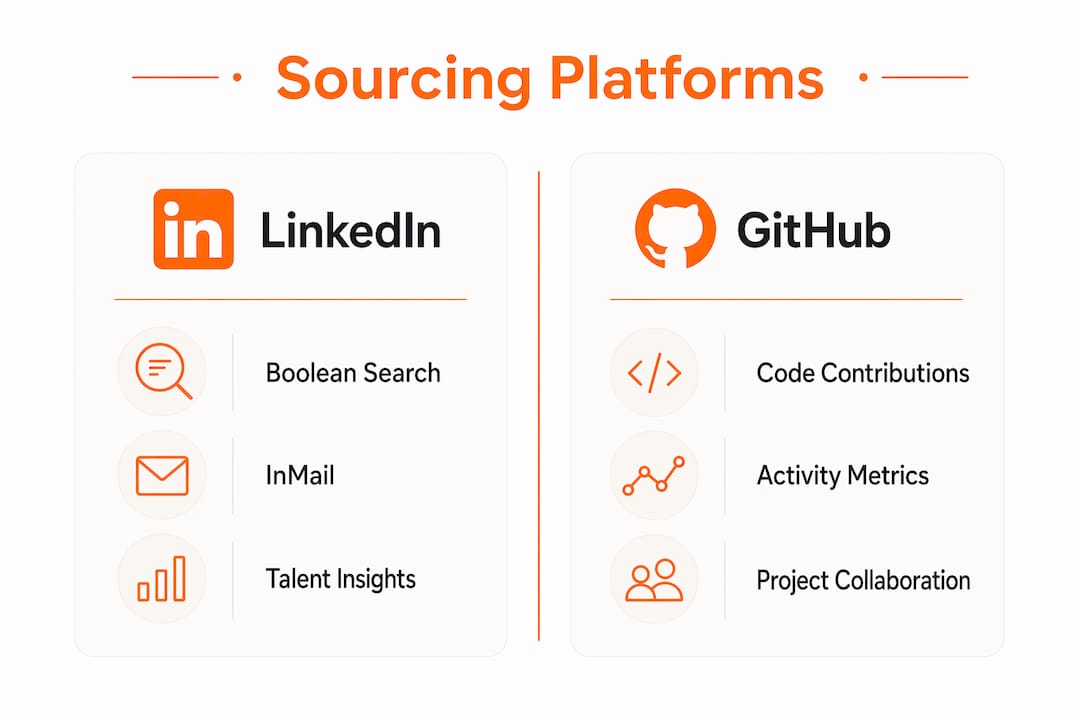
The table below compares the primary platforms used to source passive tech professionals, their core features, and where each fits best in a sourcing workflow.
| Platform | Core feature | Best use case |
|---|---|---|
| LinkedIn Recruiter | Boolean search, InMail, talent insights | Initial profile discovery and professional history review |
| GitHub | Repository contribution data, commit history | Identifying active engineers by real work output |
| GoPerfect | AI behavioral prediction scoring | Prioritizing candidates most likely to respond |
| Stack Overflow Talent | Q&A activity, tag expertise | Finding specialists in niche technical domains |
| Slack/Discord communities | Real-time engagement, community reputation | Accessing developers in focused tech ecosystems |
Niche communities deserve specific attention. Slack workspaces like Rands Leadership Slack, Discord servers tied to specific frameworks, and forums on Lobsters or Hacker News host engineers who never post on LinkedIn. These are not secondary sources. For certain specialties, particularly in cybersecurity and systems programming, they are the primary source.
How to use multi-channel sourcing to uncover hidden IT talent
Multi-channel parallel searches capture talent that keyword filters on any single platform will miss. The most effective sourcing workflows do not start with people. They start with repositories.
Here is a practical multi-channel sourcing sequence:
-
Identify high-signal repositories. Search GitHub for repositories that match your tech stack and have recent, sustained commit activity. A repository with 200 contributors and commits from the past 30 days is a live talent pool. High-signal repositories show repeated active commits and direct relevance to your stack, revealing contributors overlooked by conventional profile searches.
-
Evaluate contribution quality, not just quantity. Review the actual pull requests and issues. A contributor who writes clear documentation, reviews others' code, and closes issues thoughtfully is demonstrating professional judgment, not just technical output.
-
Target contributors ranked 3rd through 10th. Developers ranked 3rd to 10th among repository contributors tend to be more accessible and responsive than top maintainers, who are often unreachable due to high visibility. This is one of the most underused tactics in passive sourcing.
-
Check cross-repo presence. A candidate active across multiple repositories in related domains signals consistent engagement. Cross-repo contribution consistency indicates sustained skill and professional seriousness. A sparse single public profile does not mean inactivity. It may mean the candidate's most significant work is in private repositories.
-
Move to community platforms. After identifying candidates on GitHub, cross-reference their activity on Stack Overflow, relevant Discord servers, or technical Slack groups. Seeing the same handle contributing thoughtfully across platforms confirms both skill and engagement level.
-
Use LinkedIn for professional context. Once you have a candidate's GitHub identity, LinkedIn provides employment history, tenure data, and network connections. This is where behavioral prediction tools add value, scoring the profile against signals like recent job changes, new skill endorsements, or shifts in network activity.
Pro Tip: Do not automate the GitHub sourcing step. Automated scrapers pull contributor lists but miss the qualitative signals that separate a strong candidate from a prolific one. Spend 10 minutes manually reviewing the top 15 contributors in each target repository before adding anyone to your outreach list.
What outreach strategies convert passive IT professionals into candidates?
Personalized outreach referencing a candidate's specific work produces significantly better response rates than generic job pitches. The standard passive candidate message fails because it treats the recipient as a job seeker. Passive professionals are not job seekers. They are employed, often well-compensated, and receiving multiple messages per week from recruiters. The message that gets a response is the one that proves you did the work.
Effective outreach follows a clear structure. The first message does not pitch a job. It references something specific: a repository contribution, a conference talk, a Stack Overflow answer, or a published article. It offers something of value, such as a relevant industry report, a perspective on a technical challenge, or a connection to someone in their field. The job opportunity is mentioned briefly, if at all, in the first contact.
Common outreach mistakes to avoid:
- Sending generic templates. A message that could apply to any engineer signals that you did not research the candidate. Response rates drop sharply.
- Leading with compensation. Salary figures in a first message position the role as transactional. Passive candidates respond to mission, team quality, and technical challenge first.
- Giving up after one message. A follow-up sequence of three to four messages over three weeks is standard practice. Most responses come from the second or third contact, not the first.
- Misrepresenting the role. Overstating scope or flexibility damages trust immediately. Passive candidates talk to each other. Reputation in technical communities is a real asset or liability.
A practical engagement timeline: send the first message on a Tuesday or Wednesday morning. Follow up five to seven days later with a brief, direct note. A third message two weeks after that can include a specific piece of content relevant to the candidate's work. If there is no response after four contacts over 30 days, move on and revisit in six months.
Pro Tip: Reference the candidate's GitHub username or a specific commit in your first LinkedIn message. It takes 90 seconds to look up and immediately differentiates your outreach from every other recruiter in their inbox.
What challenges arise when recruiting dormant IT candidates?
Passive hires perform 15% better and retain 20% longer than active hires, but the time-to-hire averages 46 days compared to 33 days for active candidates. That gap is not a flaw in the process. It is the cost of accessing better talent. Hiring managers who expect passive sourcing to match active pipeline speed will consistently mismanage the process.
The most common sourcing errors and their fixes:
-
Over-filtering profiles. Requiring exact title matches or specific degree credentials eliminates strong candidates who built skills through open-source work or non-traditional paths. Filter on demonstrated output, not credentials.
-
Ignoring behavioral signals. A candidate who recently updated their LinkedIn headline, added new certifications, or increased posting frequency is signaling openness. These are the candidates to prioritize.
-
Slow follow-through after a response. When a passive candidate responds, the window is short. Delays of more than 48 hours in scheduling a call communicate low urgency and lose candidates to faster-moving competitors.
-
Treating sourcing as a one-time event. Effective passive sourcing requires always-on infrastructure across professional networks, community groups, and open-source platforms. Sourcing only when a role opens means starting from zero every time.
The metric that matters most in passive sourcing is not volume of profiles found. It is the ratio of responses to first messages sent. A 15% to 20% response rate on a targeted, personalized outreach list indicates a healthy sourcing process. Rates below 10% signal that either the targeting or the messaging needs adjustment.
Track response rates by channel, message type, and candidate seniority. This data identifies which sourcing channels produce the most engaged candidates and which message formats generate replies.
Key takeaways
Identifying passive IT talent requires multi-channel sourcing, behavioral prediction tools, and personalized outreach to access the 70% to 85% of IT professionals not visible on job boards.
| Point | Details |
|---|---|
| Passive talent dominates the market | 70% to 85% of IT professionals are passive, making proactive sourcing the only way to reach most of the talent pool. |
| Start with repositories, not profiles | GitHub sourcing from high-signal repositories uncovers quality contributors missed by standard keyword searches. |
| Target mid-tier contributors | Contributors ranked 3rd to 10th in a repository are more accessible and responsive than top maintainers. |
| Personalize every first message | Reference specific candidate work in the opening message to separate your outreach from generic recruiter templates. |
| Build always-on sourcing infrastructure | Passive sourcing only works when it runs continuously, not as a reactive response to open headcount. |
What I've learned about sourcing passive IT talent after years in the field
The biggest mistake I see hiring managers make is treating passive sourcing as a volume game. They automate everything, blast 500 messages, and wonder why the response rate is 3%. Passive IT professionals are not ignoring recruiters because they are busy. They are ignoring recruiters because the messages they receive are indistinguishable from each other.
In 2026, the shift I am watching closely is how AI behavioral prediction tools are changing the prioritization step. Tools that score candidate openness based on tenure patterns and network activity are genuinely useful, but only when paired with human judgment on message quality. The technology identifies who to contact. It does not tell you what to say.
The recruiters and hiring managers who consistently fill technical roles with strong passive candidates share one habit: they treat sourcing as relationship management, not transaction processing. They contribute to the communities where their candidates spend time. They share useful content. They build a presence that makes their outreach feel like a continuation of a relationship rather than a cold interruption.
Patience is also non-negotiable. A 46-day average time-to-hire for passive candidates is not a problem to solve. It is the reality of working with professionals who are not in a hurry. The organizations that accept this and build their hiring timelines accordingly consistently outperform those that do not.
— Diego
How Plucktalent helps you reach passive IT professionals
Plucktalent combines 17 years of IT and cybersecurity recruiting expertise with Plucky AI, a sourcing co-pilot built specifically for technical hiring. The platform connects hiring managers directly with qualified passive candidates by bypassing job board noise and focusing on professionals whose skills match open roles precisely. For HR teams that need to fill specialized positions without waiting for applications, Plucktalent's sourcing and engagement services provide the infrastructure to run always-on passive candidate pipelines. Hiring managers can also explore the Plucktalent job seekers platform to see how candidates are profiled and matched, which informs better outreach targeting from the start.
FAQ
What is passive IT talent?
Passive IT talent refers to technology professionals who are currently employed and not actively searching for new roles but may be open to the right opportunity. This group represents 70% to 85% of the global IT workforce.
Why do passive IT hires outperform active candidates?
Passive hires perform 15% better and stay 20% longer than active hires on average. This is attributed to their stability, current skill application in active roles, and the selectivity of the hiring process that identifies them.
Which platforms are best for sourcing passive tech professionals?
LinkedIn Recruiter, GitHub, and Stack Overflow Talent are the primary platforms. GitHub is particularly effective for identifying engineers by actual work output rather than self-reported skills.
How many follow-up messages should you send to a passive candidate?
A sequence of three to four messages over 30 days is standard practice. Most responses from passive candidates come from the second or third contact, not the first outreach.
How does AI improve passive IT candidate sourcing?
AI behavioral prediction tools analyze tenure, network shifts, and platform activity to score each candidate's likelihood of being open to a new role. This allows recruiters to prioritize outreach lists before sending any messages, improving efficiency and response rates.