
Enterprise IT talent placement is the process of identifying, sourcing, and onboarding technology professionals into large organizations where hiring cycles, approval chains, and role complexity create barriers that smaller companies never face. HR professionals and talent acquisition specialists who need to place IT talent at enterprise companies consistently run into the same structural problems: vague job definitions, overbuilt interview loops, and procurement friction that slows every placement. The good news is that these are process problems, not talent shortage problems. Fixing them requires role clarity, targeted sourcing, and a workforce model that mixes permanent hires with contract staffing where appropriate.
What prerequisites are needed to place IT talent at enterprise companies?
Successful enterprise IT talent placement starts before the first candidate search. The most common reason enterprise hiring stalls is not a lack of qualified candidates. It is a lack of internal alignment on what the role actually requires.
Clear role definitions accelerate sourcing. When a hiring manager and an HR professional disagree on whether a DevSecOps engineer needs five years or ten years of experience, every shortlist gets rejected. The fix is a role intake session that locks in must-have skills, reporting structure, compensation band, and success metrics before sourcing begins. This single step removes the most common cause of wasted recruiter time.
Overengineered interview loops and multi-stakeholder approvals are self-inflicted bottlenecks that cause candidate drop-off before an offer is ever made. A candidate with cloud security architecture skills does not wait six weeks for a committee to schedule a panel interview. They accept another offer.
AI-powered recruiting platforms have changed the cost equation for enterprise IT staffing. AI recruiting services reduce traditional agency costs by about 70% and deliver interview-ready candidates in two weeks or less. That cost reduction matters in enterprises where IT staffing budgets are scrutinized alongside headcount approvals.
The foundational prerequisites for effective IT talent acquisition strategies at the enterprise level include:
- A completed role intake document signed off by the hiring manager and HR before sourcing starts
- A defined interview process with no more than four rounds for senior roles
- A compensation benchmark updated within the last 90 days
- A clear decision owner who can approve an offer without a committee vote
- Procurement pre-approval for contract placements to avoid last-minute delays
Pro Tip: Run a 30-minute role calibration call with the hiring manager, a current team member, and HR before posting any IT role. Misalignment caught at this stage saves weeks of wasted sourcing.
How do you source and engage top IT candidates for enterprise roles?

The most sought-after IT professionals are not browsing job boards. Active applicant markets limit effectiveness; deliberate engagement of passive talent is the defining competitive advantage in IT recruitment. Inbound applications rarely surface the profiles enterprises actually need for senior or specialized roles.
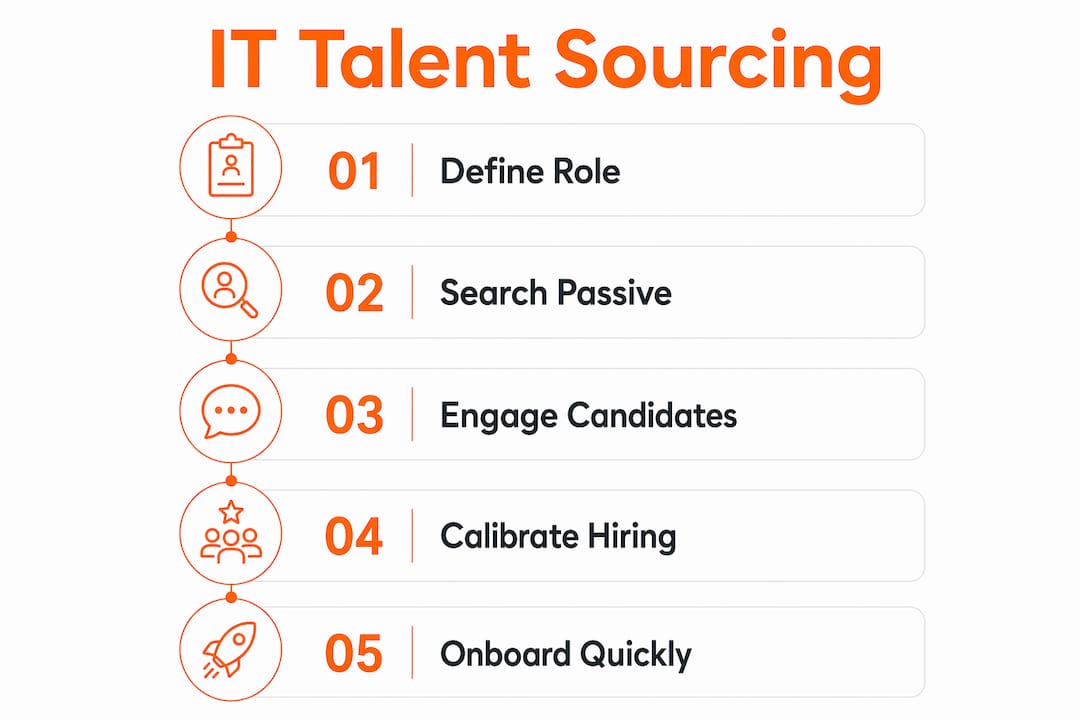
The first sourcing decision is role classification. Treating all IT roles uniformly leads to inefficiencies. Commodity roles, such as help desk support or junior QA analysts, respond well to job board postings and volume sourcing. Strategic scarcity roles, such as security architecture, principal engineers, or AI/ML specialists, require bespoke direct outreach. Mixing these two approaches wastes budget and produces weak shortlists for the roles that matter most.
For strategic scarcity roles, talent mapping is the correct method. Talent mapping means building a list of qualified professionals currently employed at peer companies, then reaching out with a specific, personalized message about the role. This is not mass mailing. It is a targeted conversation that respects the candidate's time and signals that the enterprise has done its homework.
Passive candidate engagement also requires patience and consistency. A candidate who declines an initial outreach in march may be open to a conversation in september after a reorg or a project ends. Maintaining a warm pipeline of previously contacted candidates is one of the highest-return activities in enterprise IT talent acquisition. Plucktalent's approach to filling IT roles without job boards reflects this discipline.
- Use LinkedIn Recruiter, GitHub profiles, and conference speaker lists to identify passive candidates for strategic roles
- Personalize every outreach message with the specific technology stack and project context
- Follow up twice before removing a candidate from the pipeline
- Track response rates by role type to calibrate messaging over time
Pro Tip: For security and infrastructure roles, search conference speaker archives from events like RSA Conference or AWS re:Invent. Speakers are proven experts who are often open to senior opportunities.
What hiring process optimizations reduce time-to-fill at enterprise companies?
Senior IT roles filled within 60 days are considered competitive; searches extending beyond 90 days correlate with delayed transformation programs and measurable business risk. Most enterprise hiring teams know this. Few have fixed the process steps that cause the delay.
The four most common process bottlenecks in enterprise IT hiring are:
- Undefined ownership. No single person is accountable for moving a candidate from screen to offer. Decisions get deferred to committees that meet infrequently.
- Unstructured interviews. Interviewers ask different questions to different candidates, making comparison impossible and extending deliberation time.
- Late compensation alignment. Salary ranges get confirmed after a candidate has already been through three interview rounds, leading to offer declines that waste everyone's time.
- Procurement delays for contract roles. Vendor onboarding and contract execution can add two to four weeks to a placement that should take days.
The table below shows the impact of structured process changes on time-to-fill for common enterprise IT role categories.
| Role category | Typical time-to-fill without process fixes | Time-to-fill with structured process |
|---|---|---|
| Senior software engineer | 70–90 days | 45–55 days |
| Cloud infrastructure architect | 80–100 days | 50–65 days |
| Cybersecurity analyst | 60–80 days | 35–50 days |
| IT project manager | 50–70 days | 30–45 days |
Speed and quality in enterprise IT hiring depend more on process design and role clarity than on talent availability. The talent exists. The process is the constraint.
Pre-vetted talent pipelines address the sourcing delay directly. When a recruiter maintains a warm list of candidates who have already been screened for skills, availability, and compensation expectations, the time from role approval to first interview drops significantly. Plucktalent's AI-driven talent discovery approach builds exactly this kind of pipeline for enterprise clients.
When should enterprises use contract IT consultants versus permanent hires?
Contract IT consulting and permanent hiring serve different purposes. Using the wrong model for a given situation adds cost and delays outcomes.
Contract IT consulting allows the fastest scaling for enterprise transformation programs, with a 3–5 week timeline from search to onsite start. Permanent hires for equivalent roles typically take 4–6 months from job approval to start date. For a cloud migration or ERP implementation with a fixed deadline, that difference determines whether the project launches on time.
| Hiring model | Best use case | Typical time to start | Key risk |
|---|---|---|---|
| Contract IT consultant | Transformation projects, specialized expertise, surge capacity | 3–5 weeks | Continuity after project ends |
| Permanent hire | Core platform roles, long-term team building | 4–6 months | Longer ramp time, higher cost if wrong fit |
| Hybrid model | Ongoing programs with variable workload | Varies by role mix | Governance complexity |
Governance matters in contract staffing. Enterprises need clear statements of work, defined deliverables, and IP ownership clauses before a contractor starts. Without these, legal and compliance teams will delay the engagement anyway, eliminating the speed advantage that contract staffing provides.
Reducing internal procurement approvals for contract placements can shrink contract execution from weeks to days. Pre-approved vendor lists and master service agreements with staffing partners are the most effective way to achieve this. Enterprises that invest in these agreements once benefit from faster placements on every subsequent engagement.
Pro Tip: For transformation projects lasting six months or longer, consider a contract-to-hire structure. It gives both the enterprise and the consultant a trial period before committing to a permanent offer.
Key Takeaways
Effective enterprise IT talent placement requires process discipline, role clarity, and a workforce model that matches the right hiring type to each role's timeline and strategic importance.
| Point | Details |
|---|---|
| Role clarity before sourcing | Define must-have skills, compensation, and decision ownership before any search begins. |
| Passive talent engagement | Direct outreach to employed professionals produces better shortlists than inbound applications for senior roles. |
| Process design drives speed | Structured interviews, clear ownership, and pre-approved compensation cut time-to-fill more than sourcing volume does. |
| Contract staffing for speed | Contract placements start in 3–5 weeks versus 4–6 months for permanent hires, making them the right choice for transformation projects. |
| Separate role types | Commodity IT roles and strategic scarcity roles need different sourcing methods to avoid wasted budget and weak shortlists. |
What enterprise IT hiring gets wrong in 2026
The most persistent mistake I see in enterprise IT hiring is treating every open role as the same problem. A company posts a job description, waits for applications, runs five interview rounds, and then wonders why the best candidates disappeared after round two. That process works for roles where candidates are plentiful and patient. It fails completely for security architects, principal engineers, and AI specialists who have three other conversations happening simultaneously.
The second mistake is confusing thoroughness with quality. A six-round interview process does not produce a better hire. It produces a hire who was willing to sit through six rounds. The candidates who declined after round three were often the strongest ones. Structured assessments with clear scoring criteria, completed in three rounds or fewer, consistently produce better outcomes than marathon interview loops.
What actually works is treating hiring as a sales process for the enterprise. The candidate is evaluating the company just as hard as the company is evaluating the candidate. Enterprises that brief candidates on team culture, project scope, and growth path during the first conversation close offers faster and at lower compensation premiums than those that reveal these details only after an offer is made.
AI tools have changed what is possible in sourcing, but they have not replaced the judgment required to evaluate a senior IT professional. The best results come from combining AI-powered candidate discovery with a recruiter who understands the technical context well enough to have a credible first conversation. That combination is what separates a strong shortlist from a pile of resumes.
— Diego
Plucktalent's approach to enterprise IT talent placement
Plucktalent combines 17 years of IT and cybersecurity recruiting expertise with Plucky AI, a dedicated sourcing co-pilot that connects enterprises directly with qualified candidates. The platform bypasses generic job board traffic and focuses on pre-qualified professionals who match the specific skills and seniority level each role requires.
Plucktalent supports both permanent placement and contract staffing models, giving enterprise HR teams the flexibility to match the right hiring approach to each role's timeline and budget. For teams looking to reduce hiring cycles without adding internal headcount, Plucktalent's enterprise IT staffing services cover sourcing, screening, and pipeline management. IT professionals seeking enterprise roles can also connect directly through the Plucktalent job seekers page.
FAQ
What is enterprise IT talent placement?
Enterprise IT talent placement is the process of sourcing, evaluating, and onboarding technology professionals into large organizations with complex hiring structures. It differs from standard IT recruiting because of multi-stakeholder approvals, procurement requirements, and longer decision cycles.
How long does it take to fill a senior IT role at an enterprise company?
Senior IT roles filled within 60 days are considered competitive. Searches extending beyond 90 days increase business risk and correlate with delayed technology programs.
What is the difference between contract IT staffing and permanent hiring?
Contract IT consultants typically start within 3–5 weeks and suit transformation projects with defined timelines. Permanent hires take 4–6 months on average and are the right choice for core platform roles requiring long-term team continuity.
Why do passive candidates matter more than active applicants for IT roles?
Passive talent engagement increases competitive advantage because the most qualified IT professionals are already employed and not browsing job boards. Direct outreach to passive candidates produces stronger shortlists for senior and specialized roles.
How can enterprises reduce time-to-fill for IT roles?
Fixing internal bottlenecks, including unclear role definitions, unstructured interviews, and late compensation alignment, reduces time-to-fill more than increasing sourcing volume. Pre-vetted talent pipelines and pre-approved procurement agreements for contract staffing also cut placement timelines significantly.