
An IT talent pipeline is defined as a proactively managed pool of pre-qualified candidates ready to fill technology roles before vacancies arise. This structure transforms reactive hiring into planned workforce development. A well-built pipeline reduces time-to-hire from 52 days to under 25, making the process 40–50% faster than posting and praying. For HR professionals and hiring managers in tech, the IT talent pipeline explained here covers every stage: identification, qualification, engagement, and ongoing data management. The result is faster hires, better candidate fit, and far less scrambling when a critical role opens.
What are the key components of an IT talent pipeline?
An IT talent pipeline is not a spreadsheet of resumes. It is a living system with defined stages, tracked data, and regular engagement. The difference between a real pipeline and a contact list comes down to data quality and process discipline.

The five data fields every candidate record needs
A valid pipeline entry requires five fields per candidate: current role, most recent conversation, compensation expectations, movement timeline, and funnel status. Remove any one of those fields and the record becomes a contact, not a pipeline candidate. This distinction matters because incomplete records cannot support a hiring decision. They sit idle and decay.
Pipeline stages and what they mean
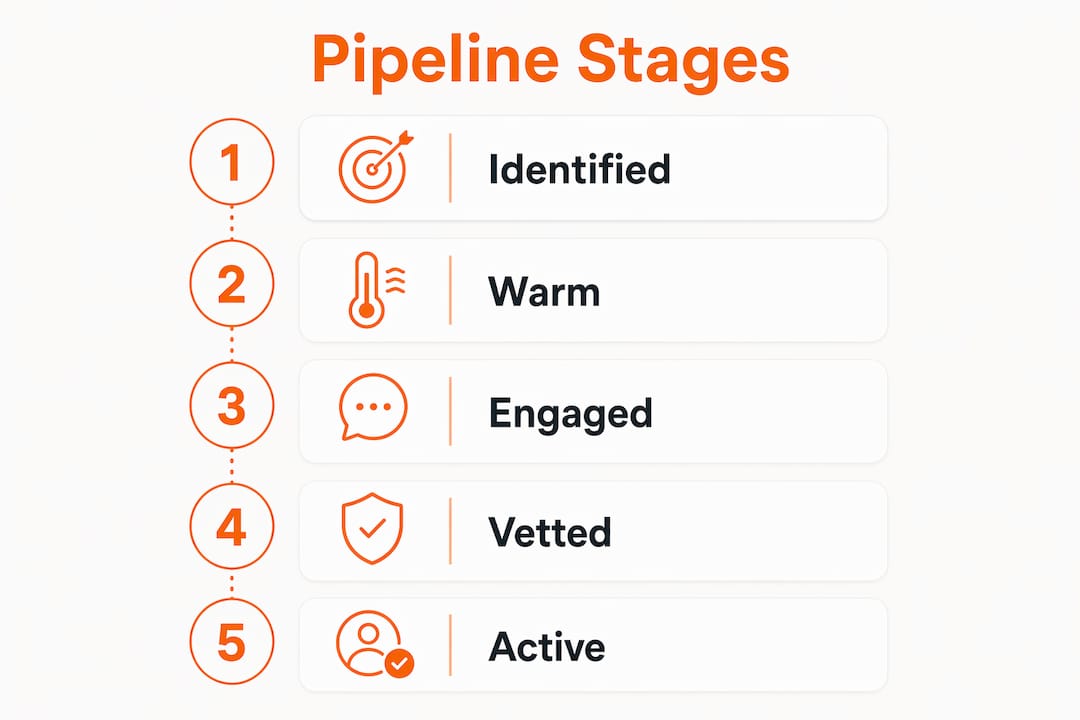
Effective IT talent pipelines move candidates through five stages: Identified, Warm, Engaged, Vetted, and Active. Each stage has a clear definition and a recruiter action attached to it.
| Stage | Candidate status | Recruiter action |
|---|---|---|
| Identified | Located but not yet contacted | Research and qualify against role criteria |
| Warm | Initial contact made | Send personalized outreach; log response |
| Engaged | Two-way conversation started | Conduct a qualification call; capture data fields |
| Vetted | Meets role criteria; data complete | Share with hiring manager; confirm interest |
| Active | Ready to interview within 30 days | Schedule and move through interview process |
Each stage transition should happen within five business days. Delays at any stage reduce the candidate's likelihood of accepting an offer later.
Pro Tip: Review your pipeline monthly. If more than 30% of records lack a recent conversation date, the pipeline has already started to decay into a static list.
How does building an IT talent pipeline speed up hiring?
The speed benefit of a tech talent pipeline is measurable and significant. Proactive pipelines cut hiring time by 40–50% compared to reactive methods. That means a role that previously took 52 days to fill can close in under 25 days. For engineering and security teams where every open seat slows delivery, that difference is material.
Candidate engagement quality also drives speed. Personalized outreach achieves 49% higher response rates than templated messages. A recruiter targeting a 25–35% reply rate baseline will hit that number consistently with personalized contact, and miss it consistently with generic InMail blasts.
"Successful pipeline builders view candidates as long-term customers, earning loyalty over time and insulating against market shifts. The relationship built before a role opens is what determines whether a candidate answers the call when it does."
Passive candidates are not lost candidates. 71% of passive candidates remain open to engagement for up to 18 months when a consistent communication cadence is maintained. That 18-month window is the pipeline's operating life for any given candidate. Recruiters who treat that window as an asset, rather than a waiting period, build the strongest pipelines.
Moving candidates through each stage in under five business days consistently increases offer acceptance rates. Speed inside the funnel signals organizational seriousness to candidates. Slow internal processes communicate the opposite, and top IT talent reads those signals quickly.
What common pitfalls undermine IT talent pipelines?
The most common mistake is treating a pipeline like a passive database. Hiring managers collect resumes, add them to a folder or ATS, and assume the pipeline is built. It is not. A real IT talent acquisition strategy requires active management, not storage.
Pitfalls that kill pipeline health
- No recent conversation data. Records without a logged interaction in the past 90 days are effectively cold. Candidates have moved, changed their compensation expectations, or accepted other offers.
- Templated outreach. Generic messages produce low response rates. Personalized contact tied to a candidate's specific background and current role performs measurably better.
- Building pipelines for every role. Maintaining pipelines for all roles yields poor ROI. Recruiter effort should concentrate on revenue-critical or difficult-to-fill IT positions.
- No defined stage ownership. When no one owns the transition from Engaged to Vetted, candidates stall and disengage.
- Ignoring compensation data. A candidate who was open to $130,000 six months ago may now expect $155,000. Pipelines without updated compensation fields produce failed offers.
Inconsistent outreach causes candidate ghosting. A quarterly rhythm of three light-touch communications per year prevents disengagement without overwhelming passive candidates. That cadence is low enough to feel respectful and frequent enough to keep the relationship alive.
Pro Tip: Set a calendar reminder every 90 days for each active pipeline segment. A brief, relevant message, such as sharing a relevant industry article or a role update, counts as a valid touch and resets the engagement clock.
How to build and maintain an IT talent pipeline
Building a tech talent pipeline from scratch follows a clear sequence. Skipping steps produces the static lists described above. Following them produces a system that delivers candidates on demand.
Step-by-step pipeline construction
- Forecast workforce needs by skill cluster. Work with engineering and product leads to identify which skill sets the organization will need in the next one to two quarters. Segment by cluster, such as cloud infrastructure, application security, or DevOps, rather than by job title. Titles change; skills do not.
- Source targeted candidates. Use LinkedIn, GitHub, professional communities, and referral networks to identify candidates who match the skill cluster. Prioritize candidates who are active in their field but not actively job searching.
- Send personalized outreach. Reference the candidate's specific work, recent projects, or published content. Aim for the 25–35% reply rate baseline. Track every response and non-response.
- Conduct qualification calls. Capture all five data fields: current role, recent conversation, compensation, movement timeline, and funnel status. A 20-minute call is sufficient. Document everything in the ATS or pipeline management tool immediately after.
- Assign a nurture cadence. Place each qualified candidate into a 90-day contact cycle. Rotate message types: a role update, an industry article, a brief check-in. Keep each touch short and relevant.
- Refresh continuously. For roles the organization fills frequently, treat the pipeline as a permanent asset. Add new candidates monthly. Archive records that have gone cold beyond 18 months without re-engagement.
Hiring managers play a direct role at the Vetted stage. Recruiters should not present candidates to hiring managers until the five data fields are complete. Incomplete records waste manager time and erode trust in the pipeline process.
Pro Tip: Align pipeline building with the company's product and engineering roadmap. If a new product launch is planned for Q3, the pipeline for the supporting roles should be active by Q1. Roadmap alignment turns pipeline building from reactive to genuinely proactive.
ATS platforms and dedicated pipeline management tools track stage transitions, log conversations, and flag records that have gone stale. The tool matters less than the discipline of updating it after every candidate interaction. A well-maintained record in a basic ATS outperforms a neglected record in an enterprise platform.
Key Takeaways
An IT talent pipeline built on complete candidate data, consistent engagement, and defined stage ownership reduces time-to-hire by up to 50% and produces measurably higher offer acceptance rates.
| Point | Details |
|---|---|
| Define pipeline vs. contact list | Every candidate record needs five data fields: role, conversation, compensation, timeline, and funnel status. |
| Use defined stages | Move candidates through Identified, Warm, Engaged, Vetted, and Active within five business days per stage. |
| Personalize outreach | Personalized messages achieve 49% higher response rates than templated ones; target a 25–35% reply rate. |
| Focus on critical roles | Build pipelines only for hard-to-fill or revenue-critical IT roles to protect recruiter efficiency. |
| Maintain a quarterly cadence | Three light-touch contacts per year keep passive candidates engaged for up to 18 months. |
What I have learned about IT talent pipelines after 17 years
The most common failure I see is not a lack of candidates. It is a lack of data discipline. Organizations invest time sourcing candidates, then let the records go stale because no one owns the update process. Six months later, the pipeline is full of names and empty of usable information.
The mindset shift that changes everything is treating candidates as long-term customers. A customer relationship requires consistent, relevant contact. It requires knowing what the customer values and what has changed since the last conversation. The same is true for pipeline candidates. The recruiter who remembers that a candidate mentioned wanting to move into a management role in 18 months will have a very different conversation than the recruiter who sends a generic "checking in" message.
Speed inside the funnel is the second variable most organizations underestimate. Internal process speed is the most important factor for pipeline success. A candidate who is ready to move in 30 days will not wait 45 days for an internal approval cycle. The pipeline delivers the candidate. The internal process either captures or loses them.
For specialized roles like security engineering and identity management, the best pipelines also incorporate training and internal mobility. External hiring alone cannot fill the volume of specialized IT roles the market currently demands. Organizations that combine external pipeline building with internal development programs consistently outperform those that rely on one channel alone.
The organizations that build the most resilient pipelines treat IT workforce development as an ongoing program, not a project that starts when a role opens. That distinction, between program and project, is where most hiring organizations either win or fall behind.
— Diego
How Plucktalent supports IT talent pipeline development
Plucktalent brings 17 years of IT and cybersecurity recruiting expertise to the pipeline problem. The platform connects qualified tech candidates directly with hiring managers, bypassing the noise of generic job boards. For HR professionals building a tech talent pipeline, Plucktalent provides candidate sourcing, ATS-ready profile preparation, and direct hiring manager access. The Plucky AI co-pilot supports candidates in presenting their skills accurately and efficiently, which means the candidates entering your pipeline arrive better prepared and faster to qualify. HR teams and hiring managers can review Plucktalent's candidate network and services to see how the platform fits their current pipeline gaps.
FAQ
What is an IT talent pipeline?
An IT talent pipeline is a proactively managed pool of pre-qualified technology candidates ready to fill roles before vacancies are posted. It differs from a resume database by maintaining active engagement, complete candidate data, and defined funnel stages.
How long does it take to build an IT talent pipeline?
A functional pipeline for a specific skill cluster can be operational within four to six weeks. Pipelines for hard-to-fill roles like security engineering or cloud architecture typically require eight to twelve weeks to reach a usable depth of qualified candidates.
How often should recruiters contact pipeline candidates?
A quarterly cadence of three light-touch contacts per year keeps passive candidates engaged without causing disengagement. Consistent contact at this frequency maintains candidate openness for up to 18 months.
What data fields does every pipeline candidate record need?
Every record needs five fields: current role, most recent conversation date, compensation expectations, movement timeline, and current funnel status. Records missing any of these fields function as contact lists, not pipelines.
Which IT roles benefit most from a talent pipeline?
Revenue-critical and difficult-to-fill roles, such as security engineers, cloud architects, and DevOps specialists, produce the best return on pipeline investment. Maintaining pipelines for every role dilutes recruiter effort and reduces overall pipeline quality.