
A job search funnel is a structured framework that maps every stage of your search, from discovering target companies to accepting an offer, so you can track progress and improve results at each step. Most job seekers treat their search as a single activity. The funnel approach treats it as a system with distinct stages, each with its own conversion rate and its own failure mode. Understanding this distinction is the core insight behind every effective job search strategy. Plucktalent applies this exact framework to help IT and cybersecurity professionals move through the pipeline faster and with far less wasted effort.
What are the key stages of the job search funnel?
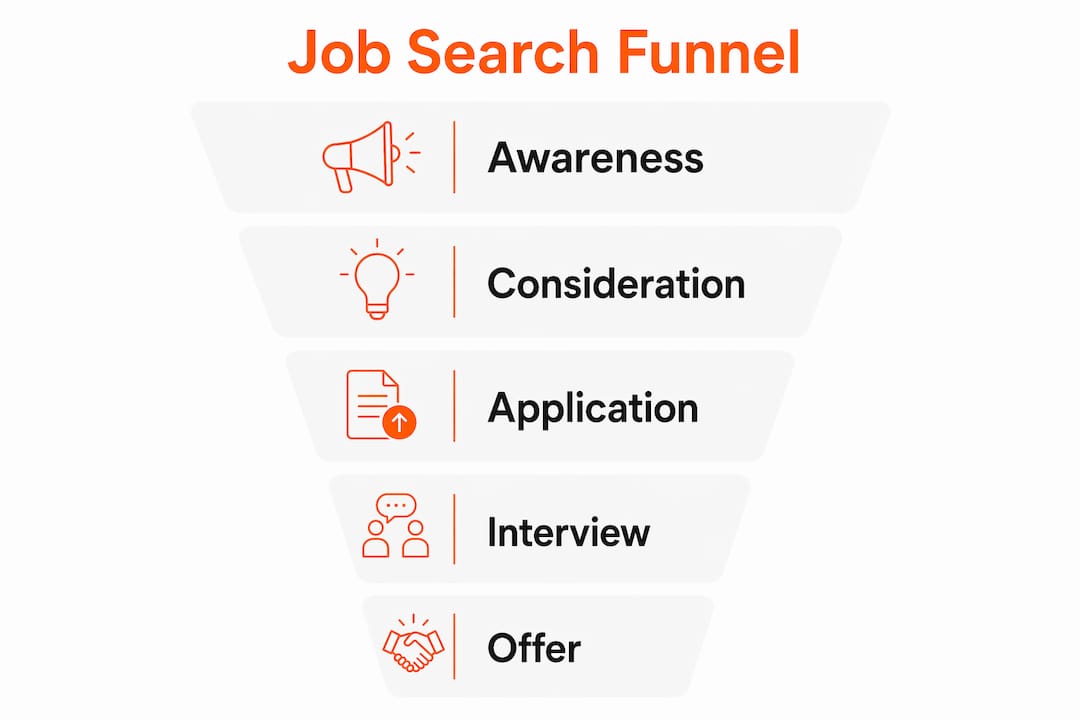
The job search funnel mirrors a sales or marketing funnel. It moves candidates from broad awareness down to a single accepted offer, with each stage filtering the pool further.
The five core stages are awareness, consideration, application, interview, and offer. Each stage requires a different activity from you and a different response from employers.
Awareness is where you identify companies actively hiring for your skills. This is not passive job board scrolling. It means building a target list of employers, monitoring hiring signals, and positioning yourself where decision-makers can find you.
Consideration is the stage most candidates skip entirely. This is where you build trust before you apply. Engaging with company content, sharing relevant posts, and demonstrating expertise through your LinkedIn activity all signal credibility to hiring managers before your resume ever arrives.
Application is the conversion point most people focus on exclusively. A tailored, ATS-ready resume submitted to the right role at the right company is the goal here. Volume without targeting produces poor results.

Interview is where positioning shifts from written to verbal. Your ability to communicate specific achievements and fit determines whether you advance or stall.
Offer is the final stage. Negotiation, timing, and follow-through all affect whether an offer converts to an accepted position.
| Funnel stage | Your primary activity | Employer response | Key output |
|---|---|---|---|
| Awareness | Build target company list | Passive awareness of your profile | Qualified employer list |
| Consideration | Engage, share, network | Recognition and trust building | Warm relationships |
| Application | Submit tailored resume | ATS screening and recruiter review | Interview invitations |
| Interview | Communicate fit and achievements | Evaluation and scoring | Offer or rejection |
| Offer | Negotiate and decide | Final approval and onboarding | Accepted position |
The table above shows why fixing only your resume rarely solves a slow job search. Each stage has its own inputs and outputs. A breakdown at awareness means you are targeting the wrong companies. A breakdown at consideration means you are applying cold into a crowded field.
How do conversion rates affect your job search funnel strategy?
Conversion rates are the single most useful diagnostic tool in the job search funnel. They tell you exactly where your process breaks down, so you stop guessing and start fixing the right thing.
Healthy application-to-interview rates sit at 7–9%. A rate below 3% signals a targeting or positioning problem, not a volume problem. Sending more applications into a broken funnel produces more rejections, not more interviews.
Interview-to-offer rates typically fall between 15–25%. If your rate sits below that range, the fix is interview preparation, not resume revision.
Channel choice has an equally large impact on conversion. Cold online applications convert at 0.1–2%. Referrals and warm outreach convert at 30–40%. That gap is not marginal. It means a single referral is statistically worth 15–400 cold applications.
| Application channel | Typical conversion rate | Best use case |
|---|---|---|
| Cold job board application | 0.1–2% | High-volume, low-effort roles |
| Direct company website | 2–5% | Targeted, well-researched roles |
| Warm outreach or networking | 10–20% | Mid-funnel trust already established |
| Referral from known contact | 30–40% | Highest-yield channel available |
Referrals bypass the largest volume filters in recruiting and put candidates directly in front of decision-makers. That is why channel mix matters as much as application quality.
Pro Tip: Track your application-to-interview rate weekly. If it drops below 5%, stop adding volume and audit your targeting criteria and resume positioning instead.
What common bottlenecks break the job search funnel?
Diagnosing the exact stage where your funnel breaks accelerates your search more than any single tactic. The four most common failure points each produce a distinct pattern in your conversion data.
- Poor role targeting. You apply to roles that do not match your actual skill set or seniority level. The symptom is a very low application-to-interview rate across all channels, even when your resume is strong.
- Weak resume positioning. Your resume lists responsibilities instead of quantified achievements. Recruiters and ATS systems both penalize this. The symptom is low callback rates even from roles that match your background.
- Wrong channel mix. You rely almost entirely on cold job board applications. The symptom is high application volume with very few responses, regardless of role fit.
- Interview performance gaps. You reach interviews regularly but rarely advance to offers. The symptom is a below-average interview-to-offer rate. The fix is preparation and practice, not more applications.
Each bottleneck requires a different response. Treating all four as the same problem is the most common mistake job seekers make. Most candidates view the funnel as uniform rather than as distinct stages. Recognizing which specific stage is underperforming is the key advantage.
Pro Tip: Run a weekly funnel review. Log every application, interview, and outcome in a simple spreadsheet. After two weeks, your conversion data will show you exactly where to focus.
How to build and optimize your job search funnel step by step
Building a functioning job search funnel takes about one week of setup and then consistent weekly maintenance. The steps below follow the funnel from top to bottom.
-
Build your awareness layer. Create a target list of 20–40 companies actively hiring in your field. Use LinkedIn, industry job boards, and company career pages. Set up job alerts for each target. This replaces random browsing with a focused pipeline.
-
Invest in the consideration stage. Candidates who build trust through posts and network engagement before applying see significantly higher interview and hire rates. Comment on content from hiring managers at target companies. Share relevant industry insights. Connect with recruiters before a role opens.
-
Build a modular asset library. Maintain a bank of 40–60 quantified achievements grouped by skill category. When a new role appears, pull the most relevant bullets and assemble a tailored resume in under 30 minutes. This approach maintains quality without burning hours on each application.
-
Prioritize warm channels. Allocate at least 50% of your weekly effort to referrals, warm outreach, and direct recruiter contact. Reserve cold applications for roles where you have a strong match and no warm path available.
-
Prepare for interviews as a separate discipline. Interview performance is its own funnel stage. Practice answering behavioral questions using the STAR method (Situation, Task, Action, Result). Record yourself. Review the playback. Most candidates underestimate how much preparation affects their offer rate.
-
Track and review weekly. Weekly funnel reviews that measure conversion metrics enable rapid adaptation. Schedule 30 minutes every Friday to log your numbers and identify the weakest stage. Adjust your channel mix or targeting criteria based on what the data shows, not on how you feel about the week.
-
Avoid burnout through batching. Batch similar tasks together. Write all outreach messages on Monday. Submit applications on Tuesday and Wednesday. Reserve Thursday for follow-ups. This structure prevents the scattered, reactive approach that drains energy without producing results.
Treating your job search like a funnel removes emotional bias by turning each rejection into a data signal rather than a personal verdict. That mindset shift is what separates candidates who search for months from those who close offers in weeks.
Key takeaways
The job search funnel is a five-stage system where conversion rates at each stage reveal exactly where to focus effort for faster, more predictable results.
| Point | Details |
|---|---|
| Five distinct stages | Awareness, consideration, application, interview, and offer each require different tactics. |
| Conversion benchmarks matter | A 7–9% application-to-interview rate is healthy; below 3% signals a targeting problem. |
| Channel mix drives yield | Referrals convert at 30–40% versus 0.1–2% for cold applications. |
| Consideration stage is often missing | Building trust before applying significantly increases interview and hire rates. |
| Weekly reviews accelerate results | Tracking conversion metrics weekly lets you fix the right stage instead of guessing. |
Why the funnel changed how I think about job searching
I spent years watching talented professionals send out 80 applications and get three interviews, then conclude they were not good enough. That conclusion was almost always wrong. The problem was never their qualifications. It was that they were treating a five-stage system as if it had only one stage.
The funnel framework does something specific that generic job search advice cannot. It separates the problem. A low application-to-interview rate is a positioning or targeting problem. A low interview-to-offer rate is a communication problem. These require completely different fixes. Conflating them wastes weeks.
The consideration stage is the one I see overlooked most consistently. Job seekers who engage with a company's content, connect with its recruiters, and demonstrate expertise before applying are not just being polite. They are building a conversion advantage that cold applicants cannot replicate. The data on referral and warm outreach conversion rates confirms this directly.
The other shift worth making is emotional. Approaching the job search like a business funnel introduces clarity and control into a process that otherwise feels random. A rejection stops being a judgment and starts being a data point. That is not a coping mechanism. It is a more accurate description of what a rejection actually is.
Run your numbers. Fix the right stage. Repeat.
— Diego
Plucktalent and your job search funnel
Plucktalent was built specifically for IT and cybersecurity professionals who recognize that a generic job search produces generic results. The platform combines 17 years of recruiting expertise with Plucky AI, a dedicated job search co-pilot that helps candidates build ATS-ready profiles, identify the right target companies, and connect directly with hiring managers.
For professionals ready to move through the pipeline with a structured, data-backed approach, Plucktalent's job seeker services address every stage of the funnel, from profile positioning to direct employer introductions. The platform removes the guesswork from channel selection and resume tailoring so candidates spend time on high-yield activities. Learn more about the full range of career support options available through Plucktalent.
FAQ
What is a job search funnel?
A job search funnel is a five-stage framework covering awareness, consideration, application, interview, and offer. It helps candidates track progress and identify where their search process breaks down.
What is a healthy application-to-interview conversion rate?
A healthy rate is 7–9%. Rates below 3% typically indicate a targeting or resume positioning problem rather than a volume problem.
Why do referrals outperform cold applications so significantly?
Referrals convert at 30–40% because they bypass automated screening filters and place candidates directly in front of decision-makers. Cold applications convert at just 0.1–2%.
How often should I review my job search funnel metrics?
Weekly reviews are the standard. Tracking applications, interviews, and outcomes every Friday gives you enough data to adjust your channel mix or targeting before wasting additional weeks on an ineffective approach.
What is the consideration stage and why does it matter?
The consideration stage is the trust-building phase before you apply. Candidates who engage with company content and network with hiring managers before submitting an application see significantly higher interview and hire rates than those who apply cold.