
A job search timeline is a planned roadmap that breaks the job search process into specific phases, from initial research through offer negotiation, so you can manage tasks and time without losing momentum. Most job seekers treat the search as a single event. It is actually a sequence of distinct phases, each with its own tasks and deadlines. Understanding what is a job search timeline, and how to build one, is the difference between a reactive search and a deliberate one.
What is a job search timeline and why does it matter?
A job search timeline is a phased, structured plan that organizes every step of the search process, from planning and document preparation through networking, applications, interviews, and negotiation. CareerOneStop's Job Search framework uses exactly this structure to help candidates stay clear on what to do and when. Without a timeline, job seekers tend to skip preparation phases and jump straight to applications, which leads to slower responses, weaker materials, and missed opportunities.
The timeline matters because hiring is not instant on either side. SHRM's 2025 recruiting benchmarks show the average time to fill a position is roughly 6 weeks from posting to offer. That figure covers only the employer's process. It does not include the weeks a job seeker spends preparing before applying. A structured job search plan accounts for both sides of the clock.

Phases in a complete timeline include: planning and research, document preparation, networking, job applications, interviews, and offer negotiation. Each phase feeds the next. Weak preparation in phase one creates delays in every phase that follows.
What are the key phases of a job search timeline?
A complete job search timeline runs through six distinct phases. Each phase has specific tasks that must be finished before the next phase can run efficiently.
Phase 1: Planning and research This phase starts well before any application is submitted. You identify target roles, target companies, and target industries. You assess your skills against job requirements and research compensation ranges. This phase can start 6–12 months before your target start date for competitive or specialized roles.
Phase 2: Document preparation This phase covers your resume, cover letter templates, LinkedIn profile, and a personal employment record. Maintaining a personal record of your employment history, references, and credentials reduces delays when completing applications. Employers use applications to compare candidates directly, so accuracy and completeness matter.
Phase 3: Networking Networking is not a single event. It is a planned, ongoing activity that runs throughout the entire search. CareerOneStop recommends short, targeted connection requests with resume attachments and scheduled follow-up calls. Many jobs are never publicly posted, making early relationship-building one of the highest-return activities in the timeline.
Phase 4: Job applications Applications should go out roughly 3–4 months before your target availability date. This phase requires a complete documentation package prepared in advance. Applying without that package ready creates gaps and delays that cost you interviews.
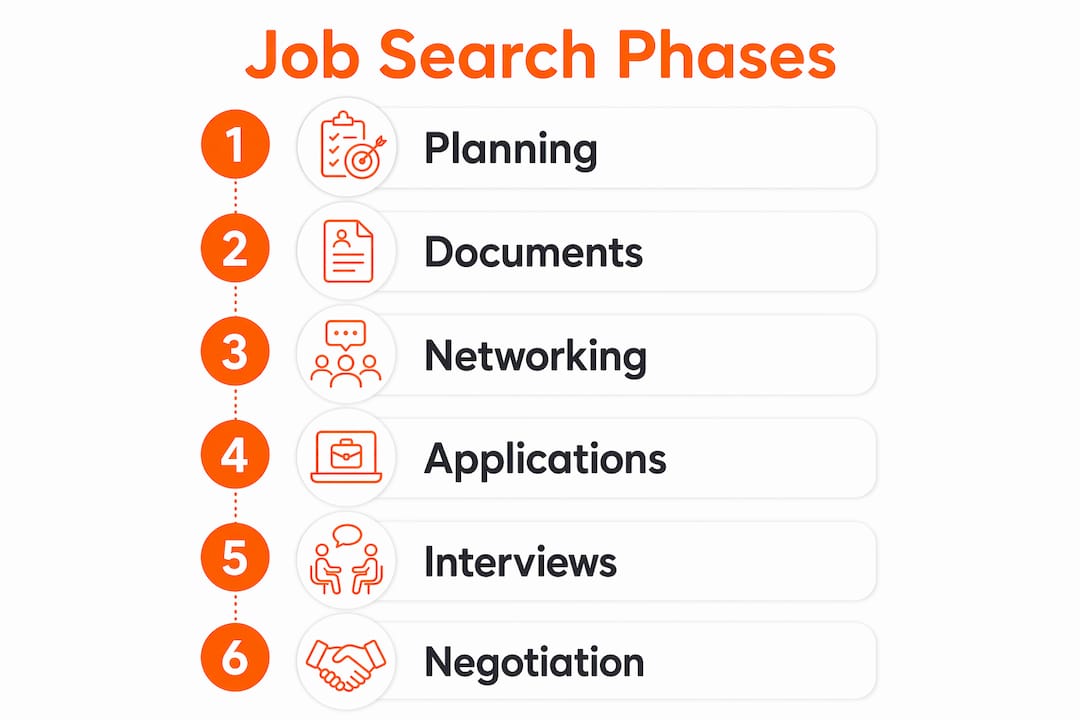
Phase 5: Interviews Interview preparation is its own phase, not a last-minute task. Arriving 10–15 minutes early and sending a thank-you note within 24 hours are standard best practices. Both signal professionalism and keep you visible to hiring managers during their decision process.
Phase 6: Offer negotiation This phase begins when an offer arrives. Preparation here means knowing your target salary range and your non-negotiables before the call happens, not during it.
How long does a typical job search take?
The median job search duration in the U.S. is approximately 11 weeks. That means roughly half of job seekers land a role within about 2.5 to 3 months of active searching. The word "active" is important. That 11-week figure starts when applications go out, not when preparation begins.
Add 4–8 weeks of preparation before the first application, and the full job search plan from start to finish runs closer to 4–5 months for most candidates. Senior roles, specialized technical positions, and fields with limited openings extend that window further.
The table below summarizes key job search timeline benchmarks for 2026.
| Phase | Typical Duration |
|---|---|
| Planning and research | 4–8 weeks |
| Document preparation | 2–4 weeks (overlaps with planning) |
| Networking (ongoing) | Starts at week 1, runs throughout |
| Active applications | 3–4 months before target start date |
| Employer time to fill | ~6 weeks (SHRM 2025 benchmark) |
| Median full search duration | ~11 weeks of active applications |
Entry-level job seekers face a different timing dynamic. NACE's Job Outlook 2026 data shows that recruiting cycles for college hires split between fall and spring seasons. New graduates who miss the fall recruiting window often wait until spring, adding months to their search. Knowing which cycle applies to your target employers is a core part of building an effective job search timeline.
Industry also affects duration. IT and cybersecurity roles tend to move faster than average when candidates have current certifications and ATS-ready profiles. Roles requiring security clearances or niche technical stacks can extend the timeline by weeks or months beyond the median.
How should you plan and time your job search for best results?
Timing your job search means starting the information-gathering phase early, not just submitting applications on a schedule. Expert guidance frames application timing as distinct from search start timing. You need enough lead time to make confident job fit decisions before committing to an application.
A practical job application schedule looks like this:
- 12 months out: Research target roles, companies, and compensation. Begin informational interviews with people in your target field.
- 6–9 months out: Update your resume, LinkedIn profile, and reference list. Build your personal employment record.
- 4–6 months out: Begin active networking. Attend industry events, reach out to former colleagues, and schedule informational calls.
- 3–4 months out: Submit applications. Apply to roles that match your target start date, not roles that need someone immediately unless you are available now.
- Ongoing: Track every application, follow-up, and contact in a job search log. This record prevents duplicate outreach and keeps follow-up on schedule.
Pro Tip: Write a short, targeted outreach email for each networking contact. Include a specific ask, such as a 20-minute call, and a concrete date range. Vague requests get ignored. Specific ones get responses.
Effective networking uses elevator pitches, concrete asks, and systematic follow-up. Building this into your calendar, not leaving it to chance, is what separates a structured job search plan from an unstructured one.
Post-interview timing is equally specific. Sending a thank-you note within 24 hours and asking about next steps before the interview ends are practices that directly affect hiring outcomes. Both should be planned in advance, not improvised.
What are common pitfalls in managing a job search timeline?
The most common mistake is treating the timeline as an application calendar only. Job seekers who skip the preparation and networking phases arrive at the application stage with weak materials and no relationships at target companies. The result is a longer search, not a shorter one.
Other frequent errors include:
- Late or missing thank-you notes. Sending a follow-up more than 48 hours after an interview signals low interest. Plan the note before the interview, not after.
- No tracking system. Without a job search log, you lose track of who you contacted, when you applied, and what follow-up is due. This creates gaps in communication that cost you opportunities.
- Generic outreach. Sending the same connection request to 50 contacts produces low response rates. Targeted, personalized messages with specific asks produce results.
- Applying too late. Submitting applications less than 4 weeks before your target start date puts you behind the employer's hiring cycle. Most offers take 6 weeks to materialize after the first application.
Pro Tip: Build a simple spreadsheet with columns for company name, role, application date, contact name, follow-up date, and status. Update it after every interaction. This single habit prevents most timeline management failures.
Minimizing the gap between identifying a role and submitting a complete application is a core time-saving strategy. A full documentation package prepared in advance makes that possible.
Key takeaways
A structured job search timeline that starts with research and networking, not applications, produces shorter and more effective searches across all career levels.
| Point | Details |
|---|---|
| Start earlier than you think | Research and networking should begin 6–12 months before your target start date. |
| Know the employer's clock | SHRM data shows average time to fill is roughly 6 weeks, so factor that into your application schedule. |
| Median search is 11 weeks | Half of U.S. job seekers find a role within about 2.5 to 3 months of active applications. |
| Track every interaction | A job search log prevents missed follow-ups and duplicate outreach. |
| Post-interview timing matters | Send thank-you notes within 24 hours and ask about next steps before leaving the interview. |
Why I think most job seekers get the timeline backwards
Most candidates I have seen treat the job search like a sprint that starts the day they decide to move. They update the resume, hit apply on 30 listings, and then wonder why nothing moves. The timeline is backwards. The phases that produce the most results, research, informational interviews, and relationship-building, happen before a single application goes out.
The 11-week median search duration is real, but it measures active applications. It does not measure the weeks of preparation that make those applications competitive. Job seekers who skip preparation are not starting at week one. They are starting at a deficit.
Networking is the piece most people treat as optional. It is not. Many roles, especially in IT and cybersecurity, are filled through referrals before a public posting ever appears. Building those relationships early, through informational calls and targeted outreach, puts you in front of opportunities that never show up on a job board.
The other thing I have seen consistently is that structured tracking reduces stress. When you know exactly where every application stands and when every follow-up is due, the search feels manageable. Without that structure, it feels like waiting. The timeline is not just a productivity tool. It is a way to stay in control of a process that otherwise controls you.
— Diego
Plucktalent and the job search process
Plucktalent is built for IT and cybersecurity professionals who need more than a job board. The platform connects candidates directly with hiring managers at companies actively filling technical roles, bypassing the application black hole that slows most searches.
Plucktalent combines 17 years of recruiting expertise with Plucky AI, a dedicated job search co-pilot that helps candidates build ATS-ready profiles and reach the right contacts at the right time. For professionals managing a structured job search plan, the platform provides the tools to track progress, time outreach, and move through the pipeline faster. Explore Plucktalent's career services to see how the platform supports each phase of the search process.
FAQ
What is a job search timeline?
A job search timeline is a structured plan that organizes the search into phases: research, document preparation, networking, applications, interviews, and negotiation. It helps job seekers manage tasks and deadlines from start to offer.
How long does a job search typically take?
The median job search duration in the U.S. is approximately 11 weeks of active applications. Adding preparation time, the full process from start to offer typically runs 4–5 months.
When should you start applying for jobs?
Apply roughly 3–4 months before your target start date. Research and networking should begin well before that, ideally 6–12 months out for competitive or specialized roles.
How does employer hiring time affect your job search plan?
SHRM's 2025 data shows the average time to fill a position is roughly 6 weeks. Job seekers should factor that window into their application schedule to avoid applying too close to their target start date.
What is the biggest mistake in managing a job search timeline?
The most common mistake is skipping preparation and networking phases and treating the timeline as an application calendar only. This weakens materials, reduces referral opportunities, and extends the overall search duration.