
IT recruiter placement time is defined as the total elapsed time from role intake to accepted offer for a technical position. Reducing it is the single most controllable factor in IT hiring competitiveness. The industry standard term is "time to fill," and the two phrases refer to the same metric. Staffing firms using AI-powered sourcing and screening now report 40–60% faster time to fill, with many completing professional placements in under 10 days. For IT managers and hiring executives, that gap between 10 days and the industry average represents lost productivity, higher contractor costs, and candidates lost to faster-moving competitors.
How to reduce IT recruiter placement time at each hiring stage
The IT hiring cycle breaks into four stages: sourcing, screening, interviewing, and offer. Each stage carries a different delay profile, and targeting the right one first produces the fastest results.
The application-review-to-recruiter-screen stage is the longest single delay in IT hiring, with a median lag of 8 days. That one gap alone can be compressed to under 1 day with AI screening. The cause is straightforward: recruiter capacity runs out before application volume does, and manual triage is slow by design.

Interview scheduling is the second major bottleneck. Coordinating panel availability, candidate windows, and technical assessment slots through email chains adds days to every cycle. The offer stage, by contrast, is rarely the problem. Most offer delays trace back to poor decision frameworks earlier in the process, not slow approvals.
| Hiring stage | Typical delay | Primary cause |
|---|---|---|
| Application review to recruiter screen | 8 days (median) | Manual triage, recruiter capacity |
| Interview scheduling | 4–7 days | Calendar coordination, panel assembly |
| Technical assessment | 2–4 days | Scheduling, tool setup |
| Offer approval | 1–2 days | Decision framework gaps |
Sourcing delays vary by role seniority. Senior IT roles in cybersecurity or cloud architecture take longer to source because the candidate pool is smaller and passive. Addressing sourcing speed requires different tools than addressing screening speed.
How can AI-powered tools cut screening and scheduling time?
AI resume parsing, semantic candidate matching, and fit scoring are the three technologies that directly compress the screening stage. Parsing extracts structured data from unstructured resumes. Semantic matching compares candidate profiles against role requirements at the concept level, not just keyword level. Fit scoring ranks candidates automatically, so recruiters review a prioritized shortlist instead of a raw pile.
Manual resume screening demands 6–8 seconds per application. For 10 active IT roles, that consumes more than 20 hours weekly. AI screening cuts that same volume to minutes per batch, freeing recruiters for interviews and relationship work. That is not a marginal gain. It is a structural shift in how recruiter time gets allocated.
Scheduling automation produces a separate category of savings. Automated scheduling with real-time calendar sync reduces interview delays by 4–7 days compared to manual coordination. It also reduces no-shows by 29% through automated reminders and faster booking confirmation. Simple self-scheduling links are not enough. True efficiency requires real-time calendar sync and automated panel assembly, not just a link to a booking page.
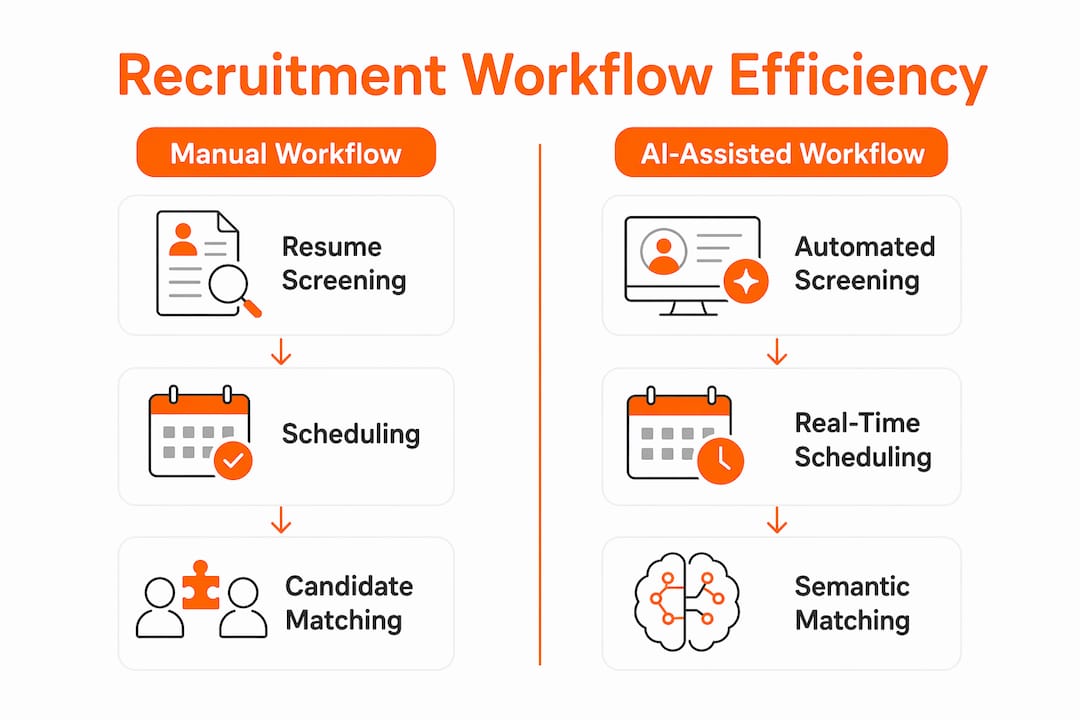
The table below compares manual and AI-assisted workflows across key screening and scheduling tasks.
| Task | Manual workflow | AI-assisted workflow |
|---|---|---|
| Resume screening (100 applications) | 20+ hours | Under 30 minutes |
| Candidate ranking | Recruiter judgment, inconsistent | Automated fit scoring, consistent |
| Interview scheduling | 4–7 days of email coordination | Same-day confirmation |
| No-show rate | Baseline | Reduced by 29% |
| Time to shortlist | 8+ days | Under 1 day |
Pro Tip: Start AI implementation with screening and scheduling modules before touching sourcing or analytics. These two modules produce the fastest measurable ROI and require the least change management from your recruiting team.
Connected AI workflows that integrate sourcing, screening, outreach, and scheduling into a single system outperform disconnected point solutions. Firms using isolated tools see partial gains. Firms with fully integrated AI pipelines complete standard IT placements in under 10 days.
What process design strategies shorten IT hiring cycles?
Technology alone does not fix a broken process. The structure of how hiring stages run relative to each other determines cycle length as much as any tool.
Running hiring stages in parallel cuts 8–15 days from IT hiring cycles. The standard sequential model runs recruiter screens, then technical assessments, then hiring manager interviews one after another. A parallel model runs recruiter screens and technical assessments simultaneously, then feeds hiring manager interviews immediately after. The quality of the shortlist does not drop. The calendar does.
Key process design changes that shorten IT hiring cycles:
- Parallel stage execution. Run recruiter screens and technical assessments at the same time rather than sequentially.
- Structured interview scorecards. Standardized evaluation criteria improve decision speed and reduce mis-hire risk by giving interviewers a clear framework before the conversation starts.
- Decision frameworks for offers. Define approval authority and salary bands before the role opens, not after a candidate is selected.
- Contract-to-hire arrangements. For senior or niche IT roles, contract-to-hire structures provide immediate technical contribution while the permanent search continues. This eliminates the productivity gap that occurs during long hiring cycles.
- Limit interview rounds. Three rounds is the maximum for most IT roles. Each additional round adds days and increases candidate dropout rates.
The most common mistake is treating each hiring stage as a dependency of the previous one. That assumption is rarely true. Most stages can begin before the prior one closes, and the time savings compound across a full hiring cycle.
How to implement AI and process improvements in your IT workflow
A structured rollout prevents the two most common failure modes: tool adoption without process change, and process change without tool support.
Step 1: Set prerequisites. Confirm ATS integration capability, define role criteria in writing before sourcing begins, and align hiring managers on evaluation standards. AI tools perform poorly when role requirements are vague.
Step 2: Enable AI sourcing and semantic search. Deploy semantic search across your candidate databases and job boards simultaneously. Semantic search surfaces candidates who match role intent, not just job title keywords.
Step 3: Deploy AI screening with automated ranking. Configure fit scoring against your defined role criteria. Recruiters should receive a ranked shortlist, not a raw applicant list.
Step 4: Implement AI interview scheduling with real-time calendar sync. Connect the scheduling tool directly to all panel members' calendars. Automated reminders go to candidates 24 hours and 1 hour before each interview.
Step 5: Train recruiters on high-value tasks. Automation of mechanical recruiting steps frees recruiters to focus on relationship-building and qualitative judgment. Recruiters who understand this shift perform better after AI adoption, not worse.
Step 6: Monitor time-to-hire metrics by stage. Track each stage separately. A drop in overall time to fill that masks a growing bottleneck in one stage will resurface as a larger problem later.
| Implementation step | Key action | Expected benefit |
|---|---|---|
| Prerequisites | ATS integration, role criteria definition | Clean data for AI tools |
| AI sourcing | Semantic search across databases | Larger, better-matched candidate pool |
| AI screening | Automated ranking and fit scoring | Shortlist in under 1 day |
| AI scheduling | Real-time calendar sync, automated reminders | 4–7 days saved per role |
| Recruiter training | Focus on judgment and relationships | Higher placement quality |
| Metric monitoring | Stage-level time-to-hire tracking | Ongoing bottleneck identification |
Pro Tip: Pilot AI tools on 3–5 active roles before full deployment. Measure shortlist quality and time-to-screen against your baseline. A 30-day pilot gives you enough data to justify full rollout and identify configuration issues before they scale.
AI recruitment tools typically cost $200–$800 monthly per user, with ROI achievable within 30–90 days. One staffing agency reported a 24-day payback period after deployment. That figure reflects both reduced vacancy costs and increased placement volume.
What pitfalls slow IT recruiter placement speed?
The four most common barriers to faster IT placement are over-reliance on manual screening, poor technology integration, unclear hiring criteria, and client-side scheduling delays.
Over-reliance on manual screening is the most fixable. Recruiters who review every application individually cannot scale. AI screening removes this ceiling without removing recruiter judgment from the process.
Poor technology integration means tools that do not share data. An ATS that does not connect to the screening tool forces manual data entry between stages. That manual step reintroduces the delay the tool was meant to eliminate.
Solutions that address these barriers directly:
- Set SLA targets for each hiring stage. A target of delivering a quality shortlist within 48 hours of role intake, a practice known as speed to shortlist, gives recruiters a concrete pace to maintain and helps manage client-side delays.
- Invest in staff training for AI tools before deployment, not after problems emerge.
- Define hiring criteria in writing before sourcing begins. Vague criteria produce slow, inconsistent screening decisions.
- Build candidate no-show protocols into the scheduling workflow. Automated reminders reduce no-shows by 29%, but a rebooking protocol handles the remainder without recruiter intervention.
Measurable improvement follows within one to two hiring cycles when these fixes are applied together. The gains are not theoretical. They show up in stage-level time-to-hire reports within weeks.
Key Takeaways
Reducing IT recruiter placement time requires combining AI-powered screening and scheduling with parallel process design, structured evaluation criteria, and stage-level metric tracking.
| Point | Details |
|---|---|
| Longest delay is screening | The application-review-to-screen stage averages 8 days and is compressible to under 1 day with AI. |
| AI cuts screening to minutes | Manual screening of 100 applications takes 20+ hours; AI completes the same task in under 30 minutes. |
| Parallel stages save 8–15 days | Running recruiter screens and technical assessments simultaneously cuts weeks from IT hiring cycles. |
| Connected AI outperforms point tools | Integrated AI workflows deliver placements in under 10 days; disconnected tools produce only partial gains. |
| Speed to shortlist drives control | Targeting a 48-hour shortlist delivery gives recruiters a measurable pace and reduces client-side delay impact. |
What I have learned from 17 years of watching IT hiring cycles
The most persistent myth in IT recruitment is that speed and quality trade off against each other. They do not. Every time I have seen a hiring team slow down to "be more careful," the actual problem was a broken process, not a speed problem. The slowness was a symptom, not a safeguard.
The teams that consistently place IT talent fastest share one habit: they measure every stage separately. They do not track overall time to fill and call it done. They know exactly where the days are going. When a bottleneck appears in scheduling, they fix scheduling. When it appears in offer approval, they fix the decision framework. That specificity is what separates teams that improve from teams that stay stuck.
AI adoption changes the recruiter's job, but not in the way most people fear. Recruiters who embrace AI screening and scheduling spend more time on the conversations that actually determine placement quality. The mechanical work disappears. The judgment work expands. That is a better job, not a diminished one.
The contract-to-hire approach for senior IT roles is still underused. Hiring teams treat it as a fallback when they should treat it as a parallel track. Running a contract arrangement while the permanent search continues keeps the business moving and reduces the pressure that leads to poor permanent hiring decisions.
The measurement piece is where most improvement efforts stall. Teams implement AI tools, see initial gains, and stop tracking. Six months later, a new bottleneck has formed in a different stage and no one noticed. Continuous stage-level monitoring is not optional. It is the mechanism that keeps gains from eroding.
— Diego
Plucktalent and faster IT placement
Plucktalent combines 17 years of IT and cybersecurity recruiting expertise with Plucky AI, a dedicated job search co-pilot built for technical talent. The platform connects candidates directly with hiring managers at companies actively hiring for specific skills, bypassing the noise of generic job boards.
For IT managers looking to shorten hiring cycles, Plucktalent's recruitment services include AI-driven screening, ATS-ready candidate profiles, and direct hiring manager connections. The platform is built for the speed and specificity that IT roles require. IT professionals and hiring teams can review available IT job opportunities and connect with recruiters who specialize in technical placement. Plucktalent removes the steps that slow most IT hiring cycles down.
FAQ
What is IT recruiter placement time?
IT recruiter placement time, also called time to fill, is the total elapsed time from role intake to accepted offer for a technical position. Reducing it directly lowers vacancy costs and improves hiring competitiveness.
Which hiring stage causes the most delay in IT recruitment?
The application-review-to-recruiter-screen stage causes the longest delay, with a median lag of 8 days. AI screening compresses this stage to under 1 day.
How much faster does AI make IT recruitment screening?
AI screening reduces candidate processing time by 75% and enables staffing firms to complete placements 40–60% faster than manual workflows.
What is speed to shortlist and why does it matter?
Speed to shortlist is the practice of delivering a qualified candidate shortlist within 48 hours of role intake. It gives recruiting teams a measurable pace target and reduces the impact of client-side delays outside recruiter control.
Can parallel hiring stages reduce IT placement time without lowering quality?
Running recruiter screens and technical assessments simultaneously cuts 8–15 days from IT hiring cycles without reducing shortlist quality. Structured interview scorecards maintain evaluation consistency throughout the parallel process.