
Talent mapping is defined as the proactive process of identifying, assessing, and cataloging current and potential workforce skills to align human capital with future organizational goals. In IT and cybersecurity, where skill shortages are acute and roles evolve fast, this process is not optional. Companies with mature talent mapping strategies reduce time-to-fill by 25–40% and cut external recruitment costs by up to 50%. Understanding what is talent mapping in IT contexts gives HR leaders and business executives a direct path to smarter workforce decisions. Tools like PeopleGPT and research from the Brandon Hall Group confirm that structured talent mapping separates reactive hiring from genuine workforce architecture.
What is talent mapping in IT workforce planning?
Talent mapping in IT is the systematic process of documenting who has what skills, where gaps exist, and which internal or external candidates can fill future roles. It goes beyond a headcount spreadsheet. The process creates a living picture of your workforce's capabilities against the skills your organization will need in 12, 24, or 36 months.
Most HRIS systems underrepresent employee skills because they rely on job titles rather than actual competencies. Active skills mapping reveals 20–30% more internal talent availability than standard HR records show. That gap is significant. It means organizations are often recruiting externally for roles that existing employees could fill with modest development.
For IT and cybersecurity teams specifically, this matters more than in most fields. Skill sets like cloud security, DevSecOps, and AI governance shift faster than job descriptions can track. Talent mapping captures those shifts in real time and gives HR leaders the data to act before a vacancy becomes a crisis.

What are the key steps in the talent mapping process?
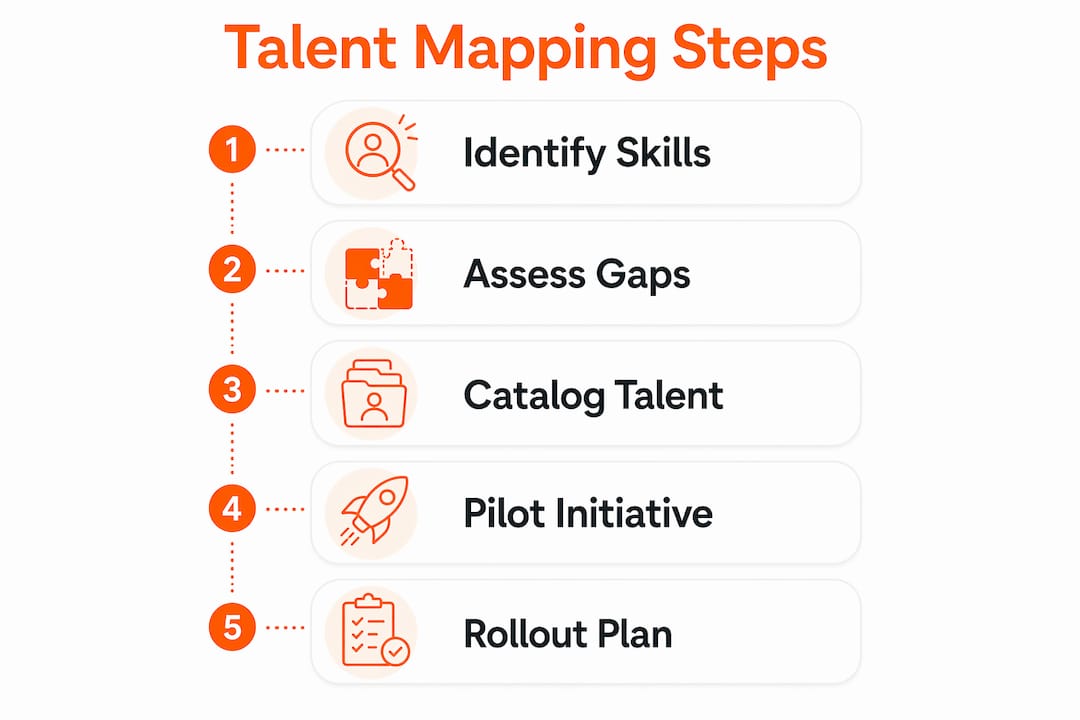
The talent mapping process steps follow a logical sequence from internal assessment to external market analysis to gap resolution. Each step builds on the last.
- Identify critical roles. Define which positions are most vital to business continuity and growth over the next one to three years.
- Assess current employees. Evaluate skills, performance history, and growth potential across your existing workforce.
- Analyze the external labor market. Research candidate availability, compensation benchmarks, and competitor hiring activity for your target roles.
- Identify skill gaps. Compare what you have internally against what the business will need. Note both current shortfalls and projected future gaps.
- Develop gap-closing strategies. Decide which gaps to address through internal development, targeted recruitment, or contractor arrangements.
- Refresh the map regularly. Talent maps become obsolete within 6–12 months without updates. Schedule refresh cycles at least twice per year.
Pilot projects typically last 3–6 months, with full organizational rollouts spanning 12–24 months. Starting small lets you validate your methodology before scaling.
Pro Tip: Start your talent mapping initiative in one business unit or function. A focused pilot produces faster results and builds internal credibility before you expand company-wide.
How does talent mapping differ from succession planning and sourcing?
Talent mapping, succession planning, and candidate sourcing are related but distinct. Conflating them leads to misaligned expectations and incomplete workforce strategies.
Talent mapping covers the entire talent ecosystem, both internal and external, while succession planning focuses narrowly on identifying internal replacements for leadership roles. Sourcing is a tactical recruiting activity. Talent mapping is a strategic intelligence function that informs sourcing, succession planning, and long-term workforce architecture simultaneously.
The table below clarifies the core differences:
| Dimension | Talent Mapping | Succession Planning | Candidate Sourcing |
|---|---|---|---|
| Goal | Workforce readiness across all levels | Leadership continuity and risk mitigation | Fill open requisitions |
| Scope | Internal and external talent ecosystem | Internal candidates only | External candidate pools |
| Data focus | Skills, potential, market availability | Performance, leadership readiness | Contact details, job fit |
| Time horizon | 1–3 years forward-looking | Immediate to 2 years | Current open roles |
| Outcome | Workforce architecture plan | Succession slate | Candidate pipeline |
Talent mapping produces named individuals with detailed professional backgrounds, while market mapping analyzes aggregate labor market conditions. Both inform strategy, but talent mapping is the more granular and operationally useful output. Proactive talent acquisition teams maintain these maps before requisitions open, which enables rapid outreach within 24 hours of a role being approved.
What are the measurable benefits of talent mapping?
The benefits of talent mapping are quantifiable and substantial. Organizations that implement structured talent mapping programs report outcomes across recruitment efficiency, retention, and business performance.
- Companies with mature programs reduce time-to-fill by 25–40% and cut external recruitment costs by up to 50%.
- Organizations using skills-based talent mapping are 63% more likely to achieve business goals and 98% more likely to retain high-potential employees.
- Companies are up to 107% more likely to place talent effectively when using comprehensive mapping strategies.
Each of these figures points to the same conclusion: talent mapping converts workforce data into competitive advantage. The 98% retention improvement alone justifies the investment for any organization competing for scarce IT talent.
"Talent mapping is not a project with a finish line. It is a continuous intelligence mission. Organizations that treat it as a one-time exercise lose their advantage within a year." — Workforce Planning Help, 2026
The strategic advantage extends beyond cost savings. Organizations with current talent maps respond faster to market disruptions, reorganizations, and sudden departures. In IT, where a single unfilled security role can expose the business to risk, that speed is a material operational benefit.
What are the common challenges in implementing talent mapping?
Implementing talent mapping is not without friction. The most common obstacles are data accuracy, manager resistance, and maintaining currency over time.
Most organizations have visibility into only 30–40% of employee skills at the start of a mapping initiative. That incomplete baseline discourages some teams from beginning at all. The correct response is to start anyway. An 80% accurate talent map created quickly delivers more strategic value than a perfect map delayed by years of data collection.
Manager resistance is a significant barrier in practice. Managers who view top performers as personal assets resist sharing talent information across the organization. This behavior is common and understandable, but it undermines the entire purpose of talent mapping. Organizations that succeed shift this dynamic by incentivizing managers to develop and export talent, rather than hoard it. Recognition programs, performance metrics tied to team development, and visible executive sponsorship all help drive that culture change.
Maintaining currency is the third challenge. Talent maps degrade fast in IT because roles, skills, and people change constantly. Scheduling mandatory refresh cycles every 6–12 months and assigning clear ownership to specific HR business partners keeps maps current and credible.
Pro Tip: Assign a named owner to each talent map segment. Shared ownership means no ownership. One person accountable for accuracy produces better data than a committee with diffuse responsibility.
For organizations mapping passive IT talent externally, resources like identifying passive IT candidates provide practical frameworks for building external talent pools before roles open. The AI at scale research from BRDGIT also highlights how skills-driven workforce intelligence is becoming a core function in technology organizations, not just an HR exercise.
Key takeaways
Talent mapping is the most direct method for converting workforce data into faster hiring, lower costs, and stronger retention across IT and cybersecurity organizations.
| Point | Details |
|---|---|
| Define before you map | Talent mapping covers internal and external talent ecosystems, not just open roles. |
| Start with imperfect data | An 80% accurate map built quickly outperforms a delayed perfect one every time. |
| Refresh every 6–12 months | Maps become obsolete fast in IT; scheduled updates are non-negotiable. |
| Separate from succession planning | Talent mapping is broader in scope and forward-looking across all levels, not just leadership. |
| Measure the ROI | Time-to-fill reductions of 25–40% and cost savings of up to 50% are documented outcomes. |
Talent mapping is a discipline, not a deliverable
After working in IT recruiting for years, the pattern I see most often is this: an organization builds a talent map once, files it, and treats it as done. Six months later, the data is stale, the roles have shifted, and the map is useless. The exercise gets written off as a failure when the real failure was treating it as a project rather than an ongoing practice.
The organizations that get genuine value from talent mapping treat it the way a good financial team treats a cash flow forecast. It is never finished. It is updated, challenged, and acted on continuously. The Brandon Hall Group's research on workforce planning consistently shows that the gap between high-performing and average organizations is not the sophistication of their initial map. It is the discipline of maintaining it.
There is also a technology dimension that most HR teams underestimate. AI-assisted tools are now capable of scanning external labor markets, flagging skill shifts, and updating internal profiles automatically. That changes the economics of talent mapping significantly. What once required a dedicated team of sourcers can now be managed by a smaller group with the right platform. The question is not whether to use these tools. The question is whether your organization has the process discipline to act on what they surface.
The importance of talent mapping will only grow as IT skill sets continue to fragment and specialize. Organizations that build the discipline now will have a structural advantage in hiring speed, workforce agility, and retention that competitors will struggle to replicate quickly.
— Diego
How Plucktalent supports your workforce planning strategy
Plucktalent connects IT and cybersecurity professionals directly with hiring managers at companies actively building their talent pipelines. For HR leaders and business executives, that means access to a pre-vetted pool of high-level tech talent that is already mapped, profiled, and ready to engage.
Plucktalent's platform combines 17 years of IT recruiting expertise with Plucky AI to surface candidates who match specific skill requirements, not just job titles. That approach directly supports the external talent mapping process by reducing the time and noise involved in identifying qualified candidates. Whether you are filling a gap identified through your talent map or building a proactive pipeline, Plucktalent's workforce planning services and job seeker resources are built for the IT and cybersecurity market specifically.
FAQ
What is talent mapping in simple terms?
Talent mapping is the process of identifying and assessing current and potential employees to match workforce capabilities with future business needs. It covers both internal staff and external candidate pools.
How long does a talent mapping initiative take?
Pilot programs typically run 3–6 months. Full organizational rollouts span 12–24 months, with refresh cycles recommended every 6–12 months to keep data current.
How does talent mapping differ from succession planning?
Talent mapping covers the entire internal and external talent ecosystem across all roles and levels. Succession planning focuses narrowly on identifying internal replacements for leadership positions.
What are the biggest benefits of talent mapping for IT organizations?
Organizations with mature talent mapping programs reduce time-to-fill by 25–40%, cut external recruitment costs by up to 50%, and are 98% more likely to retain high-potential employees.
Where should an organization start with talent mapping?
Start with a single business unit or critical function. An 80% accurate map built quickly in one area delivers more value than waiting for perfect data across the entire organization.