
A job requisition is defined as the formal internal document that authorizes a new hire by securing approval for headcount, budget, and business need before recruitment begins. It is the foundational document for the entire hiring cycle, ensuring alignment on compensation, reporting structure, and strategic goals across HR, finance, and leadership. Many HR professionals confuse this document with a job posting or job description. These are three distinct documents with different audiences and purposes. Applicant Tracking Systems like Workday, Greenhouse, and iCIMS all use the approved requisition as the trigger to open a role for active recruiting.
What is a job requisition and why does it matter?
A job requisition is the internal authorization document that formally starts the hiring process within an organization. Without it, no budget is committed, no recruiter is assigned, and no candidate search begins. It matters because it forces alignment before the first resume is reviewed.

The document serves as the single source of truth for everyone involved in a hire. HR uses it to open the role in the ATS. Finance uses it to confirm budget availability. Leadership uses it to validate that the hire supports current organizational priorities. When this document is incomplete or missing, hiring decisions become reactive rather than deliberate.
Job requisitions are often misunderstood as administrative hurdles when they are actually the strategic foundation for sound hiring decisions. A well-constructed requisition prevents misaligned offers, scope creep, and post-hire regret. It locks in the parameters of the role before any external communication happens.
What does a job requisition include?
A complete job requisition form contains specific fields that each serve a defined purpose in the approval and recruitment workflow. Missing even one critical field can trigger a re-submission, adding days or weeks to the process.
The core fields in a standard requisition form are:
| Field | Purpose |
|---|---|
| Role title and level | Establishes the position within the org structure and compensation band |
| Business justification | Explains why the role is needed and the cost of leaving it unfilled |
| Reporting line | Identifies the direct manager and team structure |
| Compensation range | Aligns the offer with budget and market data before recruiting starts |
| Required skills and experience | Defines the candidate profile for recruiters and hiring managers |
| Start date and employment type | Sets timeline expectations and determines contract or full-time status |
| Budget code or cost center | Routes the hire to the correct financial approval chain |
The business justification field is the most critical component of any requisition. A strong justification explains why the role is needed, what it delivers to the organization, and what happens if it remains unfilled. Finance reviewers and senior leadership rely on this field to make approval decisions quickly.
Compensation accuracy is equally important. Using current market data in the compensation band prevents finance review delays and rejected offers. Compensation band drift, where the listed range no longer reflects current market rates, is one of the most common reasons offers fall apart at the finance review stage.
Pro Tip: Replace free-text fields in your requisition form with dropdown menus tied to your HRIS data. Free-text entries trigger manual reviews that slow the approval workflow. Structured inputs move requisitions through the system faster.
Job requisition vs. job posting vs. job description
These three documents are related but serve entirely different functions. Treating them as interchangeable creates confusion across HR, recruiting, and hiring manager teams.
| Attribute | Job Requisition | Job Posting | Job Description |
|---|---|---|---|
| Audience | Internal: HR, Finance, Leadership | External: Candidates | Internal and External |
| Purpose | Authorize and budget the hire | Attract qualified applicants | Define role responsibilities |
| When created | Before recruiting begins | After requisition is approved | Before or alongside requisition |
| Contains | Business case, budget, approvals | Role summary, apply instructions | Duties, qualifications, reporting |
| Visibility | Private, internal only | Public on job boards and career pages | Shared internally and sometimes publicly |
A job requisition is a structured internal authorization document that is distinct from both the job posting and the job description. The requisition locks budget and approvals. The job posting attracts candidates externally. The job description defines the role for both internal stakeholders and candidates.
The practical implication for HR teams is sequencing. The requisition must be approved before the job posting goes live. The job description informs both documents but serves a longer-term purpose as a reference for performance management and compensation reviews. Skipping the requisition and going straight to a job posting is a compliance risk in most organizations.
For IT and cybersecurity roles specifically, the gap between what a requisition specifies and what a public job posting communicates can significantly affect candidate quality. Vague external postings often result from incomplete internal requisitions.
How does the job requisition process work?
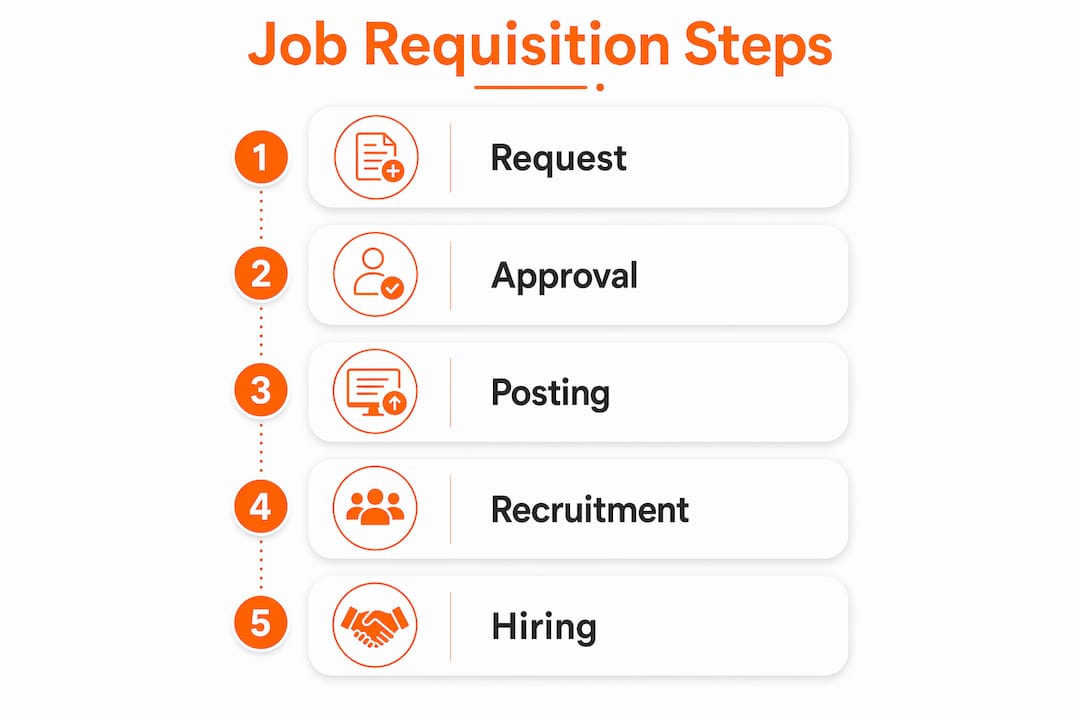
The job requisition process follows a defined sequence from identification of a hiring need through final approval. Understanding each step reduces delays and improves the quality of the hire.
-
Identify the hiring need. The hiring manager recognizes a gap, whether from attrition, growth, or a new business initiative. This is the trigger for the entire process.
-
Build the business case. The hiring manager assembles the justification, role scope, required skills, and compensation data. This step determines how quickly the requisition moves through approvals.
-
Complete the requisition form. All required fields are filled in the HRIS or ATS. Incomplete forms are the single most common cause of approval delays. Complete structured forms can shorten approval time from weeks to hours.
-
Route for approvals. The requisition moves through HR, Finance (FP&A), and senior leadership. Mapping the approval chain early and involving Finance, HR Business Partners, and leadership before submission prevents bottlenecks.
-
Receive final authorization. Once all approvers sign off, the role is officially open. The recruiter receives the approved requisition and begins sourcing.
-
Open the role in the ATS. The approved requisition triggers the creation of the job posting and activates the recruiting workflow in tools like Greenhouse, Lever, or Workday Recruiting.
Pro Tip: For unbudgeted positions, a completed requisition form alone is rarely sufficient. Unbudgeted roles typically require a supplemental business case deck that quantifies the revenue impact, risk, or operational cost of leaving the position unfilled. Prepare this before submitting the form.
Typical approval timelines range from 24 hours for pre-budgeted backfill roles to several weeks for new headcount requiring executive sign-off. The difference almost always comes down to the quality and completeness of the original submission. Automation tools within platforms like Workday and SAP SuccessFactors can route approvals and send reminders, reducing manual follow-up.
Best practices for creating effective job requisitions
Effective requisitions share common characteristics. They are specific, current, and grounded in business reality rather than idealized candidate profiles.
-
Focus on skills needed within 6–12 months. Scoping requisitions to near-term skill needs improves compensation alignment and candidate evaluation. Avoid building a profile around a past employee or an idealized version of the role.
-
Use standardized role levels and titles. Consistent titling across the organization prevents compensation inequity and simplifies ATS management. "Senior Software Engineer II" is more useful than "Rockstar Developer."
-
Anchor compensation to current market data. Pull benchmarks from sources like Radford, Mercer, or Levels.fyi before setting the compensation band. Stale data creates offer failures at the finance review stage.
-
Write a business justification that quantifies impact. State the revenue, cost, or operational risk tied to the unfilled role. A justification that says "we need more headcount" will not move through finance as quickly as one that says "this role supports a $2M contract renewal in Q3."
-
Involve stakeholders before submission. Share a draft with HR Business Partners and Finance before formally submitting. Early feedback prevents re-submissions and builds cross-functional support for the hire.
-
Use automation where available. Platforms like Workday, BambooHR, and Rippling offer requisition templates with pre-populated fields. Using these templates reduces errors and speeds up the approval workflow. You can also explore recruitment automation case studies to see how technology organizations have reduced requisition cycle times.
-
Review and update templates regularly. Role requirements shift with market conditions. A requisition template built in 2022 may not reflect the skills or compensation expectations of 2026.
Key takeaways
A job requisition is the internal authorization document that must be approved before any external recruiting activity begins, and its quality directly determines how fast and effectively a role gets filled.
| Point | Details |
|---|---|
| Requisition precedes all recruiting | No job posting, recruiter assignment, or candidate search begins without an approved requisition. |
| Business justification drives approvals | A clear, quantified justification explaining the cost of an unfilled role accelerates finance and leadership sign-off. |
| Structured forms reduce delays | Dropdown fields tied to HRIS data move requisitions through approval faster than free-text entries. |
| Requisition differs from job posting | The requisition is internal and approval-focused; the job posting is external and candidate-facing. |
| Unbudgeted roles need extra documentation | A supplemental business case deck is required for positions not already in the approved headcount plan. |
Why requisitions are the most underused strategic tool in hiring
Most hiring managers treat the job requisition as a form to fill out before the "real work" starts. That framing is wrong. The requisition is where the real work happens.
In my experience working across IT and cybersecurity hiring, the quality of a requisition predicts the quality of the hire more reliably than any other single factor. When the business justification is vague, recruiters source the wrong candidates. When the compensation band is outdated, offers collapse at the finish line. When the approval chain is not mapped in advance, roles sit open for months while stakeholders debate scope.
The organizations that hire well treat the requisition as a strategic document. They involve Finance and HR Business Partners before the form is submitted, not after. They write justifications that speak to business outcomes, not just team capacity. They update their role templates quarterly to reflect current market conditions.
Technology is making this easier. Platforms that integrate HRIS data with requisition workflows, like those discussed in HR and recruitment automation resources, are reducing the manual burden while improving data quality. But the strategic thinking still has to come from the hiring manager and HR partner who own the role.
The uncomfortable truth is that most requisition problems are communication problems. The form is just where that communication either happens or fails.
— Diego
How Plucktalent supports smarter hiring from requisition to placement
Plucktalent connects IT and cybersecurity hiring managers with pre-vetted, ATS-ready candidates who match the exact skill profiles defined in approved requisitions. The platform draws on 17 years of deep industry recruiting expertise to align candidate sourcing directly with the role scope and compensation parameters set during the requisition process.
When a requisition is approved and a role opens, Plucktalent's Plucky AI co-pilot identifies candidates whose profiles match the requisition's required skills, seniority level, and compensation band. This eliminates the gap between what the requisition specifies and what the recruiter actually sources. HR teams and hiring managers can explore Plucktalent's recruitment services to see how the platform fits into their existing requisition and approval workflows.
FAQ
What is the main purpose of a job requisition?
A job requisition formally authorizes a new hire by securing approval for headcount, budget, and business justification before recruiting begins. It aligns HR, Finance, and leadership on the role before any external activity starts.
How does a job requisition differ from a job posting?
A job requisition is an internal document used to approve and budget a role. A job posting is the external, candidate-facing advertisement published after the requisition is approved.
What happens if a job requisition is incomplete?
Incomplete requisitions are returned for re-submission, which can add days or weeks to the approval timeline. Complete, structured forms with all required fields move through approval significantly faster.
Do unbudgeted roles require a different requisition process?
Yes. Unbudgeted positions typically require a supplemental business case deck in addition to the standard requisition form to secure leadership and finance approval.
How long does the job requisition approval process take?
Approval timelines range from 24 hours for pre-budgeted backfill roles to several weeks for new headcount requiring executive sign-off. The completeness and quality of the requisition is the primary factor determining speed.