
A targeted job search is defined as a focused method of job seeking where candidates concentrate on specific roles, companies, and industries that align directly with their skills and career goals. This approach contrasts sharply with mass applications, where job seekers send generic resumes to dozens of unrelated postings. A strategic job search plan replaces randomness with clear goals, tracked actions, and consistent follow-through. The result is a measurable increase in interview conversion rates and a shorter time to hire. Plucktalent is built around this exact principle, connecting IT and cybersecurity professionals directly with hiring managers at companies actively seeking their skills.
What is a targeted job search and why does it outperform broad applications?
A targeted job search is the practice of identifying a defined set of roles and employers, then directing all application energy toward that list. Generic applications convert at less than 1% to interview. That number tells you everything about why volume-based searching fails most job seekers.

Targeted approaches, by contrast, produce interview conversion rates of 30–50%. The difference is not luck. It is the result of tailored resumes, direct network outreach, and applications that mirror the exact language of a job description.
Recruiters spend an average of seconds on an initial resume scan. A resume that reflects the specific terminology of the role clears that filter. A generic resume does not. Successful candidates aim to rank in the top 1% of applicants through internal referrals and language mirroring, not just the top 10%.
"Treating job search as an execution system connecting clear targets, proof, access, and learning improves results far more than treating it as a numbers game."
Referrals accelerate this further. An internal referral moves a candidate past the applicant tracking system and directly into a hiring manager's view. That single advantage explains why networking is not optional in a focused job search. It is the mechanism that makes targeting work.
Key targeted job search strategies to focus your efforts
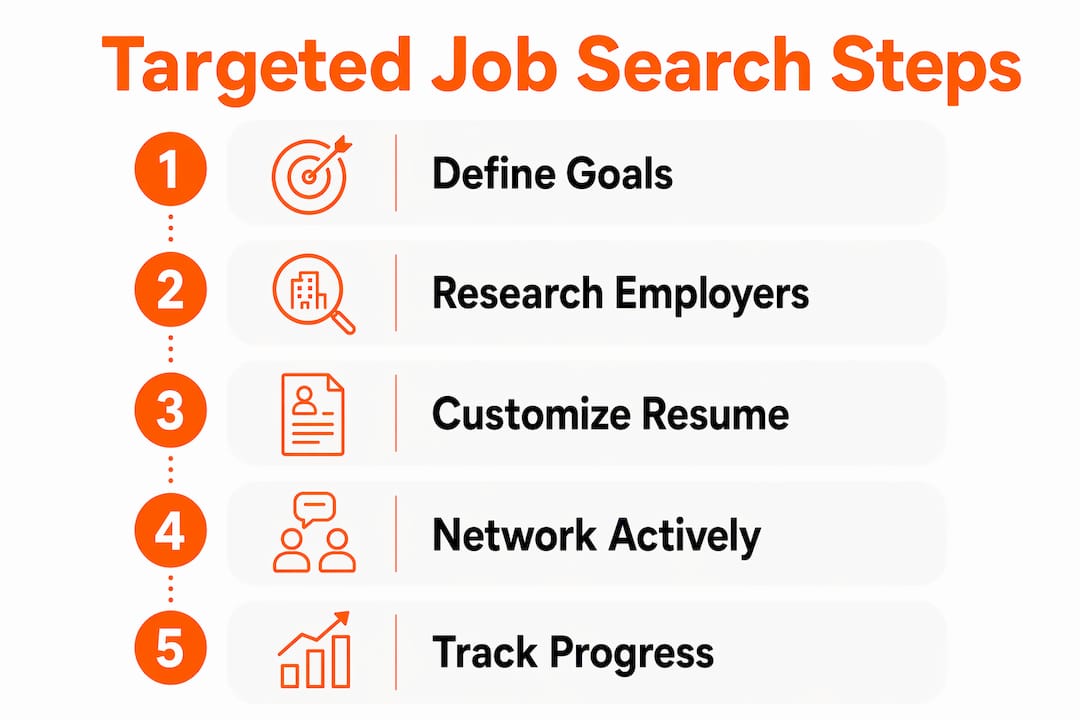
The most effective targeted job search strategies share one trait: they reduce scatter and increase relevance at every step. The following steps form a research-backed framework for job seekers ready to move from reactive to deliberate.
-
Define 1–3 specific job titles. Narrowing focus to 1–3 job titles improves resume tailoring, skill gap identification, and networking outreach. Broad targets produce broad, unfocused applications. Specific titles produce specific, credible ones.
-
Build a company target list of 30–50 employers. Research each company before applying. Review their recent news, hiring trends, and technology stack. This research feeds directly into tailored cover letters and interview preparation.
-
Prioritize direct company engagement over job boards. Job boards often lag behind real hiring activity. Building a list of target companies and reaching out proactively uncovers roles before they are publicly posted.
-
Maintain a base resume, then tailor efficiently. A base resume that is 80% aligned with target roles requires only 15–20 extra minutes of tailoring per application. This keeps the process sustainable without sacrificing quality.
-
Activate your network with structured outreach. Send 2–3 targeted messages per day to former colleagues, alumni, or industry contacts at your target companies. Follow up once after one week if there is no response.
-
Focus your resume on measurable outcomes. Skill-based hiring is the dominant approach among employers, with evidence-based resumes improving callbacks significantly. Replace generic adjectives with specific results: numbers, percentages, and project outcomes.
-
Track every application and its outcome. A structured job search tracker that monitors application volume and conversion rates at each stage helps identify where the process is breaking down. If applications go out but no interviews come back, the resume or targeting is the issue. If interviews happen but no offers follow, the problem is interview positioning.
Pro Tip: Do not rewrite your resume from scratch for every application. Update only the summary, the top three bullet points, and the skills section to match the job description. That is all a recruiter needs to see.
How to structure your daily job search routine
A consistent daily routine is what separates job seekers who land roles in 30–60 days from those who search for six months without results. A sustainable targeted routine runs about 3 hours per day and covers three distinct activities.
- Applications (60–90 minutes): Submit 2–4 tailored applications per day. Quality matters more than volume. Each application should reference the company by name and reflect the job description's language.
- Research (30 minutes): Spend time each day reviewing your target company list. Look for news, leadership changes, or new product launches that give you a reason to reach out directly.
- Networking (30–45 minutes): Send 2–3 outreach messages to contacts at target companies. Reconnect with former colleagues. Request informational interviews with people in roles you are targeting.
- Follow-up (15 minutes): Review your tracker and send follow-up messages to applications or conversations that are 7–10 days old without a response.
Burnout is a real risk in a long job search. Capping daily effort at 3 hours and treating the search like a work project, with defined start and end times, keeps momentum steady over weeks.
Pro Tip: Review your tracker every Friday. If your application-to-interview rate is below 10%, adjust your resume or targeting before the next week begins. Data tells you where to fix the process.
Common pitfalls in targeted job searches and how to avoid them
Even job seekers who understand the targeted approach make predictable mistakes. Recognizing them early saves weeks of wasted effort.
- Setting targets that are too broad. Listing 10 different job titles defeats the purpose of targeting. Pick 1–3 titles and commit to them for at least 30 days before reassessing.
- Rewriting the resume entirely for each application. This is time-consuming and unnecessary. The base resume plus focused tailoring is the correct method.
- Relying on job boards as the primary channel. Job boards are a lagging indicator of real hiring activity. Direct company engagement and network activation uncover more and better opportunities.
- Skipping conversion tracking. Job seekers who do not track their metrics cannot diagnose problems. Without data, a low interview rate looks like bad luck rather than a fixable targeting or resume issue.
- Ignoring referrals. A referral from an internal employee is the single highest-conversion path into a company. Failing to ask for introductions is the most common and most costly mistake in a focused job search.
- Abandoning the process too early. A targeted search takes 4–8 weeks to produce consistent interview activity. Job seekers who switch strategies after two weeks reset the clock every time.
The fix for most of these pitfalls is the same: treat the job search as a system with inputs, outputs, and feedback loops. Adjust based on data, not frustration.
Key Takeaways
A targeted job search produces interview conversion rates of 30–50%, compared to less than 1% for generic applications, because it combines specific targeting, tailored materials, and active networking into a single coordinated system.
| Point | Details |
|---|---|
| Define narrow job targets | Focus on 1–3 specific job titles to sharpen every application and outreach message. |
| Build a company list | Identify 30–50 target employers and research each one before applying. |
| Use a base resume | Keep a resume that is 80% aligned with target roles and tailor only key sections per application. |
| Run a daily routine | Spend 3 hours per day on applications, research, networking, and follow-up. |
| Track conversion metrics | Monitor application-to-interview rates weekly and adjust targeting or resume when results stall. |
Why intentionality beats volume every time
The conventional advice is to apply to as many jobs as possible. That advice is wrong, and the data confirms it. A conversion rate below 1% for generic applications is not a market problem. It is a method problem.
What I have observed, working across IT and cybersecurity hiring, is that most job seekers treat the search as a passive activity. They post a resume, apply to listings, and wait. The candidates who move fastest are the ones who treat the search as active work. They research companies. They reach out before a role is posted. They ask for introductions rather than waiting to be discovered.
The other thing most articles miss is the compounding effect of a tracker. When you record every application, every response, and every interview, patterns emerge within two weeks. You can see exactly which job titles get responses and which do not. You can see whether your resume is clearing the first filter or stalling there. That data removes guesswork and replaces it with a clear next action.
Discipline in the daily routine matters more than any single tactic. Three focused hours per day, every weekday, for six weeks will outperform six months of scattered effort. The job seekers who internalize this shift their results faster than they expect.
— Diego
Plucktalent and the targeted job search
Plucktalent is built for IT and cybersecurity professionals who are ready to apply the targeted approach with expert support behind them.
The platform combines 17 years of recruiting expertise with Plucky AI, a dedicated job search co-pilot that connects candidates directly with hiring managers at companies actively hiring for their specific skills. Plucktalent handles ATS-ready profile optimization, skill gap analysis, and direct employer connections, so job seekers spend less time on applications that go nowhere. The job seekers page outlines exactly how the platform supports a focused, efficient search from day one. For a full view of available career services, the services page covers every stage of the process.
FAQ
What is a targeted job search?
A targeted job search is a focused method where job seekers apply only to specific roles and companies that match their skills and goals. It replaces mass applications with tailored, research-backed outreach to a defined list of employers.
How do targeted job searches improve interview rates?
Targeted approaches produce interview conversion rates of 30–50%, compared to less than 1% for generic applications. The improvement comes from tailored resumes, internal referrals, and direct company engagement.
How many companies should be on a target list?
A target list of 30–50 companies gives enough volume to sustain daily outreach without spreading effort too thin. Pair the list with 1–3 specific job titles for the best results.
How long does a targeted job search take?
Most job seekers see consistent interview activity within 4–8 weeks of running a disciplined daily routine. Switching strategies before that window closes resets progress.
What is the biggest mistake in a focused job search?
Relying on job boards as the primary channel is the most common error. Direct company engagement and network activation consistently uncover more opportunities than public postings.