
Job search personalization is the practice of tailoring your resume, cover letter, and outreach to match the specific requirements, culture, and priorities of each employer you target. For tech professionals, this is not a nice-to-have. 61% of candidates submit generic resumes, which directly lowers their interview success rates. The gap between a generic application and a tailored one is measurable. Platforms like LinkedIn and tools built around AI-driven resume tailoring have made personalized job search more accessible, but the strategy behind it still determines the outcome.
What is job search personalization in practice?
Job search personalization means aligning every part of your application to a specific role and company, not just swapping out a job title. It covers three core areas: your resume, your cover letter, and your pre-application research.
Resume tailoring starts with the job description. Pull the exact keywords the employer uses for required skills, tools, and responsibilities. If the posting says "Kubernetes orchestration" and your resume says "container management," you are not matching. ATS systems at companies like Google, Microsoft, and mid-size SaaS firms filter on exact or near-exact terms. Rewrite your bullet points to reflect the language of the role, and quantify every achievement you can.

Cover letter customization goes one level deeper. A generic opener like "I am excited to apply for this position" signals nothing. Instead, reference something specific: a product launch, a recent engineering blog post, or a known technical challenge the company is working through. True personalization requires demonstrating understanding of specific company challenges and culture, not just filling a template with the company name.
Company research is the foundation. Read the engineering blog. Check recent press releases. Look at the company's GitHub repositories if they are public. Review the hiring manager's LinkedIn activity. This research feeds directly into both your resume framing and your cover letter specifics.
Pro Tip: Apply the Specificity Test before submitting any application. Ask yourself: could this cover letter or resume summary be sent to any other company? If yes, it is not personalized. Reference something uniquely relevant to that employer, not just the industry.
The fastest way to improve applications is referencing something uniquely relevant to the company, not just the industry. That single shift separates candidates who get callbacks from those who do not.
How can tech job seekers use AI to scale personalization?
AI tools make it possible to personalize at volume without sacrificing quality. The key is using them correctly. Tools like ChatGPT, Claude, and specialized platforms built for AI-driven resume tailoring can cut personalization time dramatically when paired with a structured workflow.
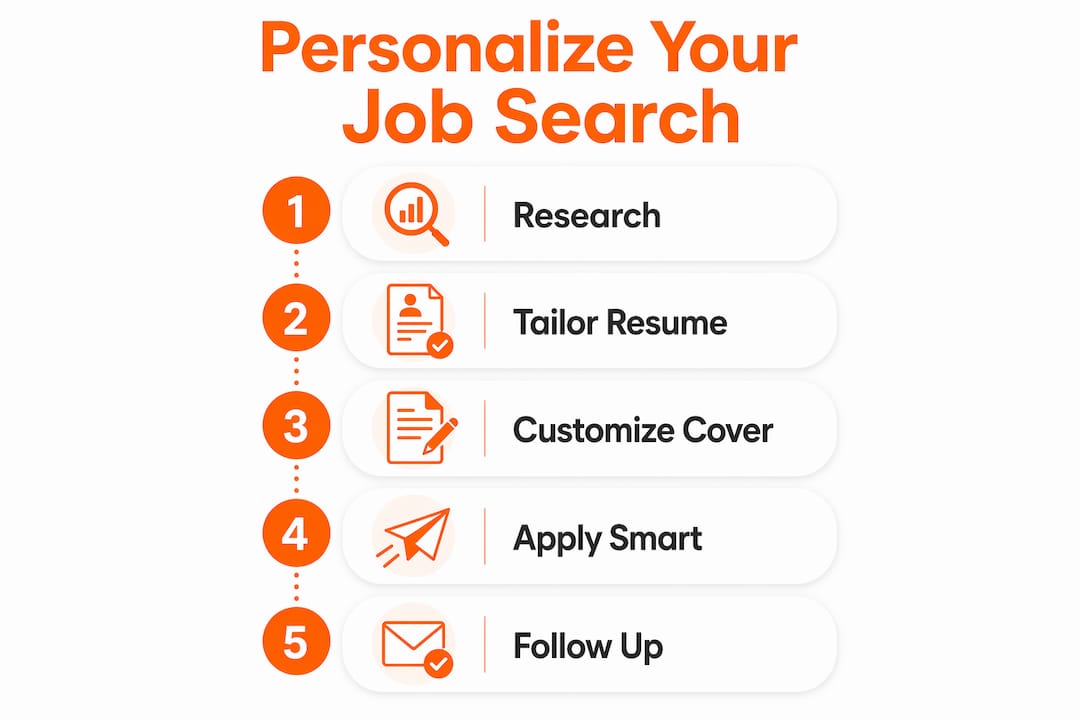
Prompt engineering workflows reduce personalization time to 2–3 minutes per application while raising ATS match rates. That is a significant shift from the 10-plus hours per week job seekers typically spend on manual application tasks.
The most effective approach uses chained prompts. Here is a practical four-step workflow:
- Extract job priorities. Paste the job description into your AI tool and prompt it to list the top five technical requirements and the top three soft skills the employer is emphasizing.
- Align your achievements. Feed your master resume into the same session and prompt the tool to match your strongest accomplishments to those priorities, using the employer's exact language.
- Generate a tailored summary. Ask the tool to write a three-sentence resume summary that positions you specifically for this role, referencing the company by name and one of its known technical focuses.
- Run an ATS check. Use a final prompt to compare your revised resume against the job description and flag any missing keywords or formatting issues.
Chained prompt engineering combines these multi-step prompts to extract job details, align accomplishments, and check ATS readiness at scale. The result is a resume that reads as genuinely tailored, not AI-generated filler.
The non-negotiable rule: AI tools should mirror your authentic skills, not fabricate them. Every output needs a human review pass. If the AI attributes a skill you do not have, remove it. Your credibility in the interview depends on what is on the page.
Pro Tip: Keep a version-controlled folder for each application. Save the job description, your tailored resume, and the cover letter as separate files. This makes follow-up conversations and interview prep significantly faster.
Generic vs. personalized applications: what the data shows
The performance gap between generic and tailored applications is not marginal. Measurable achievements and specificity in cover letters boost interview rates by 3.4x. That figure reflects what recruiters at companies like Amazon, Salesforce, and mid-market tech firms consistently report: specificity signals genuine interest and preparation.
Recruiters value four things above all else when advancing candidates: measurable achievements, tailored resumes, matching job titles, and personalized cover letters. Generic applications fail on at least three of those four criteria by default.
Highly specific references to company products, news, or challenges in applications increase interview rates by over 3x. This is not about flattery. It is about demonstrating that you understand what the company actually needs.
The table below summarizes the measurable difference between the two approaches:
| Factor | Generic Application | Personalized Application |
|---|---|---|
| ATS keyword match rate | Low, often filtered out | High, aligned to job description |
| Recruiter response rate | Below average | Up to 3.4x higher |
| Cover letter relevance | Template language | Company-specific references |
| Interview conversion | Reduced by missing context | Increased by demonstrated fit |
| Time to prepare | 5–10 minutes | 15–20 minutes with modular approach |
The 15–20 minute investment for a personalized application is the correct frame. It is not a burden. It is the cost of being competitive in a market where most candidates are not doing it.
Practical steps to personalize your tech job search
The most practical system for tech job seekers is the modular resume approach. Build one strong master resume that contains every relevant achievement, skill, and project. Then maintain a set of tailored sections you can swap in for specific roles.
A modular resume approach cuts tailored application time to 15–20 minutes while preserving quality and relevance. The master resume does the heavy lifting. The tailored version just needs the right bullets and summary for each application.
Key practices for effective personalization:
- Match your resume title to the job title. If the posting says "Senior DevOps Engineer," your resume header should say the same. ATS systems and recruiters both scan for this alignment first.
- Use the company's engineering blog as a research source. Companies like Stripe, Cloudflare, and Shopify publish detailed technical content. Referencing a specific architectural decision or product challenge in your cover letter shows genuine engagement.
- Apply directly on company portals. Applying via portals like Greenhouse or Lever preserves formatting and ATS compatibility far better than aggregator "Easy Apply" functions. Aggregators reformat resumes and compromise ATS readability.
- Avoid the "Easy Apply" trap. Major job aggregators' one-click apply functions often strip formatting and remove the personalization signals you worked to include.
- Quantify every bullet point you can. "Reduced deployment time by 40%" outperforms "improved deployment process" in both ATS scoring and recruiter attention.
Research sources worth bookmarking: company engineering blogs, Crunchbase for funding and growth context, LinkedIn for hiring manager activity, and GitHub for open-source contribution patterns. These sources give you the specific details that make applications stand out.
For tech professionals exploring AI tools, the combination of a strong master resume and a structured prompt workflow covers most of the personalization work efficiently.
Key takeaways
Personalized job search outperforms generic applications on every measurable metric, from ATS match rates to interview conversion, and the modular resume approach makes it achievable in under 20 minutes per application.
| Point | Details |
|---|---|
| Personalization definition | Tailoring resumes, cover letters, and research to each specific employer and role. |
| Generic application cost | 61% of candidates submit generic resumes, directly reducing their interview success rates. |
| AI efficiency gain | Prompt engineering workflows reduce personalization time to 2–3 minutes per application. |
| Specificity multiplier | Highly specific company references increase interview rates by over 3x compared to generic applications. |
| Modular resume system | A master resume with swappable tailored sections cuts application time to 15–20 minutes per role. |
What i have learned watching tech candidates personalize badly
The most common mistake I see is what I call surface personalization. A candidate changes the company name in the cover letter, swaps one bullet point, and calls it tailored. Recruiters at companies like Atlassian or Palo Alto Networks read hundreds of applications. They recognize the template immediately.
The second mistake is over-relying on AI output without editing it. AI tools produce plausible language, but they do not know your actual career story. I have reviewed AI-generated resumes that listed skills the candidate could not defend in a technical screen. That is a fast path to a rejection after the first interview.
What actually works is treating each application as a short research project. Spend ten minutes on the company before you touch the resume. Read one engineering post, check one recent news item, look at one job description from a similar role they posted six months ago. That context shapes every word you write. The AI then becomes a drafting tool, not a decision-maker.
The candidates who move fastest through pipelines are not the ones applying to the most roles. They are the ones applying to fewer roles with higher-quality, genuinely tailored materials. Volume is not the strategy. Precision is.
— Diego
How Plucktalent supports personalized job search for tech professionals
Plucktalent combines 17 years of IT and cybersecurity recruiting expertise with Plucky AI, a dedicated job search co-pilot built for tech professionals. The platform connects candidates directly with hiring managers at companies actively hiring for their specific skills, bypassing the generic job board process entirely.
For tech job seekers who want to stop sending applications into a black hole, Plucktalent provides ATS-ready, tailored profiles and direct access to relevant opportunities. The platform's AI-driven approach handles the personalization infrastructure so candidates can focus on the roles that actually match their background. Explore how Plucktalent supports tech job seekers or review the full range of career services available for IT and cybersecurity professionals.
FAQ
What is job search personalization?
Job search personalization is the process of tailoring your resume, cover letter, and outreach to match the specific requirements and culture of each employer you target. It goes beyond template edits to include company-specific research and language alignment.
How long does it take to personalize a job application?
A modular resume approach reduces tailored application time to 15–20 minutes per role. AI prompt engineering workflows can further cut this to 2–3 minutes for the drafting phase, with additional time for human review.
Does personalization actually improve interview rates?
Measurable achievements and company-specific references in cover letters boost interview rates by 3.4x compared to generic applications. Recruiters consistently rank tailored resumes and personalized cover letters among the top factors in advancing candidates.
What is the difference between automation and personalization?
Automation is the mechanism used to generate tailored content at scale. Personalization is the outcome, requiring deliberate configuration, real company research, and human editing to produce applications that reflect genuine fit.
Should tech job seekers use "easy apply" on job aggregators?
Applying directly on company portals like Greenhouse or Lever is the better approach. Aggregator "Easy Apply" functions often reformat resumes, which compromises ATS compatibility and removes the personalization signals you built into your application.