
Candidate ghosting is defined as the practice of a job seeker cutting off all communication with an employer without notice during the hiring process. One in four job seekers have ghosted a potential employer, and understanding why it candidates ghost employers is now a core concern for IT hiring teams. The data from LiveCareer points to competing offers, slow processes, and poor communication as the top drivers. In a market where top IT talent moves fast, a hiring process that stalls or frustrates candidates does not just lose them. It loses them silently.
Why do IT candidates ghost employers?
Candidate ghosting in IT hiring follows a clear pattern. The top reason, cited by 51% of job seekers, is accepting a competing offer before the original employer makes a decision. This is not a character flaw. It is a market timing problem.
The other common ghosting reasons in tech include:
- Losing interest in the role (32%): Candidates often discover the position does not match what was advertised. Generic or misleading job descriptions are a primary cause.
- Poor communication (23%): When recruiters go silent after an interview, candidates interpret that silence as disinterest and move on.
- Non-competitive pay (23%): Salary transparency issues cause candidates to ghost silently rather than negotiate, especially when an offer lands far below expectations.
- Role mismatch: Job descriptions that promise one thing and deliver another during the interview process push candidates to disengage without explanation.
- Bait-and-switch job postings: When the actual role differs significantly from the posting, candidates feel misled and stop responding.
Each of these reasons reflects a process failure, not a candidate failure. IT professionals in particular have options. When a process feels disorganized or disrespectful of their time, they prioritize the employer that communicates clearly and moves quickly.
Pro Tip: Disclose the salary range in the first outreach message. Candidates who know the compensation upfront are far less likely to disengage later over pay misalignment.

How does the 2026 tech market drive ghosting behavior?
The 2026 IT hiring market creates conditions that make ghosting more likely, not less. Senior IT professionals routinely juggle 3–5 active hiring processes simultaneously. They rank each process by speed, clarity, and perceived respect. A slow or impersonal process gets deprioritized fast.
AI-driven screening has added a new layer to this problem. 38% of qualified professionals skip AI-only interviews entirely. That figure reflects a direct rejection of impersonal hiring mechanics. When 51% of candidates who completed an AI interview received no follow-up, the message candidates received was clear: the employer does not value their time.
The table below shows how traditional and AI-driven hiring approaches compare in their impact on candidate engagement.
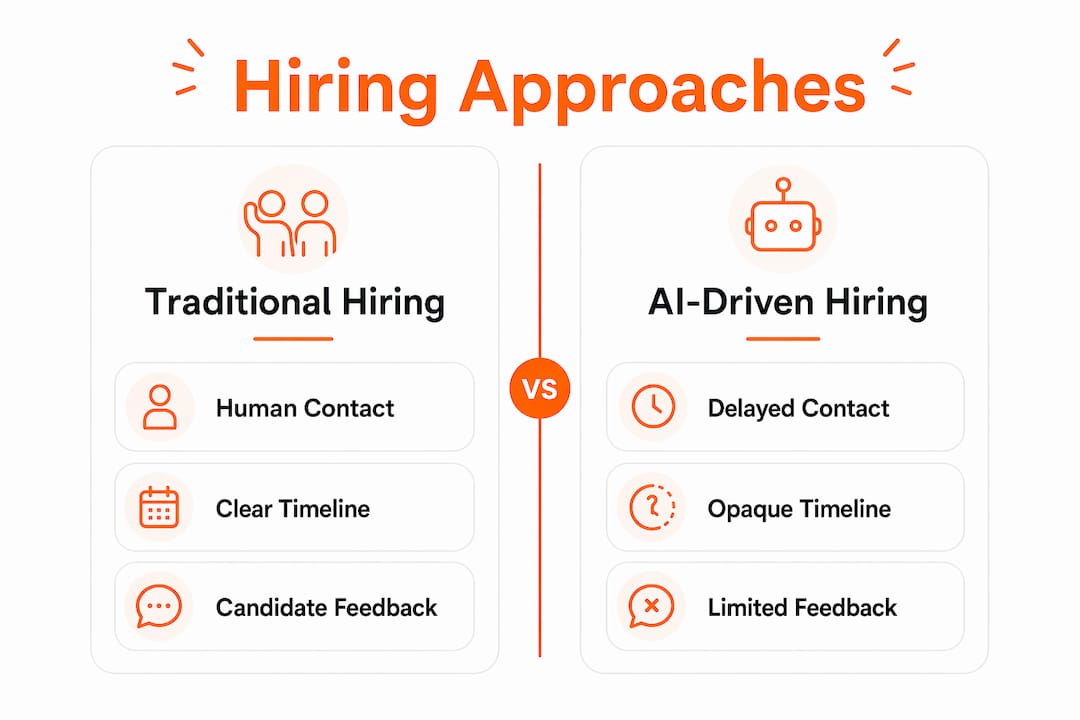
| Factor | Traditional Hiring | AI-Driven Hiring |
|---|---|---|
| Human contact | Early and consistent | Delayed or absent |
| Candidate feedback | Provided after interviews | Often automated or missing |
| Screening experience | Personal and two-way | One-sided and impersonal |
| Ghosting risk | Moderate | Significantly higher |
| Candidate trust | Builds over time | Erodes without human touch |
Interview fatigue compounds the problem. When IT candidates face four or five rounds with no clear timeline or feedback, they mentally check out. 21% withdraw after three or more interview stages. The process itself becomes the reason candidates disappear.
Pro Tip: If your process includes an AI screening step, follow it with a human touchpoint within 48 hours. That single change reduces walkout rates significantly.
What process and communication failures push candidates to disengage?
Specific process failures drive IT candidates avoiding interviews and going silent. The median time-to-hire is 68.5 days, but top IT talent stays on the market for only 10–15 days. That gap alone explains a large share of ghosting in job applications.
The most common process failures include:
- Scheduling delays over one week: Candidates who wait more than seven days for an interview slot often accept another offer in the meantime.
- Redundant interview rounds: When panelists ask the same questions without reading prior notes, candidates perceive disrespect from the process and disengage.
- Automated rejection emails: A form rejection after multiple interview rounds signals that the employer does not value the candidate's investment of time.
- No feedback after interviews: 47% of candidates withdraw due to poor communication. Silence after an interview is interpreted as rejection, even when it is not.
- Impersonal outreach: Mass-templated messages with no personalization tell candidates they are one of hundreds. That perception lowers motivation to stay engaged.
Candidates often disengage silently after a single bad interaction. They are managing multiple processes and prioritize based on emotional resonance, not just salary. A recruiter who communicates clearly and treats the candidate as a person holds attention far longer than one who runs a technically correct but cold process.
Ghosting also carries a reciprocal dynamic. Candidates treat ghosting as a response when employers have previously ghosted them or shown poor engagement. The behavior mirrors what they have experienced.
How can employers reduce IT candidate ghosting?
Reducing candidate ghosting requires changes to process, not just communication style. The following five steps address the most common ghosting triggers in IT hiring.
-
Shorten the hiring timeline. Top IT talent is off the market in 10–15 days. A process that runs longer than three weeks loses candidates to faster-moving employers. Compress interview stages and set internal decision deadlines before the process starts.
-
Post salary ranges upfront. Transparency on compensation early in the process prevents silent dropout caused by unmet pay expectations. Candidates who know the range before the first call are less likely to disappear after an offer.
-
Replace generic job descriptions. Generic job postings actively reduce candidate motivation. Write descriptions that reflect the actual day-to-day work, the team structure, and the specific technical stack. Specificity signals that the role is real and the employer knows what they need.
-
Add human touchpoints after automated steps. AI screening tools like those used in automated recruitment processes work best when paired with a human follow-up. A brief personalized message after an automated screen keeps candidates engaged and signals that a real person is involved.
-
Coordinate interview panels. Redundant and uncoordinated interview rounds are perceived as disrespectful by top candidates. Share notes between interviewers, set a clear agenda, and limit rounds to what is genuinely necessary. Candidates who feel their time is respected stay in the process.
Understanding recruiter language and AI-driven hiring signals also helps employers craft outreach that resonates with IT professionals rather than triggering their disengagement instincts.
Key takeaways
IT candidates ghost employers primarily because the hiring process fails to match the speed, transparency, and respect that the IT job market demands.
| Point | Details |
|---|---|
| Competing offers drive most ghosting | 51% of candidates ghost after accepting another offer, so speed is the primary defense. |
| Slow timelines create the gap | Top IT talent leaves the market in 10–15 days; a 68.5-day median hire time guarantees losses. |
| AI-only interviews increase dropout | 38% of qualified candidates skip AI-only screens; always pair automation with human follow-up. |
| Poor communication is a top trigger | 47% of candidates withdraw due to poor communication; timely, personal outreach reduces this. |
| Salary transparency prevents silent exits | Disclosing pay ranges early removes the most common reason candidates disengage without notice. |
The part of ghosting that hiring data does not capture
I have spent years watching IT hiring teams treat candidate ghosting as a mystery. It is not. The data is clear, and the patterns are consistent. What the data does not fully capture is the emotional logic behind the behavior.
IT professionals in 2026 are not passive job seekers. They are evaluating employers the same way employers evaluate them. Every slow response, every redundant interview round, every automated message that reads like it was sent to a thousand people is a data point. Candidates collect those data points and make decisions based on them.
The reciprocal nature of ghosting is the part most hiring teams miss. When a candidate goes silent, the instinct is to blame the candidate. The more useful question is: what did the process communicate to them before they went silent? In most cases, the answer is that the process communicated indifference.
The fix is not complicated. Faster decisions, real salary numbers, and a recruiter who actually reads the candidate's background before the first call. Those three things alone would eliminate the majority of ghosting cases I have seen. The teams that treat candidates as professionals worth respecting do not have ghosting problems. The teams that run candidates through a factory process do.
— Diego
How Plucktalent helps IT employers engage candidates
Plucktalent connects IT and cybersecurity employers directly with qualified candidates who are actively in the market. The platform combines 17 years of IT recruiting expertise with Plucky AI to match candidates to roles based on specific skills, not keyword overlap.
Employers using Plucktalent reach candidates who are already vetted, engaged, and moving through the pipeline with purpose. The platform's approach addresses the core ghosting triggers: slow processes, poor fit, and impersonal outreach. Candidates arrive with optimized, ATS-ready profiles and a clear understanding of the role. Explore the IT recruitment services Plucktalent offers, or visit the job seekers page to see how the platform supports both sides of the IT hiring process.
FAQ
What is the number one reason IT candidates ghost?
Accepting a competing offer is the top reason, cited by 51% of candidates who ghost. Fast-moving IT hiring teams reduce this risk by compressing their timelines and communicating decisions quickly.
How long before a candidate is considered ghosted?
Most recruiting professionals consider a candidate ghosted after 48–72 hours of no response following a scheduled touchpoint. In IT hiring, that window is shorter because candidates are managing multiple active processes.
Does poor communication cause candidate ghosting?
Yes. 47% of candidates withdraw due to poor communication during the hiring process. Silence after an interview is one of the most common triggers for IT candidates avoiding interviews and going dark.
Why do candidates disappear after AI interviews?
38% of qualified professionals skip AI-only interviews entirely, and 51% who complete them receive no follow-up. Candidates interpret the lack of human contact as a signal that the employer is not genuinely interested.
Can better job descriptions reduce ghosting?
Yes. Generic job postings reduce candidate motivation and increase dropout rates. Specific descriptions that reflect the actual role, team, and technical requirements attract candidates who are genuinely interested and less likely to disengage.