
IT recruiter expertise is defined as the specialized combination of technical literacy, market knowledge, and human judgment that enables a recruiter to identify, evaluate, and place technology professionals with accuracy that generalist or automated approaches cannot match. Why IT recruiter expertise matters becomes clear when you look at the numbers: organizations that partner with expert recruiters achieve 40–50% improvements in quality of hire, retention, and time-to-productivity compared to transactional or AI-only hiring. That gap is not a rounding error. It reflects the difference between a recruiter who understands what a senior DevSecOps engineer actually does and one who matches keywords on a resume. For IT professionals and job seekers, understanding this distinction changes how you evaluate the recruiters who represent you.
Why IT recruiter expertise matters for hiring outcomes
Expert IT recruiters produce measurable results, and the data is direct. Organizations working with specialized recruiters report 40–50% gains across three core metrics: quality of hire, retention rates, and time-to-productivity. Each of those metrics has a dollar value attached. A bad hire in a senior engineering role can cost a company well over a year's salary when you account for lost productivity, re-hiring costs, and team disruption.
Speed is the second major advantage. Specialized IT recruitment firms complete many placements within 2–3 weeks by drawing on pre-vetted talent pipelines built over years. That timeline is not achievable through cold job board postings. It requires a recruiter who already knows which candidates are open to new roles, which ones are a flight risk at their current employer, and which ones have the exact certification stack a client needs.

The risk reduction benefit is equally significant. Expert recruiters conduct thorough technical screening before a candidate ever reaches a hiring manager. They evaluate cultural fit, communication style, and long-term career alignment. That process filters out candidates who look strong on paper but would struggle in a specific team environment.
Key benefits of working with an expert IT recruiter include:
- Faster placements through access to pre-screened talent pools built over years of relationship management
- Higher retention rates because recruiters match candidates on culture and career trajectory, not just technical skills
- Reduced hiring risk through structured technical screening and reference validation before the interview stage
- Salary accuracy because experienced recruiters know current market rates by role, location, and seniority level
Pro Tip: Ask any recruiter you work with how many placements they have made in your specific technical domain in the past 12 months. That number tells you more than any credential on their website.
Can AI replace a specialized IT recruiter?
AI cannot replace a specialized IT recruiter. That is not an opinion. It is a structural limitation of how current AI tools function in hiring contexts. Sourcing, which once consumed roughly 60% of a recruiter's day, is now largely automated. That shift has freed expert recruiters to focus on the work AI genuinely cannot do: navigating counter-offers, setting accurate salary expectations, and building the kind of trust that moves a passive candidate from "not looking" to "let's talk."
"Recruitment expertise is defined by judgment gained through cumulative experience and pattern recognition. That judgment is not replicable by AI because it requires contextual understanding built from years of real hiring successes and failures. An algorithm can match keywords. It cannot tell you why a candidate left their last role, whether they will thrive under a specific CTO's leadership style, or how to handle a competing offer at the final stage."
AI also fails to interpret nuanced job title variations and cannot identify transferable skills the way a human recruiter can. A candidate with the title "Platform Reliability Engineer" at one company may be doing identical work to someone titled "Site Reliability Engineer" at another. An AI tool scanning for exact title matches will miss one of them. An expert recruiter will not.
The human skills that AI consistently misses include:
- Reading emotional intelligence and communication style during candidate conversations
- Evaluating whether a candidate's stated motivations align with what a role actually offers
- Assessing soft skills and cultural fit that determine long-term team success
- Interpreting body language, hesitation, and enthusiasm in ways that predict offer acceptance and retention
What technical skills do expert IT recruiters develop?
Technical literacy is the foundation of effective IT recruitment. It does not require a recruiter to write code. It requires the ability to read technical documentation, understand certification hierarchies, and recognize role-specific nuances that affect candidate suitability. A recruiter who cannot distinguish between AWS Solutions Architect Associate and Professional certifications will struggle to screen candidates for a senior cloud infrastructure role.
Building this literacy takes time. Technical literacy in IT recruitment requires 12–18 months of deliberate learning. Most recruiters do not invest that time. The ones who do become significantly more effective at screening, candidate engagement, and client advisory work. That investment gap is exactly why the difference between a generalist recruiter and a specialized one is so pronounced.
Experienced IT recruiters maintain their technical knowledge through direct collaboration with engineers and regular attendance at tech community events. That ongoing practice keeps their understanding current as technology stacks evolve. A recruiter who learned cloud infrastructure in 2020 but has not updated their knowledge since will miss the significance of a candidate's experience with Kubernetes or Terraform in 2026.
The skills expert IT recruiters develop over time include:
- Understanding coding languages and frameworks at a functional level to evaluate candidate experience claims accurately
- Interpreting certifications such as CISSP, CCIE, AWS, and Azure credentials in the context of specific role requirements
- Reading system architecture descriptions to assess whether a candidate's background matches the technical environment they would join
- Storytelling and narrative translation, which means articulating company mission and role challenges in ways that resonate with technical candidates
- Staying current through engineer partnerships and industry events that reflect real-world technology trends
Pro Tip: When evaluating a recruiter's technical literacy, ask them to explain the difference between two related roles in your field. Their answer will tell you immediately whether they understand the work or are just reading job descriptions.
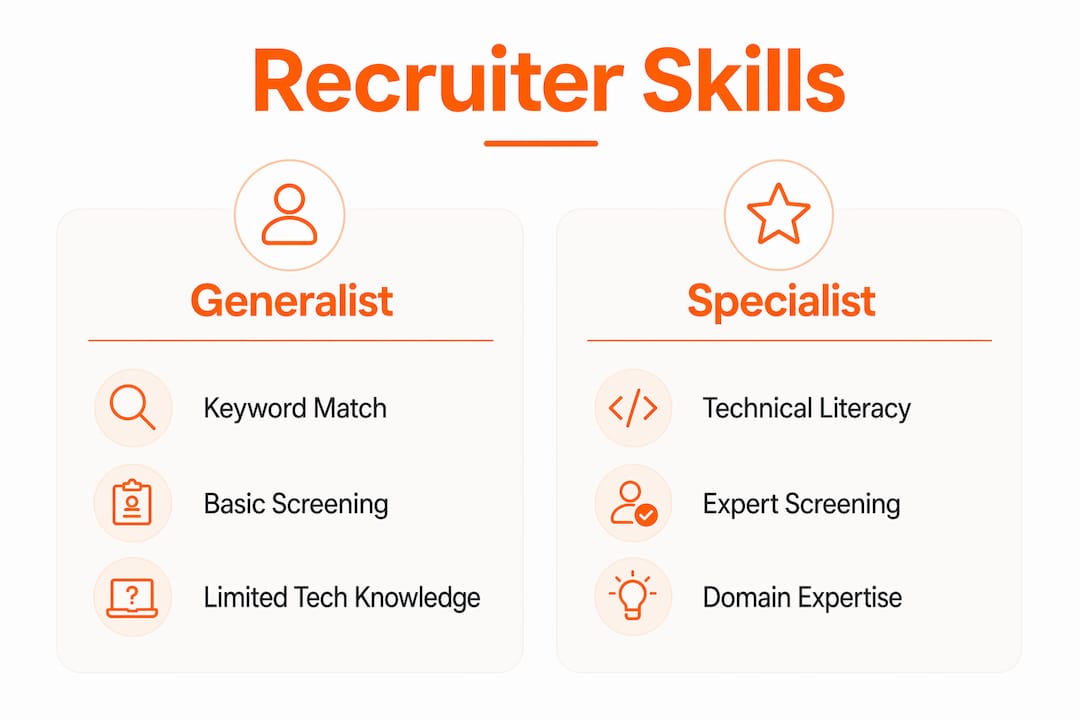
The comparison below shows how technical literacy changes recruiter effectiveness across key tasks:
| Task | Generalist recruiter | Specialist IT recruiter |
|---|---|---|
| Resume screening | Keyword matching only | Evaluates actual experience depth and context |
| Candidate interviews | Generic behavioral questions | Role-specific technical and situational questions |
| Salary guidance | Broad market ranges | Accurate rates by role, stack, and seniority |
| Job description review | Takes it at face value | Identifies gaps, unrealistic requirements, and red flags |
| Candidate advocacy | Presents the offer | Negotiates terms and addresses technical concerns |
How does recruiter expertise benefit IT professionals directly?
Expert IT recruiters provide direct, practical value to candidates. They give you market intelligence you cannot easily find on your own: current salary ranges by role and location, which companies are actively hiring versus posting roles they have no budget to fill, and which hiring managers are known for strong technical leadership. That information changes how you approach your job search.
Recruiters with deep IT experience also decode job descriptions for you. A job posting that lists 12 required technologies often reflects a wish list, not a hard requirement. An expert recruiter knows which three of those 12 actually matter for the role and can tell you whether your background is a genuine fit or a stretch. That saves you from applying to roles where you will not advance past the first screen.
The candidate experience managed by expert recruiters also affects your long-term career. Candidate experience impacts employer branding and future hiring relationships, which means a recruiter who handles your placement well becomes a long-term career asset, not a one-time transaction.
Specific ways expert IT recruiters support job seekers include:
- Providing salary benchmarks based on real placement data, not public survey averages
- Advocating directly with hiring managers on your behalf during the offer stage
- Preparing you for technical interviews with role-specific context the job description does not include
- Connecting you with roles that are not publicly posted, which represent a significant portion of senior IT placements
- Building a relationship that supports multiple career moves over time, not just the immediate opening
Key Takeaways
Expert IT recruiter expertise drives measurably better hiring outcomes by combining technical literacy, human judgment, and market knowledge that AI tools and generalist recruiters cannot replicate.
| Point | Details |
|---|---|
| Measurable hiring improvements | Expert recruiters deliver 40–50% gains in hire quality, retention, and time-to-productivity. |
| Faster placements | Specialized recruiters complete many IT placements within 2–3 weeks using pre-vetted talent pipelines. |
| AI has real limits | AI automates sourcing but cannot evaluate cultural fit, soft skills, or nuanced candidate motivations. |
| Technical literacy takes time | Building genuine IT recruitment expertise requires 12–18 months of deliberate, domain-specific learning. |
| Direct candidate value | Expert recruiters provide salary intelligence, interview prep, and access to unpublished roles. |
The part most IT professionals get wrong about recruiters
Working in and around tech hiring for years, I have seen one consistent pattern: IT professionals underestimate how much a recruiter's technical knowledge affects their outcome. Most candidates treat all recruiters as interchangeable. They send their resume to whoever reaches out and assume the process will be the same regardless of who is running it. That assumption costs people real opportunities.
The recruiter who understands the difference between a staff engineer and a principal engineer, who knows what a zero-trust architecture project actually involves, and who has placed candidates at the specific company you are targeting will get you further than one who cannot. That recruiter will brief you accurately before your interview, position your experience correctly to the hiring manager, and handle the offer conversation with context that a generalist simply does not have.
The other misconception I see constantly is that AI tools have made expert recruiters less relevant. The opposite is true. As sourcing becomes automated, the recruiters who invested in technical depth and relationship skills have become more valuable, not less. The commodity work is gone. What remains is the judgment work, and that is where specialized IT recruitment separates itself from the rest of the market.
— Diego
Plucktalent connects IT professionals with expert recruiting support
Plucktalent combines 17 years of IT and cybersecurity recruiting expertise with Plucky AI, a dedicated job search co-pilot built for tech professionals. The platform connects candidates directly with hiring managers at companies that are actively filling roles, bypassing the generic job board process entirely.
For IT professionals tired of sending applications into a void, Plucktalent provides ATS-ready profiles, direct hiring manager access, and recruiter-level market intelligence. For organizations, the platform applies the same depth of specialized knowledge that produces the quality and retention improvements the data consistently shows. Explore IT career support built specifically for technology professionals, or review the full range of tech recruiting services Plucktalent offers.
FAQ
Why does IT recruiter expertise matter more than general recruiting?
IT recruiter expertise matters because technology roles require domain-specific screening that generalist recruiters cannot perform accurately. Specialized recruiters evaluate certifications, architecture experience, and technical depth in ways that reduce mis-hires and improve retention.
How does recruiter expertise affect hiring speed?
Specialized IT recruitment firms complete many placements within 2–3 weeks by drawing on pre-vetted candidate pipelines built through years of relationship management, which is not achievable through standard job postings.
Can AI tools replace an experienced IT recruiter?
AI automates sourcing but cannot evaluate soft skills, cultural fit, or nuanced candidate motivations. Expert recruiters handle the judgment-intensive work that determines whether a placement succeeds long-term.
How long does it take a recruiter to develop real IT expertise?
Technical literacy in IT recruitment requires 12–18 months of deliberate learning, including reading technical documentation and collaborating directly with engineers. Most recruiters do not invest this time, which is why specialist expertise is rare.
What direct benefits do IT job seekers get from expert recruiters?
Expert IT recruiters provide accurate salary benchmarks, access to unpublished roles, role-specific interview preparation, and direct advocacy with hiring managers. Those advantages are not available through self-directed job board searches.