
Job boards are high-volume, low-conversion platforms that consistently fail to connect job seekers with suitable employment. The core reason why job boards have low success rates is a structural mismatch: they generate roughly half of all applications but deliver less than a quarter of actual hires. That gap is not a glitch. It is the product of misaligned incentives, outdated listings, and algorithms built for volume rather than fit. Understanding these failure points helps job seekers stop wasting time and start using channels that actually work.
Why job boards have low success rates: the volume problem
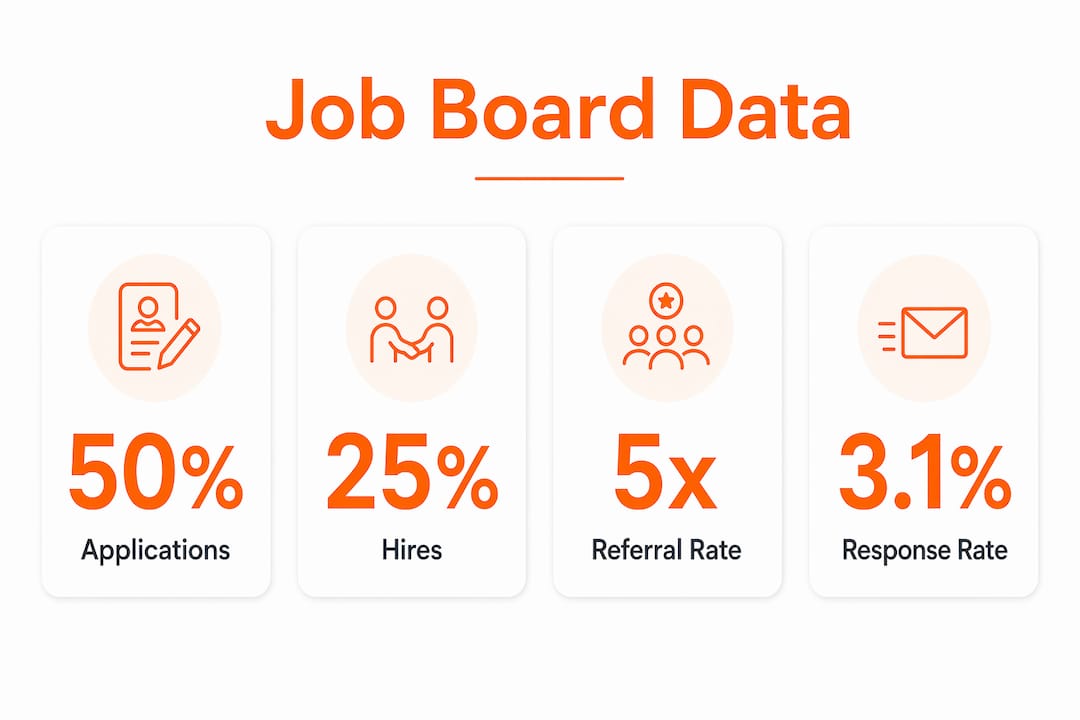
Job boards drive about 49–50% of job applications but account for only 24.6–27% of total hires. That means the channel producing the most applications produces the fewest hires per application submitted. The math is stark: you are competing in the highest-traffic lane with the lowest odds.
The contrast with other channels makes this clearer. Sourced talent hires at 5x the rate of inbound applicants, and referrals convert at 11x the rate of inbound applications. Referrals and direct sourcing are not just slightly better. They operate in a different category of effectiveness entirely.
Recruiters compound the problem. Employers receive hundreds of applicants per posting but review only a small fraction of those submissions. The result is a system where most candidates never receive feedback, and most applications never receive a human review. That experience erodes trust in the platform and discourages quality candidates from engaging seriously.
Pro Tip: Track your application-to-response rate across platforms. If you submit more than 20 applications with fewer than 2 responses, the platform is not working for you. Shift your time budget accordingly.
The table below shows how hiring channels compare on conversion efficiency.
| Channel | Share of applications | Share of hires |
|---|---|---|
| Job boards (inbound) | ~49–50% | ~24.6–27% |
| Direct sourcing (outbound) | ~2.6% of applicants | ~11% of hires |
| Referrals | Low volume | Converts at 11x inbound rate |
The data confirms that job board limitations are not marginal. They are structural.
How ghost listings drain candidate time and effort
Many job listings remain active long after the role has been filled. Employers and job boards lack contractual obligations to update or close postings promptly. The result is a significant share of listings that represent jobs no longer available, often called "ghost" listings.
Ghost listings are not always accidental. Many postings are evergreen or phantom listings designed to build candidate pipelines or collect resumes rather than fill an immediate opening. Employers use them to stay visible and maintain a talent pool. The cost of that practice falls entirely on the job seeker.
The practical consequences for job seekers include:
- Time spent tailoring applications for roles that are already closed
- No response or acknowledgment, which creates the impression of being ignored
- False signals about market demand in a given field or location
- Repeated applications to the same company under different posting dates
- Erosion of confidence in the job search process itself
The low success of job boards is partly a transparency problem. Platforms have little financial incentive to remove listings because active postings signal platform health to both employers and investors.
Do job board algorithms actually match candidates to jobs?
Job board algorithms are built to maximize application volume, not match quality. Algorithms reward quantity of applications over candidate quality or intent. A job seeker who applies to 50 roles generates more platform activity than one who applies to 5 carefully selected roles. The platform benefits from the first behavior. The job seeker does not.

This incentive structure produces what industry consultant Jeff Dickey-Chasins identifies as a "spray and pray" environment rather than a curated experience that matches top talent with the right roles. Job boards prioritize employer posting volume over candidate experience. That trade-off is a primary reason for job board failure.
The consequences for job seekers are direct:
- Search results surface roles based on keyword overlap, not actual fit
- Candidates with specialized skills receive listings for generic or entry-level roles
- Employers receive large volumes of unqualified applicants, which slows hiring
- Relevant postings get buried under sponsored or boosted listings
Pro Tip: When using a generalist job board, filter by date posted (last 7 days) and apply only to roles where your skills match at least 80% of the listed requirements. This reduces wasted applications and improves your response rate.
LinkedIn captures about 75–80% of saved jobs but has a response rate of around 3.10% due to massive volume and competition. Google Jobs shows an average application-to-interview conversion rate of around 10%, which is roughly 300% better than LinkedIn. Platform choice matters, and the largest platform is not the most effective one.
The AI job matching for tech roles field is developing faster alternatives that score candidates against job requirements using structured data rather than keyword frequency. That approach addresses the core matching failure of traditional job boards.
What works better than job boards for finding a role?
Job seekers spend most of their search time on platforms where they rarely get hired. Niche platforms and direct company career pages consistently outperform generalist boards on interview conversion. The shift toward these channels reflects a broader recognition that job board effectiveness declines as platform size grows.
The channels that outperform job boards follow a clear pattern: they reduce noise and increase signal. Here is how the alternatives rank by effectiveness for most job seekers:
- Employee referrals. Referrals convert at 11x the rate of inbound applications. A warm introduction from a current employee bypasses the ATS filter entirely and puts your name in front of a hiring manager directly.
- Direct company career pages. Applying through a company's own website removes the intermediary. The application goes directly into the employer's ATS without competing against aggregated listings from dozens of other boards.
- Niche and industry-specific platforms. Platforms built for a specific field, such as cybersecurity, IT, or finance, attract employers who are actively hiring for those skills. The candidate pool is smaller and more relevant, which improves match quality for both sides.
- Outbound sourcing and LinkedIn outreach. Reaching out directly to hiring managers or recruiters at target companies generates responses at a higher rate than passive applications. This approach requires more effort per contact but yields better results per hour spent.
- Recruiting firms with industry specialization. Specialized recruiters maintain relationships with hiring managers and know which roles are genuinely open. They also provide feedback, which generalist job boards almost never do.
The table below compares generalist job boards against niche and direct channels on key hiring factors.
| Factor | Generalist job boards | Niche and direct channels |
|---|---|---|
| Application volume | Very high | Low to moderate |
| Hire conversion rate | Low (24.6–27% of hires) | High (referrals: 11x inbound) |
| Listing accuracy | Low (ghost listings common) | High (employer-direct postings) |
| Candidate feedback | Rare | More frequent |
| Relevance of results | Low (keyword-based) | High (skill and role-specific) |
Filling IT roles without job boards is increasingly the approach taken by companies that need specialized talent quickly. Job seekers who understand this shift can position themselves in the channels where hiring decisions actually happen.
Key Takeaways
Job boards generate the most applications but deliver the fewest hires per application, making them the least efficient channel for serious job seekers who want consistent results.
| Point | Details |
|---|---|
| Volume does not equal results | Job boards produce ~50% of applications but only 24.6–27% of hires. |
| Ghost listings waste real time | Many active postings are already filled or are pipeline-building exercises. |
| Algorithms favor quantity | Job board matching is keyword-based, not skill-fit-based, reducing relevance. |
| Referrals convert far better | Referrals hire at 11x the rate of inbound job board applications. |
| Niche channels outperform | Direct career pages and specialized platforms deliver higher interview rates. |
The honest picture on job boards
Job boards are not useless. They are misused. Most job seekers treat them as the primary channel when the data says they should be the secondary one. I have seen this pattern repeat across years of observing hiring outcomes: candidates who spend 80% of their search time on generalist boards and 20% on networking get far worse results than those who flip that ratio.
The frustration is understandable. Job boards are visible, easy to access, and feel productive. Submitting 10 applications in an hour creates the sensation of progress. But activity is not the same as traction. The platforms are designed to keep you applying, not to get you hired.
The candidates who succeed treat job boards as a research tool, not a hiring tool. They use boards to identify companies that are actively hiring, then go directly to those companies' career pages or find a contact inside the organization. That approach uses the board's information without depending on its broken conversion model.
For IT and cybersecurity professionals specifically, the generalist board problem is worse. Roles in those fields require precise skill matching that keyword algorithms cannot reliably perform. A posting for a "security engineer" might attract 400 applicants with wildly different backgrounds. The hiring manager reviews 20. The other 380 receive no response. Niche platforms and direct recruiter relationships cut through that noise in ways that generalist boards structurally cannot.
— Diego
Plucktalent connects IT professionals directly to hiring managers
Plucktalent was built specifically for IT and cybersecurity professionals who have experienced the low success of job boards firsthand. The platform combines 17 years of industry recruiting expertise with Plucky AI, a dedicated job search co-pilot that connects candidates directly with hiring managers at companies actively seeking their specific skills. Applications go through an ATS-ready, tailored profile rather than a generic submission that disappears into a queue. Job seekers on Plucktalent bypass the noise that generalist boards produce and enter hiring pipelines where their skills are already relevant. Learn more about how the platform works on the Plucktalent job seekers page or review the full range of recruiting services available.
FAQ
Why do job boards produce so few hires relative to applications?
Job boards drive about 49–50% of applications but only 24.6–27% of hires because algorithms prioritize volume over fit, and recruiters can only review a fraction of submissions.
What are ghost listings on job boards?
Ghost listings are postings that remain active after a role is filled or that were never tied to an immediate opening. Employers use them to build candidate pipelines, which wastes job seeker time and contributes to the low success of job boards.
Which hiring channel has the highest conversion rate?
Referrals convert at 11x the rate of inbound applications, making them the most effective channel for getting hired. Direct sourcing and niche platforms also significantly outperform generalist job boards.
Are niche job boards more effective than generalist ones?
Niche platforms and direct company career pages consistently outperform generalist boards on interview conversion because they attract employers with specific hiring needs and reduce irrelevant applicant volume.
How can job seekers improve their results without abandoning job boards entirely?
Job seekers get better results by using generalist boards to identify target companies, then applying directly through those companies' career pages or reaching out to internal contacts. This approach uses job board information while avoiding its low conversion rates.