
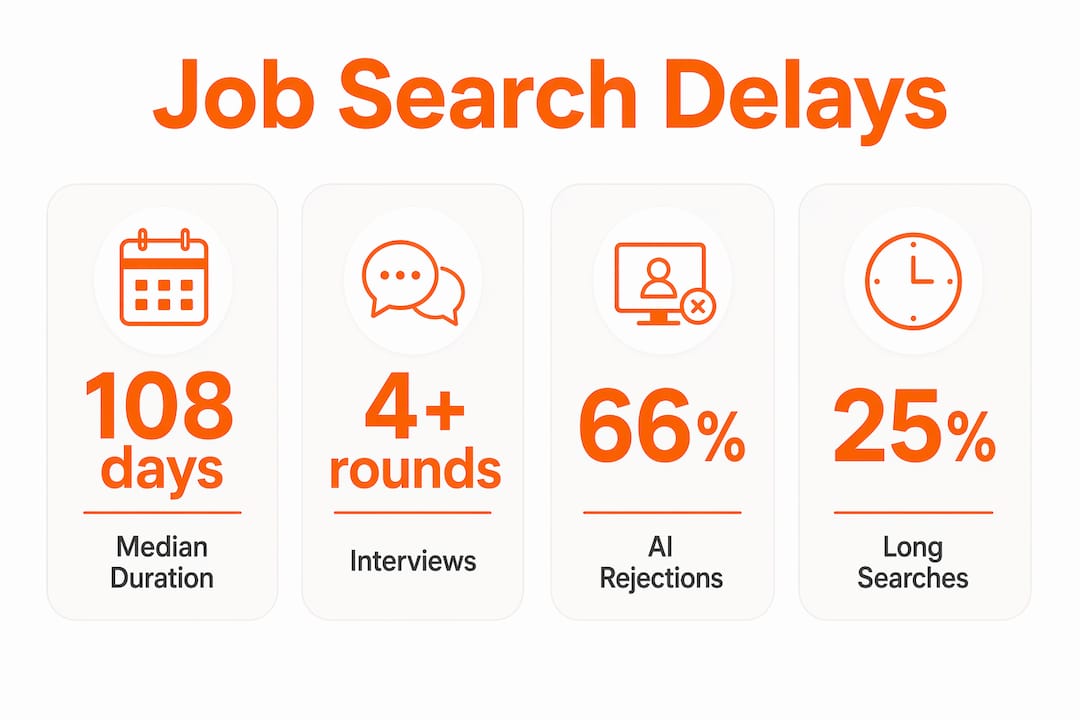
A job search takes months because hiring cycles have slowed, candidate pools have grown, and structural labor market shifts have made the process longer than at any point in recent history. The median time from search start to first offer reached 108 days in Q1 2026, a 30% increase from Q4 2025. That figure represents the longest recorded search duration since tracking began. For IT and cybersecurity professionals, understanding why job applications take long is the first step toward doing something about it.
Why job search takes months in 2026
Several forces are working together to extend the average job hunt well beyond what most candidates expect. Hiring managers are moving more cautiously. Interview rounds have multiplied. And the sheer number of applicants competing for each role has increased significantly.
Slow hiring processes and extended interview cycles are the most direct cause. Companies now conduct more rounds of interviews before making offers, partly due to economic uncertainty and partly due to internal approval chains that grew longer after post-pandemic restructuring. Each additional round adds days or weeks to the timeline.

Increased selectivity from employers means candidates face more screening steps. Roles that once required two interviews now commonly require four or five. This is especially true in technology and cybersecurity, where employers want to verify both technical skills and cultural fit before committing.
Large candidate pools create fierce competition. 1 in 4 job seekers have been searching for more than a year, and 45% report searching for at least three months. This means the pool of active, experienced candidates is larger than usual, which increases the time any single applicant spends waiting for a response.
AI screening and automation add another layer of delay. Applicant tracking systems filter resumes before a human ever sees them. A resume that does not match specific keyword patterns gets rejected automatically, regardless of the candidate's actual qualifications.
Economic and market conditions compound all of the above. Inflation, budget freezes, and post-pandemic workforce adjustments have caused many companies to slow hiring or pause it entirely, then restart it months later. Candidates caught in those pauses experience delays that have nothing to do with their qualifications.
How does the modern job market environment affect search duration?
The 2026 labor market has structural characteristics that make delays in job searching more common than they were even two years ago. These are not temporary fluctuations. They reflect deeper shifts in how employment works.
Long-term unemployment is becoming a status quo rather than a temporary condition for many workers. There are approximately 1 million more job seekers than available jobs as of early 2026. That imbalance means even qualified candidates face extended waits simply because supply exceeds demand.
The following table shows how key market factors affect search duration:
| Factor | Effect on search duration |
|---|---|
| Candidate oversupply | More competition per role; longer wait for responses |
| AI resume screening | Qualified candidates filtered out before human review |
| Ghost job listings | Time wasted on roles that are not actively being filled |
| Remote job competition | Lower conversion rates; broader applicant pools |
| Offer withdrawals | Restarts the process after weeks of progress |
AI rejection is now a documented obstacle. 66% of job seekers report being rejected by AI screening tools, and 18% lost specific opportunities to automation in 2026. This means a significant portion of applications never reach a hiring manager.
Ghost jobs and scams waste considerable time. 93% of surveyed job seekers applied to ghost jobs, and 72% encountered scams. These listings create the appearance of opportunity while producing no real progress.
Remote job applications carry their own disadvantage. Remote roles have a lower conversion rate of 3.63% compared to onsite positions, making them harder to land and prolonging the overall search for candidates who apply primarily to remote listings.
Pro Tip: Applying through Google job search yields a 2.4x higher response rate than applying through LinkedIn. Diversifying application channels beyond LinkedIn reduces time spent waiting for responses that may never come.
Which application strategies can speed up finding a job?
The factors prolonging a job hunt are largely outside a candidate's control. The application strategy, however, is not. Research shows clear differences in outcomes between candidates who apply strategically and those who rely on volume alone.
-
Tailor every resume to the specific job. Tailored resumes double conversion rates compared to generic ones. This means adjusting language, keywords, and emphasis to match the exact requirements listed in each job posting. ATS systems reward this directly.
-
Prioritize networking and referrals over job boards. Referrals and networking result in approximately 8x more hires than standard job board applications. A direct introduction to a hiring manager bypasses the ATS entirely and moves a candidate to the front of the line.
-
Apply to fewer roles with greater precision. Mass applications yield a hiring rate of approximately 0.5%. Sending 200 generic applications produces worse results than sending 20 well-targeted ones. Quality over quantity is not a preference. It is a measurable outcome.
-
Maintain application momentum during bottlenecks. The hiring process contains long pauses between stages. Candidates who stop applying while waiting for a response lose weeks of potential progress. Continuing to apply during those pauses keeps the pipeline active.
-
Avoid over-relying on a single platform. LinkedIn is the default for most job seekers, but it is also the most crowded channel. Diversifying across company career pages, professional networks, and direct outreach to recruiters produces better results.
Pro Tip: For IT and cybersecurity roles specifically, reaching out directly to hiring managers on LinkedIn with a brief, specific message about a posted role produces a measurably higher response rate than applying through the job board alone. Plucktalent's job seeker resources include guidance on exactly this kind of direct outreach.
How do hiring process stages contribute to overall delays?
Understanding where time is lost inside the hiring process helps candidates set realistic expectations and plan accordingly. The delays are not evenly distributed across the timeline.
The data from Q1 2026 shows a clear pattern. Candidates wait an average of 6 days from application to first interview. That initial wait is relatively short. The longer delay comes after the interview. Candidates wait an average of 12 days from interview to offer. That post-interview period is where most of the frustration accumulates.
| Stage | Median wait time |
|---|---|
| Application to first interview | 6 days |
| Interview to job offer | 12 days |
| Total application to offer (Q1 2026) | 108 days |
The gap between the stage-level numbers and the overall 108-day median reflects how many candidates cycle through multiple applications before receiving an offer. Each failed application restarts the clock. The post-interview bottleneck is the most critical delay point because it comes after significant time and effort have already been invested.
Offer withdrawals add further risk. 1 in 5 job seekers had offers withdrawn in Q1 2026. An offer withdrawal after weeks of interviews sends a candidate back to the beginning. This is why continuing to apply until an offer is signed and a start date is confirmed is not optional. It is a practical necessity.
Key takeaways
A job search takes months in 2026 because hiring cycles are longer, candidate pools are larger, and structural market conditions have made the process slower at every stage.
| Point | Details |
|---|---|
| Median search time is 108 days | Q1 2026 data shows the longest recorded search duration, up 30% from Q4 2025. |
| AI screening blocks many applicants | 66% of job seekers report AI rejection; ATS optimization is now a baseline requirement. |
| Tailored resumes outperform generic ones | Tailored applications double conversion rates compared to mass-apply approaches. |
| Networking produces 8x more hires | Referrals and direct outreach consistently outperform standard job board applications. |
| Post-interview wait is the longest stage | The 12-day interview-to-offer gap is where most candidates lose momentum. |
What the data actually tells frustrated job seekers
The frustration around a long job search is understandable. But the data points to something specific: most delays are structural, not personal. A search that takes three or four months in 2026 is not a sign that something is wrong with the candidate. It reflects the current state of the labor market.
What I have observed working with tech and cybersecurity professionals is that the candidates who shorten their searches are not the ones who apply to more jobs. They are the ones who apply differently. They treat each application as a targeted communication, not a form submission. They build relationships before a role is posted, not after. They treat the post-interview silence as a reason to keep applying, not a reason to wait.
The stigma around a long search is also worth addressing directly. Long-term unemployment is shifting from an exception to an expected norm in this market. A six-month search in 2026 is not unusual. It is, statistically, close to average. Candidates who internalize that fact tend to stay more consistent and less reactive during the process.
The one thing I would push back on is the instinct to broaden the search when results are slow. Broadening usually means less tailoring, which produces worse results. The better response to a slow search is to go deeper on fewer targets, not wider across more of them.
— Diego
How Plucktalent helps IT professionals cut through hiring delays
Plucktalent is built specifically for IT and cybersecurity professionals dealing with the exact delays described in this article. The platform combines 17 years of recruiting expertise with Plucky AI, a dedicated job search co-pilot that connects candidates directly with hiring managers at companies actively hiring for their skills. Generic applications and ATS black holes are the core problem Plucktalent addresses. The job seeker services include ATS-ready resume optimization, targeted outreach support, and direct access to hiring pipelines that bypass job board noise entirely. For professionals who want to stop waiting and start moving, the full services overview is the right starting point.
FAQ
How long does a job search typically take in 2026?
The median job search takes 108 days from start to first offer in Q1 2026, according to Huntr's Q1 2026 Job Search Trends Report. That figure represents a 30% increase from Q4 2025.
Why do job applications take so long to get a response?
Most delays occur because companies run multiple interview rounds, use AI screening tools that filter applications before human review, and have internal approval processes that slow decision-making. The average wait from application to first interview is 6 days, but the full process averages over three months.
Does networking actually reduce job search time?
Referrals and networking produce approximately 8x more hires than standard job board applications, according to Q1 2026 data from Huntr. Direct outreach to hiring managers and employee referrals consistently move candidates through the pipeline faster than applying through job boards.
What are ghost jobs and how do they affect job seekers?
Ghost jobs are listings posted by companies that are not actively hiring for the role. 93% of surveyed job seekers applied to at least one ghost job in 2026, wasting time and effort on applications that will never receive a response.
Should job seekers keep applying after an interview?
Candidates should continue applying until a written offer is signed and a start date is confirmed. 1 in 5 job seekers had offers withdrawn in Q1 2026, meaning progress made during an interview process can disappear without warning.