
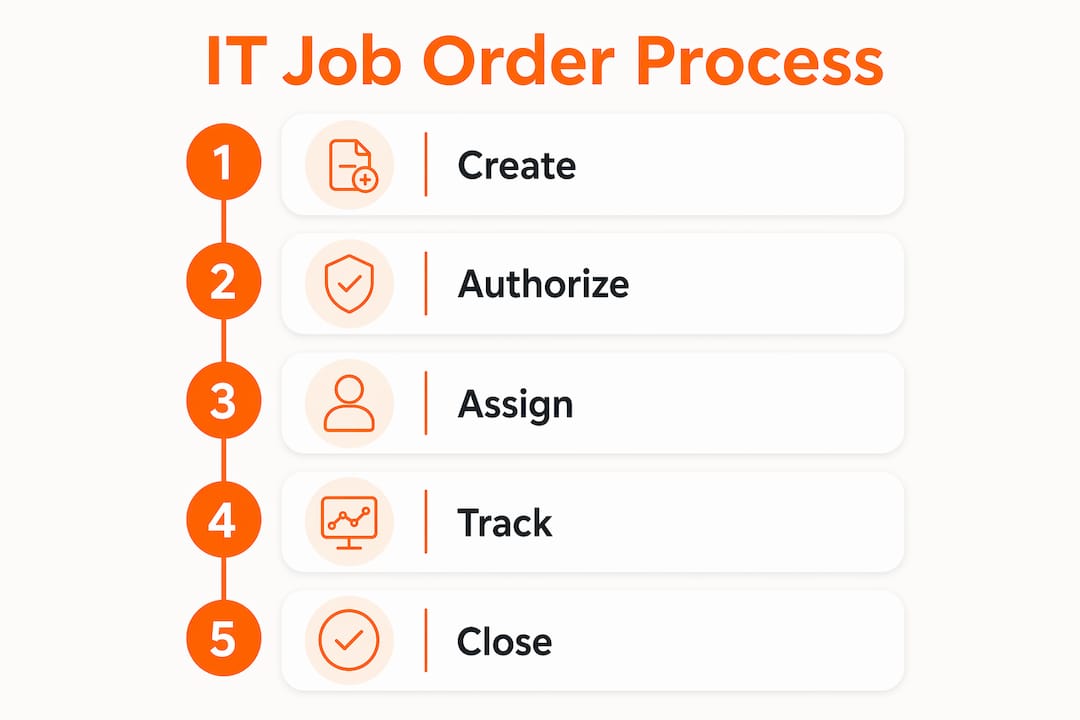
IT job order management is defined as the structured process of creating, authorizing, tracking, and closing IT job requests from initial requisition through final placement. The industry term for this process is "job order management," and it sits at the center of every successful IT hiring workflow. Incomplete requisition forms cause 45% of hiring delays, making process discipline the single biggest lever hiring managers control. Plucktalent works within this process daily, and the patterns that separate fast placements from stalled ones are consistent and learnable.
What is IT job order management explained in practice?
IT job order management is the end-to-end system that governs how a technical hiring need becomes a filled role. It covers every step from the moment a manager identifies a gap to the moment a candidate starts work. Without a defined system, requests get lost, approvals stall, and recruiters work from incomplete information.
The process connects three distinct functions: internal approval and budget authorization, recruiter assignment and candidate sourcing, and candidate tracking through interviews and onboarding. Each function depends on the one before it. A breakdown at any stage delays the entire workflow and raises cost-per-hire.

Clear hiring process flows with assigned responsibilities prevent the bottlenecks that most IT teams attribute to "the market" or "candidate scarcity." The real cause is almost always internal. Roles without defined owners, approvals without deadlines, and requisitions without technical specifics all create the same outcome: a position that stays open longer than it should.
What are the key steps in the IT job order process?
The IT job order workflow follows a predictable sequence. Deviating from it or skipping steps is the primary cause of extended time-to-fill.
- Job requisition creation. The hiring manager writes a formal request that includes the business problem, required skills, budget code, and reporting structure. This document triggers the entire downstream process.
- Internal approval. Finance, HR, and the relevant department head review and authorize the requisition. Budget allocation happens at this stage.
- Job order assignment. The approved order goes to an internal recruiter or external staffing partner. The assigned recruiter receives all decision-critical information before sourcing begins.
- Candidate sourcing and screening. Recruiters search active and passive candidate pools, screen resumes against the technical requirements, and verify compensation alignment before submission.
- Interview coordination. Screened candidates move into structured interview stages. Best-in-class organizations make hiring decisions within 24–48 hours of the final interview to avoid losing candidates to competing offers.
- Offer and acceptance. The selected candidate receives a formal offer. Any negotiation happens within a defined window to prevent delays.
- Onboarding and order closure. The job order closes when the candidate starts. Onboarding documentation, system access, and equipment provisioning complete the cycle.
Permanent IT roles typically close in 2–3 weeks, while contract roles fill within 5–10 business days when feedback moves quickly. Speed at every stage depends on preparation at the previous one.
How does a well-crafted job requisition improve IT recruitment?
A job requisition is the internal business case that authorizes hiring and allocates budget before a job posts publicly. It is not a job description. The requisition is an internal document; the job description is the external one. Conflating the two is a common mistake that produces vague postings and misaligned candidates.
Job requisitions linked to specific OKRs and 90-day deliverables close IT roles 32% faster with 27% higher retention. That gap exists because outcome-focused requisitions give recruiters a concrete target. A requisition that says "strong communication skills required" tells a recruiter nothing. One that says "candidate will own the migration of 200 legacy endpoints to Azure AD within the first quarter" tells a recruiter exactly who to find.
A well-built requisition functions as the primary key in an applicant tracking system (ATS). It links the hiring need to budget codes, cost centers, and approval workflows. Skipping or rushing this document causes misaligned data throughout the ATS and forces recruiters to work from assumptions rather than facts.
Strong requisitions include these elements:
- The business problem being solved. What breaks or slows down without this hire?
- Success markers at 30, 60, and 90 days. What does good performance look like in concrete terms?
- The technical environment. Which systems, languages, frameworks, or platforms does the role touch?
- Compensation range and flexibility. Is there room to negotiate, and what is the ceiling?
- Decision-making authority. Who approves the final hire, and who has veto power?
Pro Tip: Write the requisition as if you are explaining the role to a senior engineer, not an HR generalist. Technical specificity attracts technical candidates and filters out mismatches before the first resume arrives.
Replacing vague requisitions with concrete near-term outcomes is the single highest-return change most IT hiring managers can make. It costs no additional budget and reduces time-to-fill immediately.
What IT procurement practices support efficient job order fulfillment?
IT procurement and job order management overlap more than most hiring managers realize. Staffing vendors, contract workers, and software licenses all move through procurement workflows. When those workflows are undefined, hiring slows down even after a candidate accepts an offer.
Defining purchase ownership early is the first step toward faster approvals and deployment. Every IT job order that involves a staffing vendor, a new software seat, or a hardware deployment needs a named owner before the approval process starts. Without one, requests cycle through inboxes without resolution.
A renewal calendar that tracks owner, renewal dates, and costs prevents reactive contract management. Reactive renewals force rushed decisions, often at unfavorable rates. A structured calendar gives procurement teams 60–90 days of lead time on every contract, which is enough time to renegotiate, switch vendors, or plan a transition.
Pro Tip: Integrate finance, IT, and operations approvals into a single workflow before any job order reaches the sourcing stage. Parallel approvals cut total approval time by removing sequential bottlenecks.
| Best practice | Common pitfall |
|---|---|
| Assign a named purchase owner at requisition creation | No ownership defined until after approval is needed |
| Maintain a renewal calendar with 60-day lead times | Renewals discovered at expiration, forcing rushed decisions |
| Link every procurement request to a specific business need | Requests approved without clear operational justification |
| Integrate finance, IT, and operations into one approval path | Sequential approvals that add weeks to the process |
| Document escalation paths for stalled approvals | No escalation process, leaving requests in limbo indefinitely |
Defining purchase ownership and integrating cross-functional approvals early prevents the operational friction that makes IT hiring feel slower than it actually is.
How can staffing agencies speed up IT candidate submissions?
The submission process is where most staffing relationships either build trust or lose it. Hiring managers judge agencies on two things: how fast profiles arrive and how relevant those profiles are. Both depend on what happens before a single resume gets submitted.
Top IT staffing firms submit fully screened, rate-confirmed candidate profiles within 30 minutes of receiving requirements. That speed is not accidental. It comes from a structured intake process that captures all decision-critical information in a single conversation before sourcing begins.
A fast, high-quality submission process follows these steps:
- Single intake call. One conversation captures the technical requirements, compensation range, interview format, decision timeline, and deal-breakers. No follow-up emails needed.
- Active pipeline search. Recruiters search pre-screened candidates already in the pipeline before opening a new search. This cuts sourcing time significantly.
- Rate confirmation before submission. Every candidate profile includes a confirmed compensation expectation. Surprises at the offer stage are eliminated.
- Technical screening. Candidates answer role-specific technical questions before their profiles go to the hiring manager. The hiring manager sees only qualified candidates.
- Formatted submission package. Each profile arrives with a summary of relevant experience, compensation confirmation, and availability date. The hiring manager can make a decision without requesting additional information.
Rate-confirmed candidate submissions reduce back-and-forth delays and give hiring managers the information they need to act quickly. Responsiveness at this stage is a direct competitive advantage. Candidates in the IT market receive multiple offers simultaneously, and the hiring team that moves first wins the placement. You can also read more about why job boards fall short for high-demand IT roles to understand why direct submission processes matter.
Key Takeaways
Effective IT job order management requires precise requisitions, defined ownership, and fast candidate submissions to reduce time-to-fill and improve placement quality.
| Point | Details |
|---|---|
| Requisition quality drives speed | Requisitions linked to OKRs and 90-day deliverables close roles 32% faster with 27% higher retention. |
| Ownership prevents stalls | Every job order needs a named owner before the approval process starts to avoid delays. |
| Procurement and hiring are connected | Integrating finance, IT, and operations approvals early removes sequential bottlenecks from the workflow. |
| Submission speed wins candidates | Top staffing firms submit rate-confirmed profiles within 30 minutes, reducing back-and-forth and securing candidates faster. |
| Decision speed closes roles | Making hiring decisions within 24–48 hours of the final interview prevents candidate loss to competing offers. |
Where most IT hiring teams get it wrong
The teams I see struggle most with job order management are not the ones with bad recruiters. They are the ones treating the process as administrative overhead rather than a core function. A job order without a named owner, a requisition without technical specifics, and a procurement workflow without escalation paths all produce the same result: a role that stays open for months while the team absorbs the workload.
The 45% of hiring delays caused by incomplete requisition forms is not a recruiter problem. It is a process design problem. Recruiters cannot source accurately from vague documents. Hiring managers who invest 30 minutes in writing a precise requisition recover that time many times over in reduced interview cycles and faster closures.
Cross-team communication is the other consistent failure point. IT hiring involves finance, HR, operations, and the technical team. When those groups operate in separate approval queues without a shared timeline, every handoff adds days. The fix is not a new tool. It is a defined workflow with named owners and deadlines at each stage.
The teams that close IT roles fastest share one trait: they treat job order management as a repeatable system, not a series of one-off requests. They document what works, measure time-to-fill by stage, and adjust when a stage consistently slows down. That discipline compounds over time and produces a hiring function that actually supports the technical team's pace.
— Diego
Plucktalent's approach to IT job order management
Plucktalent brings 17 years of IT and cybersecurity recruiting expertise to the job order management process. The platform connects IT professionals directly with hiring managers at companies that are actively filling technical roles, bypassing the delays that generic job boards create.
For hiring managers, Plucktalent's staffing and recruitment services cover requisition support, candidate sourcing, and placement coordination. For IT professionals, the Plucktalent job seekers page provides access to ATS-ready profile tools and direct connections to active hiring teams. The platform's Plucky AI co-pilot matches candidate profiles to open roles based on technical fit, not keyword overlap.
FAQ
What is IT job order management?
IT job order management is the structured process of creating, approving, tracking, and closing IT job requests from requisition through placement. It connects internal approval workflows to recruiter sourcing and candidate tracking.
Why do IT hiring delays happen so often?
45% of IT hiring delays stem from incomplete requisition forms. Vague or missing technical details force recruiters to source without a clear target, extending time-to-fill.
How long does it take to fill an IT role?
Permanent IT roles close in 2–3 weeks and contract roles fill within 5–10 business days when feedback moves quickly through each stage of the process.
What makes a job requisition effective in IT hiring?
An effective IT job requisition includes the business problem, 30/60/90-day success markers, the technical environment, compensation range, and the named decision-maker. Outcome-focused requisitions close roles faster and improve retention.
How fast should staffing agencies submit IT candidates?
Top IT staffing firms submit fully screened profiles within 30 minutes of receiving requirements. Rate-confirmed submissions eliminate compensation surprises and reduce the number of back-and-forth exchanges before an offer is made.