
AI reduces job search time by automating the most time-consuming parts of the process and delivering job matches that are relevant from the first result. Job seekers who use AI tools are more than twice as likely to receive a job offer compared to those who search manually. That gap exists because AI handles resume parsing, job filtering, and application tailoring at a speed no human workflow can match. For IT and cybersecurity professionals, where role specificity matters enormously, this precision is the difference between a 70-day search and one that wraps in weeks.
Why AI reduces job search time: the core mechanism
AI job search tools, also called AI-powered candidate matching systems, cut search time by replacing manual filtering with automated, semantically aware ranking. Traditional job boards rely on keyword matching. If your resume says "information security" and the job posting says "cybersecurity," a keyword-based system may miss the connection entirely. AI does not make that mistake.

The technology works through a two-stage process. First, embedding models convert both job descriptions and candidate profiles into vector representations that capture meaning, not just words. A vector is a numeric map of a concept. Two phrases that mean the same thing land close together on that map, so the system recognizes them as equivalent. Second, reasoning models score each match in detail, producing a reproducible number that reflects skills, seniority, location, and compensation alignment.
This two-stage approach replaces hours of manual searching with a ranked list of genuinely relevant roles. The job seeker reviews matches instead of hunting for them. That shift alone accounts for a large portion of the time savings AI delivers.
How do AI matching algorithms work to speed up job searches?
AI matching algorithms operate on semantic similarity rather than exact text overlap. The practical result is a system that understands what you do, not just what words you used to describe it.
Here is how the process breaks down:
- Embedding stage: The AI converts your profile and each job listing into vectors. Roles that align with your experience rank at the top, regardless of title variation.
- Reasoning stage: A reasoning model then scores each top match across multiple dimensions: skill overlap, seniority level, location preference, and compensation range.
- Score calibration: AI match scores are calibrated at temperature 0, meaning the system produces the same score for the same inputs every time. That consistency lets you compare opportunities reliably.
- Explanation layer: The system provides component-level explanations for each score. You see exactly why a role ranked high or low, which tells you where to focus your tailoring effort.
Keyword-based ATS systems reject roughly 40% of qualified candidates at the mid and junior level because of title mismatches or synonym gaps. AI matching recovers most of those candidates by understanding skill adjacency and domain context.
Pro Tip: When reviewing AI match scores, prioritize roles that score high on skills and seniority alignment, even if the job title looks unfamiliar. The score reflects actual fit, not surface-level label similarity.
What evidence shows AI reduces total job search time?
The data on AI-assisted job searching is direct. Job seekers using AI receive offers at a 76% rate, compared to 33% for those using traditional methods. That is not a marginal improvement. It reflects a fundamentally different search experience.
Application time per job drops from 45–60 minutes to 5–8 minutes with AI tools. That reduction comes from automated resume parsing, pre-filled application fields, and AI-generated cover letter drafts tailored to each role. A job seeker applying to 10 roles per week saves roughly six to eight hours weekly on application tasks alone.
| Metric | Traditional search | AI-assisted search |
|---|---|---|
| Offer rate | 33% | 76% |
| Application time per job | 45–60 minutes | 5–8 minutes |
| Interview rate improvement | Baseline | 25–35% higher |
| Time to first offer | ~70 days | 30–40% shorter |
| Administrative task automation | Manual | 80% automated |
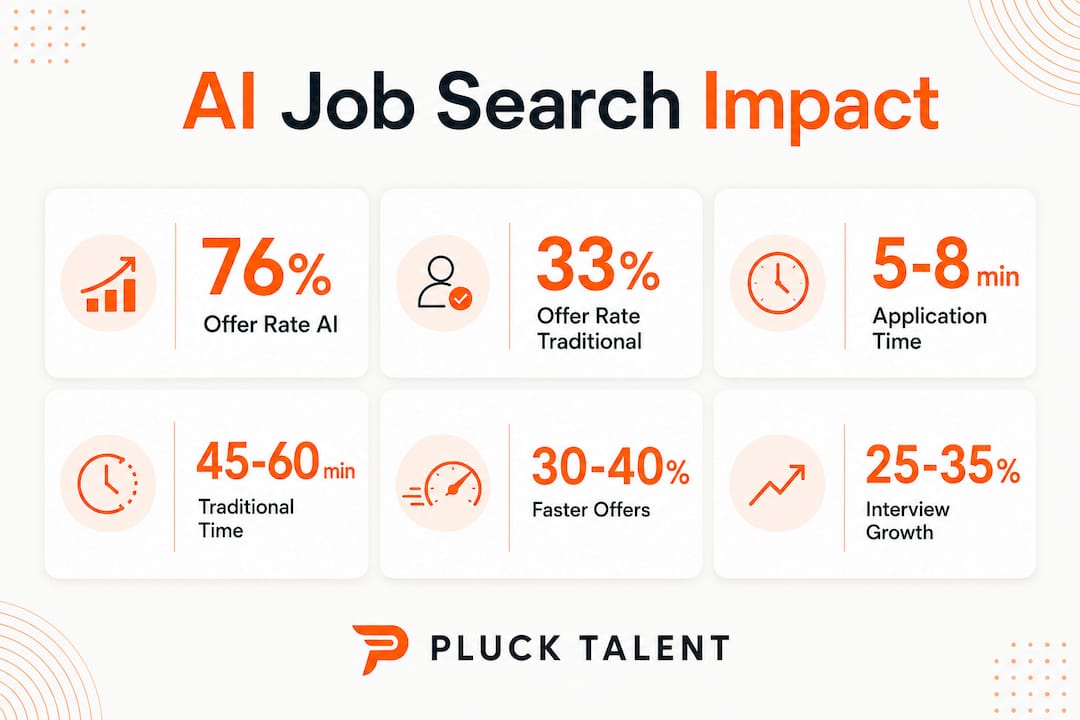
Interview rates increase by 25–35% for AI users, and time to first offer drops by 30–40%. The median traditional search takes around 70 days to produce a first offer. AI cuts that timeline substantially. For IT professionals in competitive markets, those weeks matter.
Why does AI improve job matching quality beyond speed?
Speed is the visible benefit. Match quality is the more durable one. AI does not just find jobs faster. It finds jobs that fit better, which reduces early attrition and repeat searches.
Semantic AI matching recognizes transferable skills and equivalent job titles. A candidate who has worked as a "network security analyst" will surface for "infrastructure security engineer" roles when the AI understands that both involve the same core competencies. Keyword systems miss that connection. The result is a wider, more accurate pool of relevant opportunities.
The retention data supports this. Skills-based AI matching improves first-year employee retention by 25–35%. Better initial fit means fewer mismatches, fewer early exits, and less time spent re-entering the job market. For employers, that translates to avoided replacement costs. For job seekers, it means landing a role that actually holds.
AI also surfaces roles that job seekers would not have found through manual browsing. The low success rates of standard job boards stem partly from their reliance on keyword filters that bury relevant postings under irrelevant ones. AI flips that dynamic by ranking by relevance from the start.
Pro Tip: Combine AI matching with direct outreach to hiring managers at your top-ranked companies. AI handles volume and precision. Personal contact handles cultural fit and relationship-building. Neither replaces the other.
How do modern AI job search tools save job seekers hours daily?
AI job search tools reduce time spent on four distinct tasks: finding relevant roles, tailoring applications, tracking progress, and following up. Each task that AI handles partially or fully returns hours to the job seeker each week.
-
Resume parsing and profile structuring. AI reads your existing resume and structures it into a standardized profile. That profile feeds directly into applications, eliminating manual re-entry of the same information across dozens of forms.
-
Bulk tailored application generation. AI-powered bulk tools generate personalized resumes and cover letters for each role in minutes. Application time drops from 45–60 minutes per job to 5–8 minutes. A job seeker who previously applied to five roles per day can now apply to 20 or more with the same effort.
-
Priority filtering based on match scores. AI scores each opportunity before you open it. You spend your tailoring effort on high-score roles and skip low-relevance listings entirely. That filtering alone eliminates hours of reading job descriptions that were never a real fit.
-
Administrative task automation. AI automates 80% of the screening and sorting work that job seekers previously did manually. Status tracking, follow-up reminders, and application logs run in the background.
Plucktalent applies this model specifically for IT and cybersecurity professionals. Its Plucky AI co-pilot connects candidates directly with hiring managers at companies actively recruiting for their skills, bypassing the generic job seeker pipeline that buries qualified candidates under unrelated postings.
Key Takeaways
AI reduces job search time because it replaces manual filtering, keyword guessing, and repetitive application work with automated, semantically accurate matching that delivers relevant results from the first query.
| Point | Details |
|---|---|
| Offer rate doubles with AI | AI users receive offers at 76% vs. 33% for traditional job seekers. |
| Application time drops sharply | AI cuts per-application time from 45–60 minutes to 5–8 minutes. |
| Match quality improves retention | Skills-based AI matching raises first-year retention by 25–35%. |
| Keyword ATS misses qualified candidates | Keyword systems reject ~40% of qualified applicants; AI recovers most of them. |
| Hybrid approach works best | AI handles volume and precision; personal networking handles cultural fit. |
The part most job seekers get wrong about AI tools
AI tools are genuinely useful. The data is clear on that. But the job seekers who get the most out of them are not the ones who hand everything over to the algorithm. They are the ones who treat AI as a first filter and then apply their own judgment to what comes back.
The match score tells you that a role fits your skills. It does not tell you whether the team culture matches how you work, whether the company is growing or contracting, or whether the hiring manager values the specific experience you bring. Those factors require human research and human conversation.
What I have observed is that professionals who review the AI's reasoning, not just its score, make better application decisions. When the system explains that a role scores high on skills but low on seniority alignment, that is a signal worth acting on. You can address the gap directly in your cover letter or decide the role is not worth pursuing. Either way, you are making an informed choice rather than applying blindly.
The hybrid approach that combines AI precision with personal networking consistently outperforms either method alone. AI gets you in front of the right opportunities. Your network gets you in front of the right people. Both matter.
— Diego
How Plucktalent uses AI to shorten your search
Plucktalent was built for IT and cybersecurity professionals who have spent too much time applying to roles that were never a real fit. The platform combines 17 years of recruiting expertise with Plucky AI, a dedicated job search co-pilot that matches candidates to active openings based on actual skill alignment, not keyword overlap.
Plucky AI structures your profile, scores available roles, and connects you directly with hiring managers at companies that are actively recruiting. That means fewer wasted applications and faster movement through the hiring pipeline. Job seekers on the platform work with ATS-ready, tailored profiles that reflect their real qualifications. The Plucktalent job seeker page explains how the process works and what to expect from the first match onward. For professionals ready to stop searching and start interviewing, the platform's full service overview covers every step of the process.
FAQ
How much time does AI actually save in a job search?
AI cuts per-application time from 45–60 minutes to 5–8 minutes and reduces total time to first offer by 30–40%. Job seekers using AI tools also receive offers at more than twice the rate of those searching manually.
Why do AI matching algorithms outperform keyword-based ATS systems?
AI matching uses embedding models to understand semantic meaning, so it recognizes equivalent skills and titles even without exact keyword matches. Keyword-based systems reject roughly 40% of qualified candidates due to terminology mismatches alone.
Does AI job matching improve long-term job fit, not just speed?
Skills-based AI matching improves first-year employee retention by 25–35%, which means candidates land roles that fit better and stay longer. Better initial matching reduces early attrition for both the employer and the job seeker.
What is the best way to use AI tools in a job search?
The most effective approach combines AI for volume, filtering, and application tailoring with personal networking for cultural fit and relationship-building. AI handles the precision work; direct outreach handles the human elements that algorithms cannot assess.
How does Plucktalent differ from standard job boards?
Plucktalent uses Plucky AI to match IT and cybersecurity professionals directly with hiring managers at companies actively recruiting for their specific skills, bypassing the keyword-filtered noise that causes standard job boards to bury qualified candidates.