
What AI candidate-employer fit means and how AI explains its decisions
AI candidate-employer fit is the process by which AI systems analyze resumes and job descriptions to score and rank how well a candidate matches a role. The analysis goes beyond keyword counts. It evaluates skills, career trajectory, experience recency, and contextual signals to produce a ranked list with reasons attached to each recommendation.
Tools like the Employ Inc AI Screening Companion generate fit scores alongside explanations, mapping each recommendation to specific job requirements. That transparency matters. When a recruiter can see why a candidate ranked highly, not just that they did, trust in the AI output increases. Transparent fit recommendations also benefit candidates, who feel more confidence in the process even when not selected.
Real-time bias monitoring is built into leading platforms as a standard governance feature, not an afterthought. Responsible AI governance requires that fit recommendations remain auditable, explainable, and open to challenge.
Key transparency requirements for AI fit tools:
- Explanations of how each score was calculated
- Mapping of candidate attributes to job must-haves and nice-to-haves
- Candidate notice that AI assisted the decision
- A clear path for candidates to raise concerns or request recourse
How AI candidate matching works: core techniques and workflows
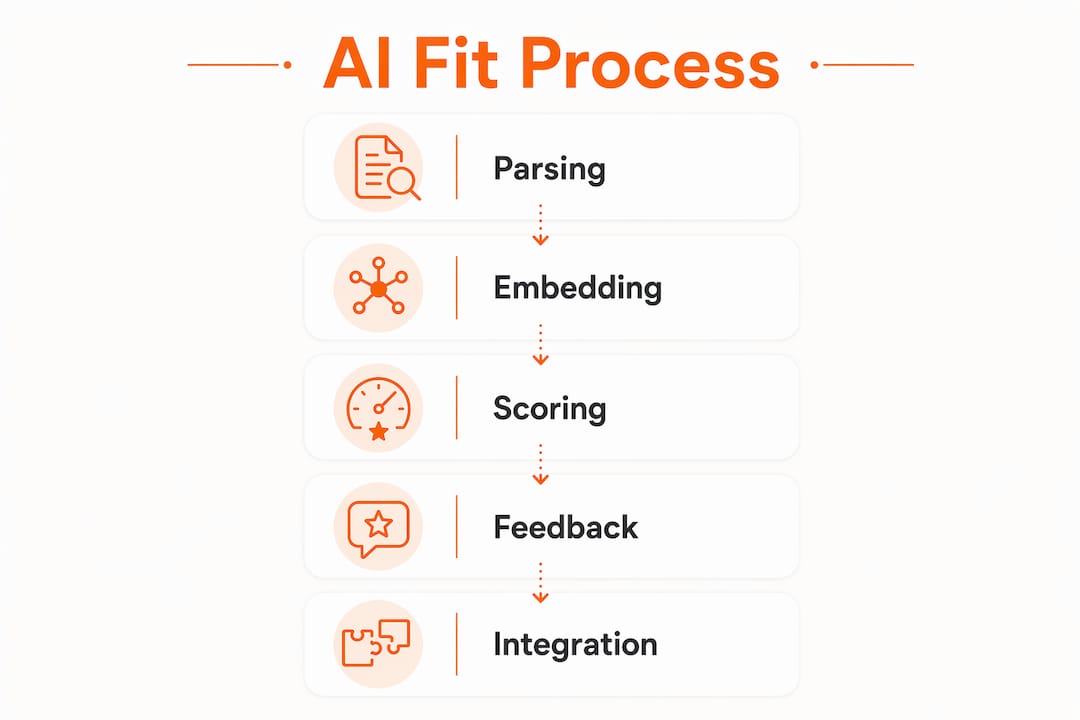
AI matching starts with data ingestion. Resumes and job descriptions are parsed into structured data fields: skills, job titles, tenure, education, and industry context. Raw text becomes machine-readable attributes that the system can compare at scale.
Semantic embeddings then represent those attributes as vectors in a shared mathematical space. A candidate who "led product launches" and a job description requiring someone who "managed cross-functional teams" can register as a strong match even without identical wording. The AI reads meaning, not just text.

Reinforcement learning with human feedback (RLHF) refines the model over time. Feedback loops capture why specific candidates were accepted or rejected, teaching the system to reflect each hiring team's unstated preferences. Scoring criteria extend well beyond keywords to include skills adjacency, career progression patterns, and how recently relevant experience was gained.
| Technique | What it does | Key benefit |
|---|---|---|
| Resume parsing | Converts unstructured text to structured data | Enables consistent comparison across candidates |
| Semantic embeddings | Maps skills and experience into vector space | Surfaces candidates with equivalent but differently worded experience |
| RLHF calibration | Learns from recruiter accept/reject signals | Adapts to team-specific preferences over time |
| Skills adjacency scoring | Identifies related competencies | Reduces false negatives from narrow keyword filters |
| Career trajectory analysis | Evaluates progression patterns | Flags candidates with growth potential beyond current title |
How AI fit evaluation benefits recruiting teams and hiring outcomes
AI-driven hiring pipelines reduce time-to-hire and cut the number of interviews needed to reach a qualified shortlist. The efficiency gain is measurable. According to SHRM research, Employers using AI or automation report that these tools save time and increase efficiency, and many recruiters say they accelerate the hiring process. AI recruitment has also been shown to reduce cost-per-hire significantly.
Quality of hire improves alongside speed. AI surfaces candidates whose skills match the role but whose resumes might have been overlooked in a manual review, particularly when job titles differ across industries. Recruiters spend less time on mechanical screening and more time on relationship building and final evaluation, which is where human judgment adds the most value.
Explainable AI outputs also strengthen recruiter confidence. When a fit score comes with a clear rationale, the recruiter can validate it quickly, override it when context warrants, and document the decision for compliance purposes.
Statistic callout: Modern AI screening tools reach 89–94% accuracy in identifying candidates qualified by technical skills and experience, though human review remains necessary for motivation and culture fit assessment.
Accuracy, limitations, and the human role in AI fit assessment
AI fit scores are confidence estimates, not definitive verdicts. A score of 92% means the model believes this candidate is a strong technical match. It does not mean the candidate will succeed in the role, get along with the team, or stay beyond six months. Culture fit remains outside what current AI systems can reliably measure.
Calibration is another practical constraint. AI models need human feedback signals before they can accurately reflect a specific team's preferences. Without that input, a generic model applies generic criteria, which often produces generic results. Recruiters should plan for a calibration period at the start of any new role type.
Bias is a real risk. AI trained on historical hiring data can replicate the patterns in that data, including patterns that disadvantaged certain groups. Continuous bias audits and clearly defined role criteria reduce this risk, but they do not eliminate it without ongoing human oversight.
Pro Tip: Validate AI shortlists periodically by having a hiring manager review a random sample of candidates the system ranked below the cutoff. This catches systematic blind spots before they affect hiring outcomes.
Limitations recruiters should account for:
- AI cannot assess motivation, interpersonal style, or cultural alignment
- Fit scores reflect training data quality, which varies by platform
- Soft skills and leadership potential require structured interviews and reference checks
- Human recruiters make the final selection decision in every case
Responsible AI governance and bias monitoring in candidate fit tools
Responsible AI use in recruitment rests on three principles: fairness, transparency, and accountability. Fairness means the system evaluates candidates on demonstrated skills rather than proxy attributes. Transparency means every recommendation can be explained. Accountability means a human remains responsible for every hiring decision, regardless of what the AI recommended.
IBM watsonx.governance is one example of enterprise-grade AI governance software applied to hiring contexts. It provides tools for monitoring model behavior, flagging drift, and documenting decision logic for audit purposes. Platforms built on governance frameworks like this can demonstrate compliance with regulatory requirements more readily than those without structured oversight.
Regulatory frameworks such as Canada's Directive on Automated Decision-Making require organizations to conduct Algorithmic Impact Assessments before deploying automated decision systems, notify candidates that AI assisted the decision, provide meaningful explanations of how decisions were made, and offer candidates a path to challenge outcomes. U.S. jurisdictions are moving in a similar direction, with New York City's Local Law 144 requiring bias audits for automated employment decision tools.
Data privacy and security requirements apply to every stage of AI fit evaluation. Candidate data must be handled under applicable data protection standards, stored securely, and not retained longer than necessary. Governance policies should address data minimization, access controls, and third-party vendor compliance as part of any AI hiring deployment.
How AI fit analysis integrates with existing ATS systems and hiring workflows
AI fit analysis does not replace an applicant tracking system. It connects to one. Most enterprise ATS platforms now support API-based integrations that allow AI scoring engines to receive parsed candidate data, return ranked results, and write fit scores back into the candidate record without requiring recruiters to leave their existing workflow.

The practical effect is that recruiters see AI-generated fit scores alongside the candidate profile they already review. No separate tool, no manual data transfer. AI hiring signals surface inside the same interface recruiters use for scheduling, communication, and pipeline management.
Integration depth varies by platform. Some ATS vendors embed AI scoring natively. Others rely on middleware connectors or direct API calls to third-party matching engines. Before deploying any AI fit tool, recruiting teams should confirm that the integration preserves audit trails, maintains data residency requirements, and does not introduce duplicate candidate records.
Real hiring scenarios where AI candidate-employer fit has made a difference
A technology company hiring for a cloud infrastructure role used AI semantic matching to surface candidates whose resumes listed "on-premises data center management" rather than "cloud." The AI recognized skills adjacency between the two and ranked those candidates alongside certified cloud engineers. Several were hired and performed at or above the level of candidates who had cloud-specific titles.
High-volume hiring presents a different use case. Retail and logistics employers processing thousands of applications per week use AI fit scoring to reduce the review pool to a manageable shortlist without manual pre-screening. Recruiter time shifts from reading every resume to evaluating a curated set, which allows more thorough assessment of each finalist.
Candidate self-selection is a third scenario. When AI fit scores and rationale are shared with applicants early in the process, candidates who see a low match score often withdraw voluntarily. This reduces downstream interview load and improves the signal-to-noise ratio for hiring teams without requiring additional screening steps.
Future trends in AI for candidate-employer fit
Multimodal AI is the next development most likely to affect candidate fit assessment. Systems that analyze not only text but also structured behavioral data from assessments, video interview signals, and work sample outputs will produce richer fit profiles than text-based matching alone. The accuracy ceiling for technical skills matching will rise as a result.
Explainability requirements will tighten. Regulatory pressure in the U.S. and internationally is pushing toward mandatory disclosure of how AI fit scores are generated, not just that they were used. Platforms that cannot produce auditable decision logs will face compliance risk as these rules take effect. AI business automation tools built with governance-first architectures are better positioned for this environment.
Recruiter roles will continue to shift toward evaluation and relationship management as AI handles more of the initial screening and ranking. The job board model of passive candidate discovery is already losing ground to active AI matching, where systems identify qualified candidates before they apply. By 2026, the most effective recruiting teams are those that treat AI fit analysis as a core workflow component rather than a supplementary filter.
Key Takeaways
AI candidate-employer fit evaluation works best when semantic matching, human calibration, and responsible governance operate together across the full hiring workflow.
| Point | Details |
|---|---|
| Semantic matching beats keywords | AI reads meaning and context, surfacing candidates with equivalent experience regardless of exact wording. |
| Accuracy has a ceiling | AI screening reaches 89–94% accuracy for technical skills but cannot reliably assess culture fit or motivation. |
| Calibration requires human input | AI models need recruiter feedback signals to reflect team-specific preferences accurately. |
| Governance is a compliance requirement | Frameworks like Canada's Directive on Automated Decision-Making mandate candidate notice, explanations, and recourse options. |
| Human oversight is non-negotiable | Recruiters retain final decision authority; AI fit scores guide but do not replace human judgment. |
FAQ
How do you determine if a candidate is a good fit?
AI fit tools score candidates on skills, experience recency, and career trajectory, then provide explanations for each score. Human recruiters validate those scores using structured interviews and reference checks to assess motivation and cultural alignment.
Can AI accurately assess culture fit?
Current AI systems cannot reliably measure culture fit. AI fit scores reflect technical and experiential alignment; culture assessment requires human judgment through interviews, behavioral questions, and reference conversations.
How does AI candidate matching differ from keyword search?
Keyword search requires exact term matches. AI candidate matching uses semantic embeddings to identify candidates with equivalent skills and experience even when their wording differs from the job description.
How can recruiters tell if a candidate used AI to write their application?
AI detection tools exist but are classified as automated assessment systems under frameworks like Canada's Directive on Automated Decision-Making, meaning their use triggers the same transparency and notice requirements as other AI hiring tools. Structured interviews and follow-up questions remain the most reliable verification method.