
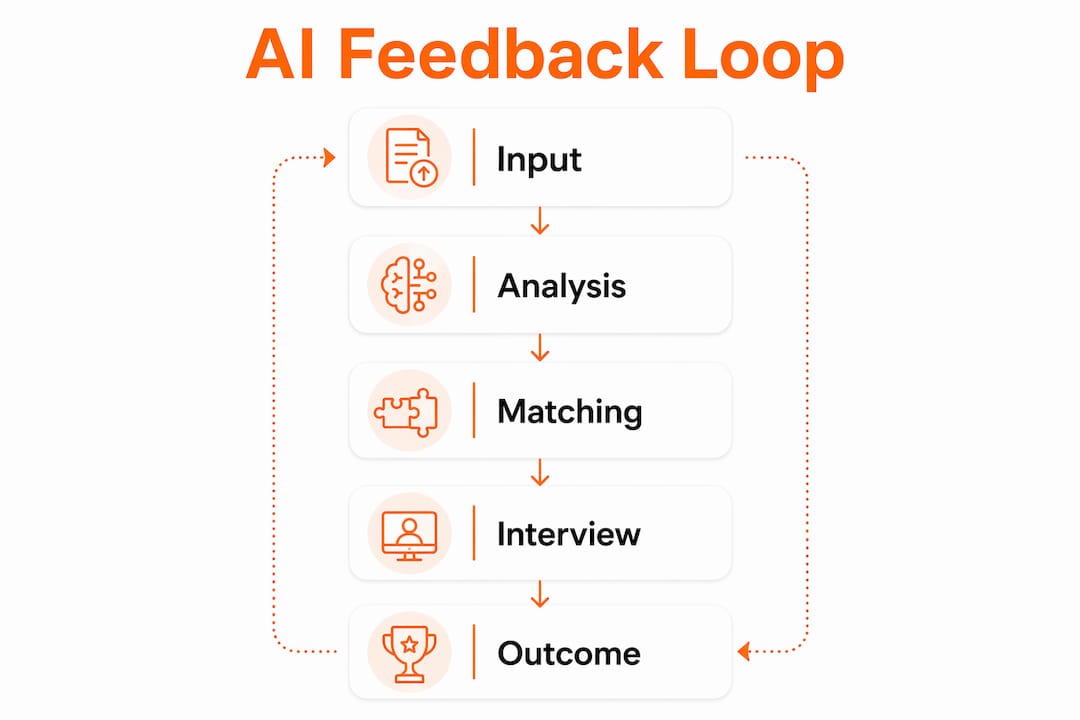
An AI feedback loop in job searching is a continuous cycle where AI systems collect data from candidate interactions and hiring outcomes, then use that data to refine future recommendations and screening decisions. The loop does not run once. It runs after every application, every interview, and every hire, adjusting its criteria each time. For job seekers, understanding how this cycle works is the first step toward using it to their advantage rather than being filtered out by it.
The core components of the loop are:
- Data collection: AI gathers signals from resumes, application behavior, and interview responses.
- Outcome tracking: Hiring results, offer acceptance rates, and post-hire performance feed back into the model.
- Iterative refinement: The AI adjusts its scoring and matching criteria based on what outcomes the data predicts.
- Recommendation delivery: Updated criteria produce more targeted job matches and screening decisions.
- Candidate influence: Job seeker behavior, profile updates, and feedback responses shape the next cycle.
The distinction between memory and learning matters here. Storing past applications is memory. Adjusting search criteria and profile weighting based on those outcomes is a true feedback loop. Most job seekers, and many AI tools, stop at memory.
How AI-powered resume screening works and what it means for you
ATS systems reject a large majority of resumes before a human reviewer ever sees them. That figure alone explains why so many applications disappear without a response. AI resume screening works by parsing submitted documents for keywords, formatting signals, and skill matches against the job description. The system then scores each resume and ranks candidates before any human involvement.
The feedback loop enters here in a specific way. When a screened-in candidate later performs well on the job, that outcome is logged. The AI updates its weighting to favor similar profiles in future cycles. When a screened-in candidate underperforms, the opposite adjustment occurs. Over time, the model becomes more calibrated to what actually predicts job success at that organization, not just what looks good on paper.
Common challenges job seekers face with resume AI:
- Keyword gaps: Resumes that use different terminology than the job description score lower, even when the underlying skills match.
- Formatting errors: Tables, graphics, and non-standard fonts can cause parsing failures that make a resume unreadable to the system.
- Generic language: AI-generated resume text that is not personalized often reads as low-signal to both ATS systems and human reviewers.
- Overoptimization: Keyword stuffing is detectable. ATS systems are increasingly trained to flag unnatural keyword density.
Pro Tip: Start with your own original content, then use AI to refine it. A resume built from your real experience will hold up in the interview; one generated wholesale from a job description will not.
Yale University's Office of Career Strategy advises candidates to treat AI drafts as raw material, not finished product. Employers increasingly scan submitted materials to detect unedited AI output, and detection can result in automatic disqualification.
How AI-driven job matching refines recommendations over time
Job matching algorithms work by comparing a candidate's profile against open roles across multiple dimensions: stated skills, work history, location, salary expectations, and behavioral signals like which postings a candidate clicks or saves. The initial match is a starting point. What makes it a feedback loop is what happens after.

When a candidate applies and advances through screening, that outcome updates the model's understanding of what a strong match looks like for that role type. When a candidate applies and is rejected, the system notes the mismatch. Platforms that run true feedback loops use this data to narrow or expand future recommendations automatically, without the candidate manually adjusting filters.
Job seekers can actively influence recommendation quality by:
- Completing profiles fully: Incomplete profiles give the algorithm less signal, producing lower-quality matches.
- Engaging selectively: Clicking, saving, and applying to roles that genuinely fit trains the system toward better suggestions.
- Updating skills regularly: Adding recent certifications or completed projects shifts the model's understanding of the candidate's current level.
- Providing explicit feedback: On platforms that allow it, marking a recommendation as irrelevant directly updates the next cycle's output.
The practical implication is that job seekers who treat AI platforms as static job boards miss the learning dimension entirely. The platform gets smarter only when the candidate interacts with it consistently and honestly.
What AI does during virtual interviews and skill assessments
AI plays two roles in virtual interviews. The first is logistical: scheduling, recording, and transcribing responses. The second is evaluative: analyzing speech patterns, word choice, response structure, and in some cases facial expression data to score candidate performance against predefined criteria.
Skill assessments follow a similar pattern. AI-administered tests in areas like logical reasoning, technical knowledge, and situational judgment generate structured scores that feed directly into the hiring pipeline. Those scores become data points in the feedback loop, informing which assessment criteria actually predict job performance over time.
Benefits and limitations of AI-driven assessments:
- Benefit: Consistent scoring across all candidates removes interviewer-to-interviewer variation.
- Benefit: Structured scorecards linked to post-hire outcomes improve calibration over multiple hiring cycles.
- Limitation: AI assessments can encode existing biases if the training data reflects historical hiring patterns that favored certain groups.
- Limitation: Candidates unfamiliar with AI interview formats often underperform relative to their actual ability.
Practicing interview questions with iterative AI critique produces better preparation than passive study. The method is direct: give an AI the job description, ask it to run a realistic interview one question at a time, and request specific feedback after each answer. Repeating this process sharpens responses faster than reviewing written guides.
Structured interview scorecards combined with outcome tracking are what separate a genuine feedback loop from a one-time evaluation. Without linking scorecard data to post-hire performance, the loop never closes and the system never improves.
How AI feedback loops change job seeker outcomes
The clearest benefit of a well-designed feedback loop is speed. Recruitment feedback loops help organizations reduce time-to-hire and improve offer acceptance rates by continuously refining the process based on outcome data. For candidates, faster cycles mean shorter waits between application and decision, and more consistent communication throughout.
Match quality also improves. As the AI accumulates more outcome data, its recommendations become more accurate. A candidate who receives a match from a mature feedback loop is more likely to be genuinely qualified for that role than one surfaced by a keyword-only filter.
Potential concerns job seekers should understand:
- Bias amplification: If historical hiring data reflects demographic imbalances, the AI may replicate those patterns in future screening decisions.
- Opacity: Most candidates cannot see why they were screened out, making it difficult to address the specific gap.
- Data privacy: Candidate interaction data, including behavioral signals and assessment responses, is stored and used to train models. Knowing what data a platform collects is a reasonable question to ask before applying.
- The doom loop risk: When both candidates and employers rely entirely on AI without human judgment, application volume rises while signal quality falls. The result is a system where neither side gets what it needs.
The job seeker's role in a healthy feedback loop is active, not passive. Platforms and employers that use AI to detect active hiring signals rather than just filter resumes produce better outcomes for candidates because the data driving decisions is richer and more current.
Expert insights on avoiding AI hiring pitfalls and maximizing results
The most consistent advice from recruiting professionals on AI feedback loops comes down to one principle: AI should enhance candidate work, not replace it.
One technique that consistently improves application quality is the drafter-critic AI architecture. One AI agent drafts the resume or cover letter; a separate agent critiques it against the specific job description for missed keywords, generic phrasing, and factual inconsistencies. The output of two-agent review is measurably stronger than a single-pass prompt.
Common AI misuse traps to avoid:
- Sending unedited output: Recruiters recognize generic AI text. It signals low effort and often triggers automatic disqualification.
- Allowing AI to fabricate credentials: Any invented skill or achievement must be defended in the interview. Getting caught ends the process.
- Ignoring ATS formatting: A well-written resume that a parser cannot read never reaches a human reviewer.
- Treating the loop as static: Candidates who update their profiles and engage with platform feedback consistently get better recommendations than those who apply once and wait.
Closing the interview feedback loop requires linking interview scorecard data to post-hire outcomes. For job seekers, the parallel is tracking which application strategies produce interviews and which produce silence, then adjusting accordingly.
Plucktalent combines 17 years of recruiting expertise with AI-driven profile optimization to connect IT and cybersecurity professionals directly with hiring managers at companies actively seeking their skills. The platform is built around the principle that AI-enhanced recruiting works best when human judgment remains at every decision point.
Key Takeaways
AI feedback loops in job searching work because candidate outcome data continuously refines AI screening, matching, and recommendation systems, producing better results for job seekers who actively engage with the process.
| Point | Details |
|---|---|
| ATS rejection rate | Roughly 75% of resumes are rejected by ATS before a human sees them; keyword alignment is critical. |
| True feedback vs. memory | Storing past applications is memory; adjusting search criteria based on outcomes is a genuine feedback loop. |
| Drafter-critic method | Using two AI agents, one to draft and one to critique, produces stronger application materials than single-pass prompts. |
| Bias and privacy risks | AI feedback loops can amplify historical hiring biases; candidates should understand what data platforms collect. |
| Active engagement matters | Candidates who update profiles, engage selectively, and track outcomes get progressively better AI recommendations. |
FAQ
Do AI job searches actually work?
AI job search tools work when candidates use them to research, tailor, and prepare rather than to auto-apply at volume. Platforms with true feedback loops, where outcomes update future recommendations, produce better matches over time than static job boards.
What is a feedback loop in AI?
A feedback loop in AI is a process where the system's outputs and their real-world outcomes are fed back as inputs to refine future decisions. In hiring, this means interview results and post-hire performance data continuously update the AI's screening and matching criteria.
What is the 30-60-90 rule in an interview?
The 30-60-90 rule refers to a candidate's plan for early job milestones. Presenting a clear plan demonstrates preparation and role understanding, both of which score well in structured AI-assisted interview assessments.
Which jobs are least affected by AI screening?
Roles that require demonstrated judgment, relationship management, and contextual problem-solving are harder for AI to screen purely on keyword signals. That said, AI accelerates core job search tasks across nearly every field, so understanding how feedback loops work is relevant regardless of industry.
How can job seekers influence AI recommendations?
Job seekers can influence AI recommendations by completing profiles fully, engaging only with relevant postings, updating skills after new certifications, and providing explicit feedback on platform suggestions. Each of these actions gives the algorithm better signal for the next recommendation cycle.