
Cybersecurity jobs can be remote, and a growing share of them are. But eligibility hinges on the role, the employer's industry, and the sensitivity of the systems involved. Roughly 58% of cybersecurity positions now offer remote or hybrid arrangements, while jobs tied to classified networks, physical hardware, or 24/7 security operations centers still lean on-site.
TL;DR:
- Remote cybersecurity jobs are mostly available for roles involving cloud management, code review, documentation, and risk management, while roles requiring physical access remain on-site.
- On-site roles often involve access to classified networks, hardware maintenance, or active incident response that cannot be performed remotely.
- Employers expect remote candidates to demonstrate experience with cloud platforms, scripting, security tools, and strong asynchronous communication skills.
- Salaries for remote cybersecurity positions vary significantly depending on specialization and seniority, with cloud and application security roles commanding higher pay.
- Confirming a role's remote status requires checking for explicit language about flexibility, understanding access requirements, and asking about on-site expectations during interviews.
Table of Contents
- Are Cybersecurity Jobs Remote? Roles That Fit Working From Home
- Which Roles Are Fully Remote, Hybrid, or On-Site?
- What Do Employers Expect From Remote Cybersecurity Hires?
- How Much Do Remote Cybersecurity Jobs Pay?
- Where to Find Legitimate Remote Cybersecurity Jobs
- Security Risks of Remote Work, and How Employers Respond
- Recruiter Perspective: What Actually Sets Remote Candidates Apart
- How Plucktalent Helps You Land a Remote Cybersecurity Role
- Primary Sources and Further Reading
- Sources
- FAQ
Are Cybersecurity Jobs Remote? Roles That Fit Working From Home
Not every cybersecurity title carries the same remote-fit score. Some roles were built for distributed work from the start. Others depend on physical access to servers, badge-controlled facilities, or air-gapped networks that make remote work impractical.
Here is how the most common cybersecurity job titles typically break down:
- Cloud security engineer (fully remote): Manages cloud provider consoles, configures access policies, and reviews infrastructure as code, all from a browser or terminal.
- Application security analyst (fully remote): Runs static and dynamic code scans, reviews pull requests, and coordinates with development teams over chat and video.
- GRC (governance, risk, and compliance) analyst (fully remote): Writes policy, tracks audit evidence, and manages risk registers, work that rarely requires a physical office.
- Threat intelligence analyst (commonly remote or hybrid): Monitors open-source feeds, dark web forums, and vendor reports to track emerging threats.
- Security technical writer or instructor (fully remote): Documents procedures or teaches certification courses, often for distributed teams across time zones.
- Penetration tester (hybrid): Handles most testing remotely but occasionally travels for physical security assessments or client-site engagements.
- SOC analyst (often hybrid or on-site): Monitors alerts in shifts, sometimes from a secure operations floor that restricts remote access.
- Incident responder (hybrid, sometimes on-call on-site): Needs fast physical access to compromised systems during active breaches.
- Government or defense contractor security roles (on-site): Typically require a security clearance and access to classified networks that cannot leave a secure facility.
The pattern is consistent: roles centered on cloud consoles, code, and documentation travel well. Roles tied to physical infrastructure or classified data do not.
Which Roles Are Fully Remote, Hybrid, or On-Site?
Three structural factors decide whether a cybersecurity job can go fully remote, and understanding them helps you target the right openings instead of guessing.
- Physical access requirements. Air-gapped systems, government-classified networks, and on-premises hardware maintenance force an on-site presence. No amount of VPN access substitutes for hands-on server work or a cleared facility.
- Cloud-native versus legacy infrastructure. Cloud and application security roles map naturally to remote work because the "office" is a browser tab: AWS or Azure consoles, automated telemetry dashboards, and code repositories are accessible from anywhere with reliable internet.
- Incident response cadence. Hybrid arrangements are common for SOC and IR teams. Analysts might work remotely most weeks but rotate through in-person shifts for high-severity incidents, quarterly team syncs, or onboarding periods when new hires need supervised training.
Employers rarely publish these constraints outright in a job title. They show up in the job description's mention of clearance requirements, on-call rotations, or "must be within commuting distance" language.
What Do Employers Expect From Remote Cybersecurity Hires?
Remote hiring managers screen for more than technical chops. They want proof you can operate independently without daily hallway check-ins.
Core technical expectations usually include:
- Working knowledge of at least one major cloud platform (AWS, Azure, or Google Cloud)
- Hands-on experience with SIEM tools, EDR platforms, and identity and access management systems
- Scripting ability in Python, PowerShell, or Bash for automation and log analysis
- Familiarity with frameworks like the NIST Cybersecurity Framework for structuring controls and reporting
Certifications carry different weight depending on the role. Security+ often opens the door to entry-level SOC and analyst positions. CISSP signals readiness for senior or management-track roles. OSCP matters heavily for penetration testing and offensive security jobs. Cloud-specific certifications (AWS Security Specialty, Azure Security Engineer) increasingly outweigh generalist credentials for cloud security openings.
Remote-specific signals matter just as much. Hiring managers look for prior remote work history, strong written documentation habits, and comfort with asynchronous tools like Slack, Jira, or Confluence.
Pro Tip: List a specific example of a project you documented or handed off asynchronously (a runbook, a Confluence page, a recorded walkthrough) directly on your resume or LinkedIn profile. It tells a hiring manager you can work without supervision before they ever ask.
How Much Do Remote Cybersecurity Jobs Pay?
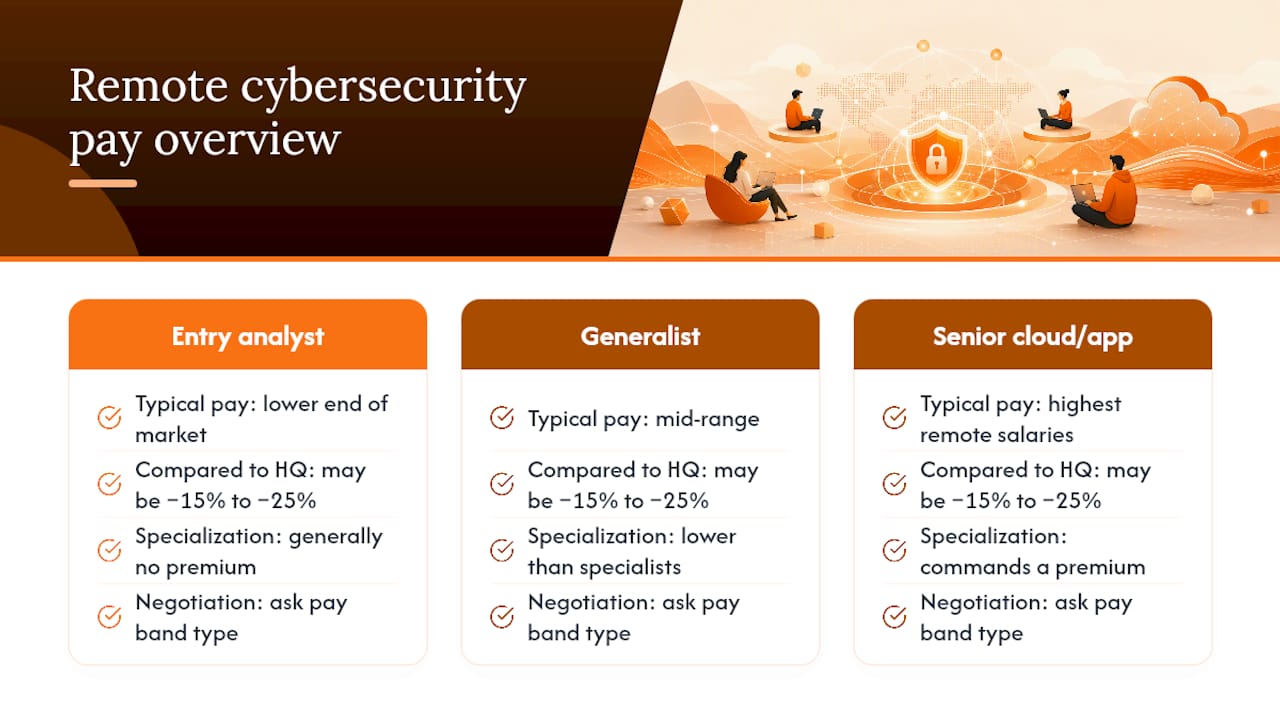
Pay for remote cybersecurity roles varies widely by specialization and seniority, and specialized roles in cloud and application security typically command a premium over generalist positions.
Pay reality check: Many employers apply location-adjusted pay for remote hires, often trimming offers by roughly 15% to 25% for candidates in lower cost-of-living areas compared to headquarters-based rates.
Entry-level analyst roles tend to sit at the lower end of the market, while senior cloud security engineers and security architects command the highest remote salaries. You can check current cybersecurity analyst salary trends for a clearer sense of where a given title lands.
When negotiating, ask directly whether the offer uses national pay bands or location-adjusted bands. That single question often reveals thousands of dollars in potential difference before you sign anything.
Where to Find Legitimate Remote Cybersecurity Jobs
Finding a genuinely remote role means reading past the job title and into the fine print.
- Check the tech stack mentioned in the posting. A listing referencing specific cloud consoles or SaaS security tools, rather than vague "network infrastructure" language, usually signals a role built for distributed work.
- Look for explicit remote policy language. "Remote eligible" is weaker than "fully remote, no relocation required." The latter is a much stronger signal.
- Watch for red flags: vague location fields ("United States" with no state), mandatory relocation clauses buried in paragraph four, or "hybrid" language that actually means five office days with flexible hours.
- Ask direct interview questions: How many office days per month, if any? Where is the team located? Does incident response ever require travel? Who covers on-call hours across time zones?
Once you confirm a role is genuinely remote, tighten your resume and LinkedIn profile to reflect remote-specific accomplishments. Reviewing a candidate experience guide can help you understand what applicant tracking systems and hiring managers actually scan for before a human ever reads your resume.
Security Risks of Remote Work, and How Employers Respond
Distributed teams expand the attack surface in ways a centralized office never did. Home networks, personal devices, and unvetted collaboration tools all become potential entry points for attackers.
Microsoft documented an attack chain where threat actors impersonated IT support inside Microsoft Teams, convinced an employee to start a remote session, then delivered a malicious installer that led to enterprise-wide lateral movement. The entry point was a trusted-looking chat message, not a firewall gap.
Organizations mitigate this with layered controls:
- Zero Trust architecture that verifies every access request regardless of network location
- Managed endpoint software and mandatory multi-factor authentication on all accounts
- Restrictions on which remote monitoring and management (RMM) tools can run on company devices
- Conditional access policies that flag logins from unusual devices or locations
Employees carry responsibility too: keeping home networks segmented from guest devices, verifying any unsolicited "IT support" contact through a second channel, and reporting anything that feels off before clicking. These practices map directly to the Identify, Protect, Detect, Respond, and Recover categories in the NIST Cybersecurity Framework.
Recruiter Perspective: What Actually Sets Remote Candidates Apart
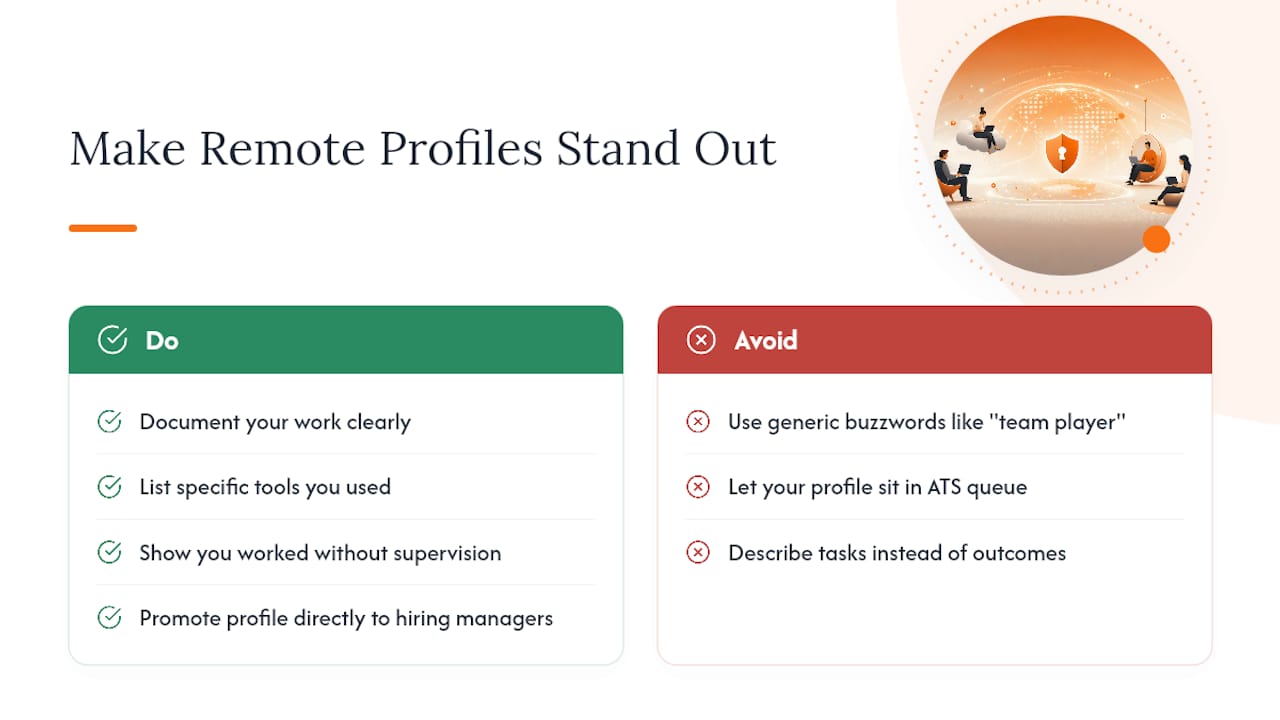
The candidates who land remote cybersecurity roles rarely have flashier resumes. They document their work clearly, cite specific tools instead of vague buzzwords, and show they've operated without daily supervision before. Weak applications lean on generic phrases like "team player" instead of concrete proof of async collaboration.
The approach focuses on getting candidate profiles in front of hiring managers directly, rather than having them sit in an applicant tracking system queue. If you take one thing from this: rewrite your resume around outcomes you delivered remotely, not just tasks you performed.
— Diego
How Plucktalent Helps You Land a Remote Cybersecurity Role
The platform helps cybersecurity professionals connect more directly with hiring managers and offers AI assistance to tailor resumes for specific roles, potentially uncovering hidden job openings not usually visible on major job boards.
This is especially beneficial for roles such as cloud security engineers, GRC analysts, and application security specialists targeting fully remote positions, where tailored resumes and better connections to hiring managers can improve chances of receiving interview invitations. Reviewing your career path options in IT and cybersecurity alongside a tailored profile gives you a clearer shot at roles that match both your skills and your remote-work goals.
Start by visiting the job seekers page to see how Plucktalent matches your background to companies actively hiring for remote cybersecurity talent right now.
Primary Sources and Further Reading
- NIST Cybersecurity Framework: control categories referenced for remote-work security guidance
- Built In: Companies Hiring Remote Cybersecurity Roles: employer examples and remote/hybrid prevalence data
- Microsoft Security Blog: IT support impersonation incident: remote-support attack chain analysis
- BLS: Network and Computer Systems Administrators: occupational duties for adjacent IT roles
Sources
- Impersonating IT support: Threat actors turn remote session into enterprise-wide access | Microsoft Security Blog
- NIST Cybersecurity Framework
- 10 Top Companies Hiring Remote Cybersecurity Roles | Built In
- Network and computer systems administrators | U.S. Bureau of Labor Statistics
FAQ
Can I Make $200,000 a Year in Cybersecurity?
Yes, but typically only at senior levels: security architects, principal engineers, and specialized cloud security leads in high-demand markets or with premium employers reach that range, while entry-level and mid-career roles sit well below it.
Is Cybersecurity a 9-to-5 Job?
It depends on the role: GRC, cloud security, and application security roles often run standard business hours, while SOC analysts and incident responders frequently work rotating shifts or on-call schedules that break from standard daytime hours.
Is Cybersecurity a Dead End Job?
No. Demand for cybersecurity skills continues to grow across industries, and specialization in cloud security, application security, or governance creates clear paths toward senior and leadership roles rather than a career plateau.
Is AI Replacing Cybersecurity Jobs?
AI is automating routine tasks like log triage and initial alert filtering, but it is shifting cybersecurity work toward higher-level analysis, oversight, and strategy rather than eliminating the field. Professionals who build skills in cloud security and AI-assisted tools tend to stay ahead of that shift, and platforms like Plucktalent help candidates position those skills clearly to employers.