
Candidate experience, in the job-seeker sense, is the sum of every interaction you have with an employer from the moment you read a job posting through onboarding. For IT and cybersecurity professionals, that journey is shaped by ATS filters, multi-round technical assessments, and communication gaps often unrelated to your qualifications. Three actions improve your position immediately:
- Make role outcomes visible. Replace responsibility lists with project evidence: a GitHub repo, a short case study, or a measurable result tied to a specific system or threat.
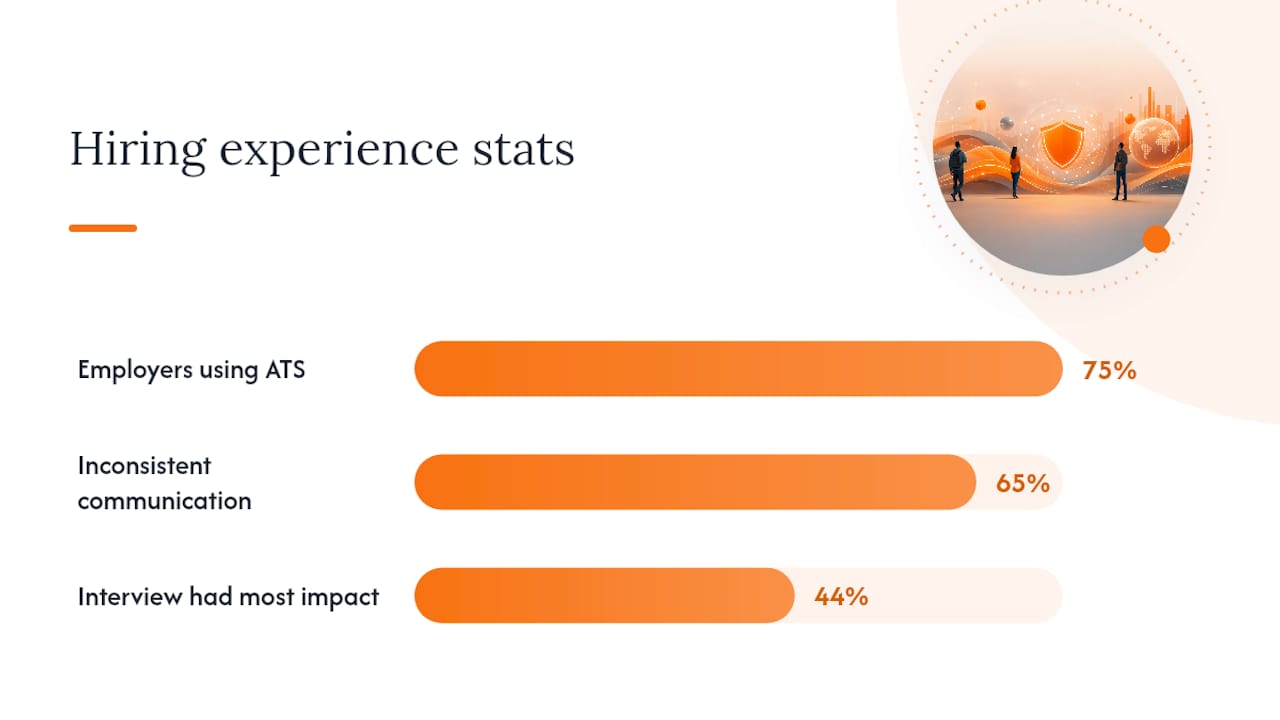
- Optimize resume metadata for AI screening. About 75% of employers use ATS; many of those systems now integrate AI-powered screening before a human reviewer ever sees your file.
- Test employer signals early. Ask about timelines, interview structure, and evaluation criteria in the first recruiter call. How a company answers those questions tells you more than the job description does.
Research cited by IBM reports that around 65% of candidates experience inconsistent communication during hiring. Data shows 44% of successful candidates say the interview experience had the greatest impact on their decision to accept an offer. Plucktalent draws on 17 years of IT and cybersecurity recruiting to help candidates navigate exactly these friction points.
Key Takeaways
Candidate experience in IT and cybersecurity is determined by how well you optimize for AI screening, how visibly you present your work, and how early you screen employers for respectful processes.
| Point | Details |
|---|---|
| ATS optimization is the first gate | About 75% of employers use ATS, and 79% of those systems include AI-powered screening; match exact keywords from each posting to survive the first pass. |
| Visible project evidence outperforms responsibility lists | Short problem-action-impact write-ups on GitHub give recruiters a 90-second signal that a resume alone cannot. |
| Screen employers early | Ask about rounds, assessment format, and timelines in the first recruiter call to avoid wasted effort. |
| Poor experience is recoverable | A brief, factual feedback note within 48 hours closes the loop professionally and keeps future doors open. |
| Plucktalent shortens the path | The platform surfaces hiring-manager contacts and ATS-ready profiles for IT and cybersecurity roles specifically. |
Table of Contents
- Why does candidate experience matter for IT and cybersecurity professionals?
- What should you expect at every hiring touchpoint?
- How can you take control of your own candidate experience?
- Which tools help you search smarter and evaluate employers?
- How do you recover from a poor candidate experience?
- What actually separates respectful hiring from the rest
- Plucktalent connects IT and cybersecurity candidates directly to hiring managers
- Sources
- FAQ
Why does candidate experience matter for IT and cybersecurity professionals?
Poor candidate experience carries direct costs for job seekers. Wasted time on multi-round processes that end without feedback, unpaid take-home projects, and radio silence after final interviews all reduce the number of quality opportunities you can pursue in parallel.
CSO Online reports that cybersecurity hiring processes are often described as "demoralizing," with excessive rounds and requests for unpaid work creating significant candidate friction. Security roles add specific complications: clearance requirements, niche skill taxonomies, and job descriptions written for a candidate who does not exist.
The Gallup figure above is worth holding onto: nearly half of accepted offers trace back to how the interview itself felt, not just the compensation package. That means a well-prepared interviewer and a clear evaluation process are not courtesies. They are measurable factors in whether top candidates say yes.
For IT roles specifically, what good looks like is concrete: the job posting states expected outcomes, not just a stack of tools; interviewers can discuss technical tradeoffs rather than recite scripted questions; and timelines are communicated at each stage without the candidate having to chase them.
What should you expect at every hiring touchpoint?
Candidate experience covers all recruitment touchpoints, from job postings and application UX through interviewer preparation and timeline transparency. The table below maps each stage, what a respectful process looks like, and the red flags worth noting.
| Touchpoint | What good looks like | Red flag |
|---|---|---|
| Job posting | Clear outcomes, required vs. preferred skills separated, realistic scope | Vague responsibilities, many required tools, no salary range |
| Application | Acknowledgment quickly, short form with relevant fields only | No confirmation email, redundant data entry after resume upload |
| Screening call | Recruiter knows the role, shares timeline and next steps | Recruiter cannot answer basic technical questions about the position |
| Technical assessment | Scoped, time-bounded, relevant to actual job tasks | Unpaid multi-day project, no rubric or evaluation criteria shared |
| Interviews | Interviewers prepared, panel size proportional to seniority | More than 4 rounds for a non-executive role, repeated questions across panels |
| Offer | Written offer matches verbal discussion, clear start date and onboarding plan | Verbal-only offer, vague onboarding, pressure to decide quickly |
For cybersecurity roles in particular, watch for assessments that ask for deliverables resembling actual consulting work. A scoped, 60-minute technical exercise is reasonable. A multi-day architecture review with no compensation is not.
How can you take control of your own candidate experience?
Control starts before you apply. Tailoring your resume to the specific posting, not just the job title, is the single highest-leverage action most candidates skip.
- Map keywords from the posting to your resume. Pull the exact terms the job description uses for tools, frameworks, and certifications. ATS systems match on those strings. If the posting says "SIEM" and your resume says "security event management," the algorithm may not connect them.
- Make your work visible with project evidence. CompTIA advises that top candidates show ongoing professional evolution through project-based work and visible repositories rather than listing responsibilities alone. A 1–2 paragraph problem-action-impact write-up on GitHub or a portfolio page gives recruiters something to skim in under 90 seconds.
- Screen employers in the first recruiter call. Ask: "How many interview rounds does this process include?" and "What does the technical evaluation look like?" A recruiter who cannot answer both questions is a signal about how the company runs its hiring.
- Follow up with a short, specific note. After each stage, send a one-paragraph message that references a specific technical point from the conversation. It demonstrates attention and keeps your name visible without being intrusive.
- Use targeted outreach over mass applications. Security Magazine reports that AI filters, arbitrary application caps, and platform taxonomy can mis-surface or exclude qualified security candidates. Direct, targeted outreach to hiring managers is often a higher-signal path than applying through a general job board.
Pro Tip: Automate the search, not the outreach. Use tools to surface relevant roles and hiring-manager contacts, then write each message manually. A personalized three-sentence note consistently outperforms a templated paragraph.
Which tools help you search smarter and evaluate employers?
The right tool stack reduces friction at the screening stage and helps you assess employers before committing time to their process.
| Category | What to look for | What to avoid |
|---|---|---|
| Portfolio/Git hosting | Public repos with README context, pinned projects, measurable outcomes in descriptions | Private repos with no public signal for recruiters |
| ATS resume scanners | Keyword gap analysis, formatting checks, export to clean PDF | Tools that rewrite your resume wholesale without human review |
| Role-discovery platforms | Direct hiring-manager contacts, IT/cybersecurity-specific filters, active-hiring signals | General job boards with broad category tags that misclassify security roles |
| Mock interview tools | Technical question banks by domain (cloud, AppSec, SOC), timed responses | Generic behavioral-only platforms with no technical depth |
AI tools for tech job seekers have expanded significantly, but the quality gap between general-purpose tools and IT-specific ones is wide. A general resume spinner may pass a basic ATS check while stripping the domain-specific language that a security hiring manager actually reads for.
For role discovery, platforms that surface hidden job markets and provide direct hiring-manager contact information reduce the time between application and first conversation. That reduction matters because the longer a search drags, the more likely a candidate accepts a suboptimal offer out of fatigue.
How do you recover from a poor candidate experience?
Two steps cover most situations. First, send a short professional note to the recruiter or hiring manager. Second, document the employer and reallocate your time to higher-signal opportunities.
- Send feedback within 48 hours. Keep it factual and brief. Note what was unclear or what created friction, and close with a forward-looking line.
- Document red-flag employers. Maintain a simple list of companies where the process was disrespectful or opaque. That list protects your time in future searches and is useful context if a recruiter asks why you are not interested in a particular company.
- Keep the relationship open. Hiring managers change. Processes improve. A polite, professional close leaves the door open for future roles without requiring you to re-litigate the experience.
A sample feedback note: "Thank you for the time your team invested in the process. I wanted to share that the timeline between stages was difficult to plan around, and clearer communication at each step would have helped. I remain interested in [Company] and hope to stay in touch for future opportunities."
What actually separates respectful hiring from the rest
The volume problem in technical recruiting is real. Hiring teams receive hundreds of applications for a single security role, and automation handles the first pass by necessity. That is not inherently disrespectful. What separates a well-run search from a poor one is whether the automation is designed to protect candidate time or just to reduce recruiter workload.
The signals worth watching: Does the job posting state what success looks like in 90 days? Does the recruiter share the full process upfront? Are interviewers prepared to discuss the actual technical environment, not just run through a question list?
Candidates who present measurable impact, not just credentials, move through both AI screening and human review faster. A resume that says "reduced mean time to detect by 40% across 12 endpoints" gives an algorithm a keyword match and a human reviewer a reason to call. Both matter.
Plucktalent connects IT and cybersecurity candidates directly to hiring managers
Plucktalent combines 17 years of IT and cybersecurity recruiting expertise with Plucky AI, a job search platform built specifically for technical professionals. The platform surfaces active hiring-manager contacts, delivers ATS-optimized resume tailoring, and connects candidates to vetted roles, cutting the time between application and first conversation.
Three direct benefits for candidates navigating the process described in this guide:
- Faster screening. ATS-ready profiles built around the specific language hiring managers in IT and cybersecurity actually use.
- Curated technical matches. Roles filtered by domain, not broad category tags that misclassify security titles.
- Fewer unpaid asks. Recruiter-vetted placements where process expectations are confirmed before you invest time.
Start your search on Plucktalent to connect with hiring managers at companies actively hiring for your skills.
Sources
- Cybersecurity hiring is deeply flawed, 'demoralizing,' and needs to be fixed | CSO Online
- How to Improve Candidate Experience with AI | IBM
- Top Strategies for Tech Job Seekers | CompTIA Global
- AI Algorithms Could Undermine Your Security Job Hunt | Security Magazine
- Candidate experience overview | Qualtrics
FAQ
What is candidate experience for IT and cybersecurity job seekers?
Candidate experience is the sum of every interaction a job seeker has with an employer, from reading the job posting through onboarding. For IT and cybersecurity professionals, it includes how well the process handles technical assessments, communication, and timeline transparency.
Why do so many IT candidates report poor hiring experiences?
CSO Online documents that cybersecurity hiring often includes excessive rounds and unpaid work requests. Around 65% of candidates across industries report inconsistent communication from employers during the process.
How many interview rounds are reasonable for a technical role?
For most non-executive IT and cybersecurity roles, four rounds or fewer is a reasonable expectation. More than four rounds without a clear rationale is a process red flag worth raising directly with the recruiter.
How does ATS screening affect IT candidates specifically?
About 75% of employers use ATS, and 79% of those systems integrate AI-powered screening. Security roles are particularly vulnerable to misclassification because platform taxonomy often groups broad IT categories together, filtering out qualified candidates before human review.
How does Plucktalent improve the candidate experience for tech professionals?
Plucktalent surfaces direct hiring-manager contacts, delivers ATS-optimized resume tailoring, and connects IT and cybersecurity candidates to recruiter-vetted roles, reducing the time and friction between application and first conversation.