
A career path in IT and cybersecurity is the sequence of roles, skills, and credentials that moves a professional from their current position toward a defined next role. The single best next step is to build a focused 6–12 month Individual Development Plan (IDP) that targets career capital: the specific skills, certifications, and projects that make the next role attainable.
Quick-start checklist:
- Identify the one role you want to hold in 12 months.
- List the three skills or credentials that role requires and you do not yet have.
- Choose one bridge project that produces a demonstrable artifact.
- Update your resume and LinkedIn to reflect current technical scope.
- Set a 90-day review date for your IDP.
Table of Contents
- How IT and cybersecurity career tracks actually progress
- Skills and certifications mapped to each career stage
- What AI-driven career path tools actually do for tech talent
- How to build an IDP that targets your next IT or cybersecurity role
- How to choose the best next step rather than a 10-year plan
- Resume, LinkedIn, and ATS actions to reach the next role
- How to pivot between tracks with concrete bridge projects
- Key Takeaways
- A recruiter's perspective on what actually moves candidates forward
- Plucktalent connects your IDP to real hiring managers
- Useful sources for your IDP and career decisions
- FAQ
How IT and cybersecurity career tracks actually progress
Most U.S. IT and cybersecurity professionals move through four broad stages: entry-level operator, mid-level specialist, senior/architect, and manager or principal. The table below maps common tracks to those stages with commonly observed U.S. salary bands based on available labor market data.
| Track | Entry | Mid | Senior/Architect | Manager/Principal |
|---|---|---|---|---|
| Security Operations | SOC Analyst I | SOC Analyst II / Threat Analyst | Detection Engineer | SOC Manager |
| Incident Response | IR Analyst | Senior IR Analyst | IR Lead | CISO / VP Security |
| Cloud Engineering | Cloud Support Eng. | Cloud Engineer | Cloud Architect | Director of Cloud |
| Application Security | AppSec Analyst | Senior AppSec Eng. | AppSec Architect | Head of Product Security |
| Governance & Compliance | GRC Analyst | Senior GRC Analyst | Compliance Architect | CISO / VP Risk |
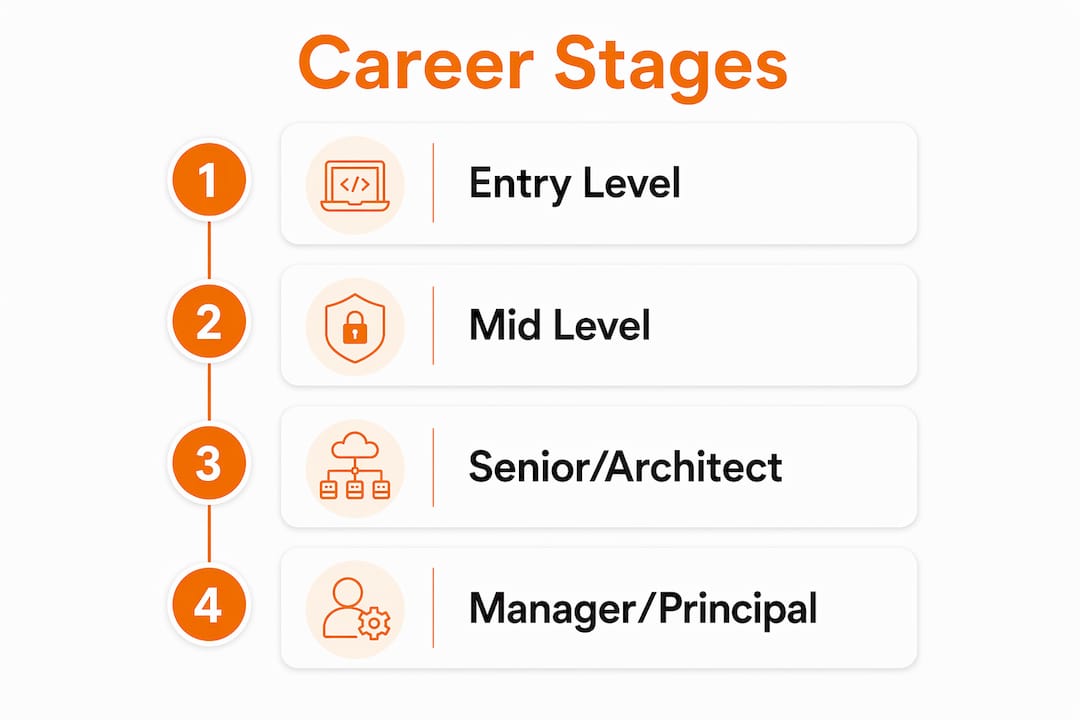
According to the Bureau of Labor Statistics, the median annual wage for information security analysts is $120,360. Entry-level cybersecurity roles typically fall somewhat below this median, while senior architects and managers in major U.S. metro markets often earn well above it.
Skills and certifications mapped to each career stage

The right credential at the wrong stage wastes time. The table below maps technical skills and certifications to career stage.
| Stage | Core Technical Skills | Key Certifications |
|---|---|---|
| Entry | Networking fundamentals, Linux CLI, SIEM basics, scripting | CompTIA Security+, CompTIA Network+, AWS Cloud Practitioner |
| Mid | Threat hunting, cloud-native security, vulnerability management | OSCP, CEH, AWS Security Specialty, CySA+ |
| Senior | Secure architecture, zero-trust design, DevSecOps, red team ops | CISSP, CISM, SABSA, GREM |
| Leadership | Risk quantification, board communication, vendor governance | CISO Executive Program, CRISC, MBA electives |
Non-technical skills matter at every stage, but their weight increases sharply above mid-level. Incident communication, stakeholder influence, and the ability to translate technical risk into business terms are what separate senior candidates from the rest.
- At entry level: documentation discipline and ticket hygiene signal professionalism.
- At mid-level: written post-mortems and cross-team communication become visible differentiators.
- At senior level: hiring, mentoring, and budget justification are expected competencies.
Pro Tip: The combination of OSCP plus a documented cloud-hardening proof-of-concept on GitHub produces a stronger hiring signal for mid-to-senior security roles than either credential alone. Hiring managers can verify the project; they can only infer the cert.
Career development frameworks consistently identify practical project experience alongside credentials as the core driver of progression.
What AI-driven career path tools actually do for tech talent
AI career-path tools compare a candidate's resume against industry role trajectories to surface skill gaps, suggest target roles, and estimate salary bands. The core output is a scenario map: given your current profile, here are three plausible next roles and what each requires.
Where these tools add real value is pattern recognition. They process thousands of job titles and transition sequences faster than any human advisor. Tools like Grow with Google's Career Dreamer and AI-powered platforms map transferable skills to realistic next roles, which helps populate an IDP with specific targets rather than vague aspirations.
AI career tools are best used for scenario generation and gap identification. They are not reliable as sole arbiters of salary claims or role-fit decisions. Human verification and local market context are required before acting on any AI-generated recommendation.
The limits are real. Salary estimates vary significantly by U.S. metro market, and AI tools trained on national averages can mislead professionals in high-cost cities or niche specializations. Privacy is a separate concern: uploading a detailed resume to a third-party AI tool shares employment history, employer names, and compensation data. Read the privacy policy before uploading. For AI-assisted job search tools built for tech roles, the best practice is to verify every AI suggestion against at least two live job postings before treating it as a planning input.
How to build an IDP that targets your next IT or cybersecurity role
The U.S. Office of Personnel Management (OPM) recognizes IDPs as the formal mechanism to align employee development with organizational goals and recommends annual updates. For IT and cybersecurity professionals, a 6–12 month horizon with 3-month checkpoints is more practical than an annual review alone.
IDP template:
| IDP Field | Example Entry (SOC Analyst → Threat Hunter) |
|---|---|
| Target role | Threat Hunter / Detection Engineer |
| Current gap | No formal threat hunting experience; no OSCP |
| Measurable objective | Complete OSCP lab environment and pass exam within 6 months |
| Actions | 1. Enroll in OSCP course. 2. Build detection lab on home server. 3. Document three hunting hypotheses as case studies. |
| Resources | OSCP course, TryHackMe, internal SIEM access |
| Timeline | Month 1–3: lab build + coursework. Month 4–6: exam prep + case studies. |
| Success indicators | OSCP pass, three published case studies, one internal hunting engagement |
| Review date | 90 days from IDP creation |
Involve your direct manager and a mentor in the IDP review. OPM guidance notes that IDPs work best as living documents updated in sync with performance cycles. More frequent 3–6 month checkpoints keep the plan relevant as the job market shifts.
Checklist to turn an IDP into interview-ready artifacts:
- Each objective produces a named, shareable output (cert, repo, case study, post-mortem).
- Every action item has a deadline and a named resource.
- The IDP is shared with at least one mentor or manager who can vouch for progress.
- Resume and LinkedIn are updated within one week of completing each IDP milestone.
How to choose the best next step rather than a 10-year plan
80,000 Hours recommends concentrating effort on the best next step and using an A/B/Z framework: Plan A is the ideal trajectory, Plan B is a nearby pivot, and Plan Z is a reliable fallback such as freelance consulting. Review cadence: every 6–24 months.
A practical decision matrix for evaluating next steps:
| Option | Speed to Impact | Learning Value | Visibility | Fallback Viability |
|---|---|---|---|---|
| Internal lateral move | Medium | High | High | High |
| External hire (new employer) | High | High | Medium | Medium |
| Certification only | Low | Medium | Low | Low |
| Bridge project (PoC/repo) | Medium | High | High | High |
| Graduate degree | Low | High | Low | Medium |
Red flags for a poor next step: low visibility to hiring managers, brittle specialization with no adjacent applications, and no measurable output at the end. A certification with no accompanying project falls into this category more often than not.
BetterUp's career development research supports running small, time-boxed experiments before committing to a full pivot. A 30-day proof-of-concept project costs little and produces evidence.
Resume, LinkedIn, and ATS actions to reach the next role
A resume that passes ATS filters and attracts a hiring manager requires specific construction. Generic summaries and vague role descriptions are the two most common failure points.
Resume checklist:
- Headline names the target role, not the current title.
- Each bullet leads with a measurable outcome (reduced MTTR by X%, deployed Y across Z environments).
- Tech stack appears in a dedicated skills section with exact tool names (Splunk, CrowdStrike, Terraform, AWS GuardDuty).
- One page for under 8 years of experience; two pages for senior and above.
- File format is .docx or .pdf per the job posting's instructions.
LinkedIn actions:
- Headline: "Threat Hunter | OSCP | AWS Security | Open to Senior Detection Roles" outperforms "Cybersecurity Professional."
- Featured section: pin the GitHub repo, case study, or published post-mortem.
- Request recommendations from managers and peers who can speak to specific projects.
- Set "Open to Work" to recruiter-only visibility to avoid alerting current employers.
For ATS keyword strategy, reverse-engineer the job description: paste the posting into a text editor, identify the five most repeated technical terms, and confirm each appears in your resume at least once in context. Keyword stuffing (listing tools with no context) triggers ATS spam filters and reads poorly to human reviewers.
How to pivot between tracks with concrete bridge projects
A lateral move from, say, cloud engineering to cloud security is credible only when the candidate can show work product, not just a new certification. The professional journey framework identifies demonstrable artifacts as the primary evidence in track pivots.
Step-by-step pivot process:
- Conduct a skills audit: list what transfers and what is missing.
- Select one bridge project that produces a public or shareable artifact.
- Seek a mentor or internal colleague in the target track for a structured pairing.
- Complete the project and document it as a case study or GitHub repo.
- Apply internally first: temporary assignments and rotations reduce risk for both sides.
- Target external applications only after the artifact is complete and the IDP reflects the new direction.
A concrete example: a cloud engineer pivoting to cloud security implements a CIS Benchmark hardening script for an AWS environment, documents the before/after state, and publishes it as a GitHub repo with a written case study. That artifact answers the hiring manager's first question before the interview begins.
Internal transfers are underused. Mentorship and internal mobility programs materially affect career satisfaction and reduce the time to a credible pivot, according to GFT's analysis of professional development programs.
When a pivot involves a significant track change (engineering to CISO track, for example), a specialist IT recruiter can compress the timeline by mapping the candidate's transferable skills to active openings before the candidate has finished building the full artifact set.
Key Takeaways
A focused 6–12 month IDP targeting career capital is the most direct route from a current IT or cybersecurity role to the next one.
| Point | Details |
|---|---|
| Build an IDP first | A 6–12 month IDP with 3-month checkpoints outperforms vague long-term planning for job progression. |
| Map skills to stage | Certifications and projects must match the target role's stage; the wrong cert at the wrong time adds little hiring value. |
| Use AI tools carefully | AI career tools help with scenario mapping and gap identification but require human verification for salary and role-fit claims. |
| Bridge projects beat certs alone | A documented PoC or GitHub repo paired with a relevant cert produces a stronger hiring signal than either alone. |
| Plucktalent accelerates the process | Plucktalent maps IDP milestones to ATS-ready profiles and direct hiring manager contacts, converting development plans into interviews. |
A recruiter's perspective on what actually moves candidates forward
Most candidates focus on credentials. Hiring managers focus on evidence. After 17 years recruiting for IT and cybersecurity roles at Plucktalent, the pattern is consistent: the candidates who move fastest through the pipeline are not always the most certified. They are the ones who can point to a specific project, a measurable outcome, or a documented decision that shows how they think.
The IDP approach works not because it is a formal document, but because it forces specificity. A candidate who says "I am working toward a threat hunter role and here is my detection lab repo" is immediately more credible than one who says "I am interested in moving into threat hunting." Hiring managers hear the second version constantly. The first version is rare.
Two actions worth doing this week: update your LinkedIn headline to name the specific role you are targeting, and create one shareable artifact from work you have already done. A post-mortem, a sanitized runbook, a short technical post. Something a hiring manager can read before the call.
Plucktalent connects your IDP to real hiring managers
Plucktalent is built for IT and cybersecurity professionals who have a clear next role in mind and need the pipeline to match. The platform takes the IDP work done above and converts it into a concrete hiring advantage: ATS-optimized resume tailoring, AI-powered role matching against active openings, and direct access to hiring manager contact information at companies actively recruiting for specific skills.
The process is direct. Upload your resume, identify your target role, and Plucktalent's platform surfaces the openings and contacts that match your current profile and IDP direction. There is no job board noise, no black-hole applications. The job seeker platform is the practical next step after completing the IDP template above.
Useful sources for your IDP and career decisions
These sources support the frameworks and templates in this article.
- OPM Career Development: The authoritative U.S. government source for IDP structure, cadence, and documentation standards. Use it to align your IDP with employer L&D processes.
- 80,000 Hours Career Planning: The A/B/Z framework and next-step focus methodology. Use it to build your decision matrix and set review cadence.
- Grow with Google Career Development: Practical SMART goal templates and the Career Dreamer skill-to-role mapping tool. Use it to populate IDP objectives with specific, measurable targets.
- BetterUp Career Development: Behavioral guidance on career capital and short-term experiments. Use it to validate next-step choices before committing to a full pivot.
These sources complement each other: OPM provides the policy framework, 80,000 Hours provides the decision logic, Grow with Google provides the skill mapping, and BetterUp provides the behavioral evidence for why short-term focus outperforms long-range planning.
FAQ
What is a career path in IT and cybersecurity?
A career path in IT and cybersecurity is the sequence of roles, skills, and credentials that moves a professional from their current position toward a defined target role. It can follow a linear track (analyst to architect) or a lateral one (engineering to security).
How long does it take to advance from entry level to senior in cybersecurity?
Most professionals reach senior-level roles within several years, depending on the track, certifications earned, and the visibility of projects completed along the way.
What is an IDP and why does it matter for job progression?
An Individual Development Plan (IDP) is a structured document that maps learning objectives, target roles, and timelines. The OPM recommends annual updates; for IT and cybersecurity professionals, 3–6 month checkpoints are more practical given how fast the field moves.
How do I pivot from one IT track to another?
Complete a skills audit, build one bridge project that produces a shareable artifact (GitHub repo, case study, or documented PoC), and apply internally before targeting external roles. A specialist recruiter can accelerate the process when the pivot is significant.
How does Plucktalent support career advancement for IT professionals?
Plucktalent matches IDP-aligned profiles to active openings and provides direct hiring manager contacts, bypassing generic job boards. The platform's AI matching and ATS optimization convert development milestones into interview opportunities.