
A smart job application is a tailored, timely, and authentic submission designed to maximize your interview conversion rate in competitive tech hiring. The term is informal, but the practice maps directly to what recruiters call a "targeted application," one built around a specific role, company, and hiring context rather than sent as a generic blast. For IT and cybersecurity professionals, the standard benchmark is a 7–9% application-to-interview conversion rate. Candidates falling below 3% typically have a targeting or ATS alignment problem, not a credentials problem. A well-built application addresses both the automated filter and the human recruiter who reads what passes through.
What is a smart job application and why does it matter for tech roles?
A targeted application differs from a generic one in three measurable ways: it uses the job description's exact language, it references something specific about the company, and it quantifies the candidate's impact. Customized applications generate a 5.75% interview rate compared to 2.68% for generic ones, measured across 1.39 million applications. That is a 115% higher interview rate from one change: personalization.
For IT and cybersecurity roles, this matters more than in most fields. Hiring managers in these sectors read for specificity. A resume that lists "managed network security" reads as noise. One that says "reduced mean time to detect by 40% across a 3,000-node enterprise network" reads as signal. The difference is not embellishment. It is precision.

ATS filters are the first gate, but they are not the decisive one. ATS systems filter on basics but do not replace human judgment. Getting past the filter only earns a human read. The application still needs to hold a recruiter's attention for the 6–10 seconds of initial review.
Why does timing matter as much as quality?
Speed compounds quality. Applying within 24–48 hours of a job posting significantly increases the probability of recruiter review compared to applying on day three or later. The math is straightforward: early applicants face a smaller pile.
The compounding effect is significant. 72% of job offers go to candidates who applied in the first five days, and early applicants are 3.1 times more likely to receive a response. Waiting a week to craft a "perfect" application is a losing trade.
The practical fix is a monitoring system, not a panic response. Set up direct alerts on company career pages for your target employers. Check LinkedIn Jobs and Indeed filters daily for new postings in your specific skill area, such as cloud security, penetration testing, or DevSecOps. The goal is to apply within 24 hours with a quality submission, not to rush a generic one out the door.
- Set up job alerts on company career pages directly, not just job boards
- Filter by date posted and sort by "most recent" every morning
- Keep a short list of 10–15 target companies so new postings surface faster
- Prepare your base materials in advance so tailoring takes minutes, not hours
Pro Tip: Bookmark the careers page of each target company and check it before job boards. Postings sometimes appear there 24–48 hours before aggregators pick them up.
What are the key components of a well-built application?
A targeted application has four distinct parts, each serving a specific function.
- Tailored professional summary. Rewrite the top three lines of your resume for each role. Mirror the job description's language. If the posting says "zero-trust architecture," your summary should say "zero-trust architecture," not "modern security frameworks."
- Company-specific hook. Add one sentence in your cover letter that references something real about the company. A human hook citing a company's engineering blog or recent product update gives a measurable edge over generic applications. For example: "Your team's recent write-up on shifting left in your CI/CD pipeline aligns directly with the work I did at [previous employer]."
- Quantified achievement bullets. Every bullet should answer "so what?" Replace "led incident response team" with "led a 6-person incident response team that reduced average containment time from 4 hours to 47 minutes." Numbers make claims verifiable.
- ATS-readable formatting. Use standard section headers (Experience, Skills, Education), avoid tables and graphics in the resume body, and match keywords from the job description without stuffing. ATS systems parse plain text most reliably.
Pro Tip: Read the job description three times before writing. First for the required skills, second for the preferred skills, and third for the language patterns. Your resume should echo those patterns naturally.
The cover letter is not dead in tech hiring. It is underused, which makes it an advantage. A three-paragraph cover letter that opens with the company-specific hook, connects your top two qualifications to the role's stated priorities, and closes with a direct ask for a conversation takes 20 minutes to write and separates you from the majority who skip it.
How do you build a repeatable application system?
A repeatable system removes the blank-page problem and keeps quality high at volume. The foundation is a Master Asset Library: a document containing 40–60 quantified achievement bullets and 8–10 project summaries that you can recombine for any application. Building this library once means tailoring a new application takes roughly 20 minutes instead of two hours.
The system has four working parts:
- Master Asset Library. All your achievement bullets, project summaries, and skill statements in one document, organized by domain (cloud, endpoint security, compliance, etc.)
- Target company list. A focused list of 10–20 companies where your skills are a strong match. Prioritize companies with active hiring signals, such as recent funding, new product launches, or open headcount in your specialty.
- Application tracker. A simple spreadsheet logging each application, the date submitted, the role, and the current status. Track your conversion rate weekly. If it drops below 3%, diagnose whether the issue is targeting, ATS alignment, or the quality of the hook.
- Follow-up log. Follow-ups kept to three sentences or fewer, referencing specific role details, perform best. Log every follow-up with the date and the response.
Pro Tip: Use AI tools to brainstorm and refine your achievement bullets, not to write your application from scratch. AI-generated text reads as generic to experienced recruiters. Use it to sharpen your own words, not replace them.
Plucktalent's approach to active hiring signals shows how AI can surface which companies are actively hiring before a posting goes public. That intelligence feeds directly into your target company list and timing strategy.
What are the most common mistakes in job applications?
The biggest myth in job searching is that volume beats quality. Sending 50 generic applications produces worse results than sending 10 targeted ones. AI automation bots that auto-apply at scale generate low-quality submissions and can trigger account flags on major platforms. Volume without targeting is noise.
Candidates who treat the job search as a numbers game consistently underperform those who treat it as a research and targeting exercise. The data on customization is unambiguous: personalization more than doubles interview rates.
Three other mistakes appear repeatedly in IT and cybersecurity applications:
- Keyword stuffing. Loading a resume with every term from the job description reads as artificial to both ATS systems and human reviewers. Use keywords where they fit naturally, not in every sentence.
- Ignoring the human hook. Most applicants skip the company-specific reference entirely. This is the easiest differentiator available and the most consistently overlooked.
- Over-following up. One follow-up email five to seven business days after applying is professional. Two follow-ups in the same week reads as pressure. Keep follow-ups brief, specific, and spaced.
Understanding why job boards produce low success rates in 2026 helps explain why applying directly on company career pages consistently outperforms board submissions for senior tech roles.
Practical steps for building a targeted IT or cybersecurity application
A focused workflow produces better results than an improvised one. These steps apply to any IT or cybersecurity role.
- Build your target list first. Identify 10–15 companies where your specific skills match their known tech stack or security posture. Research their recent hires, job postings, and public engineering content.
- Monitor career pages directly. Set browser bookmarks or use RSS tools to track new postings on company career pages. Apply within 24 hours of a posting going live.
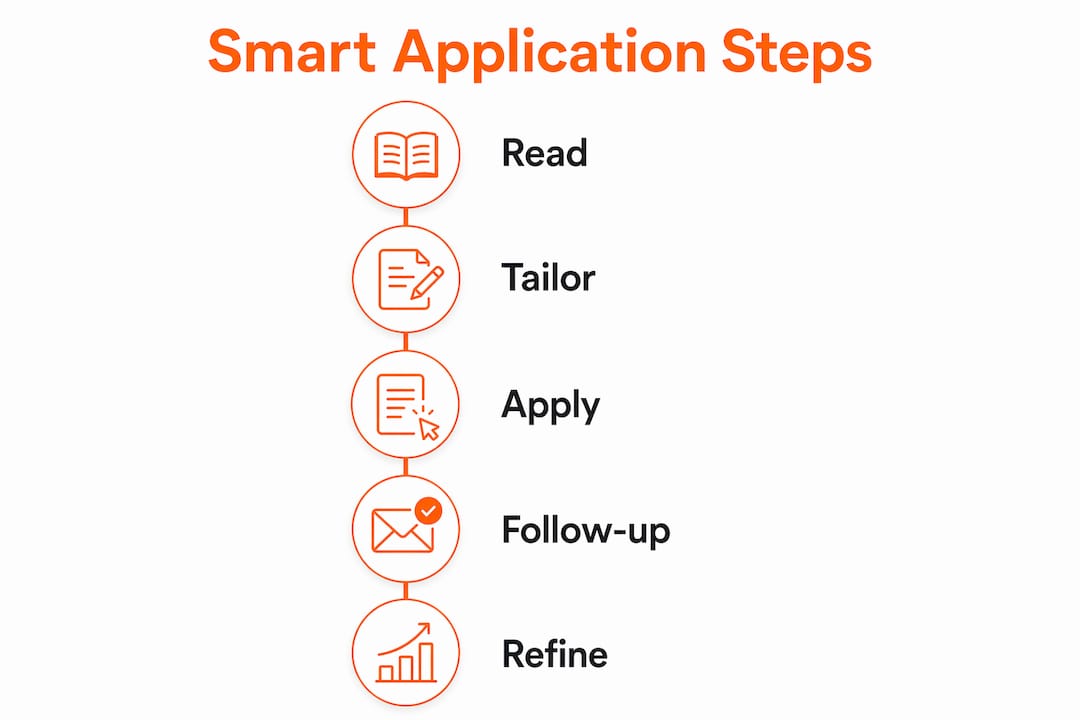
- Spend 20 minutes per application. Rewrite your summary (5 minutes), select and adjust three achievement bullets from your Master Asset Library (5 minutes), write the company-specific hook (5 minutes), and draft a three-paragraph cover letter (5 minutes).
- Apply on the company's career page, not the job board. Direct applications reach the ATS without the extra layer of a third-party platform. They also signal intent.
- Follow up once, specifically. Send one email five to seven business days after applying. Reference the role title, one specific detail from the job description, and restate your top qualification in one sentence.
Pro Tip: Before writing your hook sentence, spend five minutes reading the company's most recent engineering blog post or press release. One specific reference to their actual work signals genuine interest more than any generic enthusiasm statement.
The IT recruiter placement guide from Plucktalent details how recruiters evaluate ATS compliance and targeting quality, which gives job seekers a useful view of the other side of the process.
Key Takeaways
A targeted, timely, and personalized application is the single most effective method for improving interview conversion rates in IT and cybersecurity job searches.
| Point | Details |
|---|---|
| Timing compounds quality | Applying within 24–48 hours of a posting and customizing the application multiplies response rates. |
| Personalization doubles interview rates | Customized applications achieve a 5.75% interview rate versus 2.68% for generic ones. |
| Master Asset Library speeds tailoring | Pre-built achievement bullets and project summaries reduce tailoring time to 20 minutes per application. |
| ATS filters, humans decide | Passing ATS is necessary but not sufficient. The application must also hold a recruiter's attention. |
| Volume without targeting fails | Sending many generic applications produces worse outcomes than sending fewer, well-targeted ones. |
What I've learned after watching thousands of tech applications succeed and fail
The candidates who consistently land interviews are not the ones with the best credentials. They are the ones who treat the application as a research task, not a form-filling exercise. The company-specific hook is the clearest example. Most job seekers skip it because it takes effort. The ones who include it stand out immediately, not because it is impressive, but because it is rare.
AI tools have changed the workflow, but not in the way most people expect. The candidates using AI well are not the ones auto-applying to 200 jobs a week. They are the ones using it to sharpen a bullet point, pressure-test a cover letter opening, or identify gaps between their resume and a job description. The human voice still wins. AI is a drafting assistant, not a replacement for genuine interest and specific knowledge about a company.
The other pattern I see consistently: job seekers who track their metrics improve faster than those who do not. If your conversion rate is below 3%, that is data. It tells you something specific is not working, whether that is targeting, ATS formatting, or the quality of your hook. Treat the job search as a feedback loop, not a one-way broadcast.
Patience matters more than most people admit. Senior IT and cybersecurity roles have longer hiring cycles. A well-placed application to the right company at the right time will outperform 50 rushed ones every time.
— Diego
How Plucktalent supports IT and cybersecurity job seekers
Plucktalent combines 17 years of IT and cybersecurity recruiting expertise with Plucky AI, a job search co-pilot built for tech professionals. The platform connects candidates directly with hiring managers at companies actively hiring for their specific skills, bypassing the noise of generic job boards.
For job seekers who want their applications to reach the right people, Plucktalent provides ATS-aligned profile optimization, targeted company matching, and direct recruiter access. The job seekers platform is built specifically for IT and cybersecurity professionals who are ready to move through the hiring pipeline with applications that work. Learn more about the full range of application support services available through Plucktalent.
FAQ
What is a smart job application in IT hiring?
A smart job application is a targeted, personalized submission that mirrors the job description's language, includes a company-specific hook, and quantifies the candidate's achievements. It is built to pass ATS filters and hold a human recruiter's attention.
How long should tailoring a single application take?
A well-prepared candidate with a Master Asset Library can tailor a complete application, including resume summary, achievement bullets, and cover letter, in approximately 20 minutes.
Does applying early really make a difference?
Early applications are 3.1 times more likely to receive a response, and 72% of job offers go to candidates who applied within the first five days of a posting going live.
Should IT job seekers use AI to write their applications?
AI works best as a drafting and refinement tool, not an auto-apply bot. Using AI to sharpen your own language produces better results than generating applications from scratch, which read as generic to experienced recruiters.
Is a cover letter still necessary for cybersecurity roles?
A targeted cover letter that opens with a company-specific hook and connects your top qualifications to the role's stated priorities consistently outperforms applications submitted without one, particularly for senior and specialized positions.