
Use one page if you have fewer than five years of experience. Use two pages if you have 5+ years and need the space to prove depth. If you're switching into tech from another field, lead with a project-first resume that puts your strongest technical work above your job history. Every resume that actually works, regardless of format, builds its bullets on one formula: Action + Technology/Method + Outcome + Scale. Everything else below explains why that formula works, shows it in action across four tech roles, and gives you a tailoring routine you can run in three minutes per application.
Here's the roadmap:
- The four audiences reading your resume, and how to satisfy all of them at once
- Annotated bullet examples for engineers, data scientists, SREs, and PMs
- An ATS checklist that catches the mistakes that silently kill applications
- A fast workflow for turning one master resume into dozens of tailored versions
Key Takeaways
A strong tech resume pairs the right page length and structure with bullets that quantify Action, Technology, Outcome, and Scale in every entry.
| Point | Details |
|---|---|
| Match format to experience | Use one page under 5 years, two pages at 5+ years, and project-first structure for career changers. |
| Follow the bullet formula | Write every bullet as Action + Technology/Method + Outcome + Scale, never a vague achievement statement. |
| Group and prioritize skills | Sort skills by category and reorder them to match the target job description's top keywords. |
| Verify ATS parsing | Copy your resume into plain text to catch formatting breaks before a recruiter or system does. |
| Use Plucky AI for tailoring | Plucktalent's job seeker platform automates tailoring and connects resumes directly to hiring managers. |
Table of Contents
- Examples of Strong Tech Resumes Share the Same Bone Structure
- What Strong Bullets and Summaries Actually Look Like
- ATS Formatting Rules That Keep Your Resume Readable
- Turning One Master Resume Into Dozens of Tailored Ones
- Making Projects and GitHub Work in Your Favor
- Recruiter's Corner: What 17 Years of Placements Teach You
- How Pluck Talent Turns a Good Resume Into an Interview
- Templates and Guides Worth Bookmarking
- Sources
- FAQ
Examples of Strong Tech Resumes Share the Same Bone Structure
Every resume gets read by four different audiences, and most job seekers only write for one. The applicant tracking system scans for keyword matches. A recruiter skims for 5 to 7 seconds looking for title match and scope. An interviewer mines your bullets for talking points. A hiring manager checks whether your scale of impact matches the role's level. Yale's technical resume guidance recommends structuring skills and bullets so they satisfy the machine and the human reader simultaneously, which is the whole game.
That's where the bullet formula earns its keep. Instead of "Improved system performance," you write Action (rebuilt), Technology/Method (the caching layer using Redis), Outcome (cut average response time from 800ms to 120ms), Scale (across 3 million daily requests). Three data points instead of a vague verb. Resume analyses across recruiting platforms consistently find bullets built this way score higher with hiring managers than achievement statements without a measurable outcome attached.
Your skills section needs the same discipline. Group entries by category, Languages, Frameworks, Cloud/Infrastructure, Data & Storage, rather than dumping everything into one unsorted line. Then reorder categories so whatever the job description emphasizes sits closest to the top.
- Pull the top 5 to 8 keywords from the job posting.
- Match them against your existing skills list.
- Move matched categories to the top of the section.
- Cut anything irrelevant to the role you're targeting.
Projects and GitHub links belong near the top for early-career and career-change candidates, since there's less job history to lean on. For anyone with a solid track record, projects move below experience, as supporting evidence rather than the headline.
Pro Tip: Write your bullets in a spreadsheet first, one row per bullet, with columns for Action, Tech, Outcome, and Scale. It forces you to fill in the outcome column instead of skipping straight to the next bullet.
What Strong Bullets and Summaries Actually Look Like
Here's the formula applied across four common tech roles, with a note on why each version works.
Software Engineer
- Migrated a monolithic billing service to microservices using Go and Kubernetes, reducing deployment time from 45 minutes to under 4 minutes across 12 services.
- Built a CI/CD pipeline with GitHub Actions and Terraform, cutting failed production deploys by half over two quarters.
Data Scientist
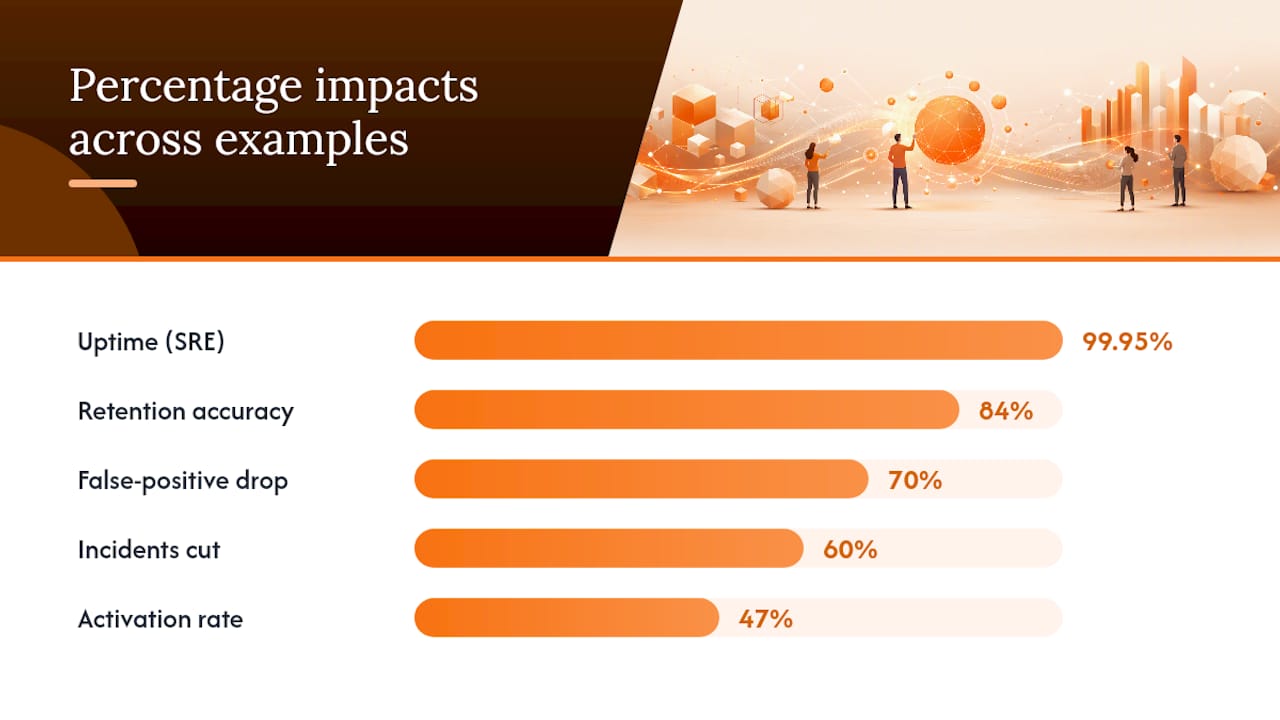
- Developed a churn-prediction model in Python using XGBoost, improving retention team targeting accuracy from 61% to 84% on a 200,000-customer base.
- Automated a reporting pipeline with Airflow and dbt, saving the analytics team roughly 10 hours of manual work weekly.
SRE / DevOps
- Redesigned alerting thresholds in Datadog and PagerDuty, dropping false-positive pages by 70% across a 40-service fleet.
- Led a Kubernetes cluster migration to reduce infrastructure spend by $180,000 annually while maintaining 99.95% uptime.
Product Manager
- Shipped a self-serve onboarding flow using feature flags in LaunchDarkly, increasing activation rate from 32% to 47% within one quarter.
Now the same principles in a full experience entry:
Backend Engineer, Series B fintech startup (40 engineers) — 2023 to Present
- Rebuilt the payment reconciliation service in Python and PostgreSQL, reducing nightly batch runtime from 6 hours to 45 minutes.
- Introduced integration tests using Pytest, cutting production incident reports tied to payment logic by 60% over six months.
- Partnered with 3 cross-functional teams to launch a fraud-detection feature now screening 50,000 transactions daily.
Notice the company-context line, "Series B fintech startup (40 engineers)," sitting right under the title. That single detail tells a hiring manager the scale you operated at before they read a single bullet, which matters more than most candidates realize.
Summaries should scale with experience level, not repeat the same three sentences at every stage:
That's an early-career summary: short, specific, one proof point. A senior summary carries more scope: "Staff engineer with 9 years leading platform teams of 5 to 8 engineers, specializing in distributed systems and cost optimization at scale."
ATS Formatting Rules That Keep Your Resume Readable
Before anything else, copy your resume text out of the PDF and paste it into a plain text file. If the sentences run together, lines break mid-word, or your contact info disappears, the applicant tracking system is probably seeing the same mess. ATS guidance recommends this extraction test as a fast way to catch parsing failures before a recruiter ever does.
A few non-negotiables:
- Put your name, target title, and contact info in the top three lines, no tables, text boxes, or headers/footers holding this information.
- Use a single-column layout with a standard font like Calibri or Arial; avoid multi-column templates that scramble reading order.
- Spell out every acronym on first use, then use the acronym afterward: "Continuous Integration/Continuous Deployment (CI/CD)" before "CI/CD" appears again.
- Keep dates consistent throughout ("Jan 2023 to Present," not a mix of formats).
- Avoid graphics, icons, and skill bars that ATS software can't read as text at all.
One keyword mismatch can be the difference between a callback and silence. Career guidance on skill-section design notes that prioritizing job-description keywords in your grouped skills section improves how consistently your resume clears automated screening, without requiring you to stuff keywords in unnaturally.
Turning One Master Resume Into Dozens of Tailored Ones
Keep a single master resume that holds every bullet, project, and metric you've ever written, even the ones that don't fit your current target role. Guidance on CV tailoring for tech roles treats this master document as the source you pull from rather than rebuild from scratch each time.
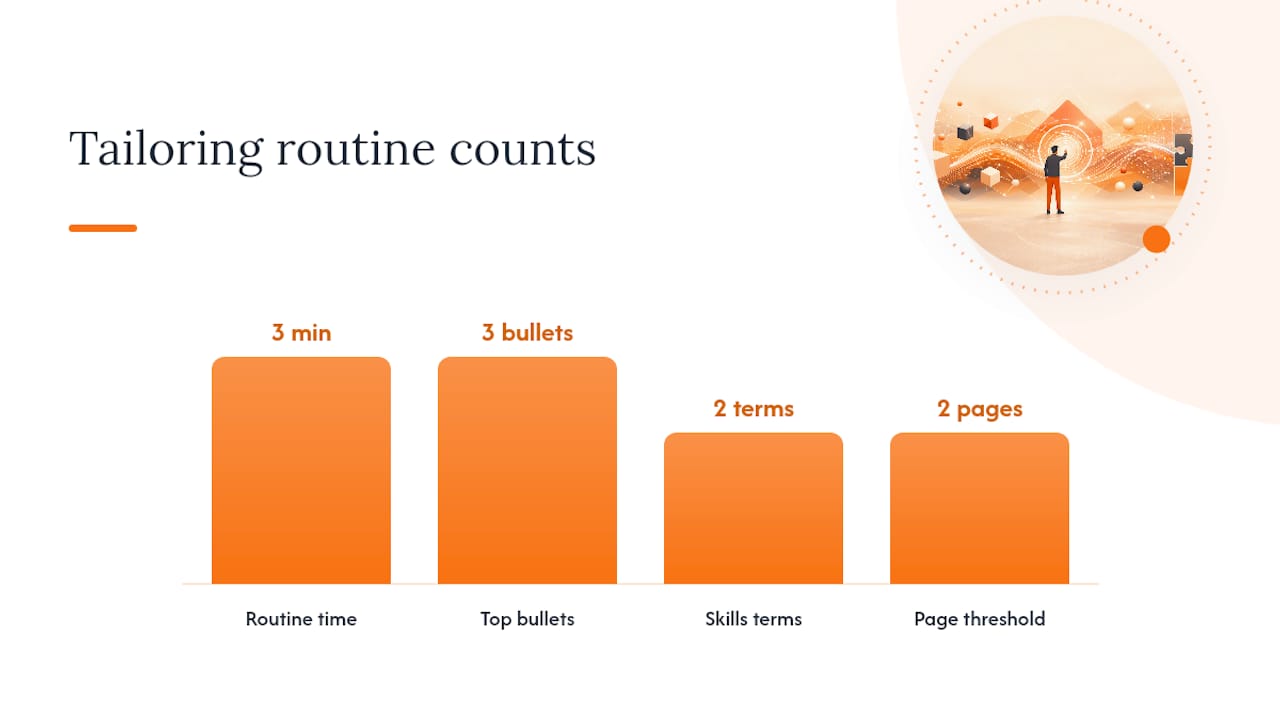
The three-minute tailoring routine:
- Rewrite your summary's first sentence to match the target title and top requirement from the posting.
- Reorder your top three bullets under each role so the most relevant one leads.
- Add two specific terms straight from the job description into your skills section or a bullet, if you can back them up honestly.
Deciding which projects to surface follows the same logic. If a project used the same stack the job posting asks for, it moves up. If it's outdated or unrelated, it either drops or moves to an extended portfolio page. Expand to two pages only when you have enough high-scale, well-quantified bullets to fill it, never to stretch thin content across more space.
Pro Tip: Save your master resume as a living document in Google Docs, and timestamp updates. Six months from now, you'll thank yourself for not having to remember what that one bullet from your old job actually said.
Making Projects and GitHub Work in Your Favor
Every project entry needs four things in one or two lines: what it does, the stack you used, your specific role, and a measurable outcome or scope. "Built a URL shortener in Node.js and Redis, handling 10,000 requests per day with sub-50ms response time" tells a reader more in one line than a project title alone ever could. Guidance for programmer resumes treats pinned repositories with clear metrics as some of the strongest proof points available to junior and career-change candidates specifically.
Include a live link or repo only when the project is polished enough to represent you well. Star counts, monthly traffic, or active user numbers are worth a mention if they're genuinely impressive; skip them if they'd undercut the point. Save your weaker or half-finished projects for an extended portfolio site, not your resume.
Recruiter's Corner: What 17 Years of Placements Teach You
The biggest red flag isn't a typo, it's a bullet with no outcome attached. Finalists get noticed in a 5-second skim because their top three bullets carry numbers a recruiter can repeat to a hiring manager without translation. If your resume gets rewrites and still gets silence, that's the point to bring in professional help rather than keep guessing alone.
How Pluck Talent Turns a Good Resume Into an Interview
Plucktalent gives you what a well-written resume alone can't: a direct line to hiring managers who are actively looking for your exact skill set, instead of a resume sitting in a queue behind 200 identical applications. If you've built a strong resume using the formula above but still aren't getting responses, the problem usually isn't your bullets, it's visibility.
The platform's Plucky AI co-pilot tailors your resume against each job description automatically, applying the same keyword and formatting logic covered in the ATS checklist above, without you rebuilding the document from scratch every time. Combine that with 17 years of recruiting relationships in IT and cybersecurity, and your resume reaches people who can actually move you forward, not just another applicant tracking system. DIY tailoring works fine when you have the time and the network. When you don't, Pluck Talent's job seeker platform picks up where the checklist leaves off. Start by uploading your resume and letting Plucky AI show you what's missing.
Templates and Guides Worth Bookmarking
Start with UNC's tech resume samples for role-specific templates, and Arvo's resume resources for additional formats to compare against your draft.
Sources
- Technical resume guidance and samples | Yale OCS
- Tech resume samples and templates | UNC CS career resources
- The 2026 Tech Resume Template: What Hiring Managers Actually Want | Pretty Resume
FAQ
What Makes a Tech Resume Example Strong?
A strong example quantifies every bullet with Action, Technology, Outcome, and Scale, rather than listing responsibilities without measurable impact.
Should My Tech Resume Be One Page or Two?
Use one page with fewer than 5 years of experience; use two pages once you have 5+ years and enough quantified achievements to justify the extra space.
How Do I Make My Resume ATS-Friendly?
Use a single-column layout, spell out acronyms on first use, and copy your resume into plain text to confirm it extracts cleanly before submitting it.
How Often Should I Tailor My Resume?
Tailor a fresh version for every application using your master resume as the source, adjusting the summary, top three bullets, and two job-specific keywords each time.
When Should I Use a Service Like Pluck Talent Instead of Tailoring Myself?
If your resume follows the formula above but still isn't generating interviews, Pluck Talent connects your profile directly to hiring managers actively seeking your skill set.