
A tech job offer breaks down into a small, repeatable set of parts: base salary, variable pay (sign-on bonus, annual bonus), equity (RSUs, stock options, ESPP), benefits (health insurance, 401(k) match, HSA), PTO and leave, job level and title, and offer terms and contingencies. Once you can name each piece, you can put a real dollar figure on it and compare offers side by side instead of guessing.
Some of these components are cash you can spend tomorrow. Base salary and sign-on bonuses fall into that bucket. Others are deferred and illiquid, at least for a while: equity grants vest over years and, at a private company, cannot be sold until there is a buyer. And a third bucket, benefits like a 401(k) match or a wellness stipend, is recurring value that never shows up on the offer letter's headline number but still affects your take-home math every year you work there.
Not every line item is equally open to negotiation. Base salary and sign-on bonus tend to move the most in conversation. Equity refreshes and title can move too, especially with a competing offer in hand. Standard benefits packages and legal boilerplate, on the other hand, rarely budge for an individual candidate. Knowing which is which before your first negotiation call saves you from spending leverage on the wrong ask.
Key Takeaways
Every tech job offer breaks into a fixed set of components, and converting each one into an annualized dollar figure is the only reliable way to compare offers accurately.
| Point | Details |
|---|---|
| Separate cash from deferred value | Base salary and sign-on bonuses are liquid now; equity is deferred and often illiquid, especially at private companies. |
| Annualize every equity grant | Divide total grant value by the vesting period and apply a liquidity discount for private-company stock. |
| Negotiate in priority order | Push on base salary first, then sign-on bonus, then title or level, then equity refresh. |
| Read the legal clauses twice | Noncompete, IP assignment, and clawback terms carry real long-term risk beyond the headline number. |
| Build a comparison table before deciding | Plucktalent's AI-driven job search platform helps candidates land more offers worth putting through this exact evaluation process. |
Table of Contents
- At-a-Glance Checklist: Every Tech Job Offer Component
- What Counts as Base Salary and How Do You Benchmark It?
- How Do Bonuses and Sign-On Pay Actually Work?
- What Is Equity and How Do You Value It?
- Which Benefits Actually Move Your Total Compensation?
- How Should You Value PTO and Leave Policies?
- Why Does Job Level Matter More Than Title?
- Which Contract Terms and Legal Clauses Should You Read Twice?
- How Do You Build a Total Compensation Comparison?
- What's the Right Way to Negotiate a Tech Offer?
- What Should You Confirm Before You Accept or Decline?
- What Do Recruiters Actually See When They Build an Offer?
- The Single Biggest Mistake Candidates Make With Tech Offers
- How Plucktalent Helps You Land a Stronger Offer
- Where to Learn More About Offer Components
- Sources
- FAQ
At-a-Glance Checklist: Every Tech Job Offer Component
Use this as your first pass through any offer letter. For each item, we've marked how often it's actually negotiable, and whether you should get the specifics in writing before you accept.
- Base salary — the guaranteed cash floor of your pay. Negotiability: high. Get in writing: the exact number and pay frequency.
- Sign-on bonus — one-time cash, often used to offset a competing offer or lost equity. Negotiability: high. Get in writing: payout date and any clawback window.
- Annual/target bonus — variable cash tied to company or individual performance. Negotiability: medium. Get in writing: target percentage and what "on-target" actually means.
- Equity (RSUs, options, ESPP) — deferred ownership stake, the biggest wildcard in tech comp. Negotiability: medium to high. Get in writing: share count, vesting schedule, and grant date.
- Health insurance — medical, dental, vision premiums and coverage tiers. Negotiability: low. Get in writing: your monthly premium share and deductible.
- 401(k) match — employer contribution to retirement savings. Negotiability: low. Get in writing: the match formula and vesting timeline on the match itself.
- HSA/FSA contributions — employer money toward a health savings or flexible spending account. Negotiability: low. Get in writing: the annual employer contribution amount.
- PTO policy — set days versus "unlimited" time off. Negotiability: medium. Get in writing: whether unused days pay out at exit.
- Parental leave — paid weeks for new parents. Negotiability: low to medium. Get in writing: paid duration and whether it's fully company-paid or supplemented by state programs.
- Job level and title — determines your salary band, equity band, and promotion path. Negotiability: medium. Get in writing: the internal level code, not just the external title.
- Offer contingencies — background check, reference check, right-to-work verification. Negotiability: none. Get in writing: what happens to your start date if any contingency runs long.
- Legal clauses (at-will, noncompete, IP assignment) — the fine print that governs your risk and mobility. Negotiability: low, but state law sometimes overrides it. Get in writing: nothing to add here, just understand what compensation the offer document is legally required to spell out before you sign.
If you only have time to clarify three things before accepting, make it the equity vesting schedule, the bonus target definition, and whether PTO pays out when you leave. Those three cause the most regret after the fact.
What Counts as Base Salary and How Do You Benchmark It?
Base salary is the fixed cash amount your employer pays you regardless of performance, company results, or stock price. It typically arrives biweekly or semimonthly and does not include bonuses, equity, or benefits value, even though recruiters sometimes fold everything into one "total comp" number during a verbal offer. If a recruiter tells you "$220,000" on a call, ask directly: is that base only, or does it include bonus and equity target?
Benchmarking base salary means comparing your offer against market data for your specific level, location, and specialization, not against a generic "software engineer" average. Internal leveling matters more than external title here: a company's "Senior Engineer" might map to another company's "Staff Engineer" band. Tools like levels.fyi, Glassdoor, and Blind aggregate self-reported offers by level and company, and they're a reasonable first check before you push back on a number.
Sample calculation: If your offer states $165,000 base paid biweekly, that's 26 paychecks of roughly $6,346 before tax and deductions. Multiply that out and you land back at $165,000 (26 × $6,346 ≈ $165,000), but the real value question is what percentage of your total compensation that base represents. At a large public tech company, total compensation for a senior engineer often runs well above base salary once equity and bonus are included, which is exactly why base alone is a misleading number to negotiate around in isolation.
A tightening labor market has also compressed the variable-pay side of offers in recent years, which puts more pressure on base salary as the stable core of your compensation. Bloomberg reported that a cooling U.S. job market has coincided with smaller bonus payouts for workers, a trend worth keeping in mind if a recruiter leans heavily on bonus upside to justify a lower base.
Pro Tip: When a recruiter gives you a salary range instead of a number, ask where in the range they'd realistically place someone with your background. Ranges often span 20 to 30 percent from floor to ceiling, and the difference between the bottom and the middle can be tens of thousands of dollars a year.
How Do Bonuses and Sign-On Pay Actually Work?
Variable cash compensation in tech offers usually splits into four distinct types, and mixing them up during negotiation is a common mistake. A signing bonus is a one-time payment, often used to bridge the gap when you're walking away from unvested equity at your old job. An annual bonus (sometimes called a target bonus) is recurring and tied to a percentage of your base, paid out after performance reviews. Commissions apply mainly to sales and some customer-facing engineering roles, calculated as a percentage of deals closed. Spot or performance bonuses are discretionary, one-off payments for a specific project or milestone.
Payout timing varies by type. Sign-on bonuses typically land in your first paycheck or within 30 to 60 days of start date. Annual bonuses pay out after the company's fiscal year closes and performance reviews wrap, which at many companies means a check that arrives 12 to 15 months after you accept the offer. A target bonus percentage of base salary is standard in tech offer letters, but "target" and "actual" are different numbers: actual payout depends on both company and individual performance multipliers.
Sign-on bonuses often come with clawback clauses, meaning you owe the money back, prorated, if you leave before a set period, typically 12 to 24 months. Read this clause closely; it's one of the few offer terms that can cost you real money after you've already spent it.
- Ask whether the sign-on bonus pays in a single lump sum or splits across two payments.
- Confirm the exact clawback window and whether it's prorated or all-or-nothing.
- Get the bonus target percentage and the performance-multiplier range in writing, not just a verbal estimate.
- If a company can't move base salary, ask whether they can front-load a larger sign-on bonus instead.
Trading equity for cash, or the reverse, is a real negotiation lever. If you're skeptical of a company's stock trajectory, or you're leaving unvested equity behind at your current job, pushing for a bigger sign-on bonus over a bigger equity grant is a legitimate ask, and recruiters hear it often enough that it rarely raises eyebrows.
What Is Equity and How Do You Value It?
Equity is the part of a tech offer most candidates undervalue or overvalue, usually because nobody walks them through the mechanics. There are three equity instruments you'll commonly encounter, and they behave very differently once tax season arrives.
RSUs (Restricted Stock Units) are a promise of actual shares, delivered to you once they vest. You don't pay anything to receive them, but RSUs are generally taxed as ordinary income at the moment they vest, based on the stock's value that day, not when you eventually sell.
Stock options (NSOs and ISOs) give you the right to buy shares at a fixed "strike price" set at grant. Non-qualified stock options (NSOs) are simpler but taxed as ordinary income on the spread between strike price and market value at exercise. Incentive stock options (ISOs) get more favorable tax treatment if you hold the shares long enough, but they can trigger the Alternative Minimum Tax (AMT) at exercise, which catches a lot of first-time option holders off guard.
ESPPs (Employee Stock Purchase Plans) let you buy company stock, usually at a 10 to 15 percent discount, through payroll deductions, common at large public tech companies but rare at startups.
Vesting, Cliffs, and Refreshers
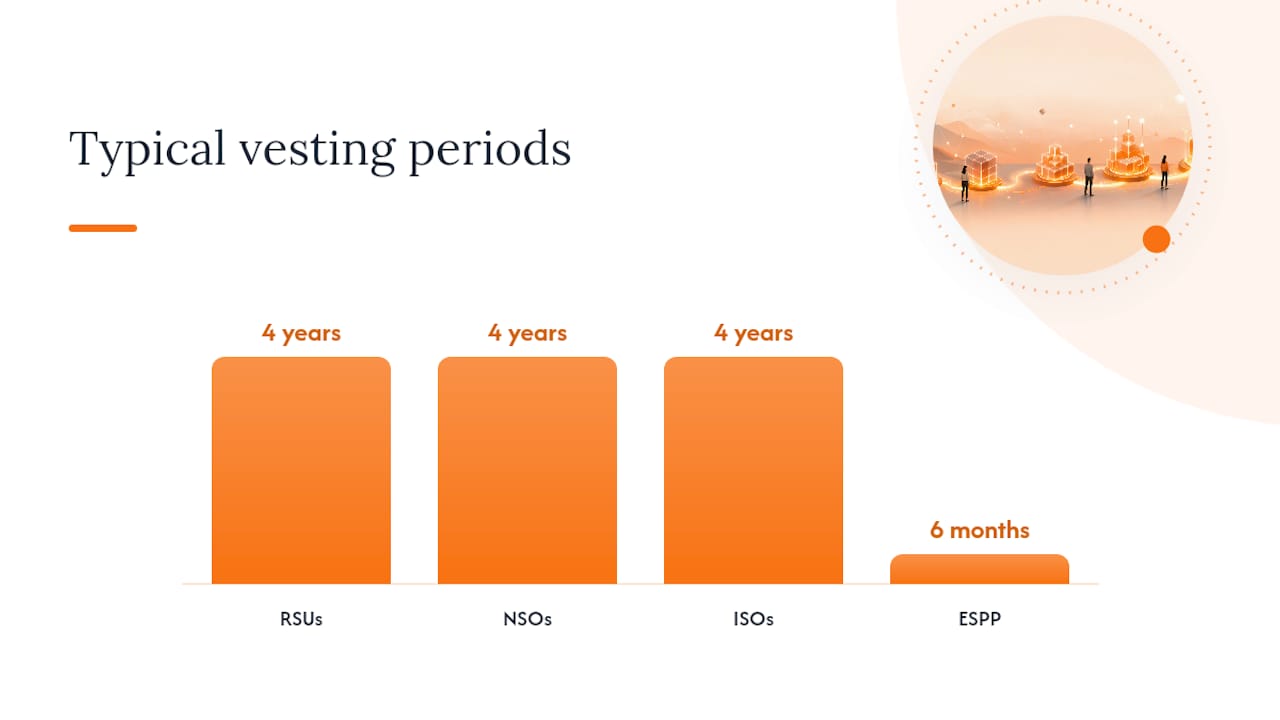
A standard tech equity grant vests over four years with a one-year cliff: you get nothing if you leave before your first anniversary, then a chunk vests all at once, followed by monthly or quarterly vesting for the remaining three years. Some companies front-load vesting (more in year one, less in year four); others back-load it to encourage retention. Ask which shape your grant follows, since it changes your effective annual equity value significantly.
Acceleration clauses occasionally speed up vesting if the company is acquired or you're terminated without cause. Forfeiture means unvested shares disappear entirely if you leave, voluntarily or not, before they vest. Refresh grants are additional equity awarded during your tenure, typically tied to performance reviews or retention concerns, and they're how most tech employees maintain (or grow) their equity value after the original grant partially vests.
| Instrument | How it's taxed | Typical vesting | Best for |
|---|---|---|---|
| RSUs | Ordinary income at vest | 4 years, 1-year cliff | Public companies, predictable value |
| NSOs | Ordinary income on spread at exercise | 4 years, 1-year cliff | Early-stage companies, flexible timing |
| ISOs | Potential capital gains if held; AMT risk at exercise | 4 years, 1-year cliff | Employees planning to hold long-term |
| ESPP | Ordinary income + capital gains on discount | Offering periods (usually 6 months) | Public companies with steady stock |
Worked example: Say your offer includes 4,000 RSUs vesting over four years at a company valued at $40 per share. That's $160,000 in equity, or $40,000 a year if vesting is even. If the company is private, apply a liquidity discount, since you can't sell those shares until a funding event, acquisition, or IPO. Discounting private equity for illiquidity and factoring in a company's refresh culture is standard practice when annualizing multi-year grants, and a 409A valuation, the mechanism companies use to set a fair-market strike price for private stock, is worth asking about directly if you're weighing options at an early-stage startup.
Tax timing differs sharply by instrument: RSUs trigger tax at vesting, options trigger it at exercise (and sometimes AMT), and a sale later triggers capital gains or losses on top of that. Carta's guide to stock option taxes walks through exercise strategies and AMT exposure in more depth than any offer letter will.
A stock option calculator can model exercise costs and expected tax outcomes before you commit real money to exercising early, which matters most at private companies where a wrong bet on the strike price versus eventual valuation is expensive to undo.
Pro Tip: Before you accept, ask for the strike price, the total shares outstanding (or a fully diluted share count), and the date of the last 409A valuation if the company is private. Without those three numbers, "4,000 shares" is a meaningless figure.
Which Benefits Actually Move Your Total Compensation?
Benefits rarely get their own line in a candidate's mental math, but a few of them carry real annual dollar value that's worth calculating explicitly rather than waving away as "standard."

Health insurance is the biggest one. Two offers with identical salaries can differ by $3,000 to $6,000 a year in your pocket depending on the employee's share of premiums and the plan's deductible. Ask HR for the exact monthly premium you'd pay under each plan tier (employee-only, employee-plus-spouse, family) and the annual deductible before you compare offers.
A 401(k) match is essentially free money, but only if you understand the formula. Some companies vest the match immediately; others vest it over several years, so ask both questions.
HSA (Health Savings Account) contributions from an employer, common alongside high-deductible health plans, typically range from a few hundred to over a thousand dollars annually and are yours to keep even if you switch jobs. FSA (Flexible Spending Account) money, by contrast, is generally use-it-or-lose-it within the plan year.
Beyond the core benefits, look for:
- Life and disability insurance — often employer-paid at a base level (typically 1x salary for life insurance), with buy-up options.
- Wellness stipends — monthly or annual reimbursements for gym memberships or mental health apps, usually $50 to $150 a month.
- Home office stipends — one-time or recurring payments toward remote work setup, common since the shift to distributed teams.
- Education/learning budgets — annual allowances, often $1,000 to $3,000, for courses, conferences, or certifications.
None of these individually rival salary or equity, but stacked together they can represent several thousand dollars a year in real value, which matters when two offers are otherwise close.
How Should You Value PTO and Leave Policies?
"Unlimited PTO" sounds generous until you realize it often means the company has no legal obligation to pay out unused days when you leave, unlike a defined PTO policy in states that require payout of accrued time off. Ironically, employees at unlimited-PTO companies sometimes take less time off than those with a fixed 15 or 20 day allotment, because there's no visible "use it or lose it" pressure and social norms end up doing the regulating instead.
Parental leave varies enormously across tech companies, from the legal minimum required by unpaid federal leave protections up to 16 to 20 weeks of fully paid leave at well-resourced employers. Ask specifically whether leave is fully company-paid, supplemented by short-term disability, or a combination, since the actual paycheck impact differs a lot between those structures.
To price PTO into your comparison, take a defined policy's day count, divide your annual salary by working days (roughly 260), and multiply by the number of PTO days to get a rough dollar value. For unlimited policies, this math doesn't apply cleanly, so ask directly what the average employee actually takes and whether any of it pays out at termination.
Pro Tip: Get PTO payout policy in writing during offer negotiation, not after you've resigned. Some states require payout of accrued PTO by law regardless of what the handbook says, so check your state's rule if the offer letter is vague.
Why Does Job Level Matter More Than Title?
Two people with the title "Software Engineer" at two different companies can be paid $50,000 apart, because title is marketing and level is the actual internal mechanism that sets your salary band, bonus target, and equity grant size. Companies build leveling systems (often labeled something like L4, L5, L6, or IC1 through IC6) specifically so compensation, promotion criteria, and scope of responsibility stay consistent across hundreds or thousands of employees.
Your level determines the band you're hired into, and most companies place new hires somewhere between the 25th and 60th percentile of that band, leaving room to grow into it through raises rather than promotion. Asking where in the band you're being placed, not just what the number is, tells you how much room exists before your next raise requires a title change.
Promotion cadence differs by company culture: some review levels annually, others every 18 to 24 months, and a faster cadence compounds into meaningfully more lifetime earnings even at an identical starting salary. Ask your recruiter or hiring manager directly:
- "What level is this role internally, and what's the salary band for that level?"
- "What's the typical time to promotion from this level to the next?"
- "How does this level compare to [name a competitor level system you know, like Google's L-levels] if you're familiar with it?"
A recruiter who can't or won't answer the leveling question is a mild yellow flag; it usually means the company's bands aren't well defined, which can mean more negotiation room, or less transparency about your growth path.
Which Contract Terms and Legal Clauses Should You Read Twice?
Most candidates skim the legal section of an offer letter and go straight to the number. That's a mistake, because a handful of clauses in there affect your actual risk and freedom more than a few thousand dollars of salary ever will.
At-will employment is standard in nearly every U.S. state, meaning either party can end employment at any time, for almost any reason. It's boilerplate, not a red flag by itself.
IP assignment clauses state that anything you create using company resources, and sometimes anything you create in your field even on personal time, belongs to the company. Read this closely if you have side projects or plan to build something outside work.
Noncompete and non-solicit clauses restrict where you can work after leaving or who you can recruit from your old team. Enforceability varies enormously by state (some states have banned noncompetes outright for most workers), so a clause that looks scary on paper may be unenforceable where you live. That said, this is a legal question specific to your jurisdiction, not something to assume based on general advice, and it's worth a quick conversation with an employment attorney if the clause looks unusually broad.
Arbitration clauses require you to resolve disputes through private arbitration instead of a public lawsuit, which limits your legal options if something goes wrong later.
Severance language, when present at all, spells out what you get if you're let go without cause. Most standard offers don't include severance unless you're at a senior or executive level, so if it's absent, that's normal, not a red flag.
Contingencies are separate from these legal clauses: background checks, reference checks, and right-to-work documentation are standard pre-employment steps, and most offers are contingent on clearing them before your actual start date.
- At-will status, noncompete scope, and arbitration requirements: standard, but read the specific wording.
- IP assignment: check if it covers personal projects or only work-related output.
- Severance: ask if none is offered, especially for senior roles.
- Background check timing: confirm it won't delay your start date past a hard deadline you've set with your current employer.
Pro Tip: If a noncompete or IP clause looks unusually broad, or you have meaningful outside projects, a quick consult with an employment attorney is inexpensive compared to the risk of signing something you don't understand. This is general information, not legal advice, so verify your state's specific rules before you rely on it.
How Do You Build a Total Compensation Comparison?
Comparing two tech offers side by side requires converting every component into an annualized dollar figure, because a $10,000 higher salary can lose to a much larger equity grant once you do the math properly.
- List every component in a single table, one row per offer: base salary, sign-on bonus (prorated over its clawback period), target bonus, annualized equity value, 401(k) match dollar value, health plan cost difference, and any recurring stipends.
- Annualize the equity. Take the total grant value at offer, divide by the vesting period (usually four years), and adjust for vesting shape if it's front-loaded or back-loaded rather than even.
- Apply a liquidity discount for private-company equity. There's no market price you can sell into immediately, so a private grant is worth meaningfully less per dollar of "paper value" than the same dollar amount in public RSUs.
- Add recurring benefit value, including your calculated 401(k) match and the dollar difference in health plan premiums between offers.
- Calculate two totals: a Year 1 number (which usually includes a sign-on bonus but only the first year of equity vesting) and a steady-state number (your expected annual total from year two onward, once sign-on cash is gone but equity refreshes may begin).
Building a table that forces a dollar value into every cell, rather than leaving vague line items, is the method compensation guides consistently recommend for making an apples-to-apples comparison.
Small changes ripple through this table more than most candidates expect. If Offer B's company has a strong refresh culture and promotes on an 18-month cadence instead of Offer A's 24-month cycle, the steady-state gap could flip entirely in Offer B's favor by year three, even though Offer A looks stronger on paper in year one. This is exactly why annualizing equity and computing separate year-1 and steady-state totals matters more than comparing headline numbers.
What's the Right Way to Negotiate a Tech Offer?
Negotiation works best when you ask for things in the right order, at the right time, and with the right justification. Randomly asking for "more of everything" reads as unfocused; a prioritized list reads as informed.
- Base salary first. It's the most negotiable line item and compounds into every future raise, bonus calculation, and even severance formula.
- Sign-on bonus second. Especially useful if you're leaving unvested equity behind or the company can't move base further.
- Title or level third. A level bump changes your salary band and equity grant size going forward, not just your current offer.
- Equity refresh or grant size fourth. Ask specifically for more shares or a shorter vesting cliff if the company won't move cash further.
- Remote policy or start date last. Lower dollar impact, but sometimes the easiest ask to get a "yes" on when everything else has hit a wall.
Timing matters. Never negotiate before you have a written offer; verbal negotiation without paper is negotiating against a moving target. If you have a competing offer, mention it specifically (company name is optional, numbers are not) rather than vaguely referencing "other opportunities," since recruiters need something concrete to take back to their compensation team.
- "I'm excited about this role. Based on my research and a competing offer at $X, I'd like to see if we can get the base to $Y."
- "Is there flexibility on the sign-on bonus to help offset the equity I'm forfeiting at my current company?"
- "Given the scope of this role, I'd like to understand if there's room to consider the next level up."
Accept that not every ask lands. A reasonable trade-off is moving on salary in exchange for a faster equity refresh review, or accepting a lower sign-on bonus if the company agrees to revisit your level at the first performance cycle instead of waiting the standard period.
What Should You Confirm Before You Accept or Decline?
Once you've negotiated to a number you're comfortable with, a short list of practical steps stands between you and actually starting the job cleanly.
- Get the final offer in writing, including every negotiated change, not just a verbal confirmation from your recruiter.
- Confirm your exact start date and how any pending contingency (background check, reference check) could push it later.
- Clarify relocation terms in writing if applicable: lump sum versus reimbursement, moving company coverage, and any tax gross-up on relocation payments.
- Verify your first paycheck date and whether the sign-on bonus arrives with it or on a separate schedule.
- Only give notice at your current job after you have the signed offer in hand, not before.
Common contingencies, like background checks, can occasionally delay a start date by one to two weeks. Ask your recruiter what happens to your agreed start date if that check runs long, so you're not caught between two employers with no clear start date at either.
If you decide to decline, a short, professional note preserves the relationship for the future: thank the recruiter, state clearly that you're declining, and avoid over-explaining your reasons unless you want to leave the door open for a counteroffer.
- Confirm the final signed offer letter matches every verbally negotiated term.
- Lock in your start date and understand what could shift it.
- Get relocation and sign-on bonus payment timing in writing.
- Don't resign your current role until the signed offer is in hand.
What Do Recruiters Actually See When They Build an Offer?
Hiring teams don't create offers in a vacuum. Most tech companies build offers off a predetermined salary band tied to level, with the compensation team, not the hiring manager, holding final authority over how far a recruiter can move that number.
The lever that moves fastest in a real negotiation usually isn't the one candidates ask about first. Recruiters typically have more flexibility on sign-on bonus and start date than on base salary, because base salary changes affect internal pay equity across the whole team, while a one-time bonus doesn't. Candidates who understand that tend to get more, faster, than candidates who push hardest on the number that's actually the least flexible.
That distinction shapes how you should split your asks between the recruiter and the hiring manager. The recruiter typically owns compensation mechanics: salary band, bonus structure, benefits questions, and sign-on bonus flexibility. The hiring manager typically owns scope, level, and team fit, and has more informal influence over whether the company pushes for an exception to the standard band.
- Ask the recruiter: salary band range, bonus target percentage, equity refresh policy, and standard timeline for the offer to expire.
- Ask the hiring manager: promotion timeline, team structure, and whether they'd advocate for a level bump if you're borderline between two bands.
- Don't ask the hiring manager for compensation specifics; they often don't have visibility into the exact numbers and will just loop the recruiter back in anyway.
Pro Tip: Present a counteroffer with a number and a reason, not just a number. "Based on a competing offer at $X and my experience with [specific skill], I'd like to see if we can close that gap" lands better than a bare ask, and it gives the recruiter language they can actually take back to their compensation committee.
The Single Biggest Mistake Candidates Make With Tech Offers
The most common error isn't underestimating equity or missing a clawback clause. It's treating an offer as one number to compare against another number, instead of treating it as a table of six or seven distinct variables, each with its own timing, tax treatment, and negotiability. Two offers with identical headline totals can differ by tens of thousands of dollars once you account for vesting shape, clawback windows, and how a company's promotion cadence compounds over three or four years.
If there's one habit worth building before your next offer conversation, it's this: build the comparison table before you talk numbers with anyone, not after. Once the components are laid out separately, negotiation stops being a guessing game and starts being a series of specific, defensible asks.
How Plucktalent Helps You Land a Stronger Offer
Understanding every component in a tech offer is only half the battle. Getting an offer worth dissecting in the first place is the other half, and that's where most job searches stall long before negotiation ever starts. Plucktalent connects IT and cybersecurity professionals directly with hiring managers who are actively hiring for their exact skill set, skipping the resume black hole where qualified candidates disappear into applicant tracking systems for weeks.
Plucky AI, Plucktalent's job search co-pilot, tailors your resume for each specific role and surfaces hidden opportunities that never make it to public job boards, so the offers you do receive are ones worth building a comparison table around. Getting started means creating a profile, letting Plucky AI optimize your materials, and getting matched with roles where hiring teams are already looking for someone like you. Visit Plucktalent's job seeker page to see how the platform works and start building a pipeline of offers worth negotiating hard for.
Where to Learn More About Offer Components
A few resources go deeper than any single article can on the tax and valuation mechanics behind tech compensation.
- Carta's guide to stock option taxes explains exercise timing, AMT exposure, and the practical difference between ISOs and NSOs.
- Investopedia's RSU primer covers how vesting and taxation work for restricted stock units specifically.
- AngelList's explainer on 409A valuations helps you understand how private companies set the strike price on your options.
- 360 Financial Literacy's stock option calculator models exercise costs and expected tax outcomes before you commit real money.
- Tech Interview Handbook's compensation guide breaks down base salary, bonus, and equity definitions with real-world examples.
This article is general information, not a substitute for advice from a qualified financial advisor. Consult a qualified financial professional about your own circumstances before acting on anything here.
Sources
- Understanding compensation - Base salary
- Stock option taxes | Carta
- Restricted Stock Units: What to Know | Investopedia
- Base Salary vs Total Compensation: Tech Offer Guide | Levelop
- Tight U.S. job market means smaller bonuses for workers | Bloomberg
FAQ
What are the typical components of a tech job offer?
A typical tech offer includes base salary, a sign-on and/or annual bonus, equity (RSUs, options, or ESPP), benefits like health insurance and 401(k) match, PTO, and legal terms such as at-will status and contingencies.
What are the levels in a tech job title hierarchy?
Most tech companies use a leveling ladder from entry-level individual contributor through senior, staff, principal, and distinguished engineer, though the exact number of levels and their names vary widely by company.
What are the different types of tech jobs?
Tech roles span software engineering, product management, data science, cybersecurity, DevOps and infrastructure, UX design, and technical sales, each with its own typical mix of base salary, bonus, and equity in the offer structure.
Can equity alone make a lower base salary worth accepting?
It can, but only if you annualize the grant, discount it for illiquidity if the company is private, and factor in the company's refresh culture. A large equity number on paper doesn't guarantee that value ever becomes real money.
Is a signing bonus taxed differently than regular salary?
No, a signing bonus is generally taxed as ordinary income just like your salary, though employers sometimes withhold it at a different flat supplemental rate before your final tax bill is calculated.
How can Plucktalent help me understand or negotiate my offer?
Plucktalent's recruiter-vetted placements connect you directly with hiring managers who can clarify level, band, and equity details upfront, and Plucky AI helps position your background so you're negotiating from a stronger initial offer.