
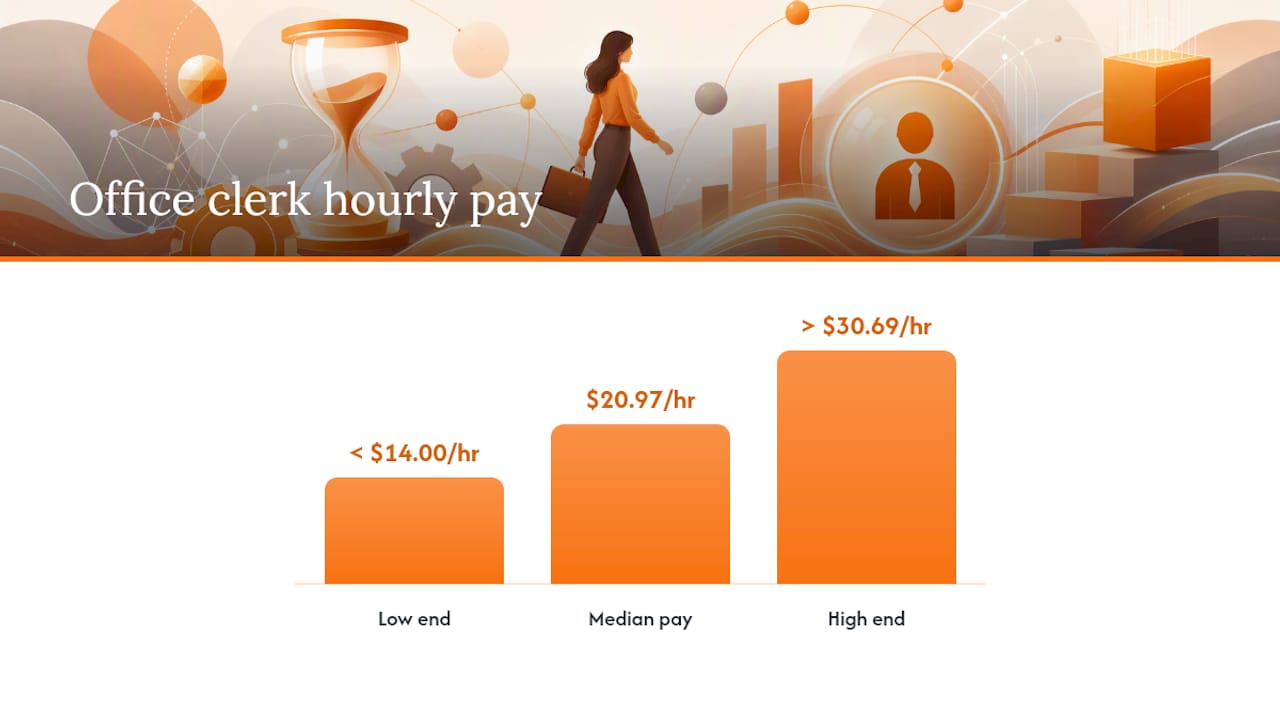
An office clerk handles the paperwork, phones, and records that keep a business running day to day, typically requiring no more than a high school diploma. The median annual pay is $43,630, or $20.97 an hour, though the top 10% of earners make over $30.69 an hour while the bottom 10% earn under $14.00. That decline doesn't mean the job disappears. It means the clerks who combine multiple duties, rather than doing one repetitive task, are the ones who stay employed.
Key Takeaways
The office clerk role offers a low barrier to entry, a median pay of $43,630, and the best job security for clerks who combine multiple duties rather than specializing in one repetitive task.
| Point | Details |
|---|---|
| Entry requirements are low | Most positions need only a high school diploma and up to a month of on-the-job training. |
| Pay varies widely | Median pay is $43,630 annually ($20.97/hr), ranging from under $14.00 to over $30.69 per hour. |
| Jobs are declining overall | Employment is projected to fall 7% from 2024 to 2034 as automation absorbs routine data entry. |
| Versatility protects your job | Clerks who bundle reception, records, and data duties are more resistant to automation than single-task workers. |
| Digital fluency drives advancement | Naming specific software platforms on a resume increases interview callbacks and supports moves into higher-paying roles. |
A Note on Getting Hired Faster
Tailoring your resume around specific tasks and software names matters more than volume of applications. If you're job hunting in tech-adjacent administrative work, Plucktalent's job seeker tools can help you match your resume to what hiring managers are actually screening for.
Table of Contents
- What Does an Office Clerk Do Day to Day?
- Where Do Office Clerks Work, and What Hours?
- What Skills and Education Does the Job Require?
- How Much Does an Office Clerk Earn?
- Is the Office Clerk Job Outlook Growing or Shrinking?
- What Job Titles Fall Under "Office Clerk"?
- How Do You Get Hired as an Office Clerk?
- Where Can an Office Clerk Role Lead?
- Which Digital Skills Keep Office Clerks Employable?
- What Challenges Come With the Office Clerk Role, and How Do You Handle Them?
- Sources
- FAQ
What Does an Office Clerk Do Day to Day?
The job is a mix of communication, paperwork, and light bookkeeping, and the exact blend shifts depending on the employer. According to O*NET's task breakdown for the role, the most consistently ranked activities are answering phones, entering data, and keeping filing systems current.
A typical day includes:
- Answering and routing phone calls
- Entering and updating records in a database or spreadsheet
- Filing paper documents and maintaining digital folders
- Sorting, opening, and distributing incoming mail
- Scheduling appointments or meetings for staff
- Photocopying, scanning, and transcribing documents
- Basic bookkeeping tasks like tracking invoices or petty cash
The specifics change by industry. In a school district office, a clerk might process student attendance records and field calls from parents. In a hospital or clinic, the job often means updating patient intake forms and coordinating between departments. In a city or county government office, clerks frequently process permits, licenses, or public records requests.
Tools are usually modest: a multi-line phone system, a photocopier or scanner, and software like Microsoft Word, Excel, and Outlook. Many employers also expect familiarity with an industry-specific database, whether that's an electronic health records system in healthcare or a case-management platform in government.
Where Do Office Clerks Work, and What Hours?
Office clerks show up in nearly every industry that runs an administrative back office, though government agencies, schools, and healthcare facilities hire them at especially steady rates.
Common conditions include:
- Most clerks work full time during standard business hours, typically 8 a.m. to 5 p.m.
- Part-time and shift work is more common in healthcare and government settings that operate extended hours
- Work happens mostly at a desk, often at a front-facing reception area or in a back-office records room
- Some roles require occasional weekend or evening coverage during peak periods, like tax season in a government finance office
Employers hiring most frequently include school districts, hospital systems, city and county governments, insurance companies, and small to mid-sized businesses that need one generalist to handle administrative overflow.
What Skills and Education Does the Job Require?
Most entry-level positions ask for a high school diploma or GED, and on-the-job training usually runs a month or less. That low barrier to entry is part of why the role attracts career changers and new graduates alike.
Employers still expect a specific skill set, split roughly into two categories:
- Hard skills: typing speeds of 40 to 60 words per minute, comfort with Microsoft Office, and the ability to learn an industry-specific database or scheduling tool quickly
- Soft skills: attention to detail, clear phone and written communication, time management, and the flexibility to switch between tasks without losing accuracy
Pro Tip: *Pair each soft skill with a number on your resume.
How Much Does an Office Clerk Earn?
The median pay for general office clerks sits at $43,630 a year, which breaks down to $20.97 an hour.
Several factors move that number:
- Industry: government and healthcare roles often pay above the median, especially where clerks handle regulated records
- Location: metro areas with higher costs of living generally post higher wage ranges, a pattern visible in the BLS occupational wage tables
- Combined duties: a clerk who handles reception and data entry together typically out-earns one doing a single repetitive task
- Software fluency: naming specific systems you've used, rather than "general computer skills," gives you leverage in salary conversations
If you want to push toward the higher end of that range, highlight any specialized software experience and multi-function responsibilities on your resume, not just years on the job.
Is the Office Clerk Job Outlook Growing or Shrinking?
Employment for general office clerks is projected to decline 7% from 2024 to 2034, a trend driven mostly by software that now handles repetitive data entry faster than a person can.
The decline isn't uniform across the role:
- Pure data-entry positions face the steepest risk, as optical character recognition and robotic process automation absorb that work
- Clerks who bundle duties, like reception plus records management plus basic bookkeeping, remain harder to replace with software
- Healthcare and government settings tend to stay more resilient because compliance requirements and in-person coordination still need a human in the loop
- Versatility is the trait that protects a clerk's job security more than any single technical skill
If you're entering the field now, aim for roles that ask you to wear more than one hat. Single-function data-entry postings are the ones most exposed to automation.
What Job Titles Fall Under "Office Clerk"?
Job listings use a range of titles for work that overlaps heavily, and knowing the pattern helps you spot the right fit before you apply.
- Office clerk or office assistant: a generalist role covering phones, filing, and data entry
- Administrative clerk: similar to office clerk, often with slightly more scheduling and correspondence work
- Records clerk or file clerk: a specialized role focused on maintaining and retrieving documents, common in legal, medical, and government settings
- Clerical aide: frequently used in schools and nonprofits for entry-level support work
When you read a listing, check whether the duties section lists one function repeatedly (a sign of a specialized role) or a mix of communication, data, and scheduling tasks (a sign of a generalist position). The title alone won't always tell you.
How Do You Get Hired as an Office Clerk?
Landing an entry-level clerk role usually takes a few weeks from application to offer, faster than most professional-track jobs. Here's the sequence that works:
- Target listings that name specific software (Excel, an EMR system, a CRM) rather than vague "computer skills," since those keywords tell you what the employer actually needs.
- Tailor your resume with task-based language: "processed 50+ data entries daily" beats "responsible for data entry."
- Quantify your accuracy or speed wherever you can, since employers screen for measurable proficiency.
- List any industry-specific systems you've touched, even briefly, under a skills section.
- Prepare for interview questions about handling scheduling conflicts, correcting data errors, and managing frustrated callers or visitors.
Resume snippets that perform well under experience sections include lines like "answered 60+ calls daily while maintaining filing accuracy across three departments." A tailored resume built around ATS keywords tends to clear automated screening faster than a generic list of duties, and tools that refine your application through repeated feedback can shorten that timeline further.
Where Can an Office Clerk Role Lead?
Office clerk work is often a launchpad, not a destination. The main difference between a clerk and an administrative assistant is scope: clerks handle task-specific, procedural work, while administrative assistants take on broader, judgment-based support. Moving from one to the other is a common and achievable step.
Paths forward include:
- Administrative assistant: requires taking on more independent decision-making and calendar management
- Records specialist: builds on filing and database experience into a more specialized, often higher-paying track
- Office manager: combines clerical experience with budget oversight and staff coordination
Short certifications in advanced Excel, records management, or basic bookkeeping help make that jump concrete on paper. Volunteering for one project that requires judgment, like reorganizing a filing system or managing a vendor list, gives you a story to tell in your next interview, and a career coach can help map that transition with more structure than trial and error.
Which Digital Skills Keep Office Clerks Employable?
Basic Microsoft Office fluency is now the floor, not the ceiling. Employers increasingly expect comfort with electronic database systems, inventory or records-management software, and platform-specific data entry screens used in healthcare, government, or logistics.

The clerks who stay hardest to automate are the ones who pair people-facing work, like handling an angry caller or coordinating between departments, with technical comfort in whatever system their industry runs on. That combination is harder to replicate with software than either skill alone.
Pro Tip: List specific platform names on your resume, not just "database experience." Naming the actual system you used, even if it's a small industry tool, signals real proficiency to a hiring manager scanning a stack of applications.
What Challenges Come With the Office Clerk Role, and How Do You Handle Them?
Repetition is the most common complaint clerks raise, since tasks like data entry and filing don't change much from day to day. The fix isn't waiting for the job to get more interesting. It's proactively asking for cross-training on a new system or process, which both breaks the monotony and builds the versatility that protects your job from automation.
Volume spikes are another recurring issue, especially in healthcare and government settings where call and paperwork loads surge around deadlines or open-enrollment periods. Clerks who build simple systems, like a triage method for prioritizing urgent requests, handle those spikes with less stress than those who tackle everything in the order it arrives.
Interruptions also come up often. Answering phones while mid-task in a database is standard for the role, and it can fragment your focus if you don't build a habit of quickly noting where you left off before switching tasks.
Finally, many clerks underestimate how much their job security depends on visibility. If your work is entirely behind the scenes, like filing or backend data entry, it's worth flagging small wins to a supervisor, such as catching a billing error or streamlining a records process. That visibility matters more when automation is trimming headcount and managers decide who stays.
Sources
- General Office Clerks : Occupational Outlook Handbook
- 43-9061.00 - Office Clerks, General
- Jobdescription
FAQ
What Does an Office Clerk Do?
An office clerk handles administrative support tasks like answering phones, entering data, filing documents, sorting mail, and scheduling appointments, with the exact mix depending on the employer's industry.
Do Office Clerks Need a Degree?
No. Most entry-level positions require only a high school diploma or equivalent, with on-the-job training typically lasting a month or less.
What Is the Office Clerk Salary?
Is a Clerk the Same as a Secretary?
Not quite. Clerks typically handle task-specific, procedural work like filing and data entry, while secretaries and administrative assistants take on broader responsibilities that involve more independent judgment and calendar management.