
Strong IT job descriptions share a clear pattern: a precise job title, a concise opening summary, specific daily responsibilities, realistic qualifications split into required and preferred, and transparent compensation. When those elements are present, qualified candidates recognize themselves in the role and apply. When they are missing, the posting attracts noise or nothing at all.
The core elements that make IT job descriptions effective:
- Clear, searchable job title that matches how candidates actually search
- An opening summary describing the role's purpose and team context in brief
- Bulleted responsibilities written with action verbs and tied to real outcomes
- Separate "Must-Have" and "Nice-to-Have" skill sections for ATS accuracy and candidate self-selection
- Salary range or compensation details stated upfront
- Plain, direct language free of buzzwords and corporate filler
- Inclusive phrasing that does not discourage qualified candidates from applying
1. How to choose the right job title for your IT posting
The job title is the first filter. Candidates search by function, level, and specialty, so a title that does not match standard industry language simply will not appear in the right searches. Standardizing job titles is critical for both human and algorithmic search performance in 2026.
Use titles like "Full Stack Software Engineer," "Systems Analyst," or "Cloud Infrastructure Engineer." Avoid creative labels like "Code Ninja" or "Tech Wizard." Those titles reduce discoverability and signal a lack of clarity about the role itself.
- Use the experience level the role actually requires ("Senior," "Mid-Level," "Junior")
- Reflect the primary function, not a department nickname
- Match the title to what candidates type into LinkedIn or job boards
- Avoid internal jargon or proprietary level codes like "L4 Engineer"
Pro Tip: Before finalizing a title, search it on a major job board. If the results look like the role you are hiring for, the title works. If not, adjust.
2. Writing a job summary and listing responsibilities that inform candidates
The opening summary sets the tone for everything that follows. Start with 2–3 sentences that describe what the person will do, why the role exists, and where it sits in the organization. Skip the corporate mission statement. Write like you are explaining the role to a colleague.
Treating the job description as a marketing asset means the summary should invite candidates into the opportunity, not demand credentials from them. Describe the tech stack upfront. IT professionals want to know what they will actually work with, and listing technologies early helps candidates assess fit before investing time in an application.
For responsibilities, use a bulleted list with action verbs. Group related tasks together rather than listing 20 unrelated items in sequence.
- Build and maintain backend APIs using Node.js and PostgreSQL
- Collaborate with product and design teams to scope and deliver features
- Support system reliability and respond to production incidents
- Contribute to code reviews and technical design discussions
- Document decisions and share knowledge across the engineering team
Pro Tip: Aim for a moderate number of responsibility bullets. More than that, and the list starts to read like a job history rather than a role description.
Long lists of generic duties and inflated skill requirements discourage qualified applicants. Focus on what the person will actually do day to day, not every possible task they might encounter in three years.
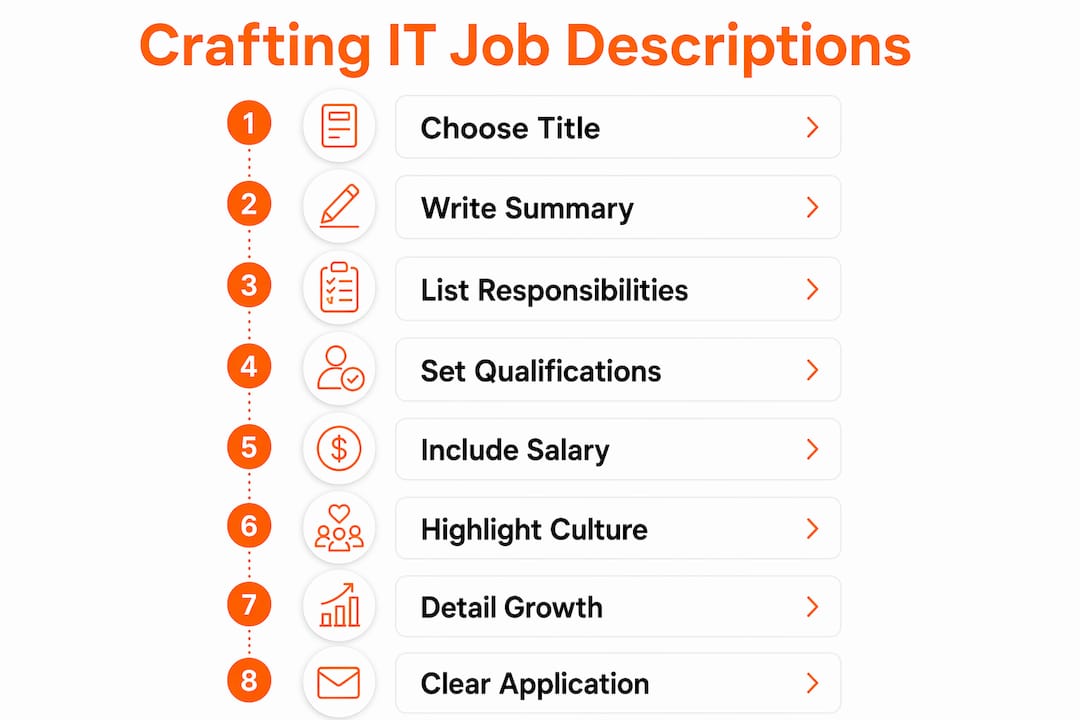
3. How to set qualifications that attract the right candidates
Qualification lists are where most IT job descriptions lose good candidates. A list of 15 required skills, half of which are "nice to have" in practice, signals that the hiring team has not thought carefully about what the role actually needs.
Separating must-have skills from nice-to-have skills improves ATS parsing accuracy and helps candidates self-select honestly. When everything is labeled "required," nothing is prioritized, and the applicant pool fills with people who either over-qualify or misread the role entirely.
- Required: 3+ years of Python development, experience with REST APIs, familiarity with CI/CD pipelines
- Preferred: Experience with Kubernetes, exposure to machine learning workflows, AWS certification
Keep the required list short and honest. If a candidate could learn a skill in the first 90 days on the job, it belongs in the preferred column. Avoid asking for years of experience with technologies that have not existed that long. Unrealistic requirements narrow the pool and signal poor market awareness to candidates who know better.
Use standard terminology for skills and certifications. Mixing "software engineer," "developer," and "programmer" without context confuses both ATS systems and candidates. Pick one term and use it consistently throughout the posting.

4. Why salary and benefits transparency attracts serious candidates
Salary transparency saves time for both employers and candidates. When a posting omits compensation details, qualified candidates often skip it entirely rather than risk wasting time on a role that does not meet their expectations.
State the salary range clearly. If the range is wide, explain what drives placement within it. List concrete benefits rather than generic phrases like "competitive benefits package."
- Base salary range (e.g., $110,000–$135,000 annually)
- Bonus structure or profit-sharing details
- Equity or stock options, if applicable
- Health, dental, and vision coverage specifics
- Flexible or remote work arrangements
- Learning and development budget
- Career progression pathways
IT professionals compare multiple opportunities at once. A posting that answers compensation questions upfront moves faster through the candidate's decision process. It also signals that the organization understands the market and is confident in what it offers.
5. How to structure IT job descriptions for readability and ATS performance
Structure determines whether a job description gets read by a human and parsed correctly by an ATS. ATS platforms rely on structure and prioritization. Clear section headers, bullet points, and consistent terminology reduce ambiguity and improve data extraction.
Most effective IT job descriptions fall between 500 and 800 words. Longer than that, and candidates start skimming or leaving. Shorter than that, and the role feels undefined.
- Use standard section headers: Job Summary, Responsibilities, Required Skills, Preferred Skills, Compensation, How to Apply
- Keep paragraphs to 2–3 sentences
- Use bullet points for responsibilities and qualifications, not for narrative content
- Avoid large text blocks that are hard to scan on mobile
- Place keywords naturally within context, not in dense lists at the bottom
Inclusive language avoids unconscious bias that may deter qualified candidates. Avoid gender-coded words and culturally specific idioms. Focus on neutral, welcoming phrasing that describes the work, not assumptions about who does it.
ATS and AI systems read for intent, not just keywords. A description that clearly explains what the role does and how success is measured performs better than one stuffed with skill terms in isolation. Clarity beats volume in IT postings.
6. What recruitment experts say about writing IT job descriptions
The most consistent advice from recruiters and hiring professionals points in one direction: treat the job description as the candidate's first real look at your organization, not as an administrative form to fill out.
Plain, direct language signals respect for technical candidates and improves recruitment outcomes. IT professionals read job descriptions critically. A posting full of vague phrases tells them more about the company than the company intends.
Practical strategies that experienced recruiters apply:
- Describe the actual tech stack, team size, and reporting structure
- State the real problems the hire will solve in the first 6 months
- Avoid phrases like "rockstar," "ninja," or "guru," which provide no useful signal to ATS or candidates
- Write outcome-based descriptions rather than credential checklists
- Get input from current team members who do the job, since they know what the role actually requires
- Review and update descriptions regularly to reflect technology and team changes
For guidance on writing job descriptions that attract better applicants, the principle is consistent: specificity and honesty outperform generic templates every time.
7. How to highlight company culture and team environment
IT professionals want to know who they will work with and how the team operates. A description that skips this information leaves candidates guessing, and guessing often leads to passing on the role.

Describe the team structure concretely. State the team size, how it is organized, and who the hire will report to. Mention whether the team works in sprints, follows a specific engineering culture, or has particular collaboration norms. If the environment is remote, hybrid, or on-site, say so directly and explain what that looks like in practice.
Avoid vague phrases like "collaborative culture" or "dynamic team." Instead, describe what collaboration actually means in the role: daily standups, async communication, cross-functional projects, or regular design reviews. Candidates who read a specific, honest description of the work environment can make a better decision about fit, which reduces early attrition after hire.
8. Why career growth and learning opportunities belong in every IT posting
Top IT candidates are not just evaluating the current role. They are evaluating where the role leads. A posting that says nothing about growth signals a dead end, even if the opportunity is strong.
Be specific about what development looks like. A learning and development budget with a dollar amount is more credible than "opportunities for growth." A clear promotion path or examples of where previous hires in the role have moved within the organization carries real weight.
- Mention access to conferences, certifications, or training platforms
- Describe mentorship structures or technical leadership pathways
- Note whether the company supports internal mobility across teams or products
- Explain how performance is evaluated and what advancement looks like
Candidates who see a clear trajectory are more likely to apply and more likely to stay. This is especially true for mid-level engineers who are choosing between roles that look similar on paper but differ significantly in long-term potential.
9. How clear application instructions reduce candidate drop-off
Clear instructions on how to apply improve candidate engagement and reduce drop-off. When the application process is vague, qualified candidates who are already fielding multiple opportunities will move on to postings that respect their time.
State exactly what candidates need to submit. If a portfolio, GitHub profile, or work sample is expected, say so. If the process involves a technical screen, a take-home exercise, or multiple interview rounds, describe the sequence. Candidates who know what to expect are more likely to complete the process.
- Specify the application method (form, email, ATS portal)
- List required materials (resume, portfolio, references)
- Provide a timeline or note that applications are reviewed on a rolling basis
- Include a contact name or email for accessibility accommodation requests
- Describe the first step after submission (recruiter screen, technical interview, etc.)
One often-overlooked detail: state whether the role is actively being filled or if the posting is exploratory. Candidates who have been through long, ambiguous hiring processes are quick to recognize when a company is not ready to hire, and they will not wait.
For a broader view of why hiring teams lose candidates at the application stage, unclear process communication ranks consistently as a top factor.
Plucktalent connects IT and cybersecurity professionals directly with hiring managers at companies that are actively filling roles. If you are building a team and want to reach candidates who are already vetted and ready to move, explore Plucktalent's services to see how AI-driven matching and 17 years of recruiting expertise work together.
Key Takeaways
Effective IT job descriptions combine clear structure, honest language, and specific details about the role, team, and compensation to attract qualified candidates and perform well in ATS systems.
| Point | Details |
|---|---|
| Use standard job titles | Searchable, industry-standard titles improve ATS visibility and candidate match rates. |
| Split required and preferred skills | Separate "Must-Have" and "Nice-to-Have" sections improve ATS parsing and candidate self-selection. |
| State salary upfront | Transparent compensation attracts serious candidates and reduces time spent screening mismatched applicants. |
| Describe the team and growth path | Concrete details about team structure and career progression reduce early attrition after hire. |
| Keep descriptions 500–800 words | Postings within this range are easier to scan and perform better in both human and algorithmic review. |
The case for treating job descriptions as living documents
The conventional view treats a job description as a one-time task: write it, post it, move on. That approach produces stale postings that no longer reflect the role, the team, or the technology in use.
In 2026, AI-powered matching systems read job descriptions for intent and context, not just keyword presence. A description written two years ago for a different version of the role will generate weaker matches, regardless of how many keywords it contains. Regular review and adjustment of job descriptions is now a practical necessity, not an optional improvement.
The deeper issue is what a poorly maintained job description communicates to candidates. IT professionals are experienced readers of organizational signals. A posting that lists outdated technologies, references a team structure that no longer exists, or uses language that does not match the company's current culture tells a story. That story is usually not the one the hiring team wants to tell.
Job descriptions that perform well in 2026 are specific, honest, and updated to reflect current reality. They describe what the role actually involves, what the team looks like today, and what the company genuinely offers. That combination builds credibility before the first conversation happens.
FAQ
How do you write an IT job description that attracts qualified candidates?
Use a clear, searchable job title, a concise 2–3 sentence summary, bulleted responsibilities with action verbs, and separate sections for required and preferred skills. Include salary details and a description of the team and application process.
Should IT job descriptions include salary information?
Salary transparency attracts more serious candidates and reduces time spent on mismatched applicants. State the range upfront along with bonus, equity, and benefits details where applicable.
Can AI tools help write IT job descriptions?
AI tools can help draft structure and suggest language, but the role-specific details, tech stack, team context, and honest qualifications must come from the hiring team. AI-generated templates without customization perform poorly in ATS matching.
What is the 70/30 rule in hiring?
The principle suggests that the job description should focus primarily on what the candidate will do and achieve, with a smaller section dedicated to company requirements. This framing keeps descriptions candidate-facing rather than credential-focused.
How long should an IT job description be?
Most effective IT job descriptions fall between 500 and 800 words. Shorter descriptions leave candidates without enough information to self-select; longer ones lose attention before the candidate reaches the application instructions.