
What does an IT hiring manager do?
The IT hiring manager is the person who owns the recruitment decision for technical roles. This individual identifies the business need for a position, defines the technical requirements, leads candidate evaluation, and makes the final hiring call. After the hire, the hiring manager becomes that person's direct supervisor.
The IT hiring manager is not an HR professional. HR manages the process. The hiring manager provides subject-matter expertise. That distinction is the foundation of how technical recruitment works.
Key duties of an IT hiring manager include:
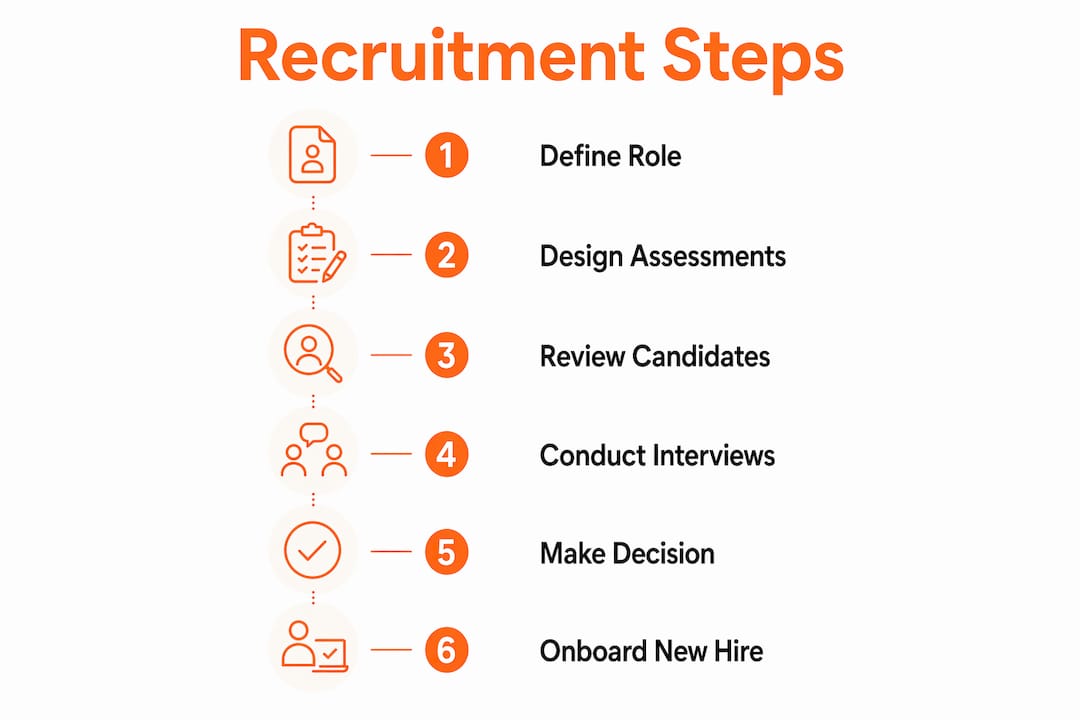
- Defining role requirements and technical competencies
- Writing or approving job descriptions with the recruiter
- Designing technical assessments such as coding exercises and code reviews
- Reviewing candidate applications and conducting interviews
- Making the final hiring decision based on technical and team fit
- Leading onboarding and setting 30/60/90-day performance expectations
- Integrating the new hire into the team
The hiring manager's involvement is the single most significant factor in whether a hire succeeds or fails. When the hiring manager is engaged and clear about requirements, the process moves efficiently. When absent or indecisive, candidates drop out and the eventual hire often mismatches expectations.

Detailed responsibilities of IT hiring managers in recruitment
Defining technical requirements
The IT hiring manager sets the technical bar for every open role. This means specifying required programming languages, frameworks, certifications, years of experience, and team-specific competencies. HR cannot perform this step alone. Without precise requirements from the hiring manager, recruiters source candidates who do not fit, and the entire pipeline loses time.

Designing and approving technical assessments
IT hiring managers create or approve technical assessments such as coding exercises, take-home assignments, and code reviews. These tools evaluate candidate ability beyond what a resume or screening call reveals. HR lacks the domain knowledge to design or score these assessments accurately.
Reviewing applications and conducting interviews
Once recruiters complete initial screening, the hiring manager reviews the shortlisted candidates. The hiring manager then leads technical interviews, assessing how well each candidate meets the defined criteria. This stage requires the hiring manager to ask role-specific questions that a generalist recruiter cannot formulate with the same depth.
Making the final hiring decision
The hiring manager selects which candidate receives an offer. This decision should be based on structured interview scorecards rather than personal rapport. In competitive IT markets, a delay of even one week between the final interview and the offer can result in losing the candidate to another employer.
Onboarding and team integration
The hiring manager's responsibility does not end at the offer letter. Research indicates that employees with a positive onboarding experience are more likely to remain with the company long-term. A hiring manager who hands a new hire a laptop with no structured plan wastes the entire investment made during recruitment. Setting clear expectations, providing early feedback, and integrating the new hire into team workflows are all part of the role.
Attracting and retaining IT talent
IT hiring managers contribute directly to employer brand perception. Candidates frequently report that the hiring manager's behavior during the interview process influences their decision to accept or decline an offer. Clear communication, timely feedback, and genuine engagement during the hiring process signal what working on the team will actually be like.
Best practices for attracting IT talent include:
- Writing precise job descriptions that reflect real day-to-day work
- Providing structured and consistent interview experiences
- Giving candidates timely feedback after each stage
- Using AI-driven candidate identification to surface qualified profiles faster
- Communicating team culture and growth opportunities honestly
Skills required to be an effective IT hiring manager
Effective IT hiring managers combine technical depth with communication and organizational skills. They must translate complex role requirements into clear language for recruiters, evaluate candidates objectively using structured criteria, and manage multiple open roles without creating bottlenecks.
Core skills include:
- Deep knowledge of the technical domain being hired for
- Ability to write and evaluate technical assessments
- Structured interviewing and candidate evaluation
- Clear written and verbal communication with recruiters and candidates
- Timely decision-making to keep hiring timelines on track
- Onboarding planning and early performance management
How IT hiring managers differ from HR in recruitment
The IT hiring manager and HR serve distinct functions. Confusing these roles creates friction, delays, and misaligned hires. The table below outlines the primary differences.
| Function | IT Hiring Manager | HR / Recruiter |
|---|---|---|
| Role type | Subject-matter expert | Process expert |
| Job description | Defines technical requirements | Formats and posts the listing |
| Candidate sourcing | Not responsible | Owns sourcing and outreach |
| Screening | Reviews shortlisted candidates | Conducts initial resume and phone screens |
| Technical assessment | Designs and evaluates | Coordinates logistics only |
| Interview leadership | Leads technical interviews | Schedules and may conduct behavioral screens |
| Final decision | Makes the hiring call | Advises and manages compliance |
| Onboarding | Leads team integration | Manages paperwork and HR systems |
| Compliance | Not primary owner | Owns EEOC and employment law compliance |
Recruiters act as process experts while hiring managers serve as subject-matter experts. Both roles are necessary. Problems arise when the boundaries blur. A hiring manager who tries to run the full process independently creates inefficiency. A recruiter who selects candidates without hiring manager input produces misaligned hires.
HR also owns compliance obligations under frameworks such as those governed by the Equal Employment Opportunity Commission. The hiring manager must operate within those boundaries, but the compliance responsibility sits with HR.
The clearest way to understand the split: HR brings candidates to the table. The IT hiring manager decides which one joins the team.
How IT hiring managers and recruiters work together
The hiring manager and recruiter partnership is the engine of IT recruitment. When it works well, roles are filled faster and with better candidates. When it breaks down, the process stalls and top talent moves on.
Where alignment matters most
The most common source of friction is unclear job requirements. Unclear or indecisive requirements from the hiring manager create bottlenecks that extend hiring timelines significantly. Recruiters cannot source accurately without a precise target. Candidates cannot self-select appropriately without an honest job description.
Alignment on the following points at the start of every search prevents most downstream problems:
- Exact technical skills required versus preferred
- Acceptable experience range and seniority level
- Compensation band and flexibility
- Interview process stages and expected turnaround at each step
- Timeline and urgency of the hire
Screening bottlenecks caused by late or vague feedback from hiring managers are one of the most common reasons IT hiring timelines extend beyond target.
Division of responsibilities in the partnership
Hiring managers are subject-matter experts but rely on recruiters for sourcing, scheduling, and market benchmarking. The recruiter brings process knowledge: where to find candidates, how to structure the pipeline, what compensation the market supports. The hiring manager brings technical knowledge: what the role actually requires and whether a candidate can do the work.
A practical division looks like this:
- Recruiter owns: sourcing, initial screening, interview scheduling, offer logistics, compliance
- Hiring manager owns: technical requirements, assessment design, interview leadership, final decision, onboarding
Communication practices that improve outcomes
Active hiring manager engagement reduces time-to-fill and improves the quality of hires. Specific behaviors that support the partnership include responding to recruiter questions within 24 hours, providing structured feedback after every interview, and attending regular pipeline review meetings.
Reducing time-to-hire in IT often comes down to the hiring manager's responsiveness at key decision points, not the recruiter's sourcing speed.
Pro Tip: Set a written intake document at the start of every search. Include required skills, preferred skills, compensation range, interview stages, and the decision timeline. Share it with the recruiter before sourcing begins. This single step eliminates most requirement-related delays.
How Plucktalent connects IT professionals with hiring managers
Plucktalent was built specifically for IT and cybersecurity professionals who want to reach hiring managers directly, without relying on job boards that rarely deliver results. The platform combines 17 years of recruiting expertise with Plucky AI, a dedicated job search co-pilot that prepares candidates with ATS-ready, tailored profiles matched to active openings.
For IT professionals who want to move through the pipeline faster, Plucktalent's job seeker platform connects them directly with hiring managers at companies that are actively recruiting for their specific skills. The platform also offers talent acquisition services for organizations looking to improve how their hiring managers and recruiters work together.
Key Takeaways
The IT hiring manager is the subject-matter expert who owns the technical requirements, candidate evaluation, final hiring decision, and new hire integration from requisition through onboarding.
| Point | Details |
|---|---|
| Hiring manager owns the decision | The hiring manager defines requirements, leads technical interviews, and makes the final hiring call. |
| Distinct from HR | HR manages sourcing, scheduling, and compliance; the hiring manager provides technical expertise and selects the candidate. |
| Onboarding drives retention | Employees with a positive onboarding experience tend to stay longer with the company. |
| Clarity prevents delays | Unclear technical requirements from the hiring manager are the most common cause of extended IT hiring timelines. |
| Engagement determines outcomes | The hiring manager's level of active involvement is the single biggest factor in whether an IT hire succeeds or fails. |
FAQ
What are the responsibilities of an IT hiring manager?
The IT hiring manager defines technical role requirements, designs or approves candidate assessments, leads interviews, makes the final hiring decision, and manages new hire onboarding and team integration.
Is the hiring manager the same as HR or a recruiter?
No. HR and recruiters manage the hiring process, including sourcing, scheduling, and compliance. The hiring manager is the subject-matter expert who evaluates technical fit and makes the final candidate selection.
What are the 5 C's of hiring?
Definitions vary across organizations, but a widely used version covers Competency, Character, Communication, Culture fit, and Compensation alignment. IT hiring managers typically evaluate the first four directly through technical interviews and structured assessments.
What is the 70/30 rule in hiring?
The 70/30 rule refers to a general guideline where roughly 70% of hiring weight goes to verified skills and experience, and 30% to cultural and team fit. IT hiring managers apply this by grounding most of the evaluation in technical assessments and structured interview scorecards rather than subjective impressions.
How does an IT hiring manager differ from a recruiting manager?
An IT hiring manager is a technical team lead or department head who owns the hiring decision for their team. A recruiting manager oversees the recruitment function itself, managing recruiters, sourcing strategies, and hiring metrics across the organization.