
The fastest route through a system design interview is not more reading. It's mastering a repeatable five-step framework and drilling it under timed conditions until it becomes automatic. Start today: memorize the framework below, commit five core concepts to real fluency, and book a timed mock interview within 48 hours. Everything else in this guide exists to support those three moves.
TL;DR:
- Master a five-step system design framework and drill it under timed conditions within 48 hours to develop automaticity during interviews.
- Focus on mastering core concepts like load balancing, caching, database choice, CAP theorem, and message queues, which appear in most interviews.
- Quantify scale and trade-offs using rough estimates, linking business metrics directly to design constraints to demonstrate realistic reasoning.
- Lead the interview conversation by clarifying requirements, stating explicit assumptions, and treating probes as opportunities to deepen your design explanation.
- Prioritize active, timed practice including mock interviews over passive reading to build communication skills and reinforce trade-off reasoning.
Table of Contents
- What Is the Best Framework for System Design Interview Prep?
- What Core Concepts Should You Master First?
- What's a Realistic System Design Study Plan?
- How Do You Structure a Mock Interview Practice Session?
- How Should You Talk About AI Infrastructure in a Design Interview?
- How Do You Handle Back-of-the-Envelope Estimation and Trade-Offs?
- How Do You Lead the Conversation and Handle Interviewer Probes?
- What Are Common System Design Interview Questions and How Should You Approach Them?
- Which Architectural Patterns Should You Know for System Design Interviews?
- How Do You Build Scalability and Reliability Into Your Designs?
- How Do You Handle Data Modeling and Schema Design?
- Why Does Clarifying Business Requirements Matter So Much?
- What Happens After You Present Your Design?
- What Resources Actually Move the Needle in Prep?
- A Recruiter-Backed Perspective: What Hiring Teams Actually Look For
- How Pluck Talent Can Accelerate Your Prep and Job Search
- Sources
- FAQ
What Is the Best Framework for System Design Interview Prep?
A system design interview rewards structure over memorized architectures. Interviewers have sat through hundreds of these sessions, and they can tell within five minutes whether a candidate has a repeatable process or is improvising. The five-step framework below gives you that process, and it works whether the prompt is "design a URL shortener" or "design a payment processing system."
Step 1: Clarify requirements (5 to 7 minutes). Your first job is to narrow an intentionally vague prompt. Ask about scale (how many users, how many requests per second), the core use cases the interviewer cares about, and what's explicitly out of scope. A useful transition line: "Before I sketch anything, can I confirm the three or four features that matter most for this system?" Interviewers expect you to drive this, not wait for them to volunteer details.
Step 2: Define the API and data contracts (3 to 5 minutes). Sketch the two or three endpoints or interfaces that define how clients interact with your system. This step forces you to commit to what the system actually does before you draw boxes. Say something like: "Let's lock in the interface first, then build the architecture that supports it."
Step 3: Draft a high-level design (10 to 12 minutes). Build the simplest version that satisfies the requirements. Google SRE's Non-Abstract Large System Design approach argues for starting with a working design and layering complexity afterward, rather than jumping straight to a "final" architecture. That's the right instinct here too. Draw the client, the service layer, the data store, and the obvious connections. Resist the urge to add caching or queues until you can explain why the simple version breaks.
Step 4: Deep dive into two or three components (15 to 18 minutes). This is where most of your score gets decided. Pick the components that carry the most technical risk, such as the database schema, the caching strategy, or how you'll handle a specific bottleneck, and go deep. State assumptions out loud: "I'm assuming read traffic outweighs writes 10 to 1, which pushes me toward a caching layer overwrite optimization."
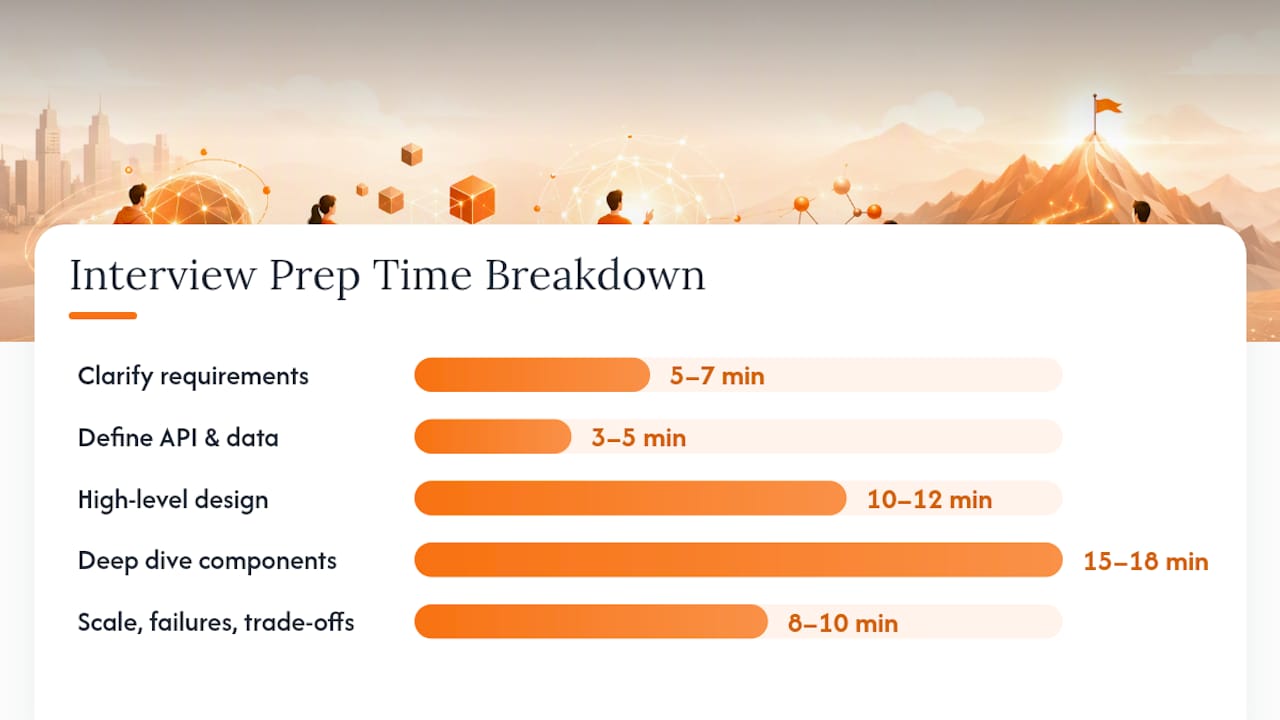
Step 5: Address scale, failure modes, and trade-offs (8 to 10 minutes). Close by stress-testing your own design. What happens when a node dies? Where does this bottleneck first? What would you change at 100 times the current load? Interviewers use this step to see if you can critique your own work, which is a skill they'll need from you on the job.
A few structural notes make this framework work in practice:
- Announce the framework out loud at the start. Saying "I'll clarify requirements, define the API, sketch a high-level design, then deep dive and discuss trade-offs" signals control before you've drawn a single box.
- Time-box yourself mentally. If step one is eating 15 minutes, cut it short and move on. Interviewers notice when candidates can't self-regulate.
- Leave the last five minutes open. Interviewers almost always want to probe something you didn't cover, and having slack time makes you look prepared rather than rushed.
This structure isn't a script to recite. It's scaffolding that keeps you from freezing when the interviewer asks something you didn't anticipate.
What Core Concepts Should You Master First?
Not every system design topic deserves equal study time. Some concepts show up in nearly every interview; others are situational. Splitting your studying into tiers keeps you from wasting hours on esoteric trivia while your fundamentals stay shaky.
Tier 1: know these cold. These concepts appear in the majority of interviews, regardless of company or seniority level.
- Load balancing. Know the difference between round robin, least connections, and consistent hashing, and be ready to explain why consistent hashing matters for cache and shard distribution specifically.
- Caching. Be fluent in cache-aside versus write-through strategies, cache invalidation problems, and where a CDN fits versus an in-memory cache like Redis.
- Database choice. Explain when you'd pick a relational database over a NoSQL store, and defend it with a concrete reason (schema flexibility, join complexity, write throughput) rather than a vague preference.
- CAP theorem and consistency models. You don't need an academic definition. You need to say, in plain terms, that a partitioned system forces a choice between consistency and availability, and that most consumer-facing systems lean toward availability with eventual consistency.
- Message queues. Know when asynchronous processing (via something like Kafka or SQS) solves a problem that synchronous calls can't, particularly for decoupling services or smoothing traffic spikes.
- Rate limiting. Be able to sketch a token bucket or sliding window approach and explain why you'd rate-limit at the API gateway layer.
Tier 2: bring up when relevant, go one layer deep. Sharding strategies, service discovery, idempotency keys, and search indexing (inverted indexes, for example) fall here. You don't need whiteboard-level depth, but you should recognize when a design calls for them and describe the trade-off in a sentence or two.
Tier 3: name-drop only if the conversation goes there. Consensus protocols like Raft, geo-replication strategies, and multi-region failover fall into this bucket. Mentioning them shows breadth. Trying to explain Raft's leader election in detail when nobody asked wastes your limited time.
Quick reference: InterviewLoop recommends keeping a one-page cheat sheet of latency and throughput anchors, things like the rough cost of a memory access versus a disk seek versus a network round trip, so you're not deriving these numbers live under pressure.
A short memory aid helps here. Keep three anchor numbers in your head: a same-datacenter round trip runs roughly half a millisecond, a cross-country round trip runs closer to 50 to 80 milliseconds, and a single server can typically handle somewhere in the low thousands of requests per second before you need horizontal scaling. You don't need to be precise. You need to be fast enough that the interviewer sees you reasoning rather than guessing.
The Tech Interview Handbook's system design guide makes a point worth repeating: interviewers care far more about trade-off reasoning than trivia recall. Candidates who memorize specific architectures (say, "how Twitter's timeline works") often stumble the moment the interviewer changes one constraint, because they never internalized why the original design made those choices.
What's a Realistic System Design Study Plan?
How much time you have changes what you should prioritize, but the sequence stays consistent: fundamentals first, then timed practice, then mocks, then company-specific polish. Exponent's phased approach backs this ordering, and it holds up whether you have two weeks or six months.
If you have two weeks:
- Days 1 to 3: Drill the Tier 1 concepts above. Read one topic per session, then immediately sketch a design that uses it.
- Days 4 to 7: Run one timed 45-minute practice problem per day, solo, using a timer. Record yourself narrating out loud.
- Days 8 to 11: Book three to four mock interviews with peers or platforms that offer them. Review your recordings after each one.
- Days 12 to 14: Research your target company's actual products and known scale challenges, then run one final mock tailored to that context.
If you have eight weeks:
- Weeks 1 to 2 (fundamentals): Work through Tier 1 and Tier 2 concepts systematically. One concept, one reading, one sketch, every day.
- Weeks 3 to 4 (timed practice): Move to solo timed problems, three to four per week, covering a mix of common prompts (chat systems, feed generation, rate limiters, URL shorteners).
- Weeks 5 to 6 (mock interviews): Shift to live mocks with another engineer, aiming for two per week. This is where communication skill catches up to technical knowledge.
- Weeks 7 to 8 (company-specific prep): Study the target company's engineering blog, known outages, and public architecture talks. Run two or three mocks that simulate that company's actual interview style.
Long-term maintenance, if you're prepping months out: System design skill decays if you're not applying it. Keep it fresh by picking one production system at your current job every month and sketching how you'd redesign it for 10 times the load. Contributing to or reading through the System Design Primer on a rolling basis, one problem every couple of weeks, keeps your pattern recognition sharp without demanding a dedicated study block.
Whatever timeline you're on, the ratio matters more than the total hours. InterviewLoop's research on prep habits found that candidates who split their time roughly 40% reading and 60% active practice outperformed those who leaned heavily on reading alone. Passive consumption feels productive. It doesn't build the muscle you actually need on interview day.
How Do You Structure a Mock Interview Practice Session?
Reading about frameworks won't make them automatic. Only repeated, timed practice with feedback does that. Here's a structure that turns a vague "let's practice system design" session into something genuinely useful.
- Set a strict 45-minute timer before you start.** Real interviews run 45 to 60 minutes, and rehearsing without a clock trains bad habits, like spending 20 minutes on requirements gathering because nobody's forcing a cutoff.
- Have your partner pick the prompt cold. You should not know the question in advance. Surprise is part of what you're training for.
- Narrate everything out loud, including your framework steps. Say "I'm moving to the deep dive now" as you transition. Silence is one of the biggest red flags interviewers report, because it signals a candidate is stuck rather than thinking.
- Stop at 45 minutes regardless of where you are. Then spend 10 minutes on feedback: what was clear, what felt rushed, and where you failed to defend a trade-off when pushed.
- Record the session if your partner agrees. Watching yourself back is uncomfortable and extremely effective. You'll notice filler words, unexamined assumptions, and moments where you drew a box without explaining why.
Finding a mock partner doesn't require a formal program. Another engineer on your team, a friend prepping for the same interviews, or a study group built around a shared timeline all work, provided you brief them properly. Give your partner a one-line ask before you start: "Push back on my trade-offs and stay quiet if I go silent for more than 20 seconds, that's exactly what I want to catch." Vague feedback requests ("let me know how it went") produce vague feedback.
Your self-review checklist after every mock should include a few honest questions. Did you ask clarifying questions before drawing anything? Did you state at least one explicit trade-off per major decision? Did you catch yourself going silent for more than 15 to 20 seconds while thinking? Silent pauses read as uncertainty even when you're actually reasoning carefully, so narrate through the thinking instead of doing it in your head.
Pro Tip: Keep a running log of every mock interview with one sentence on what broke down. After five or six sessions, you'll see a pattern, usually the same weak spot (estimation, database schema, or handling pushback) showing up repeatedly. That pattern is your actual study priority, not whatever topic you feel like reviewing next.
How Should You Talk About AI Infrastructure in a Design Interview?
System design interviews increasingly touch AI-powered features, even at companies that aren't AI-first. A prompt like "design a customer support chat system" might reasonably expect you to reason about where an LLM fits, not just traditional request routing.
You don't need machine learning expertise to handle this well. You need to name the right primitives and reason about their trade-offs the same way you would for a database or a cache.
- Vector databases. Know that they store embeddings for similarity search and that they're the backbone of retrieval-augmented generation (RAG) systems, where you fetch relevant context before passing it to a model.
- RAG pipelines. Be able to sketch the flow: query comes in, gets embedded, relevant documents get retrieved from a vector store, then both get passed to the model as context.
- Batching for inference. Explain that batching multiple requests together improves GPU utilization but adds latency, a direct trade-off you should be ready to quantify in general terms.
- Cost versus latency versus accuracy. A larger model tends to be more accurate but slower and more expensive per call. Smaller, fine-tuned models trade some accuracy for speed and cost. ByteByteGo's interview framework specifically flags this three-way trade-off as something candidates should articulate, not just recognize.
A quick example: if asked to add an AI-powered search feature to an existing e-commerce system, a strong answer identifies that you'd add a vector database alongside the existing relational store, generate embeddings asynchronously when products get added, and cache frequent query embeddings to cut inference costs. That's specific enough to show real reasoning without pretending you're an ML engineer.
How Do You Handle Back-of-the-Envelope Estimation and Trade-Offs?
Interviewers use estimation to test whether your design decisions connect to real numbers or float in the abstract. A design that "should scale fine" without supporting math reads as guesswork.
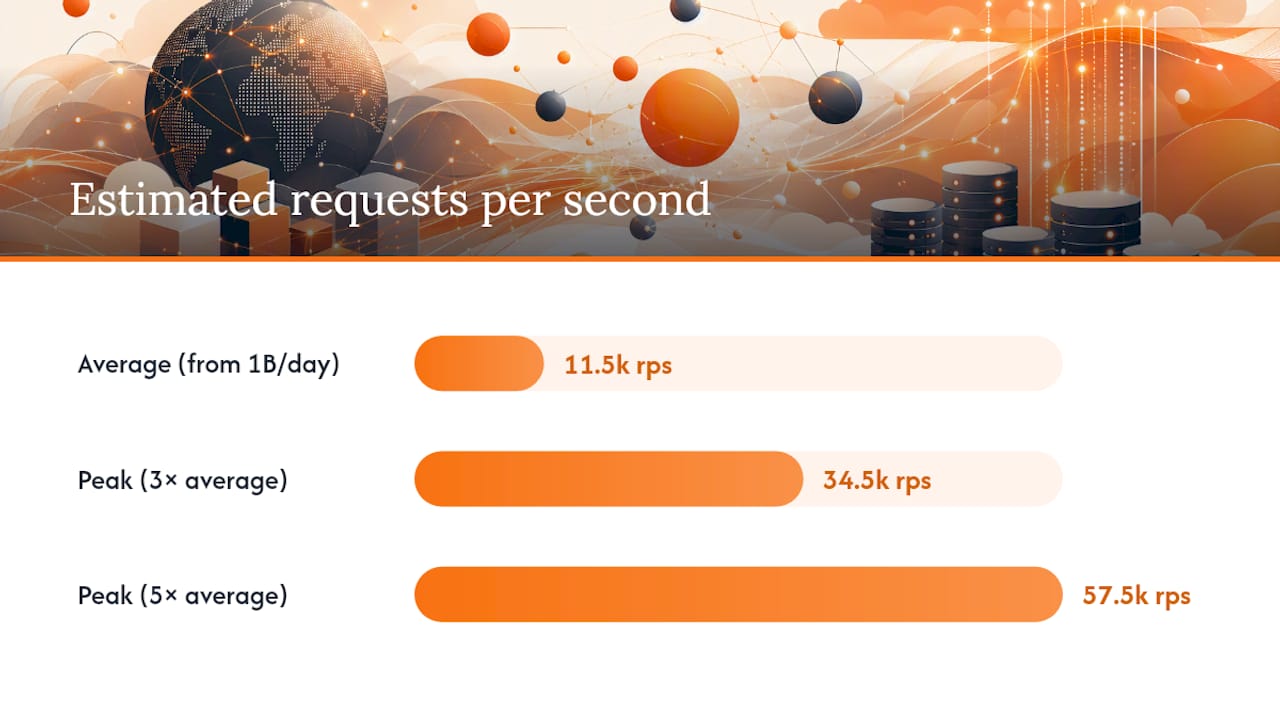
Keep your math rough and fast. If a prompt mentions 100 million daily active users, and each user makes an average of 10 requests a day, that's roughly 1 billion requests daily, or about 11,500 requests per second on average, with peak traffic likely three to five times that. You're not aiming for precision. You're showing that you can translate a business number into a technical constraint that shapes your design.
Trade-off articulation matters just as much as the math itself. When an interviewer asks "why not just use a single database?" the weak answer is "it wouldn't scale." The strong answer names the specific failure point: "At this write volume, a single primary database becomes a bottleneck around a few thousand writes per second, so I'd shard by user ID once we cross that threshold." ByteByteGo's guidance on this is blunt: never let "it depends" stand alone. Always follow it immediately with the specific factors that would change your answer.
This is also where candidates lose points quietly. Saying "I'd use caching to improve performance" is vague. Saying "I'd cache the product catalog with a 10 minute TTL since it's read-heavy and changes infrequently, which cuts database load by an order of magnitude" shows you've actually reasoned through the decision. Every design choice should come paired with the constraint that justified it.
How Do You Lead the Conversation and Handle Interviewer Probes?
A system design interview is a conversation you're expected to drive, not a test you passively respond to. Interviewers deliberately leave the prompt vague to see whether you'll ask questions or start drawing boxes based on assumptions nobody confirmed.
State your assumptions explicitly and invite correction: "I'm assuming this system needs to support 10 million users with read-heavy traffic. Let me know if that's off." This does two things. It shows the interviewer your reasoning process, and it gives them an easy opening to redirect you if you're solving the wrong problem.
When an interviewer interrupts with a probe, like "what happens if that service goes down?", treat it as useful signal, not a sign you did something wrong. Interviewers probe the parts of your design they think are weakest or most interesting, so a probe is often a hint about where to go deeper. Answer directly, then extend: "Good question, if that service fails, requests would queue up here. I'd add a circuit breaker so downstream services degrade gracefully instead of cascading."
Avoid two common communication failures. The first is going silent while thinking through a hard problem, which reads as being stuck even when you're not. Narrate your thinking instead, even messy thinking: "I'm weighing two options here, let me think through both out loud." The second is over-explaining basic concepts the interviewer clearly already understands, which wastes your limited time and can read as stalling.
What Are Common System Design Interview Questions and How Should You Approach Them?
A handful of prompts recur across companies because they each isolate a specific set of trade-offs. Knowing the pattern matters more than memorizing a specific solution.
Design a URL shortener. This tests hashing strategies, database schema for lookups, and handling collision. A strong answer covers generating short codes (base62 encoding of an incrementing ID, or a hash with collision checking), then discusses read-heavy caching since redirects vastly outnumber creates.
Design a rate limiter. This tests your understanding of token bucket versus sliding window algorithms and where in the stack rate limiting belongs. Strong candidates discuss distributed rate limiting challenges, specifically, how you keep counts consistent across multiple servers using something like Redis.
Design a news feed or timeline. This tests fan-out strategies. Do you push new posts to every follower's feed at write time (fan-out on write), or pull posts from followed accounts at read time (fan-out on read)? The right answer depends on follower count distribution, and naming that dependency is the actual signal interviewers want.
Design a chat application. This tests real-time communication patterns (WebSockets versus long polling), message ordering, and delivery guarantees. Strong answers address what happens when a user is offline and how messages get queued for delivery.
Each of these questions rewards the same underlying skill: identifying the two or three decisions that actually matter for that specific system, rather than treating every design as a generic template.
Which Architectural Patterns Should You Know for System Design Interviews?
Interviewers frequently ask you to justify a structural choice, not just draw a diagram, so understanding the trade-offs behind common patterns matters more than naming them.
Monolith versus microservices. A monolith is simpler to develop, test, and deploy early on, but it couples every team to a single deployment cycle. Microservices decouple teams and allow independent scaling, but they introduce network latency, distributed debugging, and operational overhead. The right answer to "which would you choose?" almost always depends on team size and system maturity, and saying so, with the reasoning attached, beats picking a side dogmatically.
Event-driven architecture. Services communicate through events rather than direct calls, typically via a message broker. This pattern shines when you need to decouple producers from consumers or handle traffic spikes asynchronously, such as processing uploaded videos or sending notifications. The trade-off is eventual consistency and added complexity in tracing a request across services.
Layered architecture. Separating a system into presentation, business logic, and data layers keeps concerns isolated and makes testing easier. It's less flashy to discuss in an interview, but showing you default to clean separation, even inside a single service, signals engineering discipline.
The strongest candidates don't announce a pattern and stop there. They connect the pattern to the specific constraint from the prompt: "Given that these are independent teams shipping on different schedules, I'd lean toward microservices here, even accepting the added operational cost."
How Do You Build Scalability and Reliability Into Your Designs?
Scalability and reliability aren't features you bolt onto a finished design. They need to shape decisions from the first sketch, then get explicitly revisited during the deep dive.
For scalability, the core lever is deciding what to scale horizontally versus vertically, and when. Stateless services scale horizontally with ease, just add more instances behind a load balancer. Databases are harder, which is why sharding strategy deserves specific attention: sharding by user ID keeps a user's data together but can create hot shards if some users generate disproportionate traffic.
For reliability, talk through failure explicitly rather than assuming happy-path execution. What happens when a downstream service times out? Do you retry, and if so, with what backoff strategy to avoid making things worse? A circuit breaker pattern, where a service stops calling a failing dependency after repeated failures and fails fast instead, shows you're thinking about cascading failure, one of the most common ways real systems go down under load.
Google SRE's NALSD approach reinforces a habit worth adopting directly: evaluate resilience and capacity at every step of your design, rather than treating "scale it later" as an acceptable answer. Concretely, that means stating capacity assumptions as you build, not saving them for a single "and now let's talk about scale" segment at the end.
How Do You Handle Data Modeling and Schema Design?
Data modeling decisions get skipped by candidates in a rush to draw more boxes, but they're often where interviewers dig deepest, because a bad schema choice cascades into every downstream design decision.
Start by identifying the access patterns before choosing a schema. If most queries fetch a user's recent orders, your schema should optimize for that read pattern, even if it means denormalizing data that a purist relational design would keep separate. This is the core argument for NoSQL in specific contexts: when your access pattern is known and repetitive, a document store that pre-joins related data can outperform a normalized relational schema under load.
Walk through a concrete example when relevant. For a chat application, you might model messages with a composite key of conversation ID and timestamp, which makes fetching a conversation's recent history a single efficient range query rather than a join across tables.
Don't skip indexing. Naming which fields need an index, and explaining why (frequent filtering or sorting on that field), shows you understand the cost of every query pattern, not just the happy path. And be ready to discuss the trade-off between normalization (less redundancy, more joins) and denormalization (faster reads, harder to keep consistent). Neither is universally correct. The right choice depends on whether your system is read-heavy or write-heavy, and stating that dependency out loud is exactly the signal interviewers are listening for.
Why Does Clarifying Business Requirements Matter So Much?
The single most common way candidates lose points in the first five minutes is skipping requirements clarification and diving straight into architecture. This isn't a formality. It's the step that determines whether everything you build afterward solves the actual problem.
A prompt like "design Instagram" could reasonably focus on the feed algorithm, the photo storage and delivery pipeline, or the social graph, and each of those emphases produces a completely different design. Guessing wrong wastes half your interview building the wrong thing well.
Ask pointed questions rather than open-ended ones. Instead of "what should I focus on?", try "should I prioritize the feed generation logic, or is media storage and delivery more central to what you want to see?" This gives the interviewer an easy way to redirect you and shows you already understand the system has multiple valid focal points.
Scope constraints matter just as much as feature priorities. Confirm rough scale (are we talking thousands or hundreds of millions of users?), whether this is a greenfield design or an evolution of an existing system, and whether specific non-functional requirements like sub-second latency or five nines of availability are in play. Each answer meaningfully changes your architecture, and asking for them up front is exactly the behavior interviewers are grading.
What Happens After You Present Your Design?
Most candidates treat the initial design as the finish line. Interviewers treat it as the starting point for the most revealing part of the conversation: the follow-up discussion.
Expect questions about bottlenecks first. "Where does this design break first under 10 times the load?" is nearly universal. Prepare an honest answer rather than claiming your design scales infinitely; every design has a breaking point, and identifying yours proactively is stronger than getting cornered into admitting one.
Expect a request for specific improvements next. If you identified a single point of failure in your database layer, be ready to sketch how you'd address it, replication, sharding, or a managed multi-region setup, along with the operational cost that fix introduces. Every improvement carries a trade-off, and naming it unprompted signals maturity.
Finally, expect a trade-off summary question: "If you had to redo this with a different priority, say strong consistency instead of availability, what would change?" This tests whether you understand your own design's assumptions well enough to invert them. Candidates who can only defend the design they already built, without reasoning about the alternative path, reveal that they memorized a pattern rather than understanding the trade-off space underneath it.
What Resources Actually Move the Needle in Prep?
Start with the System Design Primer for foundational vocabulary and common problem patterns. Read the Tech Interview Handbook's system design section for a clear-eyed summary of what interviewers actually grade versus what candidates assume they grade.
The trick is converting every reading session into a timed exercise. Finish an article on caching strategies, then immediately spend 45 minutes designing a system that uses caching as a core decision, not just a bullet point on a diagram. Reading without that follow-up practice step produces recognition without recall, you'll understand a concept when you see it explained again but freeze when asked to apply it cold.
- Use the System Design Primer's problem list as a rotating source of timed practice prompts, not a reading list to finish once.
- Treat engineering blog posts from companies like Uber, Netflix, or Discord as case studies, then ask "what would I have done differently with half their scale?"
- Avoid memorizing specific companies' architectures as templates. Interviewers change constraints specifically to catch candidates reciting a design instead of reasoning through one.
A Recruiter-Backed Perspective: What Hiring Teams Actually Look For
Recruiting for IT and cybersecurity roles for years surfaces a pattern that candidates rarely hear directly: hiring managers forgive an imperfect architecture far more readily than they forgive poor communication. A candidate who says "I'm not sure, let me think through two options" scores better than one who confidently states a wrong answer and refuses to budge under a probe.
The most common error isn't a knowledge gap. It's candidates treating the interview as a performance to get through rather than a conversation to lead, which shows up as silence during hard moments and defensiveness when an interviewer pushes back. The fix is almost mechanical: narrate your thinking, and treat every probe as an invitation, not an attack.
When describing past experience during a design discussion, tie it to measurable outcomes rather than responsibilities. "I redesigned our caching layer, cutting p99 latency by a meaningful margin" lands harder than "I worked on caching improvements." That specificity is exactly what a well-tailored resume built around metrics should already be doing before you ever reach the interview room.
— Diego
How Pluck Talent Can Accelerate Your Prep and Job Search
Studying the framework above gets you interview-ready. Getting in front of the right interviewer in the first place is a separate problem, and it's the one most engineers underinvest in. The platform combines deep IT and cybersecurity recruiting experience with AI to bypass job board noise, connecting your profile directly with hiring managers who are actively hiring for the skills you're practicing right now.
While you're drilling load balancing and mock interviews, the service works in parallel on the front half of the process: matching you to roles where your background is a genuine fit, and tailoring your resume and profile to clear ATS filters instead of disappearing into a queue. It's a resume and role-matching service, not a replacement for the technical prep covered in this guide, so the two work together rather than in competition. If you're putting in the hours on system design, make sure that effort actually lands in front of someone who can act on it. Visit the Pluck Talent job seekers page to see how targeted role matching and profile optimization fit into your search.
Sources
- How to Prepare for System Design Interviews — InterviewLoop
- System Design: Non-Abstract Large System Design — Google SRE
- A framework for system design interviews — ByteByteGo
- System Design Interview Prep & Questions (2026 Guide) - Exponent
- System Design Primer — donnemartin/system-design-primer
FAQ
What Are the 5 C's of Interviewing?
The "5 C's" framing isn't a standard system design term, and definitions vary depending on the source. For system design specifically, the more useful anchor is the five-step framework covered earlier: clarify, contract (API), construct (high-level design), critique (deep dive), and consider trade-offs (scale and failure).
How Do I Prepare for a System Design Interview Effectively?
Split your time roughly 40% reading and 60% active, timed practice, following the ratio InterviewLoop's research found most effective. Pair a repeatable framework with regular mock interviews rather than passively consuming more articles or videos.
Are System Design Interviews Hard?
They're difficult primarily because they're open-ended and communication-heavy, not because they demand obscure knowledge. Candidates who struggle usually lack a repeatable framework or haven't practiced narrating trade-offs out loud under time pressure, both of which are fixable with deliberate practice.
How Do You Explain a System Design in an Interview?
State your assumptions explicitly, narrate your reasoning as you draw, and connect every architectural decision to a specific constraint or trade-off rather than describing components in isolation. Interviewers grade the reasoning behind your design at least as heavily as the design itself.
How Long Should I Study Before My System Design Interview?
An eight-week phased plan covering fundamentals, timed practice, and mock interviews works well for most candidates, though a focused two-week plan can work if you concentrate on Tier 1 concepts and daily timed practice. The specific timeline matters less than following the sequence: fundamentals, then practice, then mocks, then company-specific prep.