
The single highest-leverage action to close a specific tech-role gap is to build one hands-on lab project, document it publicly on GitHub, and get it in front of a hiring manager within 90 days. This sequence outperforms any amount of passive studying.
- Days 1–30: Run a skills gap analysis against 10–15 job postings for your target role. Identify 1–2 priority skills. Start a TryHackMe or Hack The Box learning path the same week.
- Days 31–90: Complete one hands-on lab project. Publish a write-up on GitHub. Begin one role-aligned certification (CompTIA Security+ or CySA+ for most entry paths).
- Days 91–180: Finish the cert. Add a second project. Start direct outreach to hiring managers.
The global cybersecurity workforce shortfall sits at approximately 4.8 million unfilled roles, with AI-related security positions among the fastest-growing. The demand is there. The gap is proof of work.
Table of Contents
- What does a prioritized 5-step plan to close skills gaps for tech roles look like?
- How do you map a target role to the exact skills hiring managers expect?
- How do you build a portfolio that hiring managers actually trust?
- Which certifications move the needle for technical roles?
- How should you present new tech skills on your resume and LinkedIn?
- How do networking and mentorship accelerate your path to a tech role?
- How do you prepare for technical interviews and live lab tests?
- What do realistic 3-, 6-, and 12-month roadmaps look like?
- What common mistakes slow progress or hurt hireability?
- Key Takeaways
- What hiring managers actually look for when filling tech roles
- Plucktalent connects your portfolio directly to hiring managers
- Useful sources
- FAQ
What does a prioritized 5-step plan to close skills gaps for tech roles look like?
- Learn with structure. Allocate study time using a 70/20/10 distribution: 70% hands-on practice, 20% peer learning or mentorship, 10% formal courses or reading.
30-day deliverable: Gap analysis complete, learning path started, first lab underway. 90-day deliverable: One GitHub write-up published, cert exam scheduled or passed. 180-day deliverable: Two portfolio projects live, cert earned, active applications with portfolio links.
Pro Tip: Review 10–15 job postings before choosing a certification. Hiring managers write postings based on what they actually test for in interviews — those postings are a free study guide.
How do you map a target role to the exact skills hiring managers expect?
| Role | Core Skills | Evidence Type | Priority Order |
|---|---|---|---|
| SOC Analyst | SIEM triage, log analysis, incident response | Splunk queries, alert write-ups, DetectionLab screenshots | SIEM first, then IR playbooks |
| Pentester | Web app testing, network recon, exploitation | Hack The Box write-ups, Burp Suite captures, OSCP labs | Networking/OS fundamentals first |
| Cloud Security | IAM policy, misconfiguration detection, CSPM | GitHub Terraform configs, AWS/Azure audit reports | Cloud fundamentals, then IAM |
| GRC / IAM | Risk frameworks, policy writing, access control | NIST CSF gap assessments, policy samples, audit logs | NIST CSF first, then tooling |
Sample artifacts that hiring managers verify: Splunk dashboards with documented queries, Nmap scan reports with analysis notes, Burp Suite session captures with remediation steps, and GitHub repos containing lab scripts with README files explaining the objective and outcome.
Priority skills to learn first, regardless of role: TCP/IP networking, Linux command line, and basic scripting (Python or Bash). These underpin every technical role. Candidates who skip them hit a ceiling fast.
How do you build a portfolio that hiring managers actually trust?
Platforms to use: TryHackMe for structured beginner-to-intermediate paths, Hack The Box for realistic machine compromise scenarios, and DetectionLab for building a local SIEM environment. Wireshark, Nmap, and Burp Suite are the core tools to document in every relevant project.
Three project templates by time available:
- Weekend lab (8–10 hours): Complete one TryHackMe room or HTB retired machine. Write a 500-word walkthrough covering objective, tools used, key findings, and what you learned. Publish to GitHub.
- Month project (20–30 hours): Build a DetectionLab environment. Generate synthetic alerts. Write Splunk detection rules. Document the full setup and two detection scenarios.
- Multi-month capstone (60+ hours): Complete the OSCP lab environment or a full web app pentest against a practice target. Produce a professional-style report with executive summary, findings, and remediation steps.
Portfolio checklist for each GitHub entry:
- Project title and objective (one sentence)
- Tools and environment used
- Step-by-step methodology
- Screenshots or command output
- Key findings and what they demonstrate
- What you would do differently
Pro Tip: Documenting learning publicly — via blog posts or GitHub write-ups — forces mastery and signals competence to recruiters in a way that a cert list alone cannot.
Which certifications move the needle for technical roles?
| Credential | What It Proves | Estimated Cost | Best For |
|---|---|---|---|
| CompTIA Security+ | Knowledge baseline, compliance | Moderate cost | Entry-level SOC, GRC, IT security |
| CompTIA CySA+ | Threat detection and analysis knowledge | Moderate cost | SOC analyst, blue team |
| OSCP (OffSec) | Hands-on exploitation ability, real compromise | Higher cost | Pentester, red team |
| NIST CSF (self-study) | Framework knowledge, GRC alignment | Free | GRC, IAM, compliance roles |
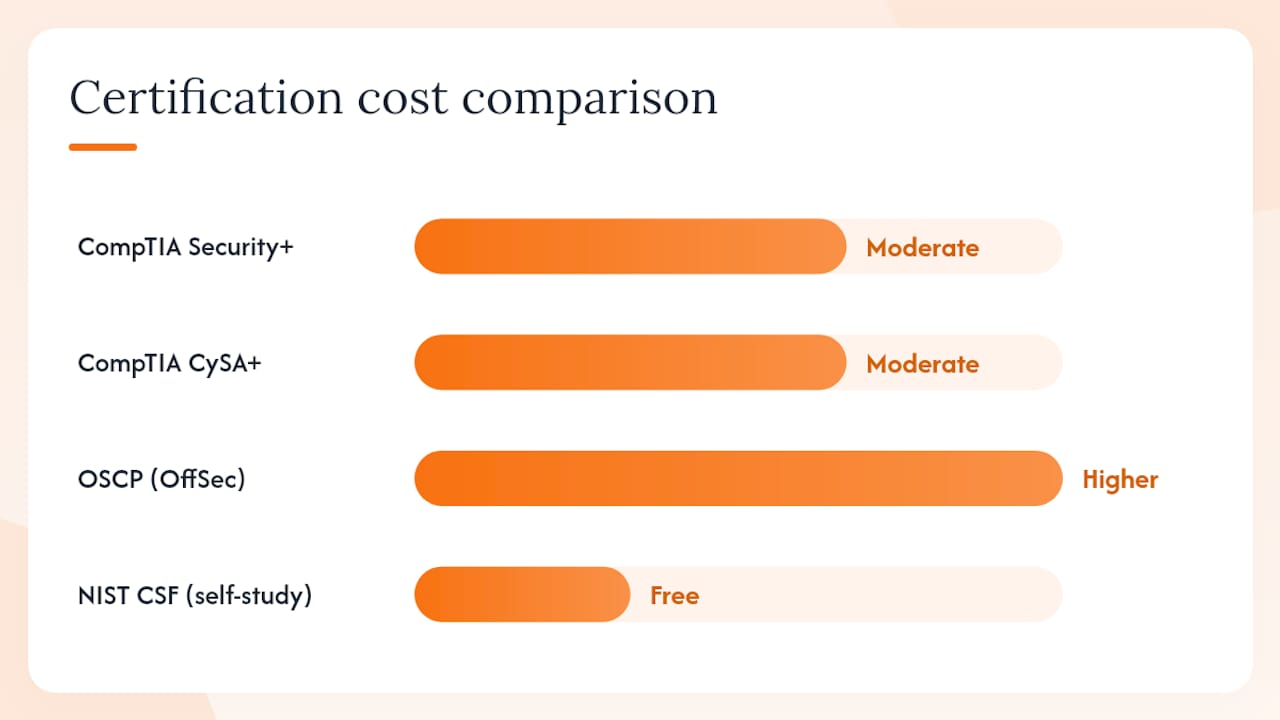
Performance-based certifications like OSCP carry significantly more weight with hiring managers for technical roles than multiple-choice exams. The exam requires actual machine compromise under time pressure — that is the kind of proof that transfers directly to interview credibility.
A practical cert ladder: Security+ first to establish baseline, then CySA+ or PenTest+ depending on your track, then a specialization cert (OSCP for offensive, CCSP for cloud). Limit your cert stack to 3–5 strategically ordered credentials paired with real project experience. More certs without matching portfolio work signals breadth without depth.
When a portfolio entry beats a cert: if you already hold Security+ and are targeting a SOC analyst role, a documented DetectionLab project with Splunk rules will move you further than adding a third knowledge-based cert.
How should you present new tech skills on your resume and LinkedIn?
Resume bullets that work:
- "Built DetectionLab SIEM environment; wrote 5 Splunk detection rules reducing simulated alert triage time by 40%."
- "Completed 12 Hack The Box machines; published write-ups on GitHub demonstrating network recon and privilege escalation."
- "Earned CompTIA Security+ (2025); currently pursuing CySA+ with projected completion Q3 2026."
ATS checklist for smart job applications:
- Match job-description keywords exactly (e.g., "SIEM," "incident response," "vulnerability management")
- Include GitHub profile URL and LinkedIn URL in the header
- List certs with full name, issuing body, and year
- Use a Projects section with one-line descriptions linking to GitHub
LinkedIn actions that get recruiter attention: add portfolio projects to the Featured section with screenshots, publish a short post describing a lab you completed (what you built, what you learned), and update your headline to include your target role title and one key skill (e.g., "SOC Analyst | SIEM | CompTIA Security+").
How do networking and mentorship accelerate your path to a tech role?
High-value communities: local BSides security conferences, online Slack and Discord servers (e.g., TryHackMe Discord, Hack The Box forums), and CTF team groups. Engage by sharing write-ups and asking technical questions, not just lurking.
Mentorship outreach sequence:
- Identify a practitioner in your target role on LinkedIn.
- Send a connection request with a one-sentence context note ("I'm transitioning into SOC analyst work and found your posts on detection engineering useful").
- After connecting, ask one specific question — not "can you mentor me?" but "I'm building a DetectionLab setup — would you be willing to review my Splunk rule logic?"
- Follow up with a summary of what you applied from their feedback.
Converting community activity into interview leads: post a completed lab write-up in a relevant Discord channel and tag it with the role you're targeting. Share it on LinkedIn. Reach out directly to hiring managers at companies you want to work for, referencing the specific project as proof of relevant skill.
How do you prepare for technical interviews and live lab tests?
Interview demo structure (10–15 minutes):
- State the objective of the lab or project (30 seconds).
- Walk through the methodology — tools used, steps taken, decisions made (5–7 minutes).
- Show the key finding or output (2–3 minutes).
- State what you would do differently or what the finding means in a real environment (1–2 minutes).
Timed practice checklist:
- Networking: subnetting, TCP/IP, DNS, firewall rules
- Linux: file permissions, process management, log parsing
- Scripting: Python or Bash for log parsing and basic automation
- SIEM: Splunk query syntax, alert logic, dashboard creation
- Web app security: OWASP Top 10, Burp Suite intercept and replay
Post-mortem template for every practice lab: write one paragraph covering what you did, what worked, what failed, and what you learned. Add it to the GitHub README. This turns every failed attempt into a portfolio artifact.
What do realistic 3-, 6-, and 12-month roadmaps look like?
| Profile | 3 Months | 6 Months | 12 Months |
|---|---|---|---|
| No IT background | Networking/Linux fundamentals, TryHackMe Beginner path | Security+ earned, 2 lab write-ups on GitHub | Entry role applications, CySA+ in progress |
| IT background (helpdesk/sysadmin) | Security+ exam scheduled, DetectionLab built | Security+ earned, 3 portfolio projects, CySA+ started | Active applications, first interviews |
| Mid-career pivot (non-IT) | Fundamentals course complete, TryHackMe started | Security+ earned, 2 projects documented | Entry role targeted, networking active |
A practical certification ladder plus portfolio and home-lab work is an effective path to entry-level security roles in 6–12 months for candidates with IT fundamentals, and 9–12 months for those coming from non-technical backgrounds.
Benchmarks checklist — ready to apply when:
- Two portfolio projects are publicly documented on GitHub
- One role-aligned cert is earned or exam is scheduled within 30 days
- You can demo a lab project in under 15 minutes without notes
- You have completed at least 5 mock technical interview questions in your target domain
Sample weekly schedule: 3 hours hands-on lab work, 1 hour cert study, 30 minutes reviewing job postings and updating gap analysis, 30 minutes community engagement or outreach.
What common mistakes slow progress or hurt hireability?
Red flags to avoid:
- Over-certifying without projects. Three knowledge-based certs and no GitHub repo is a common pattern that stalls applications. Hiring managers notice.
- Shallow project work. A lab that only shows tool output with no analysis is not a portfolio entry. Document the methodology and the meaning of findings.
- Skipping fundamentals. Candidates who jump to OSCP prep without solid TCP/IP and Linux knowledge fail the exam and struggle in interviews.
- Poor documentation. A GitHub repo with no README, no objective, and no findings is invisible to recruiters.
Corrective actions:
- Re-scope one existing project to add a methodology section and findings summary before starting a new one.
- Spend two weeks on networking and OS fundamentals before advancing to specialization topics.
- Review common job-search time wasters and cut any activity that does not produce a portfolio artifact, a cert, or a direct hiring-manager conversation.
Distinguishing an individual skill gap from an environment ceiling: if you have the skills the job postings require but are not getting interviews, the issue is likely presentation or outreach, not skill. If you are getting interviews but not offers, the gap is usually technical depth or communication of that depth.
Key Takeaways
Closing a tech-role skills gap requires hands-on proof, a role-mapped certification, and direct hiring-manager outreach — not more passive study.
| Point | Details |
|---|---|
| Hands-on proof first | One documented GitHub lab project carries more weight than multiple knowledge-only certifications. |
| Role-mapped certs | Choose 3–5 strategically ordered certifications; Security+ to CySA+ to OSCP is the standard SOC/pentest ladder. |
| Realistic timeline | Candidates with IT backgrounds can reach entry roles in several months; those from non-technical backgrounds typically need a longer period with consistent study and hands-on practice. |
| Portfolio benchmarks | Two public projects, one earned cert, and a 15-minute live demo ability are the minimum signals before applying broadly. |
| Plucktalent for outreach | Plucktalent connects IT and cybersecurity professionals directly with hiring managers, bypassing job board noise with ATS-optimized profiles. |
What hiring managers actually look for when filling tech roles
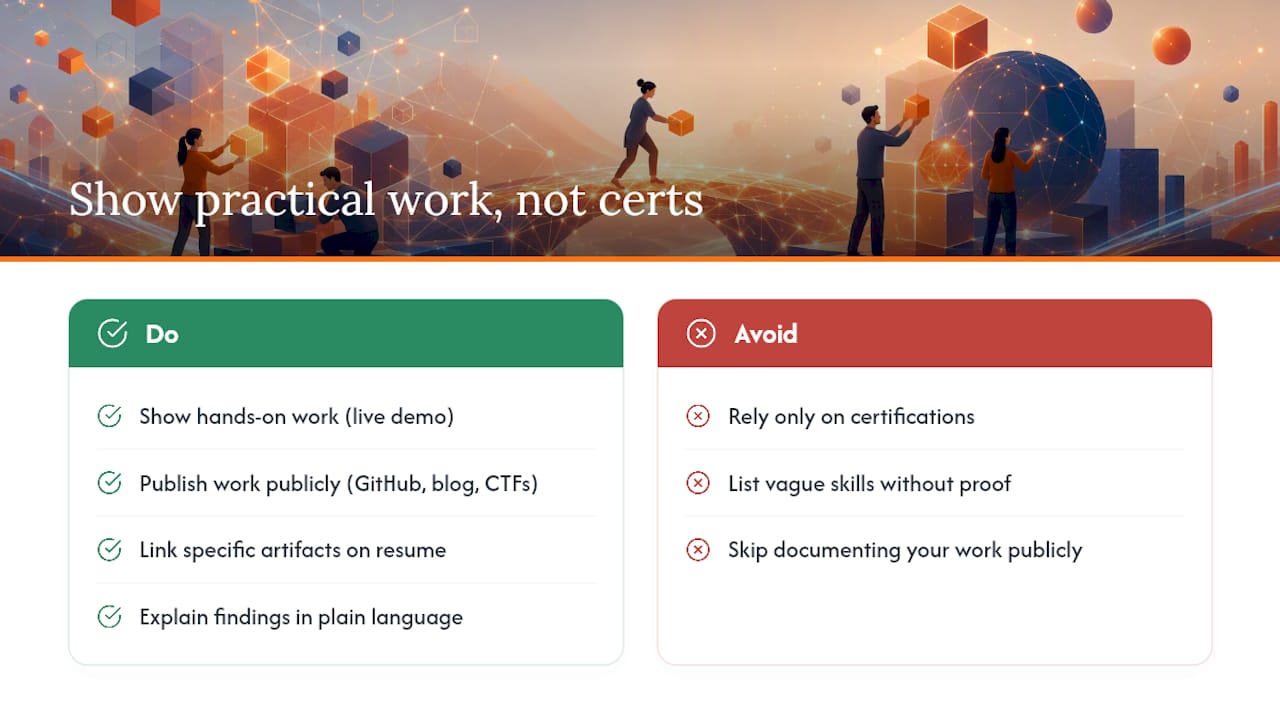
The most common mistake candidates make is treating a skills gap as a knowledge problem when hiring managers are evaluating it as a proof problem. A candidate who can walk through a Hack The Box machine compromise in a 10-minute live demo will advance past a candidate with two additional certs and no lab work. That pattern holds across SOC analyst, pentester, and cloud security roles.
Hiring managers value practical experience over credentials alone. The portfolio is the interview before the interview. Recruiters with Plucktalent's 17 years of placement experience in IT and cybersecurity consistently report that candidates who document their work publicly — GitHub repos, technical blog posts, CTF write-ups — move through hiring pipelines faster than those who do not.
The decision rule is straightforward: show the work or do not expect an interview. A resume that lists "experience with SIEM tools" is generic. A resume that links to a GitHub repo containing documented Splunk detection rules is specific and verifiable.
One additional factor that candidates underestimate: communication of technical work. A candidate who can explain what a finding means in plain language, not just what tool produced it, signals readiness for a real team environment. That communication ability is what separates candidates at the final interview stage.
Plucktalent connects your portfolio directly to hiring managers
Spending months building skills and portfolio artifacts only to lose them in a job board black hole is a known failure mode. Plucktalent is built specifically to prevent that outcome for IT and cybersecurity professionals.
The platform combines 17 years of IT and cybersecurity recruiting expertise with Plucky AI, a job search co-pilot that optimizes your resume for ATS systems, surfaces roles that match your specific skills, and provides direct hiring manager contact information. Your portfolio links, certifications, and lab projects get in front of the people making hiring decisions — not filtered out by automated screening.
For professionals who have done the work of closing a skills gap, the next step is making sure that work is visible to the right people. Start with the Plucktalent job seeker platform to connect your profile to active hiring managers in IT and cybersecurity.
Useful sources
- The value of hands-on, real-world testing in cybersecurity certifications | GIAC
- How to grow your cybersecurity skills, according to experts | Security Magazine
- carlcastanas/Cybersecurity-Roadmap
- Cybersecurity roadmap 2026 | CloudTweaks
- How to Transition into a Cybersecurity Career in 2026 (From Any Background) | UseLearnAI
- Cybersecurity Certification Roadmap 2026: Beginner to CISO | ExamCert
- Upskilling for Career Growth: Identifying and Acquiring New Skills in 2026 | CareerActionPlan
- Choosing Which Skills to Learn Next for Career Growth in 2026 | AutomateEd
Document everything in a public GitHub repository. Add each project to your LinkedIn Featured section. These two steps alone separate active candidates from passive ones in recruiter searches.
FAQ
How long does it take to close a tech skills gap?
Candidates with IT backgrounds typically reach entry-level security roles in 6–12 months. Those coming from non-technical backgrounds generally need 9–12 months with consistent weekly study and hands-on practice.
Are performance-based certs like OSCP worth the cost?
For technical roles such as pentester or red team analyst, yes. Hiring managers weight hands-on certifications that require real machine compromise significantly higher than knowledge-only, multiple-choice exams.
How many certifications do you actually need?
Three to five strategically ordered certifications paired with portfolio projects is the recommended approach. Collecting more certs without matching hands-on evidence does not improve hireability.
What should a cybersecurity portfolio include?
At minimum: two documented GitHub projects with methodology, tools, findings, and a README; one CTF or HTB write-up; and evidence of a role-aligned certification. Hiring managers verify these directly.
How does Plucktalent help IT professionals close skills gaps faster?
Plucktalent's platform uses AI to match IT and cybersecurity professionals to active roles based on their specific skills and portfolio, and provides direct hiring manager contact information so candidates bypass generic job board screening.