
An engineering manager resume has to prove management footprint and measurable outcomes in the first six seconds of a scan. That means naming team size, the systems or products owned, and one signature result before anything else. The document still needs the standard sections, a professional summary, work experience, skills, and education, and it should run one page for most managers, with clean, ATS-friendly headings throughout.
TL;DR:
- An engineering manager resume must clearly state team size and a measurable impact within the first six seconds of review to catch recruiter attention.
- Use a structured format with quantifiable outcomes in bullets, focusing on hiring, retention, delivery, or business impact, instead of responsibilities.
- Keep the professional summary brief, with specific numbers on team scope, product ownership, and key results, avoiding vague adjectives.
- Optimize the skills section by grouping relevant keywords into categories that match the job description, avoiding generic or unfocused lists.
- Follow ATS formatting rules meticulously, using standard headings, reverse chronological order, plain text, and limiting length to one page for most managers.
Table of Contents
- What Should an Engineering Manager Resume Include?
- How Do You Write a Professional Summary That Gets Read?
- How Do You Turn Job Duties Into Leadership Bullets?
- What Belongs in an Engineering Manager's Skills Section?
- What ATS Formatting Rules Actually Matter?
- What Do Strong Engineering Manager Resume Examples Look Like?
- What Mistakes Sink an Engineering Manager Resume?
- What Pluck Talent Sees in Hundreds of Engineering Manager Resumes
- What About Employment Gaps or a Recent Move Into Management?
- A Recruiter's Take: Three Things to Fix Today
- Pluck Talent: A Faster Path for Experienced IT Managers
- Sources
- FAQ
What Should an Engineering Manager Resume Include?
The order of sections is not a style preference. It follows how both software and humans read a resume: top to bottom, fastest signal first. An effective structure runs header, professional summary, work experience, skills, then education and certifications, and this sequence matches what applicant tracking systems expect when they parse resume sections.
Header. Keep it simple: full name, a professional email address (not a college handle from 2014), phone number, a LinkedIn URL, and your city and state or a remote designation. Skip the objective statement. Skip the headshot. Neither helps you and both can confuse parsing software.
Professional summary. Two to three sentences that state your management footprint, the product surface you own, and one metric that would make a recruiter stop scrolling. This is not a mission statement. It is a data dump disguised as a sentence.
Work experience. Each role opens with a scope line (team size, budget if it matters, product or platform owned), followed by three to five bullets that mix people outcomes with delivery outcomes. Omit individual contributor tasks from more than five years ago unless they explain your technical credibility in one line.
Skills. Grouped by category, tailored to the job posting, never a wall of forty buzzwords.
Education and certifications. Degree, school, graduation year (optional if it's been a while), plus any certifications relevant to the role, cloud platforms, project management, security credentials.
A few structural notes that trip people up:
- Don't bury your management title inside a paragraph. Put it in the job title line, exactly as it appeared on your offer letter or as close as your employer's title convention allows.
- If you managed a team through a reorg or a title change mid-role, use one scope line to explain it rather than creating two entries for the same job.
- Certifications go at the bottom unless one is specifically named in the job posting, in which case move it into your summary too.
- Contact details belong in the body text, not in a header or footer field, since many parsers skip those entirely.
Recruiters scanning an engineering manager resume are checking three things almost immediately: how big was the team, what did it ship, and what changed because of it. Every section above exists to answer those three questions as fast as possible.
How Do You Write a Professional Summary That Gets Read?
The formula is short: years of experience + team scope + domain + headline result. That's it. Recruiters want the summary to answer "How large were your teams?" and "What business-critical systems did they build?" immediately, and they respond better to specific numbers than to descriptive language like "results-driven" or "passionate leader," according to engineering manager resume guidance from IGotAnOffer.
Here's what that looks like across three seniority levels:
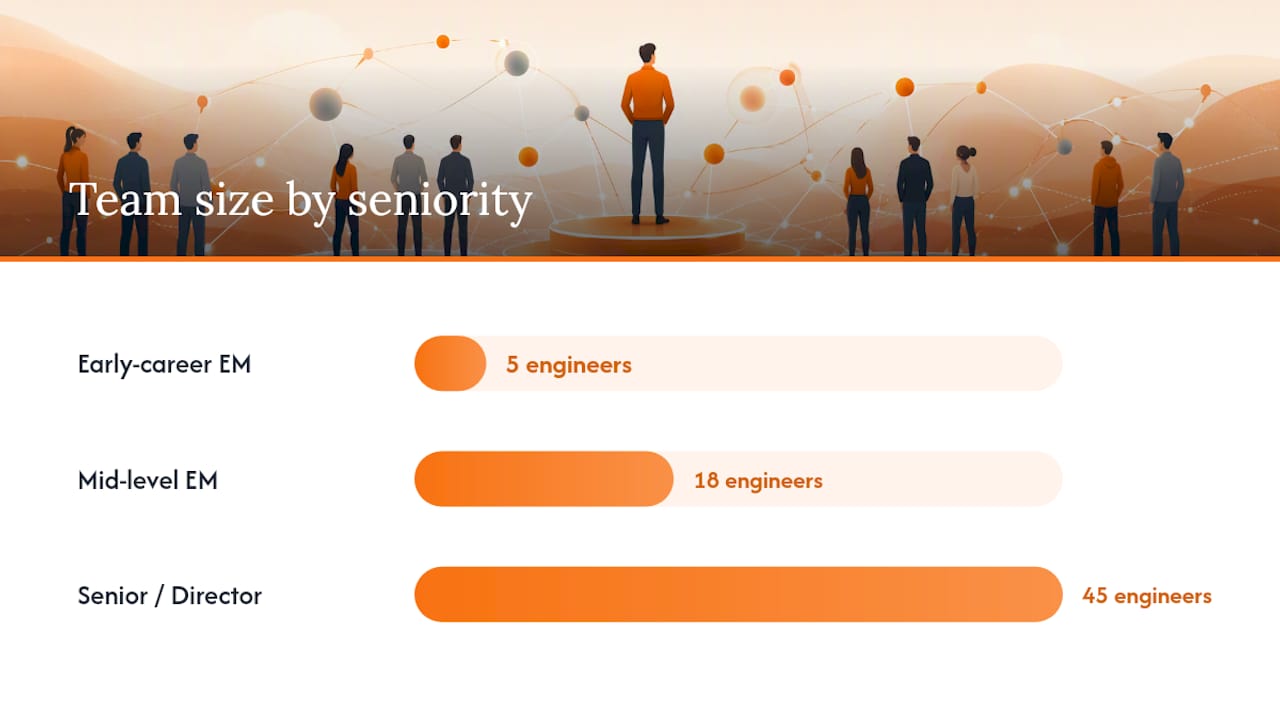
- Early-career EM (first management role, 1 to 2 years): "Engineering manager with 2 years leading a 5-person backend team building payment infrastructure for a Series B fintech startup. Reduced deployment failures 40% while hiring and onboarding three senior engineers in under six months."
- Mid-level EM (3 to 6 years): "Engineering manager overseeing 3 squads (18 engineers) across checkout and fulfillment for a mid-market e-commerce platform. Cut cart abandonment 12% through a rebuilt checkout pipeline and grew the org from 10 to 18 engineers with zero regretted attrition."
- Senior/director-level EM (7+ years, cross-org scope): "Director of Engineering managing 45 engineers across 6 teams spanning platform, data, and mobile at a Series D SaaS company. Owns a $9M engineering budget, drove a 30% reduction in production incidents year over year, and built the leveling framework now used company-wide."
Notice what's missing from all three: no adjectives doing the heavy lifting, no "strategic thinker" or "collaborative leader." Every claim is a number tied to a scope. If you can't fill in a number for team size, budget, or a measurable result, that's your first clue the summary needs more work before the rest of the resume does.
Keep the summary to three sentences maximum. Longer than that and it stops functioning as a summary and starts competing with your work experience section for the reader's attention.
How Do You Turn Job Duties Into Leadership Bullets?
Most engineering managers write bullets like a job description: "Managed a team of engineers responsible for backend services." That sentence tells a recruiter nothing about scale, outcome, or difficulty. The fix is a formula: Action + Context + Quantified Result.
Start with a scope line before the bullets even begin. Something like: "Led a team of 8 engineers (2 senior, 4 mid, 2 junior) owning the identity and access platform serving 2.1 million users." That single line does more work than three vague bullets, because it tells the reader exactly what you were accountable for before they read a single accomplishment.
Then build each bullet around one of these five outcome categories:
- Hiring and team building: "Hired 6 engineers in 9 months, cutting average time-to-fill from 52 to 31 days by redesigning the technical interview loop."
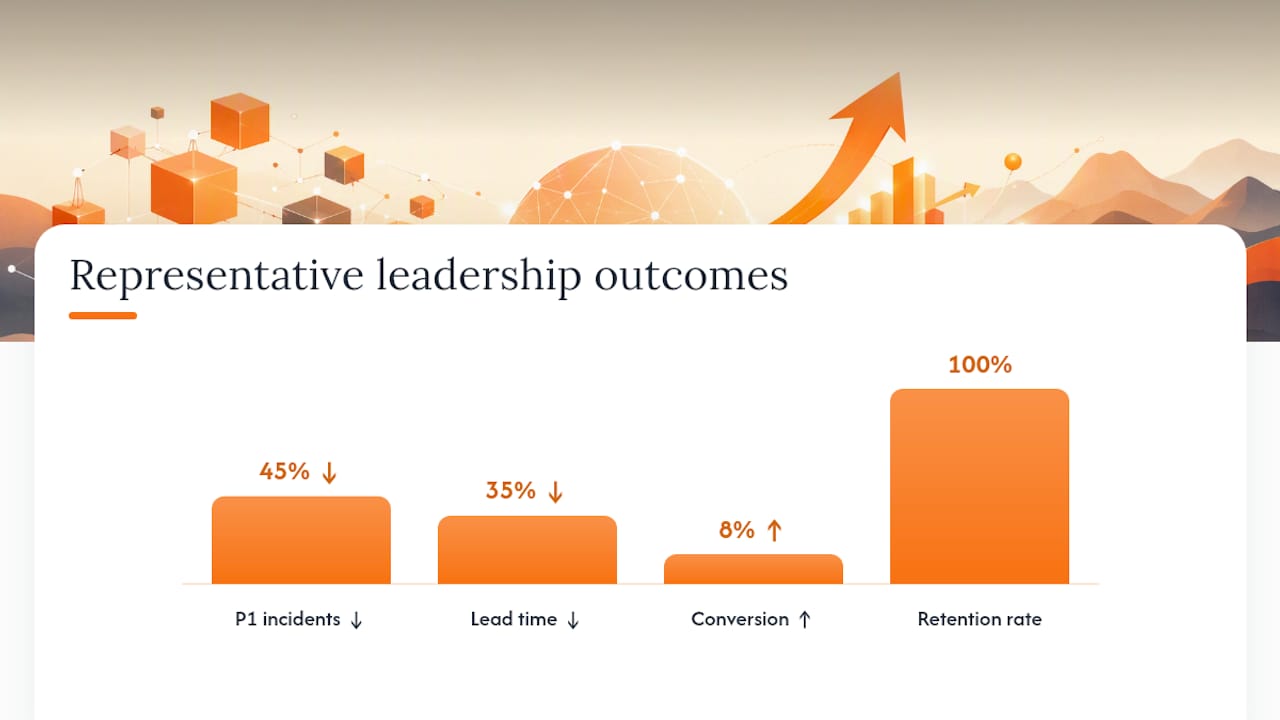
- Retention and development: "Retained 100% of senior engineers over 18 months through structured career-leveling conversations and 3 internal promotions to senior and staff roles."
- Delivery and velocity: "Improved deployment frequency from weekly to daily by introducing a trunk-based development workflow, cutting lead time for changes by 35%."
- Reliability and operations: "Reduced P1 incidents 45% year over year by leading a reliability initiative that introduced on-call rotation redesign and automated rollback tooling."
- Business impact: "Shipped a checkout redesign that increased conversion 8% and generated an estimated $2.4M in incremental annual revenue."
Each of these starts with a leadership verb, Grew, Shipped, Reduced, Hired, Promoted, Introduced, and each answers the three questions a recruiter is silently asking: how big, what happened, so what. That structure lines up with what stronger engineering manager resume examples consistently do: balance people outcomes against delivery outcomes rather than leaning entirely on one or the other.
Pro Tip: When you're deciding what to cut, cut individual contributor work before you cut a weak management bullet. A recruiter hiring for an engineering manager role wants to see people leadership evidence first. Save your one line of "built the original architecture" for context, not for a bullet slot that could hold a hiring or retention metric instead.
On bullet count: three to five bullets per role is the right range. More than five and the reader starts skimming past them; fewer than three and it looks like the role didn't have much substance. If you've held multiple manager roles at the same company, compress older ones into two bullets and give your current or most recent role the full five, since that's the one hiring managers weigh most heavily.
For roles where you transitioned from individual contributor to manager mid-tenure, split the entry with a one-line note on the transition timing, then focus bullets on the management period. A recruiter needs to know when you started managing people, not just that you eventually did.
What Belongs in an Engineering Manager's Skills Section?
The skills section for an engineering manager resume needs to do two jobs at once: pass an ATS keyword scan and reassure a human reviewer that you haven't lost touch with the technical side. That means grouping skills into categories rather than dumping them into one long, undifferentiated list.
A clean structure looks like this:
- Leadership & Management: hiring and interviewing, performance reviews, career leveling, cross-functional stakeholder management, roadmap planning, budget ownership.
- Technical: the languages, architectures, or domains you still speak fluently enough to make hiring and design decisions, backend systems, distributed systems, mobile, data pipelines, whatever applies.
- Metrics & Methodologies: DORA metrics, Agile/Scrum, OKRs, CI/CD, incident response and postmortems.
- Tools & Platforms: the specific cloud providers, project tools, and platforms named in the job posting, AWS, Azure, GCP, Jira, Datadog, and so on.
Prioritize whatever the job description names explicitly. If a posting mentions "DORA metrics" and "cross-functional stakeholder management" in the first paragraph, both phrases should appear in your skills section in close to that wording, since ATS software often matches on exact or near-exact phrasing rather than synonyms. This is where tailoring your skills list to exact job terms matters more than trying to look impressively broad.
Resist the urge to list every technology you've touched in a decade. A skills section with 35 entries reads as unfocused, not thorough. Fifteen to twenty tightly relevant skills, grouped and tailored per application, outperforms a generic master list every time.
What ATS Formatting Rules Actually Matter?
Formatting mistakes are the single most avoidable reason a qualified engineering manager resume never reaches a human. ATS software parses text in a specific order and structure, and deviating from that structure risks garbling your information before anyone reads it.
Stick to these rules:
- Use standard section headings: "Work Experience," "Skills," "Education," not creative alternatives like "Where I've Made Impact."
- List roles in reverse chronological order, most recent first, always.
- Avoid tables, text boxes, columns, and graphics for anything containing information you need parsed, contact details, job titles, dates. Many ATS platforms either skip these elements or scramble their reading order.
- Never put your name, contact information, or role titles inside a header or footer field. Some parsers ignore headers and footers entirely.
- Use a standard, readable font (Arial, Calibri, or Georgia) at 10 to 12 points, with consistent spacing.
On file format: PDF preserves your layout exactly, which matters for a human reviewer opening the file directly, but some ATS platforms and applicant portals parse .docx files more reliably, since Indeed's career guidance notes that formatting compatibility varies by system. The safest approach: follow whatever the job posting specifies. If it doesn't specify, use PDF for anything you're emailing directly to a hiring manager, and .docx if you're uploading through an online application portal.
On length: one page covers most engineering managers, including those running two or three teams. Two pages becomes acceptable once you're operating at director level with broad cross-org scope, multiple reporting managers, or a budget large enough that compressing it to one page would strip out real signal, a threshold that resume length guidance for EMs consistently draws at the director boundary rather than at years of experience alone.
One structural fact worth internalizing: ATS systems and human reviewers are not adversaries you're trying to trick with two different documents. A clean, standard-heading resume with quantified bullets satisfies both at once. The formatting rules above exist because they help a machine parse correctly and a person read quickly, not because one audience requires a compromise against the other.
What Do Strong Engineering Manager Resume Examples Look Like?
Two compact templates cover most cases: a mid-level EM managing a single team or a couple of squads, and a senior EM or director managing across multiple teams.
Mid-level EM template:
Engineering Manager, Checkout Platform, [Company], 2023–Present Scope: Lead a team of 9 engineers across 2 squads owning checkout and payments infrastructure serving 800,000 monthly active users.
- Grew the team from 6 to 9 engineers over 14 months, achieving 100% retention of senior hires.
- Reduced checkout latency 28% by leading a payment gateway migration completed two weeks ahead of schedule.
- Introduced weekly incident reviews that cut P1 incidents from 4 to 1 per quarter.
- Promoted 2 engineers to senior roles through a structured leveling framework I built and rolled out to the broader engineering org.
Senior/director EM template:
Director of Engineering, [Company], 2021–Present Scope: Own a $6M budget across 4 teams (32 engineers) spanning platform, data infrastructure, and developer tooling.
- Reduced deployment lead time from 3 days to 4 hours by driving adoption of a CI/CD platform across all four teams.
- Hired 11 engineers in 18 months, including 3 engineering managers, while maintaining a 94% offer acceptance rate.
- Cut infrastructure spend 22% ($1.1M annually) through a cloud cost optimization initiative I sponsored.
- Built the internal promotion rubric now used by 6 engineering directors across the organization.
If your current bullets read more like a job description than an accomplishment, the fix is usually a rewrite, not a rewording. Compare:
Before: "Responsible for managing engineering team and overseeing product delivery."
After: "Managed a 7-person engineering team delivering the mobile checkout redesign that increased conversion 6% and shipped three weeks ahead of the original roadmap."
The "after" version isn't longer because it's padded. It's longer because it's carrying actual information: team size, what was delivered, and what changed as a result.
Additional categorized bullets worth adapting: for hiring, "Built a technical screening process that cut time-to-hire from 45 to 27 days across 12 open roles." For retention, "Held quarterly career conversations with all direct reports, contributing to zero voluntary attrition across a 10-person team over 2 years." For cost savings, "Consolidated three overlapping internal tools into one platform, saving $180,000 annually in licensing costs." Adjust the numbers to your reality, but keep the shape: action, context, quantified result. For more copy-ready formats and full before/after rewrites, the resume templates and sample bullets guide walks through additional variations by role type.
What Mistakes Sink an Engineering Manager Resume?
The most common failure isn't a formatting error. It's a resume that describes responsibilities instead of proving impact.
- Mistake: "Managed a team" with no number. Fix: always name team size, even if it fluctuated across the role.
- Mistake: Leading with individual contributor accomplishments. Fix: put management outcomes first; technical credibility gets one line, not five bullets.
- Mistake: Buzzword-heavy summary ("results-driven, collaborative leader"). Fix: replace every adjective with a number.
- Mistake: Skills section with no structure. Fix: group into Leadership, Technical, and Tools categories.
- Mistake: Two-page resume for a single-team manager. Fix: compress to one page unless your scope genuinely spans multiple teams or a large budget.
- Mistake: Tables, columns, or graphics that scramble ATS parsing. Fix: use plain text with standard headings.
Before submitting, run through this checklist:
| Check | Why it matters |
|---|---|
| Summary states team size and one headline result | Answers the recruiter's first question in seconds |
| Every bullet follows Action + Context + Result | Proves impact instead of describing duties |
| Skills match job posting language | Improves ATS keyword match rate |
| File format matches the job posting's request | Avoids parsing failures |
| One page (two only if director-level scope) | Keeps the resume focused on what matters most |
| Proofread by a peer or recruiter | Catches gaps you can't see in your own draft |
Ask a peer, mentor, or someone in recruiting to review the draft once before you send it anywhere. A second set of eyes catches vague bullets and missing numbers faster than another pass by yourself ever will.
What Pluck Talent Sees in Hundreds of Engineering Manager Resumes
Reviewing engineering manager resumes at scale surfaces the same gap over and over: strong candidates undersell their scope because they're used to writing status updates, not sales documents. Pluck Talent's recruiting work in IT and cybersecurity hiring, paired with the Plucky AI resume co-pilot, focuses on exactly that gap, pulling out the team size, budget, and delivery metrics a candidate already has but buried three sentences deep in a paragraph.
When Plucky AI evaluates an engineering manager resume, it checks for the same signals a hiring manager checks for first: a scope line at the top of each role, quantified hiring and retention outcomes, and skills that match the specific language of the target job posting rather than a generic technical list. The goal isn't to rewrite a candidate's experience. It's to surface what's already there in a form a recruiter can verify in ten seconds.
What About Employment Gaps or a Recent Move Into Management?
An employment gap or a transition into a first management role doesn't need to be hidden or over-explained. It needs one clear, factual line and then a return to the format above.
If you have a gap between roles, a layoff, caregiving, further education, health, add a single line in your work experience section rather than leaving a mysterious blank date range. Something like "Career break, 2024–2025" with a one-line reason is enough. Recruiters have seen enough gaps since 2020 that an honest, brief note reads as normal, not disqualifying. What sinks candidates isn't the gap itself, it's a resume that looks like it's trying to hide one through vague date ranges or omitted months.
If you're transitioning from individual contributor to manager, either within your current company or as a new hire, structure the entry so the management portion gets its own scope line and bullets, separate from your IC years. A one-line note on when you started managing people and how many direct reports you took on immediately answers the question every hiring manager has: is this person actually experienced at managing, or did they manage briefly and go back to coding?
If you're moving from one industry into engineering management for the first time in that sector, a resume can name the transferable pieces directly, hiring, budget ownership, cross-functional coordination, without pretending the industry experience doesn't matter. Understanding what a hiring manager actually screens for in that first pass helps frame the gap or transition in terms the reader is already looking for.
A Recruiter's Take: Three Things to Fix Today
If there's only time to fix three things on an engineering manager resume before sending it out, fix these, in this order.
First, rewrite the summary so it states team size and one headline result in the first sentence. If a recruiter reads nothing else, that sentence should still tell them whether to keep reading.
Second, pick the three bullets across your whole resume that matter most, and convert them fully to Action plus Context plus Quantified Result. Don't try to fix all fifteen bullets at once. Fix the three that a hiring manager would read first, usually in your current or most recent role.
Third, run an ATS keyword check against the specific job posting, then save the file in whatever format that posting requests. A resume with strong content still loses to formatting mismatches more often than it should.
None of these take more than twenty minutes each. All three, done well, change how a resume reads in the first pass.
— Diego
Pluck Talent: A Faster Path for Experienced IT Managers
Rewriting a resume yourself gets you most of the way there. But if you're an experienced engineering manager targeting a specific role and want tailoring done fast, plus a route to the hiring manager instead of a generic applicant queue, A platform with AI tailoring your resume to each posting's exact language can help surface roles where you can reach a hiring manager directly rather than dropping another application into a public board.
This fits experienced IT and cybersecurity managers who already know their scope and metrics but don't have hours to rewrite and retailor a resume for every posting. Recruiter-reviewed placements mean someone checks the tailored resume before it goes anywhere, not just an algorithm. Start by reviewing what's included on the Pluck Talent services page, or head straight to the job seekers page to see current subscription options and get your resume evaluated against open roles in your specialty.
Sources
The BLS Occupational Outlook Handbook provides authoritative context on demand and role variety across computer and IT occupations. Indeed's engineering manager resume guide covers standard structure and ATS-compatible section headings. IGotAnOffer's engineering manager resume examples offer recruiter-level guidance on summary content, drawn from resumes that landed roles at major tech companies. WriteCV.ai's engineering manager resume breakdown analyzes what separates strong sample resumes from weak ones on scope, hiring metrics, and technical credibility balance.
- Engineer manager resume | Indeed Career Guide
- Engineering Manager Resume Examples (Meta, Amazon, X, etc.) — IGotAnOffer
- Writecv
FAQ
What Is the Role of an Engineering Manager?
An engineering manager owns both people leadership, hiring, retention, performance, and delivery outcomes for a team or set of teams, translating business goals into technical execution while managing the humans doing the building.
What Makes a Good Engineering Manager?
Strong engineering managers combine hiring and retention discipline with delivery accountability, meaning they can grow a healthy team while still shipping measurable outcomes tied to the business.
What Should an Engineering Manager's Resume Look Like?
It should open with a summary stating team size and a headline result, follow standard ATS-friendly headings, and use three to five quantified bullets per role that mix people outcomes with delivery outcomes, typically kept to one page.
Is Engineering Manager a Stressful Job?
The role carries real pressure from balancing people issues, hiring, conflict, performance, against delivery deadlines and technical decisions, but the level of stress varies widely by team size, company stability, and how much technical work the manager still carries.
How Long Should an Engineering Manager Resume Be?
One page fits most engineering managers, while two pages becomes reasonable at the director level once cross-org scope and budget size genuinely require the extra space to show real signal.