
For most IT hiring scenarios, contract-to-hire (C2H) is the lower-risk default. It lets you validate technical fit before committing to full employment costs. Direct hire is the right call for long-term strategic roles where institutional knowledge and retention matter more than flexibility.
The choice between these models affects total cost of employment, time-to-fill, and classification risk in ways that compound over a hiring cycle. SHRM's benchmarking data shows that placement costs and retention outcomes vary significantly by model and role type. Plucktalent supports both contract and direct hire IT recruitment, and can operationalize whichever model fits the role.
Quick model selection:
- Use contract-to-hire for project-based work, skill validation, or roles where budget approval is pending.
- Use direct hire for CISOs, architects, and other long-term institutional roles where cultural fit and retention are primary.
- Use pure contract for defined-scope engagements (cloud migrations, compliance audits) with a clear end date.
- Use a blended approach when scaling a team rapidly and needing both permanent leads and contract contributors.
Table of Contents
- What do contract, direct hire, C2H, C2C, and W-2 actually mean?
- How do contract-to-hire and direct hire compare across key dimensions?
- What does each model actually cost? A worked financial example
- What are the pros, cons, and compliance risks of each model?
- When should you use contract-to-hire, direct hire, or a blended model?
- How do you source, onboard, and manage contract and direct hire IT staff?
- How Plucktalent supports IT contract and direct hire decisions
- Key Takeaways
- Plucktalent helps you act on the right hiring model
- Useful sources
- FAQ
What do contract, direct hire, C2H, C2C, and W-2 actually mean?
Understanding the vocabulary matters because each term carries distinct tax, legal, and cost implications. Misusing them in a job order or vendor agreement creates classification exposure.
Core definitions:
- Direct hire: The employer recruits and places a candidate directly on its payroll as a W-2 employee. The hire is permanent from day one, with full benefits and employment protections.
- Contract staffing: A worker is placed for a defined period, typically through a staffing agency. The agency handles payroll, benefits, and employer taxes. The worker may be a W-2 employee of the agency or an independent contractor.
- Contract-to-hire (C2H): A contract engagement with a pre-negotiated right to convert the worker to direct employment after a trial period, commonly 3–6 months. Indeed's overview of contract work describes this "right to hire" as one of the defining features of C2H arrangements.
- Corp-to-corp (C2C): The contractor operates through their own business entity (LLC or S-Corp) and invoices the client company directly. The client pays the contractor's company, not the individual. This shifts payroll tax responsibility to the contractor's entity.
- W-2 employee: A worker classified as an employee under IRS rules. The employer withholds federal income tax, Social Security, and Medicare, and pays the employer's share of FICA taxes.
- 1099/independent contractor: A self-employed worker who receives a Form 1099-NEC. The hiring company does not withhold taxes or pay benefits. The contractor pays self-employment tax on their earnings.
Classification risk. The IRS uses a behavioral control, financial control, and relationship-type framework to determine whether a worker is an employee or a contractor. IRS guidance on worker classification is explicit: misclassifying an employee as a 1099 contractor can result in back taxes, penalties, and interest. For IT roles, the risk is real because many contractors work on-site, use company equipment, and follow employer-set schedules, all factors the IRS treats as indicators of employee status.
Callout: A cloud engineer hired on a 1099 basis but directed daily by your engineering manager is a misclassification risk. A security architect running a defined penetration test engagement under a statement of work, using their own tools, is a cleaner contractor relationship.
Role examples:
- A cloud engineer brought in for a six-month AWS migration is typically a contract or C2H hire. The work is project-scoped, the skills are specialized, and the engagement has a natural end point.
- A CISO is almost always a direct hire. The role requires institutional authority, long-term security strategy ownership, and access to sensitive systems, none of which suit a revolving contractor arrangement.
How do contract-to-hire and direct hire compare across key dimensions?
| Dimension | Contract-to-Hire (C2H) | Direct Hire |
|---|---|---|
| Total cost of employment | Bill rate + agency markup (typically 50% above pay rate) during contract; conversion fee (typically 10% of salary) at hire | Salary plus benefits and recruiter fees, which vary depending on role and market |
| Retention and loyalty | Lower initial commitment; conversion converts to full retention | Higher long-term retention when the hire is well-matched |
| Flexibility and scalability | High; scale up or down without severance exposure | Low; headcount reductions carry legal and HR cost |
| Compliance and classification risk | Moderate to high; agency handles W-2 but C2C arrangements need scrutiny | Lower; worker is a direct W-2 employee from day one |
| Administrative overhead | Agency manages payroll, benefits, and taxes during contract | Internal HR manages full employment lifecycle |
| Access to niche skills | High; contractors often hold specialized certifications (CISSP, AWS, Azure) and move between engagements | Depends on sourcing reach; harder to attract passive candidates without a strong employer brand |
Quick decision rules:
- If the role has a defined end date or uncertain headcount approval, choose C2H.
- If the role requires security clearance or access to regulated data from day one, direct hire is typically required.
- If you need a specialized skill for under 90 days, pure contract is more cost-effective than C2H.
- If the role is a people manager or department head, direct hire preserves team stability.
IT-specific examples:
A cloud migration lead needed for a 4-month Azure transition fits C2H. You get the skill immediately, evaluate the engineer's fit with your team, and convert if the migration opens a permanent infrastructure role. A security architect responsible for your SOC 2 compliance program is a direct hire. The role requires deep institutional context, vendor relationship ownership, and continuity across audit cycles.
What does each model actually cost? A worked financial example
The numbers below use realistic U.S. market assumptions. Swap your own figures into the same structure.
Assumptions:
- Role: Senior Cloud Engineer
- Target salary: $130,000/year
- Benefits load (health, dental, 401k, PTO): 28% of salary
- Direct hire recruiter fee is typically a percentage of first-year salary
- Contract bill rate markup: 50% above pay rate
- Contractor pay rate: $75/hour (approximately $156,000 annualized)
- Contract duration before conversion decision: 6 months
- C2H conversion fee: 10% of first-year salary
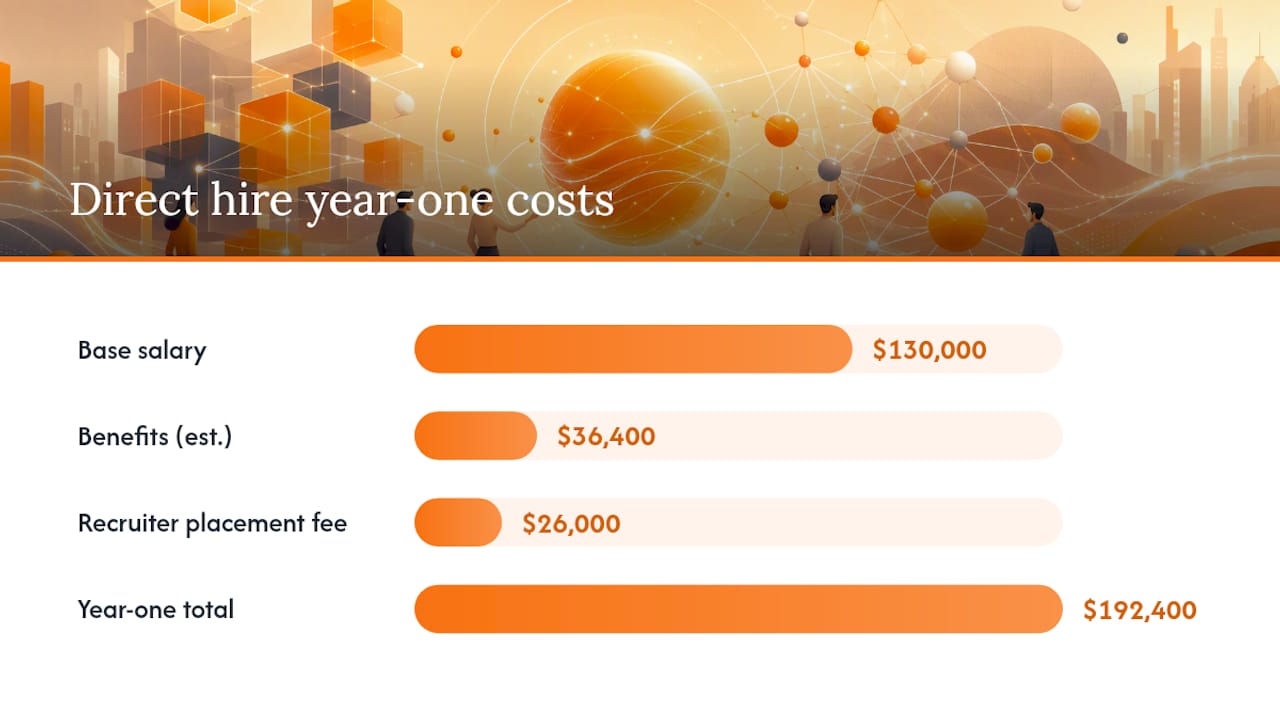
Direct hire total cost (year one)
| Item | Amount |
|---|---|
| Base salary | $130,000 |
| Benefits estimated as a proportion of salary | $36,400 |
| Recruiter placement fee | $26,000 |
| Year-one total | $192,400 |
Contract-to-hire total cost (6-month contract + conversion)
| Item | Amount |
|---|---|
| Bill rate: $75/hr with an industry-standard markup applied over 6 months | $117,000 |
| Conversion fee (10% of $130,000) | $13,000 |
| Remaining 6 months of salary | $65,000 |
| Benefits calculated as a standard proportion on 6-month salary | $18,200 |
| Year-one total | $213,200 |
Break-even observation. C2H costs more in year one when the contract runs the full 6 months before conversion. The model becomes cost-competitive when the contract period is shorter (under 3 months) or when it replaces a bad direct hire that would have triggered a replacement search. American Staffing Association data supports typical markup and conversion-fee ranges used here.
Callout: The real financial case for C2H is not year-one cost. It is the avoided cost of a failed direct hire: a replacement search, lost productivity, and team disruption that can equal 50–200% of the role's annual salary.
Hidden costs to include in your model:
- Onboarding and access provisioning (both models)
- Security clearance processing time (direct hire only, for cleared roles)
- Benefits enrollment delays (C2H conversion timing)
- Productivity ramp: contractors often reach full output faster because they are hired for a specific deliverable
BLS occupational data provides salary baselines for IT occupations that can anchor the pay-rate assumptions above. Benefits load and recruiter fee ranges align with SHRM 2025 benchmarking.
What are the pros, cons, and compliance risks of each model?
Contract staffing
Pros:
- Speed: contractors can start in days rather than weeks.
- No long-term headcount commitment; easier to scale down after project completion.
- Access to specialized IT skills (cloud, cybersecurity, DevOps) that are hard to retain full-time.
- Agency handles payroll taxes, workers' compensation, and benefits administration during the engagement.
Cons:
- Higher hourly cost than equivalent salary when annualized.
- Lower organizational loyalty; contractors may leave mid-engagement for a better rate.
- IP and confidentiality controls require explicit contract language (NDA, work-for-hire clauses).
- C2C arrangements carry misclassification risk if the worker's independence is not genuine.
Direct hire
Pros:
- Full integration into team culture, performance management, and long-term planning.
- Lower ongoing cost after year one (no agency markup or conversion fees).
- Stronger retention signal: employees hired directly tend to stay longer when the role and culture match.
- Cleaner compliance posture: W-2 from day one, no contractor classification questions.
Cons:
- Longer time-to-fill, particularly for senior or niche IT roles.
- Higher upfront cost when recruiter fees are included.
- Severance and legal exposure if the hire does not work out.
- Harder to reverse if the role scope changes after hire.
Compliance mitigation. The IRS Worker Classification 101 resource outlines the behavioral, financial, and relationship factors that determine employee vs. contractor status. For IT hiring managers, the practical mitigation steps are:
- Use a detailed statement of work (SOW) for every contract engagement. Define deliverables, not daily tasks.
- Require contractors to use their own tools and equipment where possible.
- Avoid setting contractor schedules or requiring them to attend all-hands meetings as mandatory participants.
- Include explicit IP assignment and NDA clauses in every contract agreement.
- Involve legal or HR before converting a long-term contractor to a 1099 arrangement.
Pro Tip: If a contractor has been embedded with your team for more than 12 months, follows your internal processes, and uses company equipment daily, consult employment counsel before renewing the engagement. The IRS looks at the totality of the relationship, and duration is a factor.
When should you use contract-to-hire, direct hire, or a blended model?
The right model depends on the role's time horizon, strategic importance, and the organization's risk tolerance.
Use contract-to-hire when:
- The role supports a defined project (cloud migration, ERP implementation, security audit) with a 3–6 month scope.
- Budget approval for a permanent headcount is pending but the work cannot wait.
- You want to validate a candidate's technical skills and team fit before committing to full employment costs.
- The skill set is specialized and the talent pool is thin — C2H gives you access to candidates who prefer contract work and may not apply to permanent postings.
Use direct hire when:
- The role is a long-term institutional position: CISO, VP of Engineering, enterprise architect.
- The position requires security clearance or access to classified systems from day one. Cleared roles almost always require W-2 employment.
- The role involves managing a team or owning a vendor relationship where continuity is critical.
- Your organization has a strong employer brand and can attract passive candidates who prefer permanent employment.
Use pure contract when:
- The engagement has a fixed deliverable and a hard end date (penetration test, data center migration, compliance gap assessment).
- The skill is highly specialized and not needed beyond the project.
- Speed is the primary constraint and conversion is not on the table.
Use a blended approach when:
- You are scaling a product team rapidly and need permanent technical leads alongside contract contributors.
- A regulated environment requires permanent employees in certain roles while allowing contractors in others.
Timeline expectations. Pure contract placements can close in days. C2H typically takes 1–2 weeks for initial placement, with conversion decisions at the 3–6 month mark. Direct hire searches for senior IT roles often run 4–8 weeks from requisition to offer acceptance. Supersourcing's analysis of C2H vs. direct hire notes that conversion fees typically fall around 10% of first-year salary.
Clearance and IP-sensitive roles. Federal contractors and defense-adjacent organizations often cannot place 1099 contractors in roles requiring active clearances. Direct hire is the default. Similarly, roles involving proprietary algorithms, source code ownership, or trade secrets benefit from direct employment because work-for-hire doctrine is cleaner under a W-2 relationship.

How do you source, onboard, and manage contract and direct hire IT staff?
A consistent process reduces administrative friction and protects the organization at conversion.
For contract and C2H placements:
- Independent Contractor (Self-Employed) or Employee? | Internal Revenue Service
- Worker classification 101: Employee or independent contractor? | IRS Newsroom
- Contingent and alternative employment arrangements news release | Bureau of Labor Statistics
- SHRM releases 2025 benchmarking reports | SHRM
- Pros and Cons of Choosing Contract Work | Indeed.com
- Staffing industry statistics | American Staffing Association
- Contract to Hire vs Direct Hire: Which IT Model Wins? | Supersourcing
For direct hire placements:
- Write a precise job description that reflects the actual role scope, not a generic template. Use IT job order management best practices to structure the requisition.
- Source through a recruiter or marketplace with demonstrated reach into passive IT talent. Job boards alone have low success rates for senior technical roles.
- Run a structured interview process: technical screen, panel interview, and a practical assessment relevant to the role.
- Extend an offer with a clear total compensation breakdown (salary, bonus, equity if applicable, benefits).
- Onboard with a 30-60-90 day plan that includes system access, team introductions, and defined early deliverables.
- Conduct a 90-day performance review to confirm role fit and address any gaps early.
Metrics to track:
- Time-to-productivity (days from start to first independent deliverable)
- Billable hours vs. equivalent salary cost (for contract roles)
- C2H conversion rate (percentage of contracts that convert to direct hire)
- First-year retention rate (for direct hires)
Pro Tip: At the conversion point, the most common friction is a gap between the contractor's current bill rate and the equivalent salary offer. Calculate the net-pay equivalence before the conversation: a contractor earning $112.50/hour bill rate takes home far less than that figure suggests once self-employment taxes are factored in. Framing the salary offer in net-pay terms reduces negotiation friction.
Managing a contractor pipeline across multiple agencies benefits from a structured approach. AI-assisted pipeline management can reduce administrative overhead during high-volume contract hiring.
How Plucktalent supports IT contract and direct hire decisions
Plucktalent combines 17 years of IT and cybersecurity recruiting expertise with AI-driven candidate matching to support both contract and direct hire workflows.
What Plucktalent provides for hiring managers:
- Direct placement searches for senior and specialized IT roles, including security architects, cloud engineers, and technology leadership.
- Contract staffing support for project-based and C2H engagements, with vetted candidates matched to specific technical requirements.
- Access to passive candidates who do not appear on standard job boards, through direct hiring manager contact and hidden role discovery.
- Recruiter-vetted profiles that are pre-screened for technical fit, reducing time spent on unqualified applicants.
Mapped to the decision scenarios above:
- Rapid scale-up for a product build: Plucktalent's marketplace surfaces contract-ready IT professionals with the specific stack certifications the role requires, reducing sourcing time.
- Security architect search: The platform's 17-year cybersecurity recruiting network reaches passive candidates who are not actively applying, which is where most senior security talent sits.
- C2H with conversion support: Plucktalent manages the conversion mechanics, including fee documentation and candidate communication, so the hiring manager's administrative load stays low.
Hiring managers can review Plucktalent's employer services to see the full range of contract and direct hire options available.
Key Takeaways
Contract-to-hire is the lower-risk default for most IT roles; direct hire is the right model when long-term retention and institutional continuity outweigh upfront cost.
| Point | Details |
|---|---|
| Model selection rule | Use C2H for project-based or uncertain roles; use direct hire for strategic, long-term positions. |
| Year-one cost | Direct hire runs lower in year one for most roles; C2H costs more when the full contract period runs before conversion. |
| Compliance risk | Misclassifying a W-2 worker as a 1099 contractor creates IRS tax and penalty exposure; use a detailed SOW and agency W-2 arrangements to reduce risk. |
| Time-to-fill | Contract placements close in days to weeks; direct hire searches for senior IT roles typically run 4–8 weeks. |
| Plucktalent | Supports both contract and direct hire IT placements, with vetted cybersecurity and cloud talent and conversion management included. |
Plucktalent helps you act on the right hiring model
Choosing the right staffing model is one decision. Executing it quickly, with vetted candidates and clean conversion mechanics, is another. Plucktalent's IT and cybersecurity recruiting services cover both: direct placement for strategic roles and contract staffing for project-based needs, with 17 years of recruiter expertise behind every match.
Hiring managers who need to fill a senior cloud, security, or infrastructure role, whether on a contract or permanent basis, can skip the sourcing delay. Plucktalent's network reaches passive candidates who are not on job boards, and the platform handles the administrative steps from first contact through conversion. Review the employer services page to see current options and start a search.
Useful sources
- IRS: Independent Contractor or Employee? — The primary IRS resource for understanding W-2 vs. 1099 classification factors and misclassification consequences.
- SHRM 2025 Benchmarking Reports — Recruiter fee ranges, time-to-fill medians, and retention benchmarks for HR and talent acquisition professionals.
- American Staffing Association: Industry Statistics — Staffing industry markup ranges, conversion norms, and sector trend data.
- Indeed: Pros and Cons of Contract Work — Candidate-side perspective on contract work characteristics and the right-to-hire concept.
- Supersourcing: Contract-to-Hire vs. Direct Hire — Practitioner-aligned scenario guidance and conversion-fee benchmarks for IT staffing decisions.
This article provides general information on staffing models and classification. It is not legal or tax advice. Consult IRS guidance and qualified employment counsel for classification questions specific to your organization.
FAQ
What is the difference between direct hire and contract-to-hire?
Direct hire places a candidate as a permanent W-2 employee from day one. Contract-to-hire starts with a defined contract period, typically 3–6 months, with a pre-negotiated option to convert the worker to permanent employment at the end.
What are the downsides of direct hire for IT roles?
Direct hire carries a longer time-to-fill (often several weeks for senior technical roles), higher upfront recruiter fees, and greater legal exposure if the hire does not work out. It also limits flexibility when project scope changes after the hire.
What is the difference between C2C and C2H?
C2C (corp-to-corp) describes how a contractor is paid: through their own business entity, invoicing the client company directly. C2H (contract-to-hire) describes the employment path: a contract engagement with an option to convert to permanent employment. A contractor can work C2C on a C2H engagement.
What is the 70/30 rule in hiring?
The 70/30 rule is an informal staffing guideline suggesting that a majority of a team should be permanent employees with a smaller portion as contractors or contingent workers. Definitions vary by organization and industry; it is not a formal standard. IT teams with high project variability often run higher contractor ratios during peak build phases.
How does Plucktalent support both contract and direct hire IT searches?
Plucktalent provides recruiter-vetted placements for both contract and permanent IT and cybersecurity roles, with direct access to passive candidates not found on standard job boards. Hiring managers can review available services at plucktalent.io/services.