
What is a cold outreach job search?
Cold outreach in a job search is the practice of contacting hiring managers or recruiters directly, without a prior connection or an open job listing. The goal is to create an opportunity rather than respond to one. Personalized cold outreach emails yield notably higher reply rates than generic applications submitted through job boards. Many roles are filled before they are ever posted publicly, making direct contact one of the few ways to access that segment of the market.
Cold outreach differs from cold emailing in a sales context. The job seeker is not selling a product. The objective is to start a professional conversation, gather information, or request a brief informational interview.
- Contacts hiring managers directly, regardless of posted openings
- Uncovers roles in the hidden job market
- Relies on personalization and a clear value proposition
- Produces higher engagement than generic applications
Why and when to use cold outreach in your job search
Cold outreach is most useful in competitive markets where public listings attract hundreds of applicants. It is also the right tool when a target company rarely posts openings or when a job seeker wants to get ahead of a hiring cycle. Job seekers who combine targeted outreach with tailored applications consistently outperform those who rely on mass applications alone.
The approach has real limitations. Each message requires research and personalization, so volume is naturally lower than a bulk-apply strategy. That trade-off is intentional.
- Benefits: Access to unadvertised roles, direct recruiter relationships, stronger first impressions
- Limitations: Time-intensive, requires contact research, results are not immediate
- Best timing: Early in a job search, before roles are posted, or when job boards produce no traction
Cold applications convert at roughly one hire per 180 applicants. Referral and outreach paths convert at far higher rates, which is why the channel matters.
How to craft an effective cold outreach message in 2026
The anatomy of a high-performing cold email is well established. Emails between 75 and 125 words consistently outperform shorter and longer ones. A three-email sequence produces roughly a 9.2% reply rate. Subject lines of 3–7 words, written in lowercase and specific to the recipient, generate the highest open rates.
Each message has five components: a subject line, a personalized opener referencing something recent and specific, a value bridge of one to two sentences, a single yes/no call to action, and a one-line signature. Trigger events such as a company funding announcement, a new product launch, or a leadership change give the opener immediate relevance.
- Subject line: 3–7 words, lowercase, specific to the person or company
- Opener: one sentence referencing a recent, verifiable observation
- Value bridge: what the job seeker offers, stated as an outcome
- Call to action: one low-friction yes/no question
- Total length: 75–125 words
Pro Tip: Do not ask for a job in the first message. Ask for a 15-minute conversation or a brief informational interview. That single shift removes pressure and increases the likelihood of a reply.
How cold outreach fits into a broader job search strategy
Path Ascent's job search execution system frames the search as six connected stages: Direction, Proof, Access, Apply, Convert, and Learn. Cold outreach belongs to the Access stage. It is the mechanism that moves a job seeker from having a strong profile to actually getting in front of a decision-maker.
Each stage depends on the one before it. A clear target role makes outreach messages more specific. A well-built résumé and LinkedIn profile give the message credibility. Without those foundations, even a well-written cold email lands without context.
- Define a target role and a list of viable companies before writing a single message
- Build an ATS-ready résumé and profile first, so outreach has something to point to
- Apply with tailored applications alongside outreach, not instead of it
- Track which messages receive replies and adjust the approach based on that data
Common misconceptions and expert tips for cold outreach success
The most common mistake is treating cold outreach as mass messaging. Generic, long messages that lack personalization fail consistently. Successful cold outreach asks for brief advice or an informational interview, not a job, in the first contact.
Recruiters respond to messages that show genuine research and respect for their time. Janel Houston, Lead Recruiting Specialist at Deloitte, offers direct guidance on this point:
"My best advice for cold emails is, be thoughtful. Use your judgment about what the most impactful message could be. Recruiters are just people, so put yourself in their shoes and try to imagine what kind of message they'd appreciate receiving."
Janel Houston, Lead Recruiting Specialist at Deloitte, via Handshake
Persistence matters, but one polite follow-up after no response is the appropriate limit. Sending more than two messages with no reply crosses into unwelcome territory.
- Cold outreach is not spam; it is targeted, researched, and brief
- The first message should seek a conversation, not a job offer
- Follow up once if there is no reply, then move on
- Empathy and specificity outperform volume every time
Why Plucktalent's approach works for IT professionals
Plucktalent combines 17 years of recruiting expertise with Plucky AI, a dedicated job search co-pilot built for IT and cybersecurity professionals. The platform identifies companies that are actively hiring for specific technical skills, then helps candidates reach hiring managers directly rather than submitting applications into an unmonitored queue.
Plucktalent's AI-driven system optimizes candidate profiles for ATS parsing and strategic employer reach, moving candidates through the pipeline faster than generic applications allow.
The practical result is that IT professionals spend less time on job boards with low conversion rates and more time in front of decision-makers who are already looking for their skill set. AI-detected hiring signals allow Plucktalent to time outreach around real company activity, which mirrors the trigger-event approach that produces the highest reply rates in 2026.
Step-by-step guide to planning and executing a cold outreach campaign
A cold outreach campaign requires preparation before the first message is sent.
- Define the target. Identify a specific role family and a list of 20–30 companies where skills and demand overlap.
- Build the proof layer. Update the résumé and LinkedIn profile to reflect the target role clearly.
- Find the right contacts. Identify hiring managers or team leads, not just HR generalists, using LinkedIn and company websites.
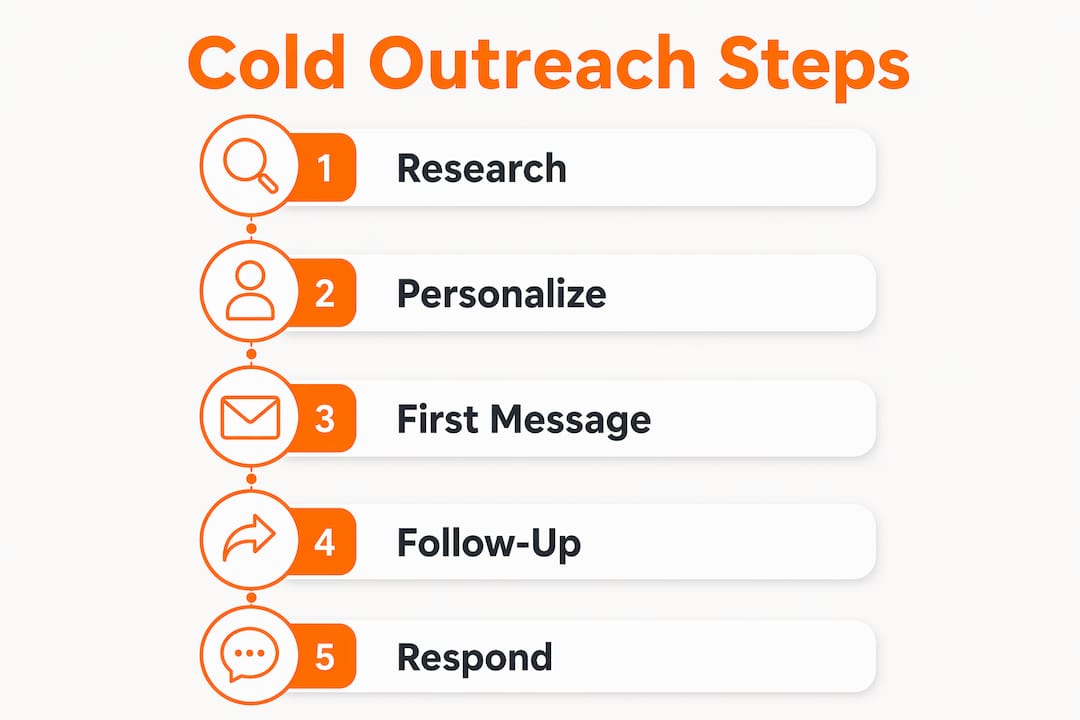
- Write the first message. Apply the 75–125 word structure: opener, value bridge, low-friction ask.
- Send and log. Record each outreach in a simple tracker with the date, contact name, company, and channel used.
- Follow up once. Send one follow-up after 5–7 days if there is no reply.
- Review weekly. Assess reply rates by message type and adjust the opener or subject line based on what is working.
Timing also affects results. Tuesday through Thursday outperform Monday and Friday for cold email open rates.
Examples and templates of successful cold outreach messages
Template 1: Informational interview request
Subject: Your work on [specific project or initiative]
Hi [Name], I came across your profile while researching [Company]'s work in [specific area]. Your background in [relevant skill] is directly relevant to the direction I'm taking my career. Would you have 15 minutes in the next few weeks for a brief conversation? I'd value your perspective on [specific topic]. [Your Name]
Template 2: Direct outreach to a hiring manager
Subject: [Role type] background, open to a conversation
Hi [Name], I noticed [Company] recently [trigger event, e.g., expanded its security team]. I have [X years] of experience in [specific skill], most recently at [Company] where I [specific outcome]. If there's a relevant opening or an upcoming need, I'd welcome a brief call. [Your Name]
Both templates stay under 100 words, reference something specific, and ask for a conversation rather than a job.
How to research and identify the right contacts for outreach

The right contact is usually a hiring manager or team lead in the relevant department, not a general HR inbox. LinkedIn is the primary research tool. Search by company name, then filter by department and seniority. Look for people with titles like "Engineering Manager," "Director of Security," or "VP of Technology."
Company news, press releases, and job postings also reveal who is building a team. A posting for five software engineers signals that a hiring manager is actively recruiting. That person is a high-priority outreach target. Job boards have low success rates as a primary channel, but they remain useful for identifying which companies are in a growth phase.
Measuring and tracking the effectiveness of cold outreach efforts
Tracking is what separates a job search system from a collection of disconnected tasks. A simple spreadsheet with six columns covers the basics: contact name, company, date sent, channel (email or LinkedIn), reply received (yes/no), and outcome.
Review the data weekly. If reply rates are below 10%, the opener or subject line needs adjustment. If replies come in but conversations stall, the value bridge or call to action is the likely issue. The goal is to identify which stage of the message is underperforming, then change one variable at a time.
Tips for follow-up communication after initial outreach
Send one follow-up message 5–7 days after the initial contact if there is no reply. Keep it shorter than the original, reference the first message briefly, and restate the ask in one sentence. Do not apologize for following up. A brief, direct follow-up is professional, not intrusive.
After a positive reply, respond within a few hours. Prompt responses signal reliability. If a conversation leads to a referral or an introduction to another contact, send a thank-you message within 24 hours and ask if there is anyone else worth speaking with. That single question often extends the network further than the original outreach did.
Handling responses, rejection, and maintaining professionalism
Not every message receives a reply, and that is a normal outcome. Amherst College's Loeb Center for Career Exploration notes that even one response from a cold outreach effort represents a new professional connection that would not have existed otherwise.
When a contact declines or does not respond after a follow-up, move on without further contact. If a reply is negative but polite, a brief thank-you response keeps the relationship intact for the future. Professionalism in rejection handling is part of the outreach record. Hiring managers talk to each other, and a respectful response to a "no" can still leave a positive impression.
Key Takeaways
Cold outreach in a job search produces reply rates of 15–30% with personalization, far exceeding the conversion rate of cold applications submitted through job boards.
| Point | Details |
|---|---|
| Reply rates with personalization | Personalized cold outreach emails yield reply rates of 15–30% according to industry data from 2026. |
| Optimal email length | Messages of 75–125 words consistently outperform shorter and longer emails in reply rate data. |
| First message goal | Ask for a brief conversation or informational interview, not a job, to reduce friction and increase replies. |
| System integration | Cold outreach is the Access stage in a structured job search; it works best after Direction and Proof are in place. |
| Follow-up limit | Send one follow-up after 5–7 days with no reply, then redirect effort to new contacts. |
FAQ
What is a cold outreach job search?
A cold outreach job search is the practice of contacting hiring managers or recruiters directly, without a prior connection or an open listing, to create job opportunities that are not publicly advertised.
What reply rate can job seekers expect from cold outreach?
Personalized cold outreach emails yield reply rates of 15–30% with high personalization, based on recent industry data.
How long should a cold outreach email be?
Emails of 75–125 words consistently outperform shorter and longer messages. The structure includes a personalized opener, a value bridge, and a single yes/no call to action.
Should the first cold outreach message ask for a job?
No. The first message should request a brief conversation or informational interview. Asking for a job immediately reduces the likelihood of a reply.
How many follow-up messages should a job seeker send?
One follow-up after 5–7 days with no reply is the appropriate limit. Sending additional messages after that is generally counterproductive.