
AI surfaces hidden job markets by scanning structured and unstructured signals across company data, candidate profiles, and market activity, then ranking matches before a human recruiter reviews them. Three actions to take now: strengthen the signal clarity in your LinkedIn and resume profiles, identify two or three predictive signals tied to your target companies, and trial an AI co-pilot or specialist talent service built for your field.
The practical result is that unadvertised roles find you rather than the reverse. Job board searches capture only a fraction of active hiring. An analysis of 200,000+ listings across 14–18 data feeds found no single source accounts for more than roughly 6% of the total corpus, which means any search confined to one or two boards misses the majority of available roles.
- Optimize signal strength: Update your job title, add verified skill tags, and list at least one project result with a measurable outcome.
- Map predictive signals: Track funding announcements, leadership changes, and product launches at two or three target companies.
- Use an AI co-pilot: Trial a platform that combines algorithmic matching with recruiter review, especially if you work in IT or cybersecurity.
Table of Contents
- How AI systems technically identify unadvertised opportunities
- The concrete signals AI tracks and where they come from
- What AI-driven discovery means for your visibility as a candidate
- Step-by-step tactics to get surfaced by AI for hidden roles
- What AI misses and the risks you should account for
- How far ahead AI predicts hiring demand and what tools cost
- A real example of AI co-pilot signal detection in practice
- Key Takeaways
- What high-performing candidates do differently
- Plucktalent's Plucky AI gives IT and cybersecurity professionals a direct path to hidden roles
- Useful sources for ongoing signal monitoring
- FAQ
How AI systems technically identify unadvertised opportunities
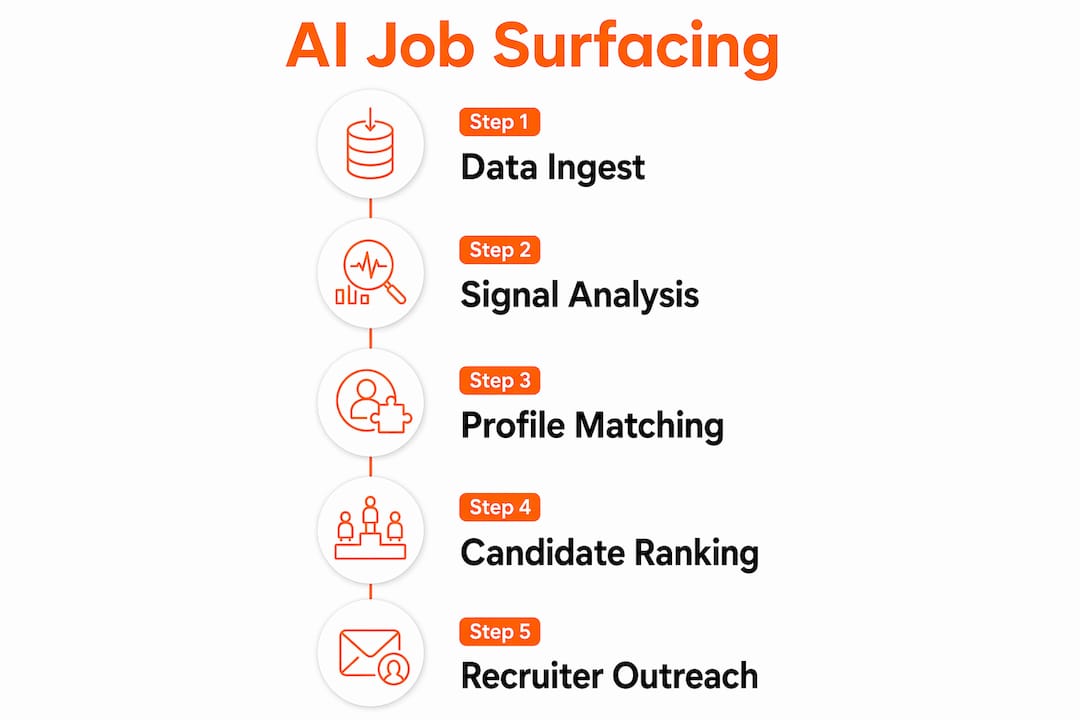
AI sourcing tools have shifted the hidden job market from a social-network problem to an algorithmic one. The pipeline follows a consistent pattern: data ingestion from public and private feeds, normalization and enrichment, model scoring, and finally surfacing to a recruiter dashboard or candidate-facing interface.
The core model types involved are semantic search (matching skill language across job descriptions and profiles), classification models (categorizing candidates by role fit), time-series forecasting (predicting when a team will hire based on growth patterns), graph and network analysis (mapping relationships between companies, roles, and candidates), and intent models (detecting when a candidate is passively open to opportunities). Each layer adds specificity to the match.
Unstructured data is where the real signal extraction happens. Press releases, SEC filings, GitHub commit histories, niche Slack communities, and investor updates are all normalized into structured hiring signals. A company announcing a Series B round, for example, generates a structured event that classification models associate with engineering and product hiring within a defined time window.

Pro Tip: Add a short "Projects" or "Selected Work" section to your LinkedIn profile with one measurable result per item. Semantic models weight concrete outcomes more heavily than job title keywords alone, and this single change can move you into match sets you were previously excluded from.
The practical implication: your profile is not just a document a recruiter reads. It is a data object that AI systems parse, score, and rank continuously. Where you add specificity, AI adds weight.
The concrete signals AI tracks and where they come from
AI detection of hiring signals draws from a wide range of sources, and not all signals carry equal predictive value. The table below maps the highest-value signals to the hiring types they typically predict.
| Signal | Data Source | Hiring Type Predicted |
|---|---|---|
| Recent funding or M&A | SEC filings, press, Crunchbase | Engineering, product, security ramp |
| Leadership hire (VP/C-suite) | LinkedIn, press releases | New strategy roles, team builds |
| Product launch or partnership | Company blog, PR Newswire | Go-to-market, technical support |
| Job-title shifts or internal moves | LinkedIn activity | Backfill and adjacent roles |
| Sudden team growth in one function | ATS anomalies, career pages | Scaling of that specific function |
| GitHub activity spike | GitHub public repos | Open-source or dev-heavy hiring |
| Investor/board update | SEC 8-K, investor newsletters | Workforce planning, restructuring |
Data sources AI systems crawl include company career pages and ATS feeds, investor updates and press releases, LinkedIn activity and endorsements, GitHub commits and repository contributions, niche Slack and Discord communities, and newsletters focused on specific verticals.
Only about 14.9% of listings include salary information, and thousands of new listings appear weekly across aggregated feeds. That velocity means data freshness is a real constraint. A signal detected today may reflect a hiring decision already in motion.
- Operations, HR, and finance roles combined can exceed engineering in unnoticed opportunity share, according to the same aggregated corpus.
- ATS anomalies, such as a company posting multiple roles in one function within a short window, are a reliable early indicator of a team scaling event.
- GitHub activity and patent filings are particularly relevant for IT and cybersecurity professionals, since technical output is a direct proxy for team capability gaps.
What AI-driven discovery means for your visibility as a candidate
Visibility now depends on signal clarity and recency, not network proximity or title prestige. AI sourcing tools rank candidates by match score before a recruiter sees the list, which means a passive candidate with a well-structured profile can appear above an active applicant with a weaker one.

Candidates can be sourced proactively. A recruiter using an AI platform may contact you before you have started an active search, based entirely on how your profile scores against a forecasted role. PwC's AI jobs barometer links AI adoption to deeper specialization requirements, meaning the roles AI surfaces tend to favor candidates with documented, specific expertise rather than broad generalist profiles.
AI has also converted informal referral networks into measurable signal events. A candidate who updates their profile with a new certification, a completed project, or a role change generates a fresh signal that re-enters the scoring pipeline. That update can move them into outreach queues they were not in the week before.
Pro Tip: Recency matters to scoring algorithms. Set a calendar reminder to update at least one profile element every 30 days, even if your role has not changed. A new skill tag, a completed course, or a revised project description counts as a fresh signal.
AI candidate-employer fit is evaluated continuously, not just when you apply. The candidates who benefit most are those who treat their profiles as live data objects rather than static documents.
Step-by-step tactics to get surfaced by AI for hidden roles
The following 30-day checklist gives IT and cybersecurity professionals a structured path to improve their AI match scores and appear in sourcing pipelines for unadvertised roles.
Profile and resume updates (Week 1)
- Consolidate job titles into a clear, consistent story. Remove vague titles like "Consultant" and replace them with specific role names that match common search terms in your field.
- Add verified skill tags. On LinkedIn, request endorsements for your top five technical skills. Verified endorsements carry more weight in scoring models than self-reported tags.
- Write one project result per role with a measurable outcome. Format: action + tool/method + result (e.g., "Reduced mean time to detect by 40% using SIEM correlation rules").
- Update your headline to reflect your current specialization, not your current employer.
Search and monitoring setup (Week 2)
- Set up aggregated job feeds using a tool that pulls from multiple ATS sources simultaneously. Single-board searches miss the majority of active listings.
- Create keyword and signal alerts for your two or three target companies. Track funding announcements, leadership hires, and product launches using Google Alerts or a dedicated aggregator.
- Schedule a weekly 20-minute review of incoming matches and adjust your profile based on patterns you observe in the roles surfaced.
Outreach (Week 3)
- Send targeted connection requests that reference a detected signal. Example: "Saw your Series A announcement last week. Curious how you're scaling the security engineering team." This approach signals awareness and specificity.
- Follow up once, seven days later, with a brief note that adds one piece of relevant context about your background.
Tool evaluation (Week 4)
- Evaluate at least one AI co-pilot or talent platform against these criteria: data freshness (how recently were signals updated?), signal coverage (does it include ATS feeds, not just LinkedIn?), and recruiter integration (does a human review matches before outreach?).
- Free tools typically offer keyword matching and basic ATS optimization.
- Paid subscriptions add signal monitoring, predictive role alerts, and in some cases direct recruiter access.
- Managed talent services, such as those offered by specialist IT recruiters, combine algorithmic matching with human vetting.
Pro Tip: AI tools for tech job seekers vary significantly in signal coverage. Before committing to a subscription, ask the provider which data sources feed their matching engine and how frequently those sources are refreshed.
Predictive hiring horizons commonly sit in the 3–6 month window, so candidates who align their profiles with forecasted skill trends appear earlier in pipelines than those who wait for a public posting.
What AI misses and the risks you should account for
AI-driven sourcing has real failure modes. Noisy signals are the most common: a company posting multiple roles in one week may be running a routine backfill, not a growth event. Data gaps are also significant. Private companies, niche ATS platforms, and roles filled through internal mobility often leave no public signal at all.
Language mismatch between a candidate's profile and a job description is a persistent problem. If your resume uses "information security" and the job description uses "cybersecurity," a semantic model may score the match lower than the actual fit warrants. Consistent terminology across all public profiles reduces this risk.
Bias in AI hiring tools is a documented concern. Models trained on historical hiring data can replicate past exclusion patterns, particularly for candidates from underrepresented groups. The AI talent acquisition playbook recommends that organizations audit their models for fairness and maintain human oversight at key decision points. As a candidate, this means AI match scores are probabilistic signals, not verdicts.
Privacy is a separate issue. Some sourcing tools scrape private community channels, including Slack groups and Discord servers, without explicit consent from participants. Candidates should be selective about what they share in semi-public professional communities and review the data practices of any platform they use.
Mitigation steps:
- Diversify signal sources rather than relying on one platform's match score.
- Human-verify any match before investing significant time in an application or outreach.
- Review the privacy policy of any AI job search tool before connecting your profiles.
- Keep a record of what personal data you have shared with which platforms.
How far ahead AI predicts hiring demand and what tools cost
AI workforce planning tools commonly forecast hiring demand 3–6 months in advance. For candidates, this means that aligning your profile with a company's anticipated skill needs now can place you in a sourcing pipeline before a public requisition appears.
Agentic AI systems can proactively source, score, and engage candidates autonomously, compressing the time between a hiring signal and recruiter outreach. Data quality remains the primary constraint: platforms with clean, frequently refreshed data produce more accurate matches than those relying on stale feeds.
| Tool Type | Typical Features | Approximate Cost Range |
|---|---|---|
| Free AI tools | Keyword matching, basic ATS scan | — |
| Paid AI co-pilot subscriptions | Signal alerts, profile scoring, role matching | $20/month |
| Enterprise sourcing platforms | Predictive analytics, ATS integration, pipeline management | Custom pricing |
| Managed talent services | Recruiter-vetted placements, direct hiring manager access | Fee on placement |
A paid co-pilot is worth considering when you are in a specialized field with limited public listings (IT and cybersecurity both qualify), when your search has stalled after 60 days on free tools, or when seniority means fewer but higher-stakes opportunities. Managed talent services add value when direct hiring manager access and recruiter vetting are priorities.
A real example of AI co-pilot signal detection in practice
The following scenario reflects how Plucktalent's Plucky AI applies signal detection for IT and cybersecurity professionals.
Situation: A senior cloud security engineer with eight years of experience had been applying through standard job boards for six weeks with minimal response. Their profile used accurate but generic titles and listed responsibilities rather than outcomes.
Signals detected by the AI co-pilot:
- A target company announced a Series B funding round, triggering a predicted engineering and security hiring ramp.
- The company's career page showed three new infrastructure roles posted within ten days, an ATS anomaly consistent with team scaling.
- The candidate's profile scored below the match threshold due to inconsistent skill terminology and no quantified project results.
Actions taken:
- Profile headline updated to reflect a specific specialization ("Cloud Security Architecture | AWS | Zero Trust").
- Three project results added with measurable outcomes.
- Outreach sent referencing the funding announcement and the candidate's relevant experience with the company's stated tech stack.
Outcome: The candidate received a recruiter response within five days and moved to a hiring manager interview within two weeks.
The human element closed the loop. The AI identified the signal and the match gap. The recruiter at Plucktalent reviewed the fit and confirmed the outreach was well-timed. The candidate's revised storytelling, grounded in specific outcomes, converted the algorithmic match into a real conversation.
Plucktalent combines 17 years of IT recruiting experience with Plucky AI to surface hidden roles and optimize ATS-ready profiles for IT and cybersecurity professionals.
Key Takeaways
AI surfaces hidden job markets most effectively when candidates treat their profiles as live data objects and align their signal output with predictive hiring indicators.
| Point | Details |
|---|---|
| Signal clarity drives visibility | Updated titles, verified skills, and project outcomes move candidates into AI match sets. |
| Predictive window is 3–6 months | Aligning with forecasted skill trends now places you in pipelines before roles are posted. |
| No single source covers the market | Analysis of 200,000+ listings shows no feed exceeds roughly 6% of total listings. |
| Bias and data gaps are real risks | Audit AI match scores with human review; diversify across multiple signal sources. |
| Plucktalent combines AI and recruiter expertise | Plucky AI pairs algorithmic matching with 17 years of IT and cybersecurity recruiting experience. |
What high-performing candidates do differently
The most common visibility mistake is inconsistency. A candidate lists "Network Security Engineer" on LinkedIn, "Senior Security Analyst" on their resume, and "IT Professional" in their headline. Each variation scores as a partial match, and the aggregate score drops below the threshold for proactive sourcing.
High-performing candidates maintain one consistent title across all public profiles, update at least one profile element monthly, and curate a short list of projects with specific, measurable results. They do not post more frequently. They post more specifically.
A common corrective action: candidates who replace a vague summary paragraph with three bullet-point project results, each with a metric, consistently report an increase in unsolicited recruiter contact within 30 days. The change is not cosmetic. It restructures the data object that AI systems parse.
One practical daily habit: spend five minutes each morning scanning one signal source, whether that is a funding newsletter, a target company's career page, or a niche technical community. Over time, this builds a current map of where hiring is likely to accelerate, which informs both profile updates and outreach timing.
Plucktalent's Plucky AI gives IT and cybersecurity professionals a direct path to hidden roles
IT and cybersecurity professionals face a specific problem: the roles worth pursuing rarely appear on public boards, and generic AI tools lack the domain depth to surface them accurately. Plucktalent addresses this directly. Plucky AI combines algorithmic signal detection with 17 years of IT and cybersecurity recruiting expertise to match candidates with unadvertised roles and connect them directly with hiring managers.
The platform covers profile optimization, ATS-ready resume tailoring, hidden role discovery, and recruiter-vetted placements. Job seekers access Plucky AI through a subscription, with the option to move to managed recruiter support for senior or specialized searches. The difference from a standard AI tool is the recruiter layer: every high-confidence match is reviewed by a specialist before outreach, which reduces false positives and improves response rates.
Explore Plucktalent's job seeker platform to see current subscription options and start a profile review.
Useful sources for ongoing signal monitoring
Keeping a signal pipeline active after reading this article requires a short list of reliable sources checked on a regular schedule.
- Company career pages and ATS feeds: Check target companies directly, weekly. ATS anomalies, such as a cluster of new roles in one function, are often the earliest public hiring signal.
- Investor updates and press releases: Follow target companies on Crunchbase and set Google Alerts for their name plus "funding," "partnership," or "expansion." Review weekly.
- LinkedIn activity feeds: Monitor connections at target companies for role changes and new hires. These signal internal mobility and backfill opportunities. Check two or three times per week.
- GitHub and technical repositories: For IT and cybersecurity roles, a company's public GitHub activity reflects team size, tech stack, and current development priorities. Review monthly.
- Niche newsletters and Slack communities: Vertically focused newsletters (security, cloud, DevOps) often carry hiring signals before they appear on job boards. Subscribe to two or three relevant ones.
- AI feedback loop in job searching: Understanding how your profile behavior feeds back into AI scoring helps you prioritize which updates to make and when.
- Job search time wasters to avoid: A practical guide to cutting low-signal activities from your search routine, freeing time for higher-value signal monitoring.
FAQ
What percent of jobs are in the hidden job market?
Estimates vary, but aggregated data from multiple listing feeds consistently shows that a large share of roles are filled before or without a public posting. No single job board captures more than roughly 6% of total active listings, according to an analysis of 200,000+ listings across 14–18 data feeds.
How does AI find unadvertised job opportunities?
AI ingests structured and unstructured data from sources including ATS feeds, press releases, SEC filings, and LinkedIn activity, then uses natural language processing and classification models to match candidate profiles to predicted hiring needs before roles are publicly posted.
How far in advance does AI predict hiring demand?
Predictive hiring horizons in AI workforce planning tools commonly sit in the 3–6 month range, giving candidates who align their profiles with forecasted skill trends a meaningful lead time advantage.
Which jobs are least affected by AI-driven hiring changes?
Roles requiring deep, documented specialization tend to benefit from AI-driven sourcing rather than being displaced by it. PwC research links AI adoption to increased demand for AI-fluent professionals with verified, specific expertise.
Can Plucktalent surface hidden IT and cybersecurity roles specifically?
Plucktalent's Plucky AI is built specifically for IT and cybersecurity professionals, combining algorithmic signal detection with recruiter review to surface unadvertised roles and connect candidates directly with hiring managers.