
Co-employment in staffing is a formal arrangement in which two entities, typically a staffing agency, professional employer organization (PEO), or employer of record (EOR), and a client business, share employer responsibilities for the same worker. Under this structure, the staffing partner handles payroll, tax withholding, and benefits while the client directs daily work assignments and performance. The immediate consequence for employers is shared administrative duties and shared exposure for employment-law violations. Agencies including the Department of Labor (DOL), the National Labor Relations Board (NLRB), and the IRS apply conduct-based tests to determine which party bears liability, and the National Association of Professional Employer Organizations (NAPEO) provides industry guidance on structuring these relationships responsibly.
Table of Contents
- How co-employment in staffing actually works
- What employers actually gain from co-employment
- Legal and operational risks you need to understand
- How co-employment differs from joint employment, employee leasing, and EOR
- How to manage and minimize co-employment risk
- What every PEO and staffing agreement should include
- Co-employment is a spectrum, not a binary status
- Key Takeaways
- Why the compliance framing around co-employment misses the bigger picture
- Useful sources for further research
- FAQ
How co-employment in staffing actually works
In a co-employment arrangement, responsibilities divide along two clear lines: administrative employment and operational control.

The staffing agency, PEO, or EOR typically serves as the employer of record. That entity processes payroll, withholds federal and state taxes, issues W-2s, administers benefits, maintains workers' compensation coverage, and handles I-9 verification. The client business, often called the worksite employer, controls day-to-day supervision, schedules shifts, assigns tasks, conducts performance reviews, and makes decisions about discipline and termination.
A Client Service Agreement (CSA) or staffing agreement codifies this split. The contract specifies which party owns each obligation. Problems arise when operational behavior drifts from what the contract says. If a client starts setting pay rates unilaterally or conducting independent terminations without involving the staffing partner, regulators may treat the client as a joint employer regardless of what the agreement states.
Responsibility matrix: who owns what
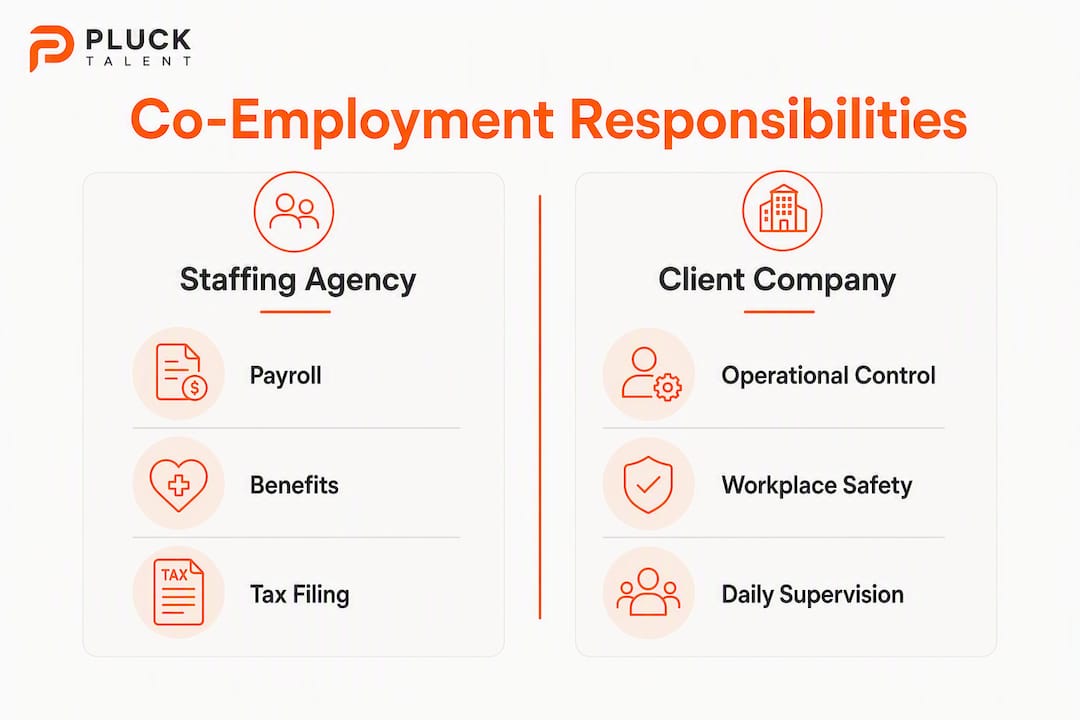
| Duty | Staffing Agency / PEO / EOR | Client / Worksite Employer |
|---|---|---|
| Payroll processing & tax withholding | ✓ | |
| W-2 issuance | ✓ | |
| Benefits administration | ✓ | |
| Workers' compensation coverage | ✓ | |
| I-9 verification | ✓ (per contract) | |
| Hiring and onboarding | Shared | Shared |
| Daily supervision & scheduling | ✓ | |
| Performance reviews | ✓ | |
| Discipline and termination | Shared | Shared |
| OSHA site safety | Shared | ✓ (primary) |
Typical temp placement workflow
- Requisition. The client submits a job order to the staffing agency, specifying role, duration, and pay range.
- Recruitment and screening. The agency sources, interviews, and selects candidates.
- Onboarding. The agency completes I-9 verification, enrolls the worker in payroll, and issues benefits information.
- Placement. The worker reports to the client site. The client assigns tasks and manages daily performance.
- Payroll cycle. The agency processes hours reported by the client, withholds taxes, and pays the worker.
- Performance and compliance monitoring. The client reviews performance; the agency monitors safety and compliance obligations.
- Offboarding. Either party initiates separation per the CSA; the agency processes final pay and handles COBRA notifications.
For a closer look at how IT job order workflows interact with these handoffs, Plucktalent's operational guide covers the mechanics in detail.
What employers actually gain from co-employment
The practical benefits of co-employment arrangements fall into two categories: operational efficiency and risk management.
Operational benefits are the most visible. Payroll processing, tax filings, and benefits administration shift to the staffing partner, freeing internal HR teams to focus on workforce strategy rather than compliance paperwork. Access to group benefits is a particular advantage for smaller businesses. A company with 15 employees cannot negotiate Fortune 500-caliber health, dental, or retirement plans on its own. Through a PEO co-employment relationship, that same company can offer benefits packages that compete with much larger employers, which directly affects hiring outcomes.

For enterprise clients, the value is speed and scale. A technology company needing 50 cybersecurity contractors within 90 days cannot build that pipeline through traditional hiring alone. A staffing partner with an existing talent pool, pre-verified credentials, and payroll infrastructure already in place compresses that timeline significantly.
Risk-management benefits are less obvious but often more consequential. Centralized tax filings reduce the chance of multi-state payroll errors. Workers' compensation coverage through the staffing partner removes a direct cost and administrative burden from the client. HR compliance expertise, particularly around wage-and-hour rules under the Fair Labor Standards Act, is built into the relationship rather than purchased separately.
NAPEO documents that businesses using PEOs tend to grow faster and retain employees at higher rates than comparable businesses managing HR independently. That data point matters for procurement teams evaluating whether the cost of a PEO relationship is justified.
Legal and operational risks you need to understand
Co-employment creates genuine legal exposure. Understanding where that exposure lives is the first step toward managing it.
Primary legal risks include:
- Joint employer liability for wage-and-hour violations. If a worker is underpaid, denied overtime, or misclassified, both the staffing agency and the client can be held liable under the FLSA.
- Discrimination claims. The EEOC's enforcement guidance confirms that both staffing agencies and client employers can be held jointly liable for discrimination based on the level of control each party exercises over the worker.
- OSHA safety violations. Under the OSH Act, both the staffing agency and the host employer share responsibility for a safe workplace. Staffing firms must inquire into and monitor client worksites even when they do not supervise day-to-day operations.
- I-9 and immigration compliance. Errors in employment verification, including duplicate I-9 processes run by both parties, create direct compliance violations.
- Tax misclassification. The IRS applies its own worker classification tests to determine whether a worker is an employee or independent contractor, separate from any contractual label.
Legal tests that determine liability
Courts and agencies do not rely on contract language alone. The DOL, NLRB, EEOC, and IRS each apply conduct-based tests that examine who actually directs work, sets pay, controls scheduling, and handles discipline. The common-law control test (derived from the Darden factors) and the NLRB's joint-employer standard focus on actual operational behavior. A "no co-employment" clause in a contract does not determine legal status if the parties' day-to-day conduct indicates shared control.
The Vizcaino v. Microsoft case is the most cited example of this principle. Microsoft used long-term contractors through staffing agencies but exercised substantial direct control over their work. A court found that those workers were common-law employees of Microsoft, entitling them to benefits Microsoft had denied them. The case established that operational reality overrides contractual classification.
Major misclassification enforcement trends in the FedEx driver cases followed the same logic: FedEx labeled drivers as independent contractors, but courts found that FedEx's operational control over routes, uniforms, and schedules made them employees. The financial exposure in those cases ran into the hundreds of millions of dollars.
The core principle from regulators and courts: A contract clause disclaiming co-employment does not create legal protection. What matters is who controls work, pay, and discipline in practice. Clients who set hours, approve raises, or conduct independent terminations retain material liability regardless of what the staffing agreement says.
The WorkwellNA co-employment technical guide frames this as a spectrum analysis: the more control a client exercises, the more exposure it carries, and no single factor is determinative.
How co-employment differs from joint employment, employee leasing, and EOR
These terms are often used interchangeably, but they describe distinct legal and operational structures.
| Dimension | Co-Employment (PEO) | Joint Employment | Employee Leasing | EOR |
|---|---|---|---|---|
| Employer of record / payroll | PEO handles payroll, taxes, W-2 | Determined by courts based on control | Leasing company is EOR | EOR handles all payroll and taxes |
| Day-to-day control | Client directs work | Both entities share control | Client directs work | Client directs work |
| Liability exposure | Shared per CSA; conduct determines actual split | Both employers fully exposed | Shared; leasing company carries primary admin liability | EOR carries primary employment liability |
| Services included | Payroll, benefits, HR, workers' comp, compliance | No services agreement; status imposed by law | Payroll, sometimes benefits | Payroll, taxes, benefits, legal compliance, HR |
| Best-fit scenarios | Small-to-mid businesses needing HR infrastructure | Involuntary finding; not a chosen model | Businesses needing workforce flexibility | Rapid market entry, cross-border hiring, project-based work |
| Pricing model | Per-employee fee or percentage of payroll | N/A | Markup on labor costs | Per-employee monthly fee |
A few distinctions deserve emphasis. Joint employment is not a service model anyone chooses. It is a legal finding imposed by courts or agencies when two entities exercise sufficient shared control over workers. Co-employment through a PEO or staffing agency is a deliberate contractual structure designed to allocate responsibilities clearly.
Employee leasing is an older term for what PEOs now do. The structure is functionally similar: a leasing company employs workers and leases them back to the client. Most states regulate employee leasing companies separately from staffing agencies.
EOR arrangements are the most comprehensive model. The EOR assumes full employer-of-record status, handling all payroll, taxes, benefits, and legal compliance. This makes EOR the preferred model for rapid market entry into a new state or country, or for project-based engagements where the client wants minimal administrative exposure.
Co-employment is also legally distinct from independent contractor misclassification. Co-employment describes two legitimate employers sharing obligations for a worker who is properly classified as an employee. Misclassification is labeling an employee as an independent contractor to avoid those obligations entirely. The legal consequences are different, but both carry significant financial risk.
How to manage and minimize co-employment risk
Risk management in co-employment is a combination of vendor selection, contract discipline, and ongoing operational governance.
Step-by-step checklist for managing co-employment risk
- Vet the staffing partner's compliance infrastructure. Confirm the agency or PEO carries workers' compensation insurance, maintains current I-9 procedures, and has documented HR compliance policies. Request certificates of insurance before signing.
- Negotiate a clear responsibility matrix in the contract. Every duty in the table above should be assigned to one party. Ambiguity is where liability grows.
- Define limits on client control. The contract should specify that the client does not set pay rates, conduct independent terminations, or make benefits decisions for placed workers. These are the actions most likely to trigger joint-employer findings.
- Include audit rights. The client should have the right to audit the staffing partner's payroll records, I-9 files, and workers' comp coverage at defined intervals.
- Assign I-9 ownership explicitly. Duplicate I-9 processes run by both parties create compliance violations. One party owns I-9 verification; the contract should name which one.
- Train client-side managers. Supervisors who interact daily with placed workers are the most common source of conduct that creates unintended joint-employer exposure. Training should cover what they can and cannot direct.
- Establish an escalation path. Define how disputes about worker performance, discipline, or termination are handled. Both parties should follow the process documented in the CSA.
- Review insurance coverage annually. Workers' comp, employment practices liability insurance (EPLI), and general liability coverage should be verified each year, not just at contract signing.
- Conduct a compliance audit at least annually. Review payroll records, I-9 files, and incident reports to confirm operational behavior matches the contract.
- Document everything. Written records of job assignments, performance reviews, and disciplinary actions create the paper trail that protects both parties in an audit or litigation.
Pro Tip: Indemnity clauses shift financial responsibility between parties, but they do not remove regulatory exposure. A client indemnified by its staffing partner can still face a DOL investigation or EEOC charge. Insurance and indemnity are financial tools, not legal shields.
What every PEO and staffing agreement should include
A well-drafted staffing or PEO agreement does more than describe services. It allocates risk, defines governance, and creates the documentation trail that protects both parties.
Core contract provisions to require:
- Responsibility matrix. A written table or schedule assigning each employer duty to one party. This is the foundation of the entire agreement.
- Payroll and tax handling. Specifies which entity processes payroll, withholds taxes, and files returns. Should include state-by-state coverage if workers operate in multiple states.
- Benefits definitions. Describes which benefits the staffing partner provides, eligibility rules, and what happens to benefits if the relationship ends.
- Workers' compensation. Identifies the carrier, coverage limits, and the process for reporting and managing claims.
- Indemnity and insurance. Each party indemnifies the other for liabilities arising from its own conduct. Both parties should carry EPLI and general liability coverage.
- Audit rights. The client retains the right to audit payroll records, I-9 files, and compliance documentation at defined intervals, typically annually.
- Data privacy and I-9 ownership. Names the party responsible for I-9 verification and attestation. Addresses data retention and access rights for worker records.
- Termination and transition assistance. Defines notice periods, final pay processing, COBRA notification responsibilities, and how worker records transfer if the relationship ends.
Sample high-level language (illustrative, not legal advice):
"The Staffing Partner shall serve as employer of record for all Placed Workers and shall be solely responsible for payroll processing, tax withholding, and I-9 verification. The Client shall not independently set compensation rates, conduct terminations, or maintain separate employment verification records for Placed Workers."
Transition plan outline for moving workers on or off a provider:
- Provide written notice per the contract's notice period (typically 30–90 days).
- Identify which workers will transition and confirm their employment status with the incoming provider.
- Transfer I-9 records, payroll history, and benefits enrollment data to the new provider.
- Notify affected workers of the change in employer of record, benefits carrier, and payroll schedule.
- Confirm workers' comp coverage is continuous through the transition date.
- Conduct a final audit of outstanding payroll, tax filings, and open claims before closing the prior agreement.
Guidance on reducing placement time during transitions is available from Plucktalent's operational resources.
Co-employment is a spectrum, not a binary status
The most useful frame for understanding co-employment risk is a spectrum rather than an on/off switch. At one end, a staffing agency places a worker, handles all payroll and HR administration, and the client limits its involvement to daily task direction. Liability is well-allocated and manageable. At the other end, a client exercises extensive control over pay, scheduling, discipline, and termination while nominally using a staffing partner for payroll only. That client has moved far along the spectrum toward full joint-employer status, regardless of what the contract says.
NAPEO's research consistently shows that businesses using PEOs grow faster and retain employees at higher rates than those managing HR independently. That advantage comes not just from outsourcing administration but from the compliance infrastructure and expertise that well-structured co-employment relationships provide.
Pro Tip: Operational discipline matters more than contract language. A perfectly drafted CSA provides no protection if client managers are setting pay rates, approving terminations, or running their own I-9 processes. Train managers, audit conduct, and treat the contract as a floor, not a ceiling.
The WorkwellNA technical guide reinforces this point: courts and agencies focus on actual conduct, not contractual disclaimers. Well-drafted agreements plus consistent operational discipline create durable protection as legal standards evolve.
Key Takeaways
Co-employment in staffing is a manageable legal structure when responsibilities are clearly allocated, contracts are specific, and operational behavior matches what the agreement says.
| Point | Details |
|---|---|
| Definition and structure | Co-employment splits employer duties between a staffing partner (payroll, taxes, benefits) and the client (daily supervision, performance). |
| Liability follows conduct | Courts and agencies apply control-based tests; a "no co-employment" clause does not override operational reality. |
| Contract specificity is required | Every employer duty must be assigned to one party in writing; ambiguity creates shared exposure. |
| Operational governance is the real protection | Manager training, audit cadence, and documented escalation paths reduce risk more than indemnity clauses alone. |
| Model selection matters | PEO, EOR, staffing, and employee leasing serve different needs; choosing the wrong model increases both cost and liability. |
Why the compliance framing around co-employment misses the bigger picture
Co-employment discussions in HR circles tend to focus almost entirely on liability avoidance. That framing is understandable, but it leads procurement teams to treat staffing relationships as legal problems to be managed rather than workforce tools to be used well.
The more productive question is not "how do we limit our exposure?" but "how do we structure this relationship so it actually works?" A staffing or PEO arrangement that is contractually airtight but operationally dysfunctional, where managers ignore the responsibility matrix, where I-9 processes are duplicated, where pay decisions happen informally, creates more risk than a less formal arrangement where both parties communicate clearly and follow consistent procedures.
From Plucktalent's perspective, built on 17 years of IT and cybersecurity recruiting, the clients who get the most value from co-employment structures are the ones who treat the staffing partner as a genuine operational partner rather than a payroll vendor. That means involving the agency in onboarding design, sharing performance data, and maintaining clear communication about role changes or terminations. The legal protections follow from that discipline. They do not substitute for it.
For HR teams evaluating IT or cybersecurity staffing partners, Plucktalent's employer services cover full-time, contract, and leadership searches with the compliance infrastructure these arrangements require.
Useful sources for further research
The sources below provide primary and authoritative guidance on co-employment, joint employer standards, and staffing compliance in the United States. Retain contracts and consult qualified employment counsel for questions specific to your situation.
- OSHA: Protecting Temporary Workers — Primary federal guidance on shared safety responsibilities for staffing agencies and host employers under the OSH Act.
- DOL: Fair Labor Standards Act — Governing statute for wage-and-hour obligations, overtime, and joint employer liability under federal law.
- DOL: Worker Misclassification — DOL's guidance on distinguishing employees from independent contractors and the consequences of misclassification.
- IRS: Employee or Independent Contractor — IRS classification tests and the common-law control factors used to determine worker status for tax purposes.
- EEOC: Enforcement Guidance on Contingent Workers — EEOC's analysis of how anti-discrimination laws apply to temporary and contingent workers in co-employment arrangements.
- NAPEO: Empower Your Business with PEOs — Industry association guidance on PEO structures, benefits, and growth data for businesses evaluating co-employment.
- ADP: What Is Co-Employment? — Practical overview of co-employment mechanics, responsibility allocation, and PEO benefits from a major payroll provider.
This article provides general information about co-employment in the United States. It is not legal advice. Confirm current rules and obligations with a qualified employment attorney or the relevant federal agency before making compliance decisions.
FAQ
What does co-employment mean in staffing?
Co-employment means two entities, typically a staffing agency or PEO and a client business, share employer responsibilities for the same worker. The staffing partner usually handles payroll, taxes, and benefits while the client directs daily work.
Is co-employment legal in the United States?
Co-employment is legal and common in the U.S. It is a deliberate contractual structure used by PEOs, staffing agencies, and EORs. It is legally distinct from independent contractor misclassification, which is the improper labeling of an employee as a contractor to avoid employer obligations.
What are the main risks of co-employment?
The primary risks are joint employer liability for wage-and-hour violations, discrimination claims, OSHA safety violations, and I-9 compliance errors. Liability follows actual conduct, not contract language, so clients who control pay, scheduling, or discipline carry greater exposure.
What are the three types of staffing arrangements?
The three most common models are traditional staffing agency placements (agency is EOR, client directs work), PEO co-employment (PEO handles all HR administration for the client's own workforce), and EOR arrangements (EOR assumes full employer-of-record status, typically for project-based or cross-border work).
How is co-employment different from joint employment?
Co-employment is a chosen contractual structure with defined responsibilities. Joint employment is a legal status imposed by courts or agencies when two entities are found to exercise shared control over workers, regardless of any agreement between them.