
Workforce augmentation is the practice of adding capability to a team through technology, external specialists, or both, without replacing the people already there. It covers two related tracks: technology-driven augmentation (AI, robotic process automation, data tools that assist workers) and human-capital augmentation (skilled contractors or embedded specialists who join a team temporarily to close a specific gap). The U.S. staffing market driving that human-capital side was projected to reach roughly $180 billion in 2026, a sign of how mainstream this model has become.
The core purpose is simple: increase output, speed, or expertise without committing to permanent headcount you may not need in twelve months.
- Not automation. Automation replaces a task. Augmentation assists a person doing it.
- Not staff augmentation alone. Staff augmentation is the human-capital half of this picture, not the whole thing.
- The real difference. True workforce augmentation blends both tracks depending on what the problem actually needs.
Key Takeaways
Workforce augmentation combines technology and external specialist talent to add capability without replacing existing staff or committing to permanent headcount.
| Point | Details |
|---|---|
| Two tracks, one strategy | Technology augmentation (AI, RPA) and human-capital augmentation (contractors, embedded specialists) work best combined, not chosen separately. |
| Not the same as automation | Automation replaces a task; augmentation assists a person still doing the work and making the call. |
| Management stays internal | In staff augmentation, the client manages day-to-day work while the vendor handles employment and payroll. |
| Pilot small, measure fast | A four to eight week sprint with one clear KPI shows whether to scale or stop before you overcommit. |
| Sourcing vetted talent matters | Plucktalent connects hiring teams with vetted IT and cybersecurity specialists for exactly this kind of augmentation work. |
A Practical Next Step for Building Your Augmented Team
Finding the right embedded specialist is its own bottleneck, and generic job boards weren't built to solve it. Plucktalent works both sides of that gap: IT and cybersecurity professionals get an AI job search copilot, Plucky AI, that tailors profiles and surfaces hiring managers directly, while hiring teams get access to recruiter-vetted candidates for full-time, contract, and leadership roles without wading through resume noise.
If you're a hiring manager trying to add a security or cloud specialist to a project without a six-month search, start with Plucktalent's recruiting services and get a sense of how a vetted placement pipeline actually moves. If you're the specialist looking for that next role, Plucktalent's job seeker platform puts you in front of the hiring managers running these exact augmentation pilots.
Table of Contents
- How Workforce Augmentation Works in Practice
- What Benefits Does Workforce Augmentation Actually Deliver
- Augmentation vs. Automation vs. Staff Augmentation
- Where Workforce Augmentation Shows Up Across Industries
- How to Pilot Workforce Augmentation Without Overcommitting
- Sources
- FAQ
How Workforce Augmentation Works in Practice
Augmentation runs on two engines working together: software that assists judgment and people who extend capacity.
On the technology side, four components show up repeatedly in industry glossaries:
- AI and machine learning — surface patterns, draft first-pass work, flag anomalies for human review.
- Robotic process automation (RPA) — handle repetitive, rules-based steps like data entry or ticket routing.
- AR/VR — overlay instructions onto physical tasks, common in field service and manufacturing.
- Cloud collaboration tools — let distributed contractors and full-time staff work inside the same systems in real time.
On the human-capital side, options range from a single embedded specialist working inside your existing team to a full extended team brought in for a defined engagement. In staff augmentation arrangements, the client keeps day-to-day management, while the staffing vendor handles employment, payroll, and HR administration.
Picture a security team facing a compliance audit. An AI tool flags configuration drift across cloud accounts nightly, while an embedded contractor with SOC 2 experience reviews the flagged items and closes gaps. Neither replaces the internal team. Both extend it.
Pro Tip: Assign an internal owner for every embedded specialist from day one. Ambiguous reporting lines are the fastest way to lose IP control and accountability.
What Benefits Does Workforce Augmentation Actually Deliver
The appeal isn't abstract. It shows up in specific operational numbers leaders can track within a quarter.
- Throughput gains. Routine work shifts to AI tools or RPA, freeing staff for judgment calls that actually need a human.
- Faster access to scarce skills. A cloud security specialist or a niche compliance expert can join a project in weeks, not the months a traditional hire takes.
- Sharper decisions. AI-supported analysis surfaces options and risks a stretched team might miss under deadline pressure.
- Flexible cost structure. Spending scales up or down with the work, instead of sitting fixed on payroll regardless of demand.
Generative AI and machine learning are the tools most often credited with offloading mundane work so employees can focus on higher-value tasks, rather than replacing the employee outright.
Track a small set of numbers to know if a pilot is working: cycle time, time-to-delivery, error rate, and cost-per-output. If none of those move within a defined pilot window, the engagement isn't paying for itself yet.
Augmentation vs. Automation vs. Staff Augmentation
Confusing these three terms is the single most common reason augmentation pilots underdeliver.
- Automation replaces a task entirely. A bot processes an invoice; no human touches it.
- Technology augmentation assists a person doing the task. An AI tool drafts a summary; a person reviews and approves it.
- Staff augmentation adds a person, not a tool, under your management, to fill a skill or capacity gap for a set period, distinct from outsourcing where the vendor owns the outcome.
The clearest signal you're actually augmenting rather than outsourcing: your team still owns the decisions and the deliverable. If a vendor is making the calls and simply handing you results, you've quietly shifted into outsourcing, no matter what the contract calls it.
Automate when a task is repetitive and rules-based. Augment with technology when a task needs speed plus human judgment. Add a specialist when the gap is a skill, not a task. Most real deployments blend all three: RPA handling intake, an AI copilot assisting triage, and a contracted specialist owning the exceptions.
Where Workforce Augmentation Shows Up Across Industries
The pattern repeats across sectors, just with different tools and different specialists in the loop.
- IT and cybersecurity. Embedded security engineers pair with AI-assisted code and vulnerability review. Measure mean time to remediate and audit findings closed per sprint.
- Customer support. AI triage handles routine tickets and routes complex cases to human agents. Measure first-response time and escalation resolution rate.
- Field service and manufacturing. AR-guided technicians work alongside contracted specialists during equipment rollouts. Measure first-time fix rate and technician ramp time.
- Healthcare. Clinical decision-support tools assist diagnosis while temporary specialist hires cover capacity gaps during demand spikes. Measure patient wait time and case backlog.
Each of these pairs a technology layer with a human-capital layer. Neither one alone solves the underlying capacity problem.
How to Pilot Workforce Augmentation Without Overcommitting
Start narrow. A pilot that tries to prove everything at once proves nothing.
- Define the job-to-be-done first. Name the exact bottleneck and pick one success metric before contacting anyone.
- Choose your mix. Tech-first for repetitive volume, people-first for a skill gap, hybrid when both apply.
- Source deliberately. Look for contractors or platforms with a vetting process, not just a resume database, especially for technical or security-sensitive roles.
- Set governance early. Access controls, IP agreements, and a named internal manager should exist before day one, not after an incident.
- Run a short feedback loop. A four to eight-week sprint with a single measurable KPI tells you fast whether to scale or stop.
Pro Tip: Write the offboarding plan for a contractor before you write the onboarding plan. It forces clarity on what IP and access need to be reclaimed.
Pairing augmentation with ongoing upskilling efforts helps preserve institutional knowledge instead of letting it walk out the door with a contractor at the end of an engagement.

Where Workforce Augmentation Is Headed
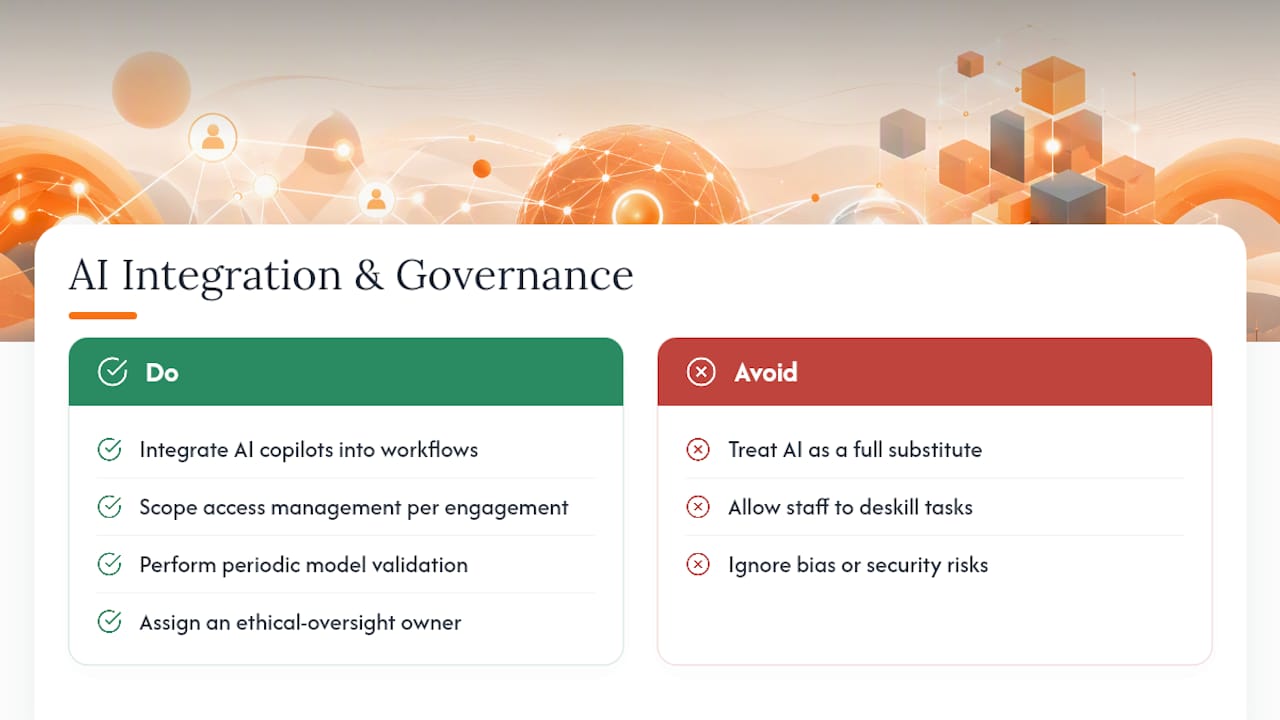
The trend line points toward tighter integration between AI copilots and daily human workflows, not standalone tools bolted onto old processes. Combining human specialists with AI systems tends to work best when technology handles scale and people handle strategic judgment, rather than treating either as a full substitute for the other.
The risks worth naming plainly: deskilling if staff stop doing the work AI now assists with, bias baked into model outputs nobody checks, and security exposure from external specialists who touch sensitive systems. Governance doesn't need to be complicated to be effective; understanding workforce assessment in the age of AI helps clarify human-AI role design and oversight. Access management scoped to the engagement, periodic model validation, regular performance audits, and a named person accountable for ethical oversight cover most of the exposure. Start there before scaling anything further.
— Diego
Sources
For deeper reading: Thunderbird's overview of automation vs. augmentation covers the market scale behind human-capital augmentation. Harvard Business School Online breaks down how generative AI changes routine workflows. Wikipedia's staff augmentation entry defines the contracting model precisely. The University of Notre Dame's ethics blog examines governance and human oversight.
- From automation to augmentation — Thunderbird School of Global Management (ASU)
- Business process automation and related distinctions — Harvard Business School Online (blog)
- Staff augmentation — Wikipedia
- Workforce augmentation — NiCE glossary
FAQ
What Does "Augmentation" Mean in the Workplace?
In the workplace, augmentation means adding a tool or a person that assists existing staff rather than replacing them, whether that's an AI system handling routine analysis or a contractor filling a skills gap.
What Does "Augmented Workforce" Mean?
An augmented workforce is a team where technology (AI, RPA, AR/VR) and human specialists work alongside permanent staff to extend capacity and expertise without expanding permanent headcount.
What Is the Difference Between Outsourcing and Workforce Augmentation?
In staff augmentation, the client manages the work and the specialist day to day; in outsourcing, the vendor owns the outcome and manages the work independently.
How Do I Know If I Need Automation or Augmentation?
Automate a task if it's repetitive and rules-based with no judgment required; choose augmentation when a task still needs human decision-making alongside technology or specialist skill.
How Long Does a Typical Workforce Augmentation Engagement Last?
Staff augmentation engagements are typically time-limited and commonly used for short-term demand spikes or specialized-skill gaps rather than permanent roles.