
Most IT resumes get rejected for five fixable reasons: keyword mismatch against the job posting, formatting that breaks applicant tracking systems, bullets that list duties instead of results, typos and inconsistencies, and a lack of targeting for the specific role. Two separate gatekeepers cause these rejections. Software filters your resume before a person ever sees it, and if it clears that filter, a recruiter scans it for roughly seven to fifteen seconds before deciding whether to read further.
Here's what to fix first, and which gatekeeper each fix targets:
- Match your job-title line to the posting's exact wording (ATS)
- Insert the exact keywords from the listing, not synonyms (ATS)
- Convert every bullet from a duty to a measurable outcome (human)
- Remove tables, columns, headers, and footers from the layout (ATS)
- Run a spell check and read the whole document aloud (human)
- Cut generic buzzwords like "team player" and "self-starter" (human)
- Save the file as the format the posting requests, usually PDF or DOCX (ATS)
- Trim the resume to two pages unless you have 15+ years of relevant experience (human)
Key Takeaways
Most IT resume rejections come from a translation gap between how candidates describe their experience and how job postings and ATS systems expect to see it described.
| Point | Details |
|---|---|
| Keywords decide the first cut | Match 60 to 70% of the exact terms in the job posting, not synonyms, to clear ATS scoring. |
| Formatting breaks parsers | Avoid multi-column layouts, tables, and headers or footers, which cause a large share of ATS failures. |
| Bullets need proof, not duties | Rewrite tasks into action, tool, and result statements with real numbers. |
| Diagnose before you rewrite | Run a parse test and keyword check to find out whether ATS or human review is blocking you. |
| Get tailored support | Plucktalent's Plucky AI and recruiting team tailor resumes and connect candidates directly with IT hiring managers. |
Table of Contents
- Why It Resumes Get Rejected: The Two Gatekeepers
- Top Reasons IT Resumes Get Rejected
- How to Tell If ATS or a Human Rejected You
- Resume Checklist and Before-and-After Examples
- ATS-Friendly Formatting Rules for IT Resumes
- Instant Red Flags That Trigger Rejection
- What to Do After Repeated Rejections
- Tailoring Your Resume for Different Roles and Industries
- Do Cover Letters Still Matter?
- Using Keywords the Right Way (Not Just Stuffing Them In)
- Bias and Subjectivity in Resume Rejection
- Let Plucktalent Handle the Tailoring for You
- Sources
- FAQ
Why It Resumes Get Rejected: The Two Gatekeepers
Before a human ever opens your resume, software usually reads it first. An applicant tracking system (ATS) parses your document into fields, scores it against the job's required keywords, and ranks or filters candidates automatically. Parsers choke on multi-column layouts, tables, text boxes, headers, footers, and images with embedded text. If the parser can't extract your job titles, dates, or skills cleanly, you get scored as a poor match even when you're exactly the right person for the role.
If your resume survives that filter, a recruiter scans it next, and they don't read it top to bottom. StylingCV's analysis of over 500,000 applications found that a majority of rejection decisions happen rapidly, often within the first hour after a resume enters the pipeline, which tells you the human review is fast and pattern-based, not a careful line-by-line read. In that quick pass, recruiters look for a title that matches what they're hiring for, a summary that signals relevant scope, and bullets that show impact rather than task lists.
Here's how the two filters differ in practice:
- ATS fixes: exact keyword matches, single-column layout, standard section headers, no images or embedded objects
- Human fixes: a tailored summary line, quantified bullets, clean visual hierarchy, no typos
- Shared fixes: a job-title line that mirrors the posting, consistent date formatting, a file name that includes your name
Both systems are looking for the same underlying signal: does this person actually fit this specific role. The mechanics of how they detect it are just different.
Top Reasons IT Resumes Get Rejected
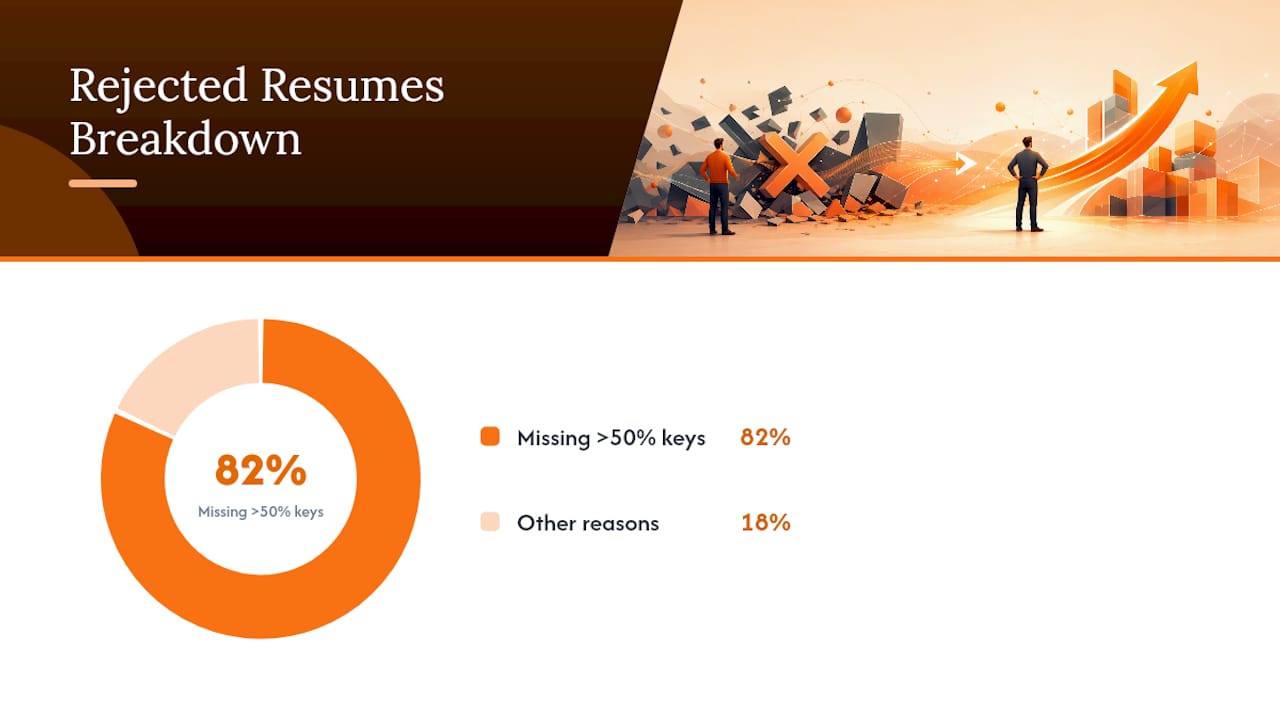
ResumeAdapter's analysis of 10,000 resume scans found a 71.4% ATS rejection rate, and 82% of those rejected resumes were missing more than half of the required keywords. That single stat explains a lot of "ghosted" applications from qualified candidates. Here's the ranked list of what actually causes rejection, and the one-line fix for each.
- Keyword mismatch or a translation gap. You have the experience, but you described it differently than the posting does. If the job wants "Kubernetes" and you wrote "container orchestration platforms," the parser may not connect the two. Fix: mirror the posting's exact nouns, especially tool and certification names, in at least one bullet or your skills section.
- ATS-unfriendly formatting. Multi-column resumes, text boxes, and graphics-heavy templates confuse parsers into scrambling your work history or dropping your contact info entirely. Fix: use a single-column layout with standard headings like "Experience" and "Skills."
- Duty-focused bullets with no measurable impact. "Responsible for network maintenance" tells a recruiter nothing about how well you did it. Fix: rewrite every bullet as action, tool, and result: "Reduced network downtime 40% by migrating to redundant Cisco switches."
- Typos and grammar errors. A single typo in a technical document reads as a lack of attention to detail, which is disqualifying for infrastructure and security roles especially. Fix: read the resume aloud before you submit it, a trick that catches errors your eyes skip over on-screen.
- Poor layout and text walls. Dense paragraphs with no white space get skimmed and skipped. Fix: break every role into three to five bullets, each one line long.
- Vague buzzwords and soft-skill stuffing. "Dynamic team player with strong communication skills" says nothing a recruiter can verify. Fix: replace adjectives with evidence, like a project you led or a metric you moved.
- Unexplained employment gaps or overqualification. StylingCV's data shows overqualified candidates get rejected from junior and mid-level roles at a surprisingly high rate, often because recruiters worry about flight risk or salary mismatch. Fix: add a line in your summary explaining the move, whether it's relocation, a career pivot, or a deliberate step down for work-life balance.
- Wrong file type or missing application instructions. Some ATS platforms still mishandle certain file formats, and ignoring a stated instruction (like "PDF only" or "include cover letter") signals carelessness. Fix: follow the posting's format instructions exactly, and default to PDF when none are given.
Pro Tip: If you're worried that showing 12 years of senior-level scope will get you flagged as overqualified for a mid-level role, don't hide your experience. Instead, add one sentence in your summary about why this specific role interests you. Recruiters aren't afraid of experience, they're afraid of a mismatch they can't explain.
The underlying pattern across nearly all of these reasons is the same: it's rarely a skills gap. It's a translation gap between how you describe your experience and how the job posting and the parser expect to see it described.
How to Tell If ATS or a Human Rejected You
You can't fix the right problem if you don't know which gate stopped you. Run these three tests before you rewrite anything.
- Run a parse test. Copy your resume into a free ATS resume parser or resume-scanning tool, listed among the AI tools tech job seekers use to check formatting. If it can't extract your job titles, dates, or contact info cleanly, you have an ATS problem, not a content problem.
- Check keyword coverage. Paste the job posting and your resume into a keyword comparison tool. If you're matching fewer than half the required terms, that's likely why you were filtered before a human ever saw the document.
- Do a five-second visual scan test. Hand your resume to someone unfamiliar with your work and give them five seconds. Ask what they noticed first. If it's not your target job title or a strong result, your layout needs work.
The symptoms usually tell you which gate failed. Instant auto-rejection emails, parsing errors, or missing contact info in an exported version point to an ATS failure. If you're getting past the initial screen (or hearing nothing back for weeks after applying to postings that closed on schedule) but landing zero interviews despite many tailored applications, that's more likely a human-scan problem: your summary, title match, or bullets aren't landing in the first scan. Track application timestamps and any status updates from the employer's portal. A pattern of "under review" status with no movement for 30+ days across many applications usually means the fix belongs in your top third, not your formatting.
Resume Checklist and Before-and-After Examples
Here's a compact, priority-ordered checklist covering both filters:
- Match your job-title line to the posting
- Hit 60 to 70% keyword coverage using exact phrasing
- Rewrite every bullet as action, tool, result
- Use a single-column layout with standard section headers
- Keep your skills section as a plain list, not a graphic
- Proofread by reading aloud
- Cut buzzwords with no evidence behind them
- Confirm dates and job titles are consistent across every entry
- Save your resume in the requested file format and use a clear file name including your full name
- Keep your resume concise, generally to two pages unless you have extensive experience
Now the part that actually changes outcomes: turning duty statements into evidence.
- Developer: Before: "Responsible for writing code for company applications." After: "Built a Python microservice that cut report generation time from 12 minutes to 90 seconds, reducing daily support tickets by 30%."
- Sysadmin/Ops: Before: "Maintained servers and performed backups." After: "Automated backup verification for 200+ servers using Bash and cron, eliminating manual checks and preventing two data-loss incidents in one year."
- Security analyst: Before: "Monitored security alerts and responded to incidents." After: "Triaged 150+ monthly alerts in Splunk, cutting mean response time from 45 minutes to 12 through a custom alert-prioritization workflow."
Recruiters don't reject candidates for lacking experience nearly as often as people assume. They reject resumes that fail to prove the experience exists. The gap is almost always in the writing, not the work.
For a broader set of adaptable templates by role, Plucktalent's resume ideas and sample bullets guide is worth a look, and IT professionals coming from support roles specifically can pull structure from this help desk resume guide.
ATS-Friendly Formatting Rules for IT Resumes
Formatting failures are more common than most candidates assume. ResumeAdapter's report found that A significant portion of rejected resumes had critical format failures including multi-column layouts, tables, and contact information placed in headers or footers, where most parsers never look.
Stick to these rules:
- Use a single-column layout, never side-by-side sections
- Avoid tables, text boxes, and embedded graphics for skills or timelines
- Put your name, phone, and email in the body text, not the header or footer
- List tools and technologies as plain nouns ("Python, AWS, Terraform"), not icons or logos
- Use standard section titles: Experience, Skills, Education
For file type, use PDF unless the posting specifically requests DOCX. Modern ATS platforms parse both well, but PDF preserves formatting more reliably across different systems. Name the file with your full name and the word "resume," like "JordanLee_Resume.pdf," especially if the application instructions ask for it.
A simple skills-section template: list categories (Languages, Cloud, Security Tools) with three to six tools each, written as a plain comma-separated line under each category heading.
Instant Red Flags That Trigger Rejection
Some issues kill your chances before a recruiter reads a single bullet. Here's what to eliminate immediately:
- Unprofessional email address (like an old nickname or a joke handle): switch to a simple firstname.lastname format
- Misspellings, especially of tool or company names: run a dedicated spell check, not just your word processor's default
- Job title on your resume doesn't match the posting's language: adjust your title line to reflect the target role, as long as it's accurate
- Unclear or inconsistent dates: use "Month Year to Month Year" consistently across every entry
- A resume that's too long for your level: cap it at two pages unless you have 15+ years of directly relevant experience
- Excessive internal jargon or acronyms specific to one employer: spell out anything a recruiter outside your last company wouldn't recognize
What to Do After Repeated Rejections
If you've applied broadly and heard nothing back, don't just send more applications faster. Slow down and diagnose first.
- Diagnose the gate. Run a parse test and a keyword check to figure out whether ATS or human review is the bottleneck.
- Rewrite your top three bullets and title line. These get the most attention in both automated scoring and human scanning, so fixing them first has the highest return.
- Retest before you reapply. Run the revised resume through a parser again to confirm it reads cleanly.
- Reapply selectively with a tailored version for each role, rather than sending the same document to dozens of postings.
Track your applications in a simple spreadsheet: role title, date applied, resume version used, parse score, and outcome. This log shows you which version is actually improving your response rate instead of relying on memory. If you're still stuck after several tailored rounds, ask a recruiter contact, a peer in a similar role, or a professional resume editor for a fresh read. Paying for expert feedback makes sense once you've already fixed the obvious issues and are still getting silence.
Tailoring Your Resume for Different Roles and Industries
A resume written for a cloud infrastructure role and one written for a cybersecurity analyst role should not look identical, even for the same candidate. Start by identifying the three to five must-have skills or tools repeated across multiple postings in your target category, then make sure those exact terms appear in your summary and at least one bullet per relevant job.

Industry context matters too. A resume aimed at a finance-sector IT role should emphasize compliance and audit experience, while the same background pitched to a startup should lead with speed and versatility. Reviewing several job descriptions in your target field before you write a single bullet helps you spot the language patterns employers in that specific niche actually use.
Resist the urge to send one "master resume" everywhere. Hiration's recruiter teardown specifically calls out "spray and pray" applications as one of the most common reasons qualified candidates get consistently rejected, since the resume never speaks directly to any single role. A tailored top third, meaning your title line and summary, takes ten minutes to adjust per application and produces a measurably different response rate than a generic version submitted fifty times.
Do Cover Letters Still Matter?
A cover letter won't fix a resume that fails ATS parsing, but it can prevent a borderline case from being rejected outright once a human reads it. Most ATS platforms don't parse cover letters for keyword scoring the way they parse resumes, so its value shows up later in the process, when a recruiter is deciding between two similar candidates.
Use the cover letter to address anything your resume can't explain cleanly: a career pivot, a gap, or why you're targeting a role that looks like a step sideways or down. Keep it to three short paragraphs. Skip the generic "I am excited to apply" opener and lead with a specific reason you fit this specific role. If the posting doesn't require one and the application system makes it optional, include a short one anyway when your background needs context. Otherwise, put that effort into tailoring the resume itself.
Using Keywords the Right Way (Not Just Stuffing Them In)
Matching keywords is not about repeating a term as many times as possible. StylingCV's guide on resume rejection specifically warns against keyword stuffing and recommends mirroring the job posting's exact phrasing (writing "JavaScript," not "JS," if that's what the posting uses) while keeping the writing natural.
Semantic relevance matters as much as exact matches now. Modern ATS platforms and the human reviewers behind them can tell the difference between a keyword dropped into a skills list and one used in context, showing how you actually applied it. "Managed AWS infrastructure" paired with a bullet about migrating services and cutting costs reads as real experience. A skills list with fifteen tools and no supporting bullets reads as padding.
Aim for keywords to appear in context at least once, ideally in a bullet describing a real project, in addition to your skills section. That combination satisfies the exact-match scoring most ATS platforms still use while also giving human reviewers the proof they're looking for.
Bias and Subjectivity in Resume Rejection
Not every rejection is about formatting or keywords. Age, gender, and vague "culture fit" judgments can influence decisions even when no one intends them to, and IT hiring is not immune to this. You can't eliminate bias from every hiring manager, but you can reduce the surface area it has to work with.
Remove graduation years if you're more than 15 years out of school, since that date is one of the most common proxies for age-based filtering. Skip a headshot entirely; American resumes don't need one, and including one only introduces variables that have nothing to do with your qualifications. Focus your summary and bullets entirely on skills, tools, and measurable outcomes rather than personal details, hobbies, or unrelated affiliations that invite subjective judgment.
"Culture fit" language in a job posting is worth noting, but you can't fully resume-proof yourself against a subjective reviewer. What you can control is making the objective case so strong, through specific tools, metrics, and results, that fit becomes a secondary conversation instead of the deciding factor.
A Recruiter's Honest Take on IT Resumes
The mistakes that make recruiters cringe are rarely dramatic. It's a resume with a strong background buried under vague bullets, no numbers, and a title line that doesn't match what's actually being hired for. Volume in this market is real, and some of it comes from postings that were never truly open. But that doesn't change what works: a resume that mirrors the job's language, proves impact with specifics, and reads cleanly in under fifteen seconds still gets the callback.
Let Plucktalent Handle the Tailoring for You
Plucktalent gets you past the exact filters this article just walked through, without you rewriting your resume from scratch for every posting. Instead of guessing which keywords a parser wants or rebuilding your layout by trial and error, Plucky AI tailors your resume to specific IT and cybersecurity roles and checks it against ATS formatting rules before you submit anything.
Beyond the resume itself, Plucktalent's recruiters, backed by 17 years in IT and cybersecurity staffing, vet profiles and connect qualified candidates directly with hiring managers, skipping the job-board queue where so many of the rejections in this article originate. If you're tired of tailoring resumes into a void with no response, visit the Job Seekers page to see how resume tailoring, ATS checks, and direct hiring-manager access work together, and get your resume reviewed against the exact criteria covered here. If you're also naming specific engineering tools and platforms on your resume, this guide to engineering software is a useful reference for getting the terminology right.
Sources
- The 2026 ATS Rejection Report: What 10,000 Resume Scans Reveal About Why Qualified Candidates Get Rejected | ResumeAdapter
- Top 10 Reasons Resumes Get Rejected in 2026 (Backed by 500K+ Applications) 2026 | StylingC
FAQ
Why does my resume keep getting rejected?
The most common causes are keyword mismatch with the job posting, ATS-unfriendly formatting, duty-focused bullets with no measurable results, and applying to roles that don't fit your experience level closely enough.
What is the seven-second rule for resumes?
Recruiters typically decide whether to keep reading within the first seven to fifteen seconds of scanning a resume, which is why your job title, summary, and top bullets need to communicate fit immediately.
What resume red flag leads to instant rejection?
Unclear or inconsistent job titles and dates, an unprofessional email address, and obvious typos in tool or company names are among the fastest ways to get rejected in the first scan.
Can I still get hired after being rejected once?
Yes. A rejection from one posting doesn't disqualify you from other roles at the same company, and diagnosing whether ATS or human review stopped you, then tailoring your resume accordingly, often changes the outcome the next time you apply. Services like Plucktalent's resume tailoring exist specifically to fix this gap between applications.