
Send one follow up email 5 to 7 business days after applying directly, or 7 to 10 business days if you applied through a portal with no direct contact. Keep it under 75 words, reference the exact role and application date, add one new proof point, and close with a low-friction ask. That is the whole system.
Most job seekers either wait too long out of fear, or chase too hard and send three messages in a week. Neither works. Recruiters and career centers agree on a narrow window and a tight structure:
- Timing: 5 to 7 business days (direct email) or 7 to 10 business days (portal only), per career-service timing guidance.
- Length: 50 to 75 words, per PitchHired's template analysis.
- Structure: role and date, one new proof point, one clear ask.
- Cap: one follow-up per thread, with a second and final nudge reserved for specific situations.
If you already have a competing offer, that timeline shrinks. You can follow up sooner, disclose the offer and its deadline, and ask for a decision timeline instead of a status update.
Key Takeaways
A disciplined follow-up email sent 5 to 7 business days after direct contact (7 to 10 for portal applications), kept under 75 words with one new proof point, outperforms repeated generic check-ins.
| Point | Details |
|---|---|
| Timing window | Wait 5–7 business days after direct email, 7–10 business days after a portal-only application. |
| Length target | Keep the email to 50–75 words with a clear subject and one direct ask. |
| One proof point rule | Add a new metric or update, not a restatement of your resume, in every follow-up. |
| Cadence cap | Send one follow-up per thread; reserve a second nudge for missed promised timelines only. |
| Offer leverage | If you have a competing offer, disclose the deadline and state your top choice clearly. |
Primary Sources and Further Reading
Timing guardrails and templates for this guide draw on Indeed's follow-up email guidance, university career center sample messages, PitchHired's analysis of concise follow-up formats, and career-service templates covering multiple work situations. Each source informed a different piece: timing windows, phone-call etiquette, word-count targets, and thread-reply best practices.
If you'd rather not draft every follow-up from scratch, Pluck Talent's job seeker platform pairs tailored resumes with direct access to hiring managers at companies actively hiring for IT and cybersecurity roles, so your follow-up lands with someone who's already looking for your skill set. For candidates who want a fuller assist, from resume tailoring to recruiter-vetted introductions, Pluck Talent's services page covers what's available beyond the DIY approach.
Table of Contents
- When Should You Send a Job Application Follow Up Email?
- Who Should You Contact and Through Which Channel?
- What Should Your Follow-Up Email Actually Say?
- Follow-Up Email Templates You Can Copy and Send
- How Do You Handle Follow-Ups at Different Hiring Stages?
- What Do You Say If You Have a Competing Offer or a Deadline?
- Pre-Send Checklist and Common Mistakes to Avoid
- What Recruiters Actually Notice in a Follow-Up
- Sources
When Should You Send a Job Application Follow Up Email?
Timing depends entirely on how you applied, not on how anxious you feel about the silence.
If you emailed a hiring manager or recruiter directly, wait 5 to 7 business days before following up. That's enough time for a first review pass without looking impatient. If you applied through a job portal like Workday, Greenhouse, or a company careers page with no named contact, wait 7 to 10 business days. Portal applications often sit in a queue before a human ever opens them, and following up too early on those doesn't accelerate anything.
Count business days, not calendar days. A Friday application means your countdown really starts the following Monday. Watch out for dead zones too: the last two weeks of December, the days around major product launches, or the week following a company earnings call are bad windows for a first follow-up, since hiring often pauses or slows.
Send between 9 and 11 a.m. in the recipient's time zone. Emails sent late Friday afternoon or over a weekend get buried under Monday's inbox pile.
| Application path | Wait before first follow-up | Notes |
|---|---|---|
| Direct email to recruiter/hiring manager | 5–7 business days | Reply in the same thread when possible |
| Portal only, no named contact | 7–10 business days | Find a verified contact before emailing |
| Post-interview thank-you | 24–48 hours | Not a status check, just a thank-you |
| Second and final nudge | 7–10 business days after the first follow-up | Reserve for referrals or promised timelines only |
The cadence rule is simple: one follow-up per thread. PitchHired's guidance is blunt about this. Three or more chases starts to look pushy, and it rarely changes the outcome. A second, final nudge only makes sense in specific cases: a recruiter promised a specific date and missed it, or you have a referral relationship that justifies one more touch. Outside those cases, silence after one follow-up is your answer. Redirect that energy toward applications with better odds instead of a fourth email to the same inbox.
Who Should You Contact and Through Which Channel?
Picking the right person matters more than picking clever words. A well-written email to the wrong inbox gets you nothing.
- Named recruiter first. If the job posting or your application confirmation names a recruiter, that's your primary contact. Recruiters triage volume and are the fastest path to a status update.
- Hiring manager when verified. Use a hiring manager's email only if you have it from a legitimate source: a LinkedIn connection, a referral, or a company directory. Guessing at email formats and firing off a cold message to a guessed address is a bad look.
- Referral introduction beats a cold contact every time. If someone inside the company can forward your note or make an introduction, that carries more weight than any subject line trick.
- Respect stated channels. If the posting says "no calls" or "applications only through our portal," follow that instruction. Breaking it signals you don't read instructions closely, which is a real concern for hiring managers evaluating attention to detail.
- LinkedIn messaging works only with an existing connection or clear permission. A cold LinkedIn message to a hiring manager you've never interacted with tends to read the same as a cold email, minus the professionalism of a proper subject line.
- Phone calls are the exception, not the default. Call only if the job posting explicitly invites calls, or a recruiter gave you a direct number during an earlier conversation. University career centers that provide phone scripts still frame calling as a secondary option behind email, reserved for cases where the employer has already opened that door.
When in doubt, email wins. It's reviewable, doesn't interrupt anyone's day, and gives the recipient time to respond thoughtfully rather than fielding an unexpected call from a candidate they haven't screened yet.
What Should Your Follow-Up Email Actually Say?
Every effective follow-up email uses the same four-part skeleton, whether you're applying for a help desk role or a director of security position.
Subject line. If you're replying to a previous email thread, keep the subject as "Re:" and don't change it, since staying in the original thread helps a hiring manager see the full context fast. If you're starting fresh because you never had a direct contact, use a subject like "Product Analyst Application, Jane Doe" or "Following Up, Cloud Security Engineer Role."
The body follows four moves, in order:
- Reference the role and the date you applied. One sentence. "I applied for the Cloud Security Engineer role on March 3rd and wanted to follow up."
- Add one new proof point. This is the piece most people skip, and it's the piece that actually moves the needle. Don't just say you're "still very interested." Give them a fact your resume didn't already show: a certification you finished last week, a project you shipped, a metric from your current role.
- Make a low-friction ask. Don't ask "did you make a decision yet?" Ask something small: "Is there a timeline for next steps?" or "Happy to share a writeup of a recent incident response project if useful."
- Sign off with contact info. Name, phone number, and a link to a portfolio or LinkedIn if relevant.
Keep the whole thing to 50 to 75 words. That's short enough to read in fifteen seconds on a phone between meetings, which is where most hiring managers actually read email. Don't reattach your resume unless something material changed. If a proof point deserves more than a sentence, a work sample link does more work than a paragraph of explanation crammed into the email body.
Pro Tip: Swap "I'm very passionate about this opportunity" for a specific number. "Reduced false positive alerts by 22% after tuning our SIEM rules" tells a hiring manager something concrete about how you work. Passion is assumed. Numbers aren't.

Adding one new detail is what separates a follow-up that gets read from one that gets deleted. Career-blog analysis of response rates consistently points to this: emails that update the reader with something new outperform generic "just checking in" notes, because they give the recipient a reason to reopen your file instead of just noting they saw your name again.
Follow-Up Email Templates You Can Copy and Send
Each template below runs 3 to 6 lines. Swap the bracketed placeholders, then add one detail specific to the company (something from their recent product launch, a news mention, or a shared connection) so it doesn't read like a form letter.
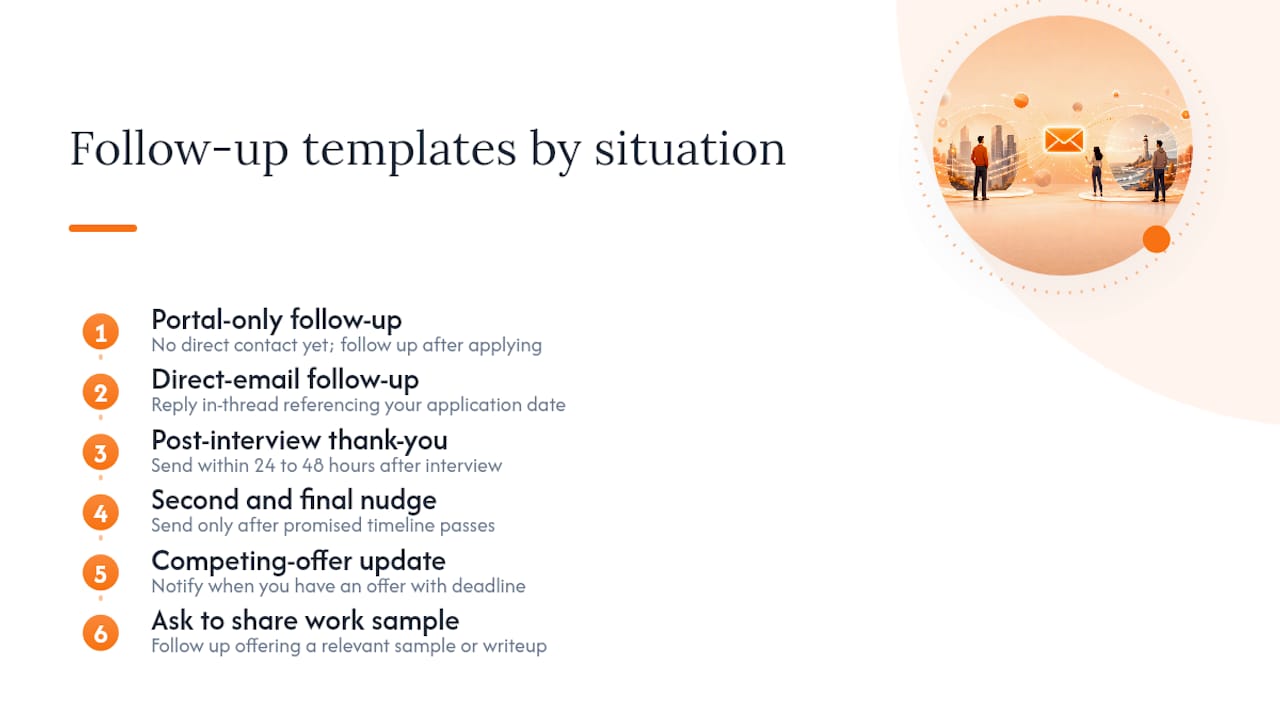
Portal-only follow-up (no direct contact yet)
Subject: Following Up, [Role Title] Application
Hi [Hiring Manager or Recruiter Name], I applied for the [Role Title] position on [Date] through your careers page. Since applying, I [one new proof point, e.g., "completed a CompTIA Security+ certification"]. Is there a timeline for next steps? Happy to provide any additional information.
Direct-email follow-up (replying in-thread)
Subject: Re: [Original Subject Line]
Hi [Name], wanted to follow up on my application for [Role Title], submitted [Date]. Since then, I [proof point]. Would you be able to share where things stand? Thanks for your time.
Post-interview thank-you (send within 24 to 48 hours)
Subject: Thank You, [Role Title] Interview
Hi [Name], thank you for the conversation about the [Role Title] role on [Date]. I enjoyed hearing about [one specific detail from the meeting, e.g., "the migration project you mentioned"], and it reinforced why I'd be a strong fit. Looking forward to next steps.
Second and final nudge (only after a promised timeline passes)
Subject: Re: [Original Subject Line]
Hi [Name], following up since you mentioned hearing back by [promised date]. No pressure, just wanted to check whether there's an updated timeline. Happy to answer any remaining questions.
Follow-up when you have a competing offer
Subject: Timeline Update, [Role Title] Application
Hi [Name], I wanted to let you know I've received an offer from another company with a response deadline of [date]. [Company Name] is genuinely my top choice, and I'd love to know if there's any flexibility to move faster on next steps.
Ask to share a work sample
Subject: Additional Info, [Role Title] Application
Hi [Name], following up on my application from [Date]. I put together a short writeup of a recent [project type, e.g., "incident response exercise"] that's relevant to this role, happy to send it if useful.
For readers building out multiple applications at once, the cold email templates built for recruiters walk through subject-line variations that work well for technical roles specifically. If drafting from scratch feels slow, AI email drafting tools can help you generate a first pass, though the proof point and personalization still need to come from you.
How Do You Handle Follow-Ups at Different Hiring Stages?
Timing and tone shift depending on where you are in the process.
- Right after an interview: send a thank-you within 24 to 48 hours. Skip the status check entirely at this stage. Instead, reference one specific moment from the conversation using a one-line version of the STAR format (situation, task, action, result): "The point you raised about reducing alert fatigue on your SOC team is exactly the kind of problem I solved at my last role by tuning detection thresholds."
- If a recruiter promised a timeline: wait until that date passes, then send a short status check that references it directly. "You mentioned hearing back by the 15th, just checking if there's an update" reads as organized, not impatient.
- If you've been ghosted after an interview: send one polite status check 5 to 7 business days after the missed or expired timeline. That's your final touch. Two total contacts after an interview, the thank-you and one status check, is the ceiling. A third message rarely changes anything and can read as pressure.
What Do You Say If You Have a Competing Offer or a Deadline?
An active offer changes the math. You don't need to wait out the standard window.
- Disclose the offer and the deadline. Vague urgency ("I need to know soon") doesn't move anyone. A specific date does.
- State that they're your top choice, if that's genuinely true. Recruiter-sourced guidance on handling competing offers consistently points to this as the detail that prompts employers to accelerate internal decisions.
- Ask for an updated timeline, not a yes or no answer. "Would it be possible to get a decision before [date]?" is easier for them to act on than "please decide now."
- If they can't move faster, accept that and decide. Thank them for their time and make your choice based on your own priorities. Chasing a company past its own process rarely ends well, even if you land the job.
Pre-Send Checklist and Common Mistakes to Avoid
Run through this before you hit send:
- Confirm the recipient's name and email are correct and current.
- Confirm the role title and application date match your records exactly.
- Confirm you've added one new proof point, not a restatement of your resume.
- Confirm your subject line is specific, not "Following Up" with nothing else.
- Confirm your email is 50 to 75 words.
- Confirm you're replying in the original thread if one exists, rather than starting a new one.
- Confirm you haven't reattached an unchanged resume.
The most common mistakes are predictable: a vague subject line, an opening sentence that says only "just checking in," reaching out through three channels in the same week, and stuffing the email with multiple asks instead of one. Any of these can turn a reasonable follow-up into one that gets skipped.
Pro Tip: If you don't hear back after your one allowed follow-up, stop. Silence after two touches is information, not an invitation to try harder. Move that energy toward the next application instead.
What Recruiters Actually Notice in a Follow-Up
Recruiters skim fast. When a follow-up email lands, three things get checked in order: does it reference the right role and date, is the subject line clear enough to place immediately, and is there a measurable proof point worth flagging to the hiring manager.
Requisition IDs matter more than most candidates realize. If your original application confirmation included a req number, include it again in your follow-up. It gives a human reviewer, or the applicant tracking system's search function, a direct way to pull your file instead of hunting through hundreds of similar submissions. Replying in the same thread does similar work: it keeps your context attached instead of forcing someone to reconstruct who you are from scratch.
Compare that to "I have strong experience with security operations," which says nothing they can act on.
A follow-up that gives a reviewer one new, verifiable fact does more than five follow-ups that just repeat interest. Context and a number beat persistence every time.
Pro Tip: Keep a running list of your last three measurable wins updated monthly. When a follow-up email is due, you'll always have a fresh proof point ready instead of scrambling to think of one.
A Recruiter's View on Treating Follow-Ups as a System
Most candidates treat each follow-up email as a one-off, written in a panic the night before they plan to send it. That's backwards. A follow-up is a pipeline action, the same as submitting the application itself, and it deserves the same tracking.
Log every application with the date sent, the follow-up date due, and whether you heard back. Reuse your templates, but change one company-specific detail each time: a recent product launch, a news mention, a shared connection. That's the only variable that needs real customization.
Silence after your one allowed follow-up is data, not a mystery to solve. If a company doesn't respond after two total touches, that tells you where your odds actually stand. Reallocating that time toward warmer leads, rather than a third or fourth message into the void, is usually the higher-return move.
— Diego
Sources
- How To Write a Follow-Up Email After a Job Application
- Application Follow-Up
- How to Write Follow Up Email After Job Application | PitchHired
- 12 follow-up email templates for every work situation
FAQ
How Do You Write a Follow-Up Email After a Job Application?
Reference the role and the date you applied, add one new proof point about your qualifications, and close with a low-friction ask like requesting a timeline. Keep the whole message under 75 words.
How Do You Politely Ask About Your Application Status?
Ask a specific, small question rather than a vague one, such as "Is there a timeline for next steps?" instead of "Did you make a decision yet?" This gives the recipient an easy way to respond even with a brief answer.
When Should You Follow Up on a Job Application?
Wait 5 to 7 business days after applying directly by email, or 7 to 10 business days if you applied through a portal with no named contact, before sending your first follow-up.
How Many Times Should You Follow Up on an Application?
Cap it at one follow-up per application thread. A second and final nudge is only appropriate if a recruiter promised a specific timeline that has since passed.
What Should You Include in a Thank-You Email After an Interview?
Send it within 24 to 48 hours, thank the interviewer for their time, and reference one specific detail from the conversation to show genuine engagement rather than a generic template.