
What actually gets hiring managers to reply
Getting a response from hiring managers comes down to a few specific behaviors. Generic applications disappear into applicant tracking systems. Direct, personalized outreach does not.
- Send a concise message with a clear ask. According to Hunter.io's 2025 report, cold emails under 150 words with a clear ask double reply rates compared to generic messages.
- Reference something specific: a recent product launch, a team initiative, or a technical challenge the company has publicly discussed.
- State one quantified achievement relevant to the role. "Reduced mean time to detect by 40%" lands differently than "experienced in threat detection."
- Make a low-effort ask that is easy to answer rather than requesting time-consuming actions.
- Apply through official channels first, then send your direct message shortly after. Referencing your official application in the outreach adds credibility.
- Use a custom-domain email address. Hunter.io's 2025 report found that using a custom-domain sender achieves 108% higher reply rates than free email providers.
- Send your resume as a linked PDF, not an attachment. Attachments increase spam filter risk.
- Follow up once, shortly after your initial message, with one new piece of information.
- Respect explicit "no contact" instructions in job postings. Ignoring them risks disqualification.
- Focus the message on technical fit and team alignment, not on logistics or process questions.
Table of Contents
- How to craft follow-up messages that actually get read
- What IT and cybersecurity hiring managers actually care about
- Where to find IT and cybersecurity hiring managers
- Communication templates for IT and cybersecurity hiring managers
- How professional networks produce hiring manager introductions
- Key Takeaways
- Plucktalent connects you directly with the hiring managers who matter
- FAQ
How to craft follow-up messages that actually get read
A follow-up is not a reminder that you exist. It is a second opportunity to demonstrate relevance.
- Send the first follow-up 3–7 business days after the initial message if no response arrives.
- Keep it under 150 words. Shorter is better.
- Add one new piece of value: a relevant certification completed, a published article, or a specific insight about the team's current project.
- Reference your original message or application to maintain context. One line is enough.
- Use a low-friction close: "Happy to send more detail if useful" or "Worth a quick chat?"
- Limit total follow-ups to one after the initial message. Additional follow-ups tend to have diminishing returns.
- Send resumes as linked PDFs rather than attachments to protect deliverability.
- Include a professional sign-off with your phone number, email, and a LinkedIn profile link.
- Avoid weekend or late-night sends. Midweek mornings perform best.
Pro Tip: Time outreach in early to mid-morning on midweek days in the hiring manager's timezone, as this tends to reduce inbox competition and improve engagement.
What IT and cybersecurity hiring managers actually care about
Understanding the role of an IT hiring manager changes how you write every message.
Hiring managers in IT and cybersecurity are typically engineering managers, directors, or product VPs. They are focused on one question: can this person solve the team's technical problems and work well with the existing group? Recruiters handle volume and logistics. Hiring managers make the actual call.
- They assess technical skills, team fit, and project alignment, not application completeness.
- They review dozens of candidates with limited time between their regular responsibilities.
- They respond best to candidates who name specific tools, frameworks, or challenges relevant to the team.
- Acknowledging their schedule in a follow-up ("I know you're managing a full pipeline") signals professionalism.
- For remote roles, asynchronous communication quality matters. Sending messages at inappropriate times or appearing aggressive can harm candidacy before any conversation starts.
- AI tools and specialized platforms can identify which hiring managers are actively hiring and signal the best outreach moments.
Messages to hiring managers should feel relational and reference specific technical details, not just restate the resume. That distinction separates candidates who get replies from those who do not.
Where to find IT and cybersecurity hiring managers

Finding the right person is the first step. Several channels work reliably.
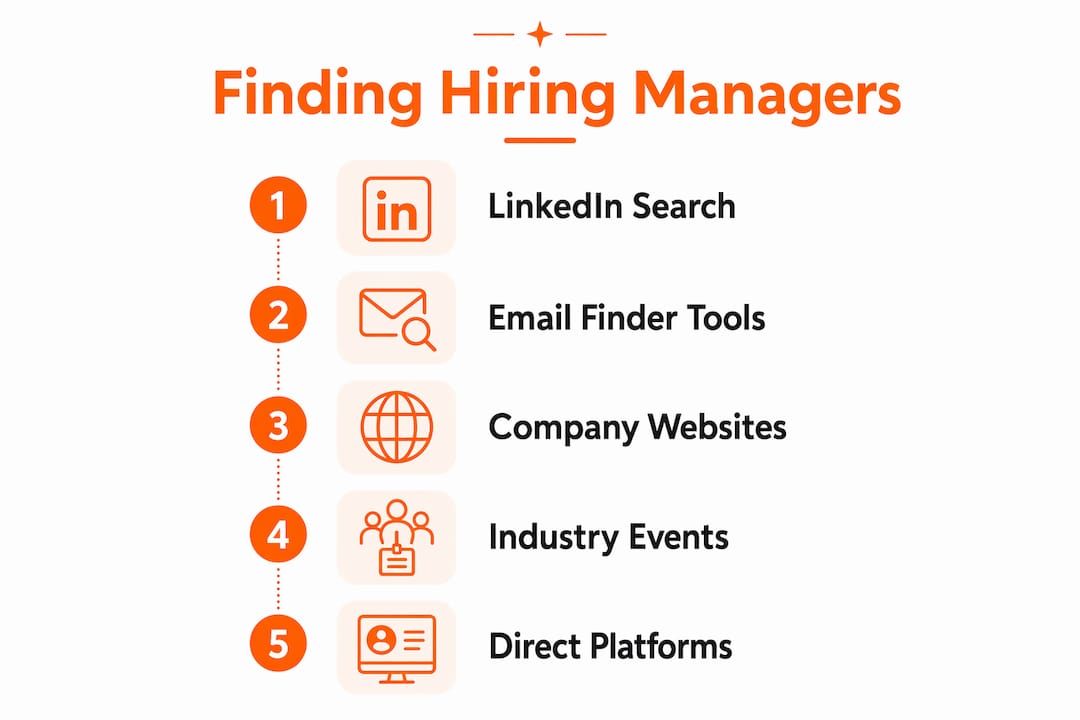
LinkedIn is the most consistent starting point. Use the People tab to search by title within a target company. Engineering Manager, Director of Security Operations, and VP of Infrastructure are common hiring manager titles for IT and cybersecurity roles. Some hiring managers post directly about open roles. Searching the company name plus "hiring" in the Posts filter often surfaces the right person.
Email finder tools such as Hunter.io, Apollo, and Snov.io locate verified work emails using company domains. Most companies follow a standard format (firstname.lastname@company.com). Hunter.io also offers a free email verifier to confirm an address before sending, which protects sender reputation.
Company websites often list team pages under /about, /team, or /leadership. Press releases and blog bylines at the right seniority level can also surface names and sometimes direct contact information.
Collecting contacts at industry events remains one of the highest-conversion methods. Security conferences such as DEF CON, Black Hat, and RSA Conference put hiring managers in the same room as candidates. A brief, relevant conversation at an event creates a warm introduction that no cold email can replicate.
Plucktalent connects IT and cybersecurity professionals directly with verified hiring managers at companies actively seeking their specific skills, bypassing the need to manually search and verify contacts.
Communication templates for IT and cybersecurity hiring managers
These templates are starting points. Personalize every bracketed field before sending.
Initial outreach after applying:
Subject: [Role] | [One Metric] | [Your Name]
Hi [Name],
I applied for the [Role] position and wanted to reach out directly. In my last role at [Company], I [specific achievement, e.g., reduced incident response time by 35%], which maps closely to what your team is working on with [specific project or initiative].
I have attached my resume (LastName_Role.pdf) and would welcome a brief conversation if the timing works.
[Name] | [Phone] | [LinkedIn]
Follow-up message (sent 3–7 business days later):
Hi [Name],
Following up on my note from [date]. I recently [new development, e.g., completed my CISSP renewal / published a write-up on zero-trust architecture] that may be relevant to your team's current priorities.
Worth a quick reply?
[Name] | [Phone] | [LinkedIn]
Both templates stay under 150 words, include one concrete achievement, and close with a low-effort ask. They do not ask the hiring manager to review a resume or provide feedback, which adds workload and reduces positive replies.
How professional networks produce hiring manager introductions
A warm introduction from a mutual contact converts at a significantly higher rate than any cold outreach. Building that network is a deliberate process.
Start with former colleagues. IT and cybersecurity professionals who have worked at target companies are the most direct path to an introduction. A brief message asking whether they know the hiring manager for a specific role is low-effort and often effective.
LinkedIn connections at the second-degree level are the next layer. When a mutual connection exists, a short message asking for an introduction is appropriate. Keep it specific: name the role, the company, and one reason the introduction makes sense.
Industry communities matter. Participating in forums such as ISACA chapters, (ISC)² local groups, or Slack communities focused on cloud security and DevSecOps puts professionals in contact with hiring managers who are active in those spaces. Contribution, not just membership, builds visibility.
Cold outreach job search strategies work when no warm path exists. Referencing a shared interest, a published article, or a conference session the hiring manager participated in creates a relevant opening without requiring a mutual contact.
When a hiring manager redirects outreach to HR or the application portal, that is still a productive outcome. Mentioning "[Hiring Manager Name] suggested I apply" in the application flags it for attention within the process.
Key Takeaways
Direct, personalized outreach under 150 words with a specific ask and correct timing is the most reliable method to get a response from hiring managers in IT and cybersecurity.
| Point | Details |
|---|---|
| Message length and specificity | Keep outreach under 150 words; reference a specific role detail or company project. Hunter.io's 2025 report showed this approach doubles reply rates compared to generic messages. |
| Timing | Send initial messages within 24–48 hours of applying; follow up once after 3–7 business days, midweek mornings preferred. |
| Low-effort asks | Ask "Worth a quick reply?" rather than requesting a resume review, which reduces positive responses. |
| Plucktalent | Connects IT and cybersecurity professionals directly with verified hiring managers, bypassing generic job board applications. |
Plucktalent connects you directly with the hiring managers who matter
Generic job boards put applications into a queue that hiring managers rarely see. Plucktalent takes a different approach: 17 years of IT and cybersecurity recruiting expertise, combined with Plucky AI, identifies hiring managers who are actively seeking candidates with your specific skills and connects you directly.
The platform produces ATS-ready, strategically tailored profiles and handles the outreach infrastructure that most candidates spend hours managing manually. For IT and cybersecurity professionals who want to stop sending applications into a void, Plucktalent is the direct path to the decision-makers. Visit Plucktalent's job seekers page to see how the platform works for your specific skill set.
FAQ
How soon should you email a hiring manager after applying?
Send your initial message within 24–48 hours of submitting the official application. This timing connects your direct outreach to a record the hiring manager can verify.
How many follow-ups should you send to a hiring manager?
Limit follow-ups to one message sent 3–7 business days after the initial outreach. A second follow-up drops response rates significantly; after two unanswered messages, move on.
What is the best time to email a hiring manager?
Send emails between 6–9 AM Tuesday or Wednesday in the recipient's timezone. This window has the lowest inbox competition and the highest open and reply rates.
How is emailing a hiring manager different from emailing a recruiter?
Hiring managers focus on technical fit and team alignment; recruiters manage logistics and volume. Messages to hiring managers should reference specific skills, tools, or project details rather than application status.
Can Plucktalent help you connect with hiring managers directly?
Plucktalent matches IT and cybersecurity professionals with verified hiring managers at companies actively hiring for their skills, bypassing the generic application process that buries most candidates in ATS filters.