
Expect to pay roughly 25% to 35% of a placed executive's first-year cash compensation for a retained search, and about 20% to 30% for contingency, usually calculated against base salary only. Retained search fits C-suite, confidential, or business-critical roles where depth of candidate mapping matters more than speed. Contingency works better for mid-level or high-volume hiring. The single biggest swing factor in your final invoice isn't the percentage quoted. It's how the firm defines "total compensation."
TL;DR:
- Fees are heavily influenced by how firms define total compensation, with minimum fees sometimes exceeding the headline percentage and increasing overall costs.
- Executive search fees are paid in installments based on milestones, with replacement guarantees typically covering six to twelve months, depending on contract terms.
- The cost of vacancy and potential mis-hire risks can justify the search fee if the role is high-impact and requires confidentiality or specialized expertise.
- Negotiation should focus on clear definitions of total compensation, expense caps, guarantee scope, and cancellation policies, rather than just the percentage fee.
- Using AI-assisted, niche recruiting firms can accelerate senior IT and cybersecurity hires, especially when open posting and broad candidate pools make traditional methods slow and costly.
Table of Contents
- What Are the Different Executive Search Fee Models?
- How Much Do Executive Search Firms Charge by Role Level?
- What Does the Search Fee Actually Cover?
- How Do Billing Schedules and Replacement Guarantees Work?
- What Drives Executive Search Fees Up or Down?
- How Do You Justify the Fee Against Cost of Vacancy?
- What Should You Require Before Signing an Executive Search Contract?
- Where This Guidance Comes From
- The Fee Conversation HR Keeps Getting Wrong
- Get Senior IT and Cybersecurity Roles Filled Without the Fee Guesswork
- Sources
- FAQ
What Are the Different Executive Search Fee Models?
Executive search firms don't all charge the same way, and the model you pick changes both the price and the process. Retained search means you pay a firm exclusively, in staged installments, for a dedicated effort that includes market mapping and confidential outreach to passive candidates who aren't applying anywhere. You're paying for depth and discretion, and you commit before you see a single resume.
Contingency search flips that arrangement. You typically engage multiple firms at once, and only the one that lands a hire gets paid. That structure rewards speed over depth, since recruiters are racing each other rather than digging deep into a narrow, hard-to-reach market. It works well for roles where qualified candidates are plentiful and confidentiality isn't a concern.
Two middle paths exist. Engaged or flat-fee search charges a fixed price regardless of final compensation, removing the incentive to inflate an offer to boost a percentage-based fee. Hybrid models combine elements of retainer and success fees, spreading risk between firm and client.
- C-suite or VP roles: retained search, given confidentiality needs and the cost of a wrong hire
- Functional or mid-level leadership: contingency or hybrid, where speed and lower cost matter more
- **High-volume leadership hiring
** (multiple similar roles): flat-fee or negotiated hybrid pricing to control aggregate spend
The contingency versus retained comparison matters most at the VP tier, where either model can plausibly work and the fee delta is largest.
How Much Do Executive Search Firms Charge by Role Level?
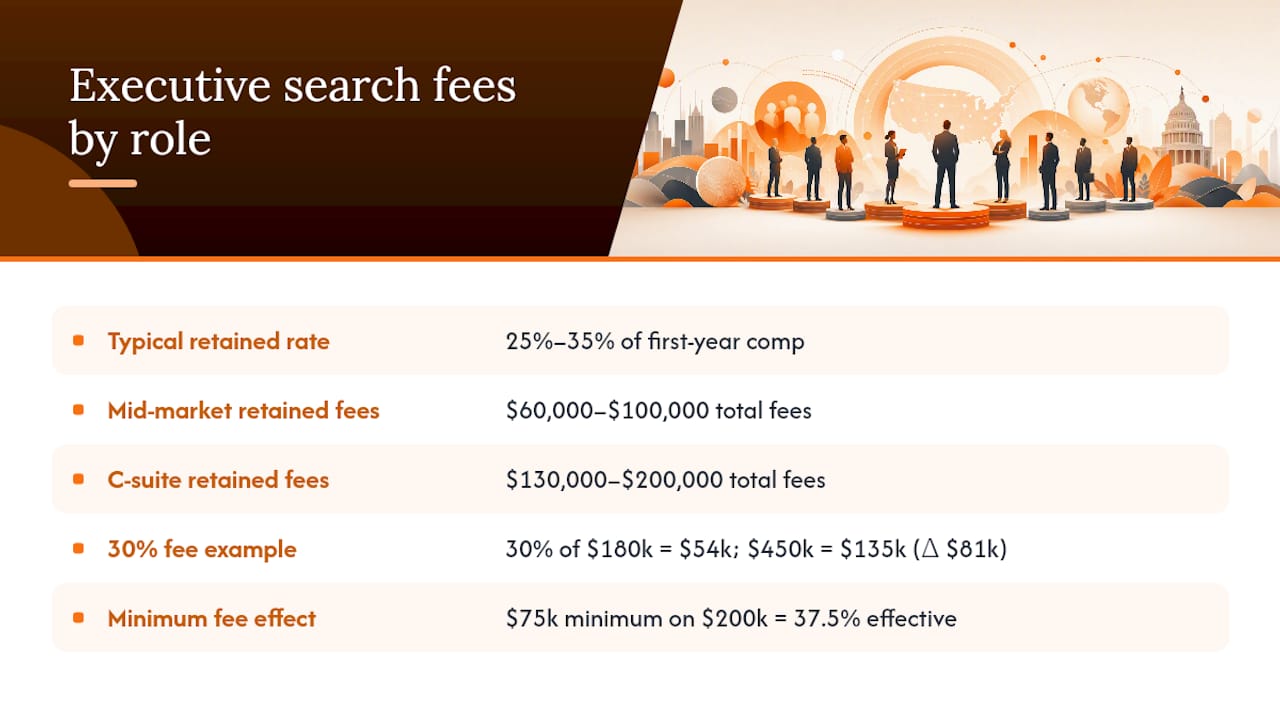
Retained fees typically land at 25% to 35% of first-year total compensation, and mid-market retained searches often fall between $60,000 and $100,000 in total fees. C-suite searches commonly run higher.
Pro Tip: Before you accept a quoted percentage, ask what dollar figure it converts to at the compensation level you're actually targeting. A 30% fee sounds identical on a $180,000 VP role and a $450,000 CEO role, but the invoice difference is over $80,000.
C-suite retained searches often land between $130,000 and $200,000 in total fee, which tracks with the table above once you apply a 30% to 35% rate to a six-figure comp package.
Minimum fees complicate mid-market math. A firm quoting a $75,000 minimum on a $200,000 role is effectively charging 37.5%, not the 30% headline rate advertised in the proposal. Always divide the minimum by the actual expected comp, not the other way around.
Reconciliation surprises happen when "total compensation" grows after signing. If a candidate negotiates a signing bonus or richer equity grant post-offer, and your contract defines total compensation broadly, your invoice grows with it. Get the components of a compensation package defined in writing before the search starts, not after an offer letter goes out.
What Does the Search Fee Actually Cover?
The professional fee pays for the core search work: market mapping, confidential candidate outreach, screening and assessment, reference checks, and coordination through offer and start date. What it usually does not cover catches HR teams off guard.
- Candidate and consultant travel for interviews
- Third-party psychometric or skills assessment tools
- Background check and credential verification services
- Job advertising or sourcing platform costs
- Administrative or research surcharges layered on top of the base fee
Administrative fees can add 10% to 12% on top of the professional fee at some firms, covering research and mapping labor that firms consider separate from the placement fee itself. Ask for a full cost breakdown in writing before signing anything.
Push for engagement-letter language that spells out a total-cost breakdown with a hard expense cap, ideally requiring your pre-approval for anything beyond a modest threshold. A proposal that bundles "expenses as incurred" with no cap is a red flag. So is a research or admin fee described only as "customary" without a number attached.
How Do Billing Schedules and Replacement Guarantees Work?
Most retained firms bill in three installments tied to milestones rather than time. The common structure looks like this:
- Engagement fee (roughly one-third), due when you sign and the search kicks off
- Shortlist fee (roughly one-third), due when the firm delivers a qualified slate of candidates
- Placement fee (roughly one-third), due when the candidate accepts and starts
Replacement guarantees typically run six to twelve months, covering a free replacement search if the hire leaves or is terminated within that window. Read the guarantee's scope carefully. Some cover voluntary departure only; others exclude terminations for cause or performance.
Cancellation clauses deserve equal scrutiny. Many contracts include post-termination hiring language that obligates you to pay a fee if you hire any candidate the firm introduced, even months after you cancel the search. Negotiate a defined lookback window (90 to 180 days is common) rather than an open-ended obligation, and ask for prorated refunds on any milestone fee tied to work not yet performed.
What Drives Executive Search Fees Up or Down?
Fee percentages aren't arbitrary. Several concrete factors push them higher.
- Role seniority and complexity: the more strategic the position, the deeper and slower the search
- Candidate scarcity: niche technical or regulatory expertise, especially in cybersecurity leadership, shrinks the eligible pool and raises price
- Confidentiality requirements: replacing an incumbent quietly costs more than an openly posted search
- Urgency: compressed timelines require more recruiter hours in a shorter window
- Industry and market conditions: competitive talent markets push firms to charge premiums for guaranteed focus
Specialized expertise in technical fields improves access to passive candidates who never apply anywhere, which is part of why niche search firms charge a premium over generalists.
You have real negotiation room, even on percentage-based deals. Limit the fee basis to base salary plus target bonus rather than total compensation including equity and signing bonuses. Cap administrative and research fees at a fixed dollar amount instead of leaving them open-ended. Require pre-approval on any expense over a set threshold. If you're running multiple searches in a year, ask for a bundled rate across the engagements.
Pro Tip: Insist on a written reconciliation clause: a single paragraph defining exactly what counts as total compensation, so nobody argues about equity or bonuses after an offer is accepted. Negotiation research shows firms give ground on expense handling and fee-base definitions far more readily than on headline percentage.
Watch for two warning signs in any proposal: an ambiguous or missing definition of compensation, and aggressive post-hire clauses that extend your liability well past the search's active window.
How Do You Justify the Fee Against Cost of Vacancy?
A retained search fee looks large in isolation. It looks different next to what an empty leadership seat actually costs your organization.
- Calculate the vacancy cost: multiply the role's monthly fully-loaded value (salary, lost productivity, delayed initiatives) by expected months vacant
- Compare against the quoted fee: a $90,000 retained fee on a VP role that would otherwise sit empty for four to six months, delaying a $2 million initiative, is a rounding error against the opportunity cost
- Weigh mis-hire risk: a failed executive hire costs far more than the search fee once severance, re-search, and lost momentum are counted
Department of Labor cost-of-hire guidance supports using vacancy and mis-hire multipliers when evaluating whether retained spend is justified for high-impact roles, and that framing translates directly into board or finance conversations. When you present the case internally, don't lead with the fee percentage. Lead with the monthly cost of the empty chair and the downside of getting the hire wrong, then show the fee as insurance against both.
Retained search delivers the clearest ROI on roles where a bad hire is expensive to unwind and confidentiality rules out an open posting. For roles with a deep, visible talent pool and low mis-hire risk, contingency or internal sourcing usually wins on cost.
What Should You Require Before Signing an Executive Search Contract?
Before signing any engagement letter, get these items spelled out in writing, not implied verbally by a sales contact.
- Written definition of total compensation — base only, base plus bonus, or inclusive of equity and signing bonus
- Expense cap with a pre-approval threshold for anything above it
- Guarantee scope — what triggers a free replacement, and what's explicitly excluded
- Post-termination hiring terms — a defined lookback window, not an open-ended obligation
- Cancellation and proration policy for fees tied to unfinished milestones
Operationally, confirm who the lead consultant is, how often you'll get status updates, who owns candidate relationships if the search ends early, and what the realistic timetable looks like for shortlist delivery. Put all of it into the statement of work, not a side email, before the first invoice arrives.
Where This Guidance Comes From
This guide draws on Plucktalent's recruiting experience across 17 years of placing IT and cybersecurity talent, combined with Plucky AI's data on how compensation and role scope shift search pricing. For deeper context on choosing a pricing model, see the contingency versus retained comparison and the practical guide to hiring senior IT professionals, both of which back the contract language recommended above.
The Fee Conversation HR Keeps Getting Wrong
Most guidance on executive search fees treats the percentage as the whole story. It isn't. Two firms can both quote 30%, and one invoice comes in $40,000 higher because of how it defines total compensation, not because the work differs. HR teams that focus their negotiation energy on shaving a percentage point off the headline rate are optimizing the wrong variable.
The bigger risk sits in the contract mechanics: undefined compensation bases, open-ended post-termination clauses, and admin fees quoted as "customary" rather than capped in dollars. Those cost more, more often, than the base percentage ever does.
If you take one thing from this guide, make it this: treat the engagement letter like a procurement document, not a handshake. Demand the total-cost breakdown, the guarantee scope, and the lookback window in writing before you sign. For technical leadership roles, especially in cybersecurity where candidate scarcity is real, that discipline matters more than finding the lowest quoted percentage.
— Diego
Get Senior IT and Cybersecurity Roles Filled Without the Fee Guesswork
Some recruiting firms offer employers faster access to qualified senior IT and cybersecurity candidates by combining specialized recruiting experience with AI tools designed to narrow the candidate pool to those who actually match the role rather than casting a broad contingency net.

Rather than juggling multiple contingency firms racing each other on the same requisition, you work with recruiters who already know the cybersecurity and IT talent pool and can move a shortlist faster because they aren't starting from a cold search. That matters most on roles where the wrong hire costs six figures in lost time and re-search fees. Teams that also want faster first-round screening can pair a search with video interviewing tools like Facecruit to compress the shortlist-to-offer window even further.
Visit Plucktalent to request a proposal for your next senior IT or cybersecurity search and get a clear fee structure before you commit to anything.
Sources
- Executive Search Fees: What Do Firms Actually Charge? (PRL International)
- Executive Recruiting Cost: 5 Fee Drivers in 2026 (Frontline Source Group)
- What Executive Search Actually Costs in 2026 (ExactSearch)
- U.S. Department of Labor (DOL)
FAQ
What are the typical fees charged by executive search firms?
Retained firms typically charge 25% to 35% of first-year total compensation, while contingency firms charge roughly 20% to 30%, usually calculated against base salary only.
What is the hardest job to recruit for?
Highly specialized technical and cybersecurity leadership roles, such as CISOs or niche cloud architects, tend to be hardest to fill because qualified passive candidates rarely apply through open postings and require targeted outreach.
Who are the big executive search firms?
The executive search market includes several large global firms alongside specialized boutique firms focused on specific industries like technology and cybersecurity, where deep sector expertise often matters more than firm size.
How much does a typical retained executive search cost in total dollars?
Mid-market retained searches often total $60,000 to $100,000, while C-suite searches commonly range from $130,000 to $200,000 or more depending on compensation level.