
Five levers move the needle on IT hiring speed: lock intake and comp band before the req posts, enforce hiring-manager SLAs, run interview stages in parallel instead of sequentially, automate scheduling with real-time interviewer sync, and pre-clear offer bands so background checks run alongside final interviews, not after. Teams that attack these bottlenecks report cutting a substantial number of days off a typical technical hiring cycle, largely by fixing human handoffs rather than buying new software.
Industry benchmarks put average time-to-hire around 40 to 45 days for many roles; optimized non-executive tech hiring can land closer to 25 to 32 days once these levers are running.
None of this works if speed replaces judgment. The goal is removing dead calendar time, not evaluation steps. Cutting a technical assessment to save two days almost always costs more than two days later, in a bad hire or a rejected offer.
- Lock intake and comp band in one meeting, before the job posts
- Enforce a prompt feedback SLA on every hiring manager
- Parallelize compatible interview stages when possible instead of stacking them sequentially
- Automate scheduling with self-service booking and interviewer sync
- Pre-clear offer approval and run background checks during final interviews
Key Takeaways
Cutting IT hiring time to 25 to 32 days requires locking intake and comp bands early, enforcing feedback SLAs, and running interview stages in parallel rather than sequentially.
| Point | Details |
|---|---|
| Lock intake first | Sign the comp band and must-have list in a 90-minute kickoff before the job posts. |
| Enforce feedback SLAs | Require hiring-manager feedback within 24 to 48 hours, with an escalation path for misses. |
| Parallelize compatible stages | Run the technical screen and culture-fit conversation the same week, not sequential weeks. |
| Pre-clear offers | Get finance approval on comp bands early and start background checks before the written offer. |
| Plucktalent accelerates both sides | Recruiting services help employers hire IT talent faster, while Plucky AI speeds candidates into vetted pipelines. |
Table of Contents
- Steps to Reduce IT Hiring Time in Your Next Open Role
- How to Execute Each High-Leverage Hiring Step
- What to Measure to Prove and Improve Your Timeline
- Where the Extra Days Actually Hide
- A 30/60/90-Day Plan to Roll This Out
- Why This Playbook Comes From Real Technical Recruiting
- The Real Bottleneck Is Ownership, Not Tooling
- Move Faster on Your Next IT Hire With Plucktalent
- Sources
- FAQ
Steps to Reduce IT Hiring Time in Your Next Open Role
Copy this into your next requisition kickoff. Each action has an owner, because unassigned tasks are the single biggest reason good intentions never turn into faster hires.
Days 0 to 7:
- Hold a 90-minute intake meeting with the hiring manager and lock the must-have list, nice-to-haves, and comp band in writing. (Owner: recruiter)
- Post the job description with a stated salary range and a realistic must-have list, not an aspirational one. (Owner: hiring manager)
- Set recurring interview windows on the hiring manager's and panel's calendars for the next three weeks. (Owner: coordinator)
- Turn on candidate self-scheduling links for the first-round screen. (Owner: recruiter)
Days 7 to 30:
- Re-engage silver-medalist candidates from the last two similar searches before sourcing cold. (Owner: recruiter)
- Pilot parallel staging on one open req: run the technical screen and the culture-fit conversation in the same week instead of back-to-back. (Owner: hiring manager)
- Start a weekly SLA report showing days-in-stage for every open candidate. (Owner: TA operations or HR)
- Get comp bands pre-approved with finance so offers do not stall at the finish line. (Owner: HR/finance)
How to Execute Each High-Leverage Hiring Step
Knowing the five levers matters less than knowing how to run them on a live req. Here is what each one looks like in practice, stage by stage.
Fix intake before you touch sourcing
Most time-to-hire problems start at intake, not sourcing. A vague job description forces recruiters to guess at fit, which means more resumes screened, more rejected interviews, and more restarts. SigmaCGI's practitioner research found that the biggest predictor of a fast, high-quality hire is how quickly the team gets to a meaningful evaluation signal, and that starts with a sharp intake.

Run a 90-minute kickoff with three outcomes: a ranked must-have list (five items or fewer), a signed comp band, and two or three sample resumes the hiring manager scores live. That last step matters more than it sounds. When a hiring manager scores real resumes in the room, disagreements about "what good looks like" surface immediately, instead of three weeks later when the fourth candidate gets rejected for a reason nobody wrote down.
Pro Tip: Ask the hiring manager to rank their must-haves against their nice-to-haves out loud, in the meeting. If they cannot rank them in under two minutes, the role is not scoped tightly enough to post yet.
A tightly scoped job description that states the compensation range also filters out mismatched applicants before they ever apply, which shrinks the screening pile without shrinking the candidate pool that matters.
Build a bench before you need one
Sourcing from zero every time a req opens is the slowest possible starting point. Maintain a lightweight CRM of silver-medalist candidates: people who made it to final rounds on past searches but lost to another candidate or timing. Re-engage them first on any new opening in the same skill family.
- Tag every rejected finalist with the skill stack and the reason they did not get the offer
- Reach out to silver-medalist candidates within 48 hours of opening a comparable req
- Ask every new hire for two referrals in their first 30 days, when goodwill is highest
- Track referral-to-hire conversion separately, since referred candidates typically move faster through screens
Employee referrals deserve special attention here because referred candidates arrive with a built-in credibility signal. A referring engineer has effectively pre-screened their friend's technical competence and work style, which often lets you compress or skip a screening step you would otherwise run cold.
Automate scheduling, but protect the calendar first
Scheduling coordination quietly eats more recruiter time than almost any other task, and InCruiter's analysis identifies interview scheduling and the debrief-to-offer gap as the two biggest sources of elapsed calendar days in most pipelines. The fix is not just a booking tool. It is a booking tool paired with protected interviewer time.

Set standing weekly interview windows for every panelist, two or three hours, same time each week, blocked on their calendar before any req opens. Layer candidate self-scheduling on top of that block. Automated scheduling without pre-set windows just moves the friction from the recruiter's inbox to a different bottleneck: panelists who "don't have availability" because nothing was reserved in advance.
Collapse interview stages without collapsing rigor
Running four sequential 45-minute interviews across four separate weeks is the single most common source of avoidable delay in technical hiring. Parallel staging fixes this by running compatible stages in the same week, sometimes the same day.
Good candidates for parallelizing: the technical screen and the culture or team-fit conversation. Bad candidates for parallelizing: a technical screen and the final hiring-manager decision meeting, which should happen after every scorecard is in, not before. The rule is simple, parallelize stages that gather independent signal, never stages where one result should inform the next.
Replacing a ceremonial recruiter-only phone screen with a 45-minute pairing session where the hiring manager participates directly also removes an entire redundant round for many technical roles, since it produces a stronger signal in less total time than two separate lower-signal conversations.
Pre-clear offers so the finish line does not stall
The offer stage is where deals die from delay, not from disagreement. SigmaCGI's field data shows that pre-cleared offer envelopes and front-loaded comp approvals turn a typical 5 to 8 day wait into a 24 to 48 hour issuance window. Get finance sign-off on a comp band during intake, not after a final-round interview, and start background and reference checks the moment a candidate reaches the final round, not after a verbal offer is accepted.
What to Measure to Prove and Improve Your Timeline
You cannot compress what you do not track. Stage-level metrics reveal where days actually disappear, and that is almost never where teams assume.
Track days spent in each stage: application to review, review to first interview, final interview to offer, and offer to signed acceptance. SHRM's benchmarking data gives useful median reference points for time-to-fill and cost-per-hire, though your own stage-by-stage numbers matter more than any external median. Alongside timing, watch four conversion rates: applied to screen, screen to interview, interview to offer, and offer to accept. A weak applied-to-screen rate points to a sourcing or JD problem. A weak interview-to-offer rate points to a scoping or calibration problem.
| Stage | Target days | What a slow number usually means |
|---|---|---|
| Application to review | 1 to 2 | Recruiter capacity or unclear intake criteria |
| Review to first interview | 3 to 5 | Scheduling friction or panelist availability |
| Final interview to offer | 1 to 2 | Missing SLA on hiring-manager feedback |
| Offer to signed acceptance | 1 to 3 | Comp band not pre-cleared with finance |
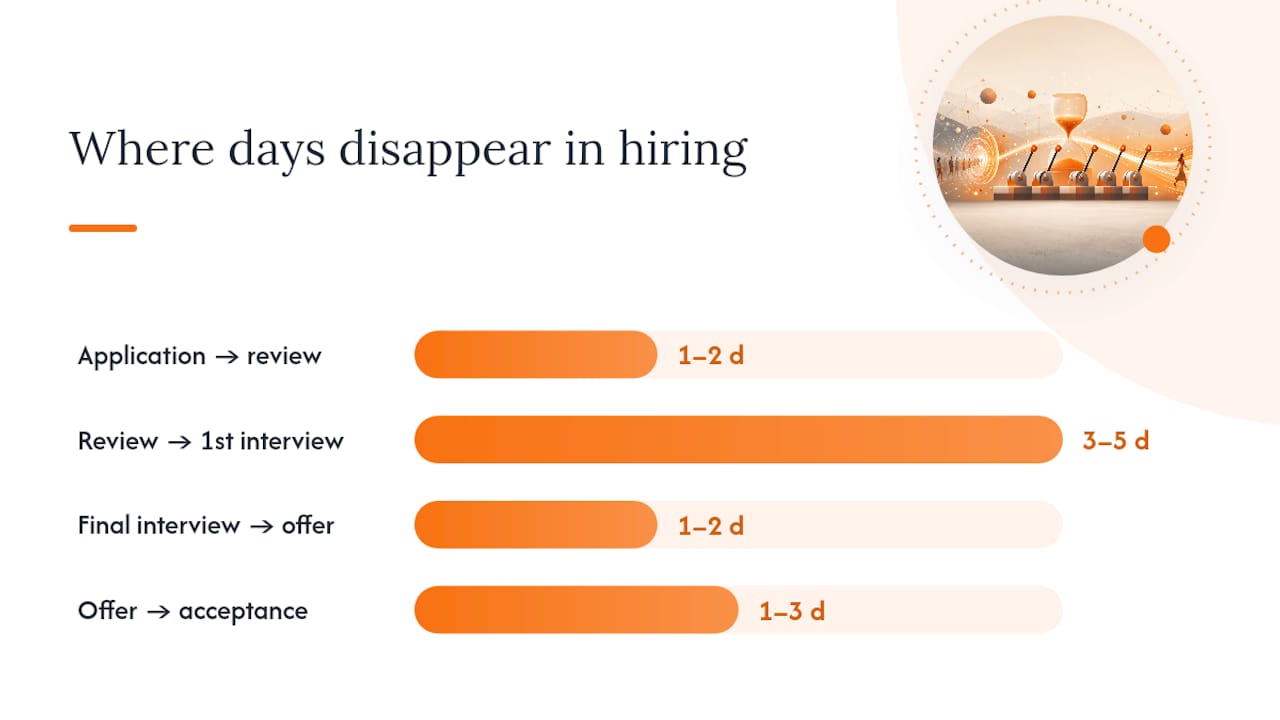
Run this as a weekly dashboard, not a monthly retrospective. Prepzo's operational research recommends a 14-day SLA template with 24 to 48 hour feedback windows built in, which gives you an early warning the moment a candidate starts aging in a stage rather than discovering it weeks later.
Where the Extra Days Actually Hide
Stage-aging is the quiet killer of hiring timelines. A candidate does not die in the pipeline all at once; they age two days here, three days there, until a role that should take four weeks takes seven.
Watch for these patterns in your weekly report:
- A hiring manager who consistently takes five or more days to submit feedback after an interview
- Interview requests that bounce between three or four proposed times before landing
- Comp approvals that only start after a candidate accepts a verbal offer, not before
- Background checks that begin after the written offer goes out, adding a full extra week at the end
Fix the first two with a hard SLA and an escalation path: if a hiring manager misses the 48-hour feedback window twice in a row, their next req gets a recruiter escalation to their own manager. Fix the last two by moving comp approval and background checks earlier in the process, not by adding software. KORE1's breakdown of lever-by-lever gains shows that intake vagueness, slow manager feedback, calendar coordination, and offer stalls account for most of the recoverable time. Automation helps with calendar coordination. It does nothing for the other three.
A 30/60/90-Day Plan to Roll This Out
- Days 0 to 30: Lock intake meetings on every open req, publish comp bands with the job posting, and set the 48-hour feedback SLA. Success signal: review-to-interview time drops measurably within the first two or three closed reqs.
- Days 30 to 60: Pilot parallel staging on two or three technical reqs and pre-clear offer bands with finance for the whole IT hiring category, not one role at a time.
- Days 60 to 90: Stand up the weekly SLA dashboard across all open reqs, formalize the silver-medalist pipeline, and calibrate hiring managers who are still missing feedback windows.
Pro Tip: Track one number obsessively during rollout: the percentage of interviews where feedback lands inside the SLA window. That single metric predicts your overall timeline better than any other you will track this quarter.
Behavior change is the hard part. A job order management framework with clear stage owners keeps managers accountable after the initial rollout excitement fades.
Why This Playbook Comes From Real Technical Recruiting
Plucktalent has spent 17 years placing IT and cybersecurity talent, which means these levers come from watching thousands of technical searches succeed or stall, not from a generic hiring template applied to every industry.
- Plucky AI, the platform's job search co-pilot, gives Plucktalent visibility into which parts of the hiring pipeline waste candidates' time the most
- Direct hiring manager access on the employer side means fewer handoffs and fewer resumes lost in an applicant tracking queue
- ATS-ready candidate profiles arrive pre-tailored, cutting review time on the employer side before a screen is even scheduled
Technical hiring rarely stalls because the wrong tool is missing. It stalls because nobody owns the handoff between stages, and the candidate ages in a queue while everyone assumes someone else is moving things forward.
Recruiting for engineering, cloud, and security roles surfaces the same pattern across companies of very different sizes: the fastest hires happen where a recruiter has the authority to enforce SLAs, not just report on them.
The Real Bottleneck Is Ownership, Not Tooling
Most advice on hiring speed leans hard on automation, and automation genuinely helps with scheduling. It does almost nothing for the three biggest time sinks: vague intake, slow hiring-manager feedback, and offer-stage stalls that come from comp approval sitting in someone's inbox.
The conventional playbook treats every stage as equally worth optimizing. It is not. A 48-hour feedback SLA enforced with a real escalation path will save more calendar days than any scheduling tool, because it fixes a human accountability gap instead of a logistics gap. If you only have the bandwidth to fix one thing this quarter, fix that one.
The second most overrated fix is adding more interview rounds to "de-risk" a hire. Every extra round is another chance for a candidate to age in the pipeline while a competing offer closes the gap. Parallel staging and a tighter, higher-signal loop beat a longer one almost every time, provided the loop still tests what actually predicts success in the role.
Prioritize intake clarity and SLA enforcement first. Everything else, including scheduling automation, is a multiplier on a process that already works, not a fix for one that doesn't.
Move Faster on Your Next IT Hire With Plucktalent
Plucktalent is built for exactly the gap this playbook targets: the days lost between a role opening and a qualified candidate reaching a hiring manager's inbox. For employers, that means direct-hire, contract, and leadership search support from recruiters who work IT and cybersecurity roles exclusively, so intake conversations start with real technical fluency instead of a generic template.
For candidates, Plucky AI shortens the other side of the same timeline, tailoring profiles to be ATS-ready and surfacing hidden roles directly with hiring managers instead of leaving applications stuck in board noise. If you are hiring, review Plucktalent's employer recruiting services and start a conversation about your open IT requisitions this week. If you are building your own pipeline of pre-vetted candidates, point qualified applicants toward Plucktalent's job seeker platform so your next silver-medalist candidate arrives already screened.
Sources
- How to Hire IT Talent Faster Without Sacrificing Quality | SigmaCGI
- How to Reduce Time to Hire: Strategies That Work | KORE1
- How to Cut Time-to-Hire by 60% Without Lowering… | InCruiter
- How to Reduce Time-to-Hire: 10 Practical Fixes | Prepzo
FAQ
What is the 70/30 rule in hiring?
The 70/30 rule generally refers to spending roughly 70% of interview time listening to the candidate and 30% talking, which keeps evaluation focused on gathering signal rather than selling the role.
What is the 80/20 rule in interviewing?
What is the 30-60-90 day plan in an interview?
It is a candidate's outline of priorities for their first 30, 60, and 90 days in a new role, and hiring managers increasingly ask for one in final rounds to test how a candidate thinks about ramping up. Employers can apply the same structure internally, as outlined in Plucktalent's 30/60/90 rollout plan for shortening hiring cycles.
What is the 3-month rule in a job?
It refers to the common practice of treating the first 90 days as a probationary or evaluation window, where both the employer and new hire assess fit before considering the placement fully settled.