
Use a four-stage, scorecard-driven hiring process that closes within three to four weeks. That single discipline separates searches that land the right person from searches that drag on for months and lose top candidates to faster competitors.
Two market realities make speed and structure non-negotiable right now:
- The BLS projects computer and information technology occupations will grow faster than the average for all occupations, intensifying competition for experienced talent.
- Statista data confirms a persistent global skill shortage in technical roles, meaning the senior candidates you want are already fielding multiple offers.
The sections below unpack every step: defining the role and success profile, setting compensation, sourcing passive candidates, running structured assessments, making offers, and keeping senior hires once they start. Each section includes a reusable template or checklist. Read straight through for the full playbook, or jump to the section most relevant to where your search stands today.
Key Takeaways
Hiring senior IT professionals requires a defined success profile, a calibrated rubric, a four-stage funnel with firm SLAs, and a compensation range validated against current market data before the search opens.
| Point | Details |
|---|---|
| Define success before sourcing | Build a role brief with 90-day outcomes and KPIs before writing the job description. |
| Use a structured rubric | Score every candidate on the same five competencies using behavioral evidence, not impressions. |
| Limit the funnel to four stages | More than four stages increases drop-off without improving hire quality. |
| Set and enforce SLAs | Target a three-to-four-week close; a search that runs past six weeks without an offer needs a diagnosis. |
| Plucktalent for senior searches | Plucktalent's IT-focused recruiting services connect employers with pre-vetted senior candidates faster than general job boards. |
Table of Contents
- What makes a senior IT hire different from every other hire?
- How to define the role and build a success profile
- What does it actually cost to hire a senior IT professional?
- Where do you find senior IT professionals worth hiring?
- How to write a senior IT job description that actually works
- How do you assess a senior IT candidate without wasting their time?
- A structured interview rubric you can use immediately
- What does a senior IT hiring funnel look like?
- How to make an offer a senior candidate will accept
- Onboarding a senior IT hire: the 30/60/90 plan
- Practical tips to close senior candidates faster
- What experienced IT recruiters see hiring managers get wrong
- How Plucktalent supports senior IT searches
- Sources
- FAQ
What makes a senior IT hire different from every other hire?
Senior IT professionals are not simply experienced individual contributors. They are expected to produce operating leverage: outcomes that multiply the output of the teams around them. A mid-level engineer ships features. A senior engineer decides which features are worth shipping, sets the architecture that makes shipping faster for everyone, and mentors the next layer of talent so the team does not depend on any single person.
The business outcomes a senior IT hire must own typically include:
- Architecture direction: Defining the technical roadmap and making design decisions that hold up at scale.
- Outage and risk reduction: Lowering mean time to recovery (MTTR) and reducing the frequency of production incidents.
- Platform stability: Owning uptime targets, SLA commitments, and the engineering practices that protect them.
- Mentorship throughput: Measurably improving the skill level and output of junior and mid-level team members.
- Hiring contribution: Participating in technical screening and raising the average quality of new hires.
- Cross-functional influence: Translating technical constraints into business language for product, finance, and executive stakeholders.
The right KPIs depend on the role type. A senior individual contributor owns technical quality metrics: code review turnaround, architecture decision record (ADR) completion, and time-to-production for complex features. A senior engineering manager owns team velocity, retention within their direct reports, and stakeholder satisfaction scores. A VP or CTO-level executive owns portfolio-level outcomes: total cost of infrastructure, engineering headcount efficiency, and the organization's ability to ship against a product roadmap.
Getting this distinction right before you post the role is the single most important step in the entire search. A job description written for a senior IC that actually needs a senior manager will attract the wrong candidates and waste everyone's time.
How to define the role and build a success profile
A job description is a marketing document. A success profile is a hiring tool. You need both, but most teams only write the first one.
The role brief template
Work through these five questions with your hiring manager and at least one technical validator before writing a single line of the job posting:
- Problem to solve: What specific technical or organizational problem does this hire fix in the next six months?
- Success in 90 days: What does "good" look like at the 30, 60, and 90-day marks? Name deliverables, not behaviors.
- Scope of decision-making: What decisions does this person own outright, and which require sign-off?
- Required domain expertise: Which technical domains are non-negotiable (e.g., AWS at scale, Kubernetes, zero-trust security architecture)?
- Non-negotiable seniority signals: What evidence of seniority must a candidate demonstrate? (Examples: led a migration affecting more than 50 engineers, designed a system handling more than 10 million daily active users, managed a team through a major incident.)
Sample success profile structure
| Element | Example content |
|---|---|
| Role purpose | Own cloud infrastructure reliability and lead a team of six SREs |
| 90-day outcome | Complete infrastructure audit; present remediation roadmap to CTO |
| KPIs | MTTR under 30 minutes; uptime targets; two junior engineers promoted within 12 months |
| Must-have skills | AWS (Solutions Architect level), Terraform, incident command experience |
| Nice-to-have skills | FinOps certification, experience with SOC 2 Type II audits |
| Decision authority | Owns tooling budget under $50K; escalates above that threshold |
The role of the IT hiring manager in this process is to validate the problem statement and the 90-day outcomes, not just approve the job description. Without that alignment, interviewers evaluate candidates against different mental models and reach conflicting conclusions.
Pro Tip: Involve at least one senior technical validator outside the immediate team when crafting the brief. An internal peer or an external advisor can stress-test the non-negotiables and catch requirements that are either too narrow (ruling out strong candidates) or too vague (letting weak ones through).
What does it actually cost to hire a senior IT professional?
Compensation for senior IT roles varies significantly by geography, remote policy, and specialization. The figures below reflect publicly available benchmarks and should be validated against current market data for your specific location and stack.
Sources: BLS occupational data; publicly available compensation surveys. Ranges are approximate and subject to market movement.
Beyond base salary, the true cost of a senior hire includes:
- Benefits and payroll taxes: Typically 20–30% on top of base salary.
- Equity dilution: For startups, equity grants at senior levels can represent meaningful ownership.
- Recruiting fees: Contingency search fees for senior roles typically run 20–25% of first-year compensation.
- Onboarding time: Senior hires often take 60–90 days to reach full productivity, representing a real cost in delayed output.
- Hiring-failure cost: A mis-hire at the senior level costs an estimated 1.5–2x annual salary when severance, re-recruiting, and team disruption are factored in.
Full-time vs. contract vs. fractional
The contract vs. direct hire decision comes down to time horizon and risk. Full-time makes sense when the role is ongoing, the domain is core to the business, and you need someone to own outcomes over years. Contract or staff augmentation works for defined projects, transformation initiatives, or when you need senior expertise immediately while a permanent search runs in parallel. Fractional senior resources (a part-time CTO or CISO, for example) suit early-stage companies that need strategic leadership but cannot yet justify a full-time executive salary.
Where do you find senior IT professionals worth hiring?
Passive candidates make up the majority of the senior IT talent pool. Most of the best people are employed, not browsing job boards. That means your sourcing strategy has to go to where they are, not wait for them to come to you.
Effective sourcing channels for senior IT talent:
- LinkedIn Recruiter with Boolean search: Strong for initial identification; response rates for cold outreach are low without personalization. Best for volume prospecting.
- GitHub and GitLab: Useful for engineers with public repositories. Search by language, contribution frequency, and project type. Signals technical activity, not just credentials.
- Niche professional communities: Slack workspaces (e.g., Rands Leadership Slack for engineering managers), Discord servers, and subreddits like r/cscareerquestions and r/ExperiencedDevs surface candidates who are actively engaged in their craft.
- Conference networks: RSA Conference, AWS re:Invent, KubeCon, and similar events are where senior practitioners gather. Sponsoring or attending builds pipeline over time.
- Referral programs: Senior hires refer other senior candidates at higher rates than any other source. A structured referral bonus for senior-level placements pays for itself.
- Executive search partners: For VP-level and above, a retained or contingency search firm with a specific IT/cybersecurity focus reaches candidates who are not visible on any public platform.
Pro Tip: Track source-to-offer conversion, not just source-to-applicant. A channel that generates 50 applicants but zero offers is worse than one that generates five applicants and two offers. Review channel ROI every 30 days during an active search and reallocate outreach effort accordingly. If a search stalls past six weeks with no qualified pipeline, escalate to a specialized search partner rather than continuing to optimize a channel that is not working.
Two outreach approaches that generate responses from senior candidates:
Initial LinkedIn message (senior engineer): GitHub outreach (technical lead): The outreach response guide covers additional personalization tactics that apply equally well when recruiters are reaching out to candidates.
How to write a senior IT job description that actually works
Most senior IT job descriptions read like a list of requirements assembled by a committee. They are long, generic, and signal nothing about the quality of the team or the clarity of the role. Senior candidates, who have options, skip them.
A job description that attracts senior candidates includes:
- Role purpose in one sentence: What problem does this person solve, and why does it matter to the business?
- Success metrics: Three to five measurable outcomes the hire will own in the first year.
- Scope and decision authority: What does this person control? Budget, headcount, architecture decisions?
- Team quality signals: Who will they work with? Name the caliber of the team, not just its size.
- Technology stack specifics: Exact tools and platforms, not "modern tech stack."
What attracts senior candidates:
- Clear scope with real ownership
- Evidence of engineering culture (architecture docs, ADRs, internal tech blogs)
- Honest description of current technical debt and the plan to address it
- Flexible work arrangements stated explicitly
What repels senior candidates:
- Laundry lists of 20+ required technologies
- "Rockstar" or "ninja" language
- Vague growth promises with no specifics
- A hiring process described as "multiple rounds" with no timeline
For a deeper look at writing job postings that convert, the IT job description guide covers structure, language, and common mistakes in detail.
Before publishing, run through this checklist:
- Role purpose is one sentence, not a paragraph
- Success metrics are measurable, not behavioral
- Decision authority is explicit
- Tech stack is specific
- Team composition is described
- Hiring process and timeline are stated
- Salary range is included (required in many U.S. states; best practice everywhere)
How do you assess a senior IT candidate without wasting their time?
HBR's analysis of hiring process failures identifies a consistent pattern: organizations spend too much time on low-signal steps (resume screens, generic phone screens) and too little on high-signal evaluation (structured technical interviews, work samples, reference calls with direct managers). For senior IT roles, that imbalance is especially costly.

The assessment matrix for senior candidates:
| Dimension | What to evaluate | Suggested method |
|---|---|---|
| Architecture judgment | Can they make sound design decisions under constraint? | Technical case study or whiteboard design session |
| Execution track record | Have they shipped at the scope this role requires? | Behavioral interview with outcome-focused probing |
| Communication | Can they explain complex tradeoffs to non-technical stakeholders? | Stakeholder simulation or presentation exercise |
| Leadership | Do they develop others, or just perform individually? | Reference calls with former direct reports |
| Cultural fit | Will they operate effectively in your decision-making environment? | Panel interview with cross-functional stakeholders |

Sample interview questions:
Architecture:
- "Walk me through the most complex system you've designed. What were the key tradeoffs, and what would you do differently?"
- "How do you decide when to build versus buy versus use open source?"
Leadership and judgment:
- "Tell me about a time you disagreed with a technical direction set by leadership. How did you handle it?"
- "Describe a situation where you had to deliver bad news to a senior stakeholder about a technical project. What happened?"
Execution:
- "What's the largest-scale migration or transformation you've led? What was your specific role, and what did success look like?"
Reference check template (three questions that matter most):
- "What was the most significant technical decision [candidate] made while working with you, and what was the outcome?"
- "How did [candidate] handle situations where they disagreed with a peer or manager?"
- "Would you hire them again for a senior role? What type of environment would they thrive in?"
A structured interview rubric you can use immediately
HBR recommends removing low-value hiring steps and replacing them with structured, calibrated evaluation. A rubric does exactly that: it gives every interviewer the same scoring framework so panel feedback is comparable rather than impressionistic.
Rubric structure
Score each competency on a 1–5 scale using behavioral evidence, not gut feel.
Calibration checklist for interviewers:
- Review the success profile and role brief before the interview, not during it
- Agree on which competencies each interviewer owns (avoid overlap)
- Score independently before the debrief call
- Require behavioral evidence for every score above 3
- Flag any score of 5 for group discussion — outlier scores in either direction deserve scrutiny
Pro Tip: Run a 30-minute calibration session with all interviewers before the first candidate enters the process. Walk through one or two sample answers and score them together. Calibration sessions cut debrief time by half and reduce the influence of the loudest voice in the room.
A sample case prompt for architecture assessment: "We're migrating a monolithic e-commerce platform to microservices. The team has 12 engineers, the platform handles 5 million orders per month, and we have 18 months. Walk me through how you'd approach this." Score the response on technical depth, tradeoff articulation, and risk awareness.
What does a senior IT hiring funnel look like?
Senior candidates drop out of slow processes. Top-performing senior candidates often prefer a concise, four-stage process with a decision within a few weeks. Every additional stage beyond four is a risk, not a safeguard. HBR's guidance on streamlining hiring supports limiting stages and adding structure rather than adding volume.
Recommended funnel and SLAs
| Stage | Purpose | Target SLA |
|---|---|---|
| Recruiter screen (30 min) | Confirm baseline fit, compensation alignment, timeline | Within 3 business days of application |
| Technical assessment or case study | Evaluate architecture judgment and domain depth | Delivered within 5 days; candidate has 5 days to complete |
| Panel interview (technical + stakeholder) | Score against rubric; assess leadership and communication | Scheduled within 5 days of assessment submission |
| Final decision and offer | Debrief, score, align, extend offer | Decision within 2 business days of final interview |
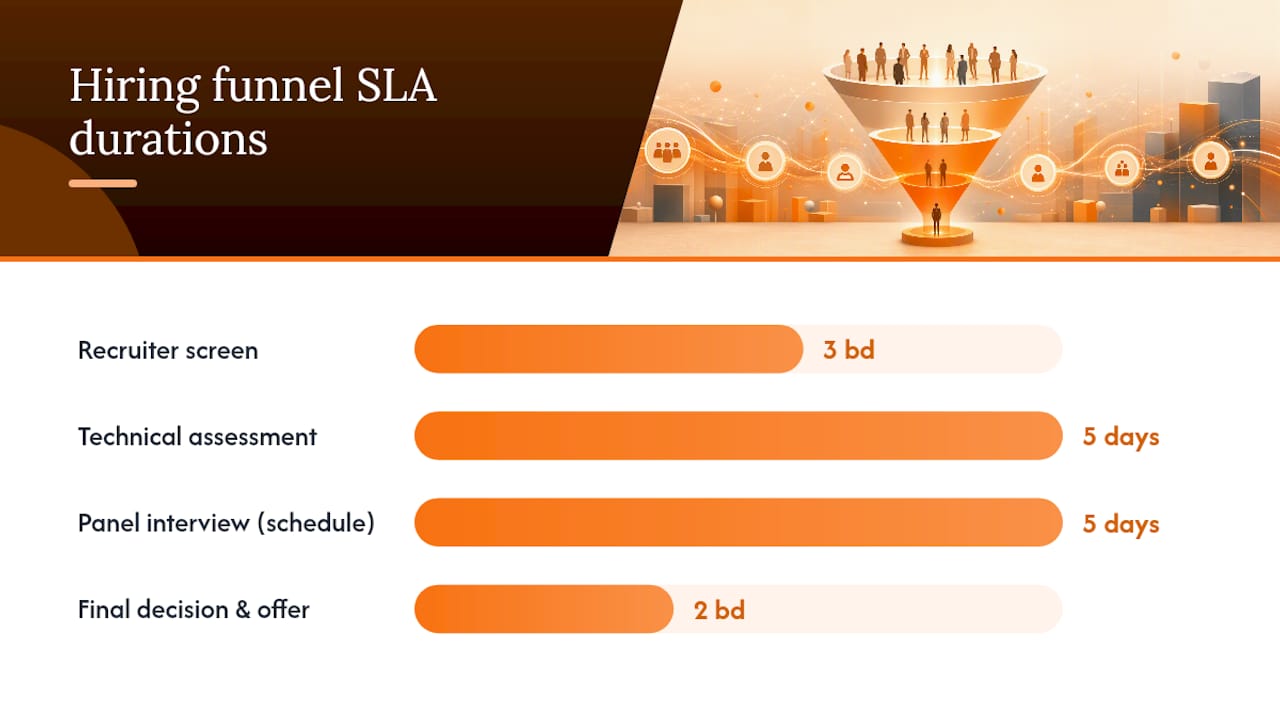
Total target timeline: 3–4 weeks from first contact to offer.
Stage gate checklist:
- Recruiter screen → Technical assessment: Candidate meets compensation range and has relevant domain experience.
- Technical assessment → Panel interview: Assessment score meets or exceeds the agreed threshold (e.g., 3+ on technical depth and architecture judgment).
- Panel interview → Offer: Rubric scores are complete; all interviewers have submitted independent scores; debrief is complete.
For governance, assign one person as the search owner who tracks every candidate's stage, flags SLA breaches, and escalates when a stage runs long. The IT job order management guide covers the internal mechanics of keeping a search on track. If the pipeline stalls at any stage for more than two weeks, pause and diagnose before continuing. The problem is usually the job description, the sourcing channel, or the assessment design, not the talent market.
For reducing time-to-hire across the full funnel, the 2026 placement time guide covers current market conditions and practical shortcuts.
How to make an offer a senior candidate will accept
Senior candidates evaluate offers differently than mid-level candidates. Salary matters, but it is rarely the deciding factor. What moves a senior hire is the combination of scope, team quality, flexibility, and the speed and respect with which the offer is delivered.
Offer checklist:
- Base salary at or above the candidate's stated range (never below)
- Equity: vesting schedule, cliff, current valuation or strike price disclosed
- Bonus structure: target percentage, payout history, and criteria
- Benefits: health, dental, vision, 401(k) match, PTO policy
- Flexibility: remote/hybrid arrangement confirmed in writing
- Start date: proposed date with room to negotiate
- Sign-on bonus: consider for candidates with unvested equity at their current employer
Negotiation tactics for senior hires:
Lead with scope, not just compensation. Senior candidates want to know the role is real: that they will have genuine decision authority, a team worth leading, and problems worth solving. Restate those elements when you extend the offer verbally before discussing numbers.
When a candidate counters, respond within 24 hours. A slow counter-response signals that the organization is not serious or that the hiring process will be equally slow once they join.
Counteroffer script:
If the candidate declines, ask for the real reason. Candidates who decline for compensation reasons often have a second candidate in the pipeline who will accept. Candidates who decline for scope or culture reasons are telling you something about how the role was positioned.
Onboarding a senior IT hire: the 30/60/90 plan
A senior hire who is not productive within 90 days is a retention risk. The onboarding plan should be built before the hire starts, not assembled during their first week.
30/60/90 template:
Days 1–30: Orient and listen
- Complete all access provisioning and security onboarding on day one.
- Schedule one-on-ones with every direct stakeholder in the first two weeks.
- Deliver a written "state of the system" or "state of the team" assessment by day 30.
- No major decisions yet; the goal is listening and mapping.
Days 31–60: Diagnose and plan
- Present a prioritized problem list and a proposed 90-day roadmap to the hiring manager.
- Take ownership of one defined workstream or project.
- Begin participating in hiring and architecture review processes.
Days 61–90: Execute and measure
- Deliver the first measurable outcome tied to the success profile KPIs.
- Conduct a structured check-in against the rubric dimensions used in hiring.
- Identify one team member to begin mentoring formally.
Retention checklist for the first six months:
- Career path conversation by month three
- Mentoring responsibility assigned (gives senior hires a stake in team development)
- Early win publicly recognized by leadership
- Bi-weekly feedback cadence with hiring manager
- Compensation review scheduled for month six if market has moved
The candidate experience guide covers how the pre-boarding and early onboarding experience shapes long-term retention, including signals that predict early attrition.
Practical tips to close senior candidates faster
Speed and specificity are the two variables hiring teams control most directly. These tactics apply from first outreach through offer acceptance.
- Respond to every candidate within one business day at every stage. Silence reads as disorganization.
- State the salary range in the job posting. Senior candidates filter on this immediately; hiding it wastes everyone's time.
- Give the hiring manager's name and LinkedIn profile in the job posting. Senior candidates research who they will report to before applying.
- Send the technical assessment with a clear rubric so candidates know how they will be evaluated. Transparency increases completion rates.
- Limit the take-home assessment to two to three hours maximum. Longer assessments signal poor process design and drive drop-off.
- Schedule the panel interview within 48 hours of receiving the assessment. Momentum matters.
- Prepare a verbal offer before the written one. Call the candidate, walk through the package, and confirm their intent before sending the formal document.
- Name a specific decision deadline. "We'll have a decision by Thursday" is more compelling than "we'll be in touch soon."
- Involve the hiring manager in at least one outreach message. A direct note from the person the candidate will report to has a materially higher response rate than a recruiter-only message.
- Share team artifacts during the process: architecture decision records, internal tech blog posts, or a team page with bios. These signal culture and quality better than any job description.
Outreach email for final close:
Subject: [First name] — following up on [Company] offer
Hi [Name], I wanted to follow up personally before Thursday's deadline. We're genuinely excited about what you'd bring to [specific team or project]. If there are any remaining questions about the role, the team, or the package, I'd rather answer them now than have them be the reason you don't join. Happy to jump on a call today or tomorrow.
Pro Tip: The best time to send a final-close message to a senior candidate is Tuesday or Wednesday morning. Response rates drop sharply on Fridays and Mondays. If you have a deadline, give the candidate at least 48 hours of business time to respond — a same-day deadline on a Friday afternoon is a reliable way to lose an otherwise interested candidate.
What experienced IT recruiters see hiring managers get wrong
After working through hundreds of senior IT searches, a few patterns repeat with enough consistency to be worth naming directly.
The most common mistake is treating a senior search like a mid-level search with a higher salary attached. Senior candidates evaluate the organization as much as the organization evaluates them. They are assessing the quality of the hiring process, the clarity of the role, and the credibility of the people they meet. A disorganized interview loop, a vague job description, or a hiring manager who cannot articulate what success looks like in 90 days sends a signal that the organization itself is disorganized. The best candidates walk away. The ones who stay are often the ones with fewer options.
The second pattern is interviewer panels that have not been calibrated. Four interviewers with four different mental models of what "senior" means will produce four incompatible assessments. One person scores a candidate a 5 on architecture because they used the right vocabulary. Another scores them a 2 because they could not defend a design decision under pressure. The debrief becomes a negotiation rather than an evaluation. The rubric in Section 8 of this guide exists specifically to prevent that outcome.
The third pattern is a compensation range that was set six months ago and has not been updated for current market conditions. The BLS occupational data and current industry surveys exist for a reason. Candidates who discover the range is below market after two rounds of interviews do not just decline the offer — they tell their network.
The fix for all three patterns is the same: treat the senior search as a strategic initiative, not a transactional process. Align the brief before sourcing. Calibrate interviewers before the first interview. Validate compensation before posting the role.
How Plucktalent supports senior IT searches
Senior IT searches fail most often at two points: the brief is unclear, or the candidate pipeline is too thin. Plucktalent's employer recruitment services address both directly. The platform combines 17 years of IT and cybersecurity recruiting expertise with Plucky AI, a co-pilot that helps candidates optimize their profiles and helps employers surface pre-vetted, actively available senior talent without waiting for job board applications.
For hiring managers running a senior search, Plucktalent offers direct-hire, contract, and leadership search options focused exclusively on IT and cybersecurity. That specialization means the candidate pool is already filtered for domain depth, and the sourcing channels reach passive candidates who are not visible on general job boards. For candidates, the platform provides ATS-ready profile optimization and direct connections to hiring managers at companies with active openings.
If your senior IT search has stalled, or you want to run it faster and with more confidence, view Plucktalent's services or visit Plucktalent to learn more about how the platform works for both sides of the search.
Sources
The following sources informed the data, benchmarks, and process recommendations in this guide:
FAQ
How many interview stages should a senior IT search include?
Four stages is the target: recruiter screen, technical assessment, panel interview, and offer. More than four stages increases candidate drop-off without improving hire quality.
What salary range should I budget for a senior IT hire?
Base salary for senior IT roles in the U.S. typically ranges from $140,000 to $230,000 depending on specialization, geography, and seniority level, with executive roles running higher. Validate against current BLS data and industry surveys before posting.
How long should a senior IT hiring process take?
Three to four weeks from first contact to offer is the target. Searches that run past six weeks without a qualified pipeline need a process or sourcing diagnosis, not more time.
What is the most common reason senior IT searches fail?
The brief is unclear before sourcing begins. When hiring managers and interviewers have different definitions of success, the evaluation produces conflicting feedback and the search stalls.
How can Plucktalent help with a senior IT search?
Plucktalent provides IT and cybersecurity-focused recruiting services for employers, including direct-hire, contract, and leadership searches, with access to pre-vetted senior candidates who are not visible on general job boards.