
Start with referrals, mobilize targeted outreach through one vetted platform or specialist staffing partner, and skip the mass job-board post entirely. Before any of that, decide which of five specific DevOps role profiles you actually need. This combination cuts false positives and shortens time-to-hire because you stop screening against a vague title and start screening against a real outcome.
TL;DR:
- Referrals are ideal for sourcing senior, passive DevOps candidates with proven production experience, especially those less likely to apply through job boards.
- Focus roles by selecting one of five clear profiles—such as CI/CD engineer or SRE—to reduce search duration from over two months to under one month.
- Use real-world, hands-on tasks during interviews to better evaluate candidates' ability to solve actual production failures rather than relying on theoretical questions.
- Short-term needs can be efficiently filled through freelance platforms, while permanent roles benefit from specialized staffing or direct hire channels with median hiring times around 17 days.
- Legal requirements include clear employment classification, non-disclosure agreements, and explicit intellectual property clauses to prevent risks associated with handling sensitive infrastructure data.
Table of Contents
- Where to Find DevOps Engineers: Channels and Trade-offs
- Decide Which DevOps Role You Really Need
- How to Evaluate DevOps Candidates: Tests, Interviews, and Validation
- Hiring Models, Timeline, and Cost Expectations
- How Pluck Talent's Recruiting Experience Speeds Up Hiring
- Legal and Compliance Considerations When Hiring DevOps Engineers
- Author Perspective: Habits That Actually Shorten DevOps Searches
- Pluck Talent: Shorten Your DevOps Hire Without the Job-Board Guesswork
- Sources
- FAQ
Where to Find DevOps Engineers: Channels and Trade-offs
Every channel works for something. The mistake most hiring teams make is picking the loudest one instead of the right one.
Referrals and employee networks win for senior, passive candidates almost every time. A production-proven engineer with six years of on-call scars isn't scrolling job boards. Ask your current infrastructure team who they'd want next to them during a 3 a.m. outage, then pay a referral bonus that reflects how hard the role actually is to fill.
Community and technical sourcing gets you engineers who are visible in the places DevOps work actually happens: GitHub contribution histories, CNCF and HashiCorp community Slacks, and forums like r/devopsjobs, where recruiters routinely find passive talent that never touches a job board. Meetups tied to specific tools (Kubernetes, Terraform, Datadog) tend to surface people who've actually shipped the thing, not just studied it.
Job boards and niche tech boards deliver volume, not precision. LinkedIn alone lists more than 11,000 active DevOps engineer postings, and Indeed's remote search returns over 2,000 openings at any given time. That volume cuts both ways: you'll get applicants, but a large share won't match the actual role. Writing a post that names the exact tool stack and the specific problem the hire will own filters out a lot of noise before it reaches your inbox.
Freelance and marketplace platforms make sense for short, scoped projects or an urgent contract gap. Curated marketplaces pre-screen for technical depth and can staff a role faster than a traditional search, which matters when a migration deadline is two weeks out.
Specialist staffing and boutique recruiters are worth the fee when you need a vetted shortlist on a deadline with a defined service level. Good agencies quote first-candidate delivery in days, not weeks.
- Referrals: best for senior, passive, high-trust hires
- Communities (GitHub, CNCF, Slack, r/devopsjobs): best for niche tool expertise
- Job boards: best for volume when the req is airtight
- Marketplaces: best for short-term or urgent contract needs
- Staffing specialists: best for fast, vetted shortlists with SLAs
Pro Tip: Post the exact incident type the hire will own ("stabilize a flapping CI pipeline," not "manage DevOps processes"). Specificity in the headline alone will change who applies.
Decide Which DevOps Role You Really Need
"DevOps engineer" has become a catch-all title, and that vagueness is one of the biggest reasons searches drag on. Job postings that bundle platform engineering, SRE, and DevSecOps into a single requisition take significantly longer to fill than postings built around a single, clear profile. Some case examples show searches dropping from 60-plus days to under 30 once the role gets clarified.
Five profiles cover almost every real DevOps req:
- CI/CD and automation engineer: owns build pipelines, deployment automation, and release velocity
- Cloud or platform engineer: builds and maintains the internal infrastructure other engineers deploy on top of
- Reliability engineer (SRE): owns uptime, incident response, and error-budget tradeoffs
- DevSecOps engineer: embeds security scanning, compliance, and access controls into the pipeline
- Release or build engineer: manages versioning, artifact management, and complex multi-service releases
Ask yourself one question: what breaks first if this role goes unfilled? If deployments stall, you need CI/CD. If the platform itself is fragile, you need a platform engineer. If outages are the pain, you need SRE. That single test does more to sharpen a job description than any list of "nice to have" tools ever will.
Seniority changes both cost and channel. A mid-level automation engineer is reasonably findable through job boards and marketplaces. A senior platform engineer who's architected multi-region infrastructure is almost always a referral or specialist-staffing hire, because that person isn't actively applying anywhere.
How to Evaluate DevOps Candidates: Tests, Interviews, and Validation
Algorithmic coding puzzles tell you almost nothing about whether someone can fix a broken production pipeline under pressure. Hands-on tasks that mimic real failure modes are a far better predictor of on-the-job performance than whiteboard interviews.
- Design a short, focused hands-on task. Give the candidate a broken Terraform module, a failing CI pipeline, or a misbehaving Kubernetes deployment and ask them to triage it live or async within a set window. Score them on diagnosis speed, communication of tradeoffs, and whether the fix is production-safe or just a patch.
- Probe for real production ownership in the interview. Ask for a specific incident they handled: what broke, how they found it, what the postmortem said, and what changed afterward. Vague answers here are a red flag; specific war stories are the signal.
- Check references for artifacts, not adjectives. Don't ask "was this person a good team player." Ask for examples of runbooks they wrote, postmortems they authored, or Terraform modules they published. Artifacts prove work; opinions don't.
- Use a paid trial or contract-to-hire period as the final gate. A short paid engagement, even one to two weeks on a real ticket, reveals more than five more interview rounds. Structure it with a defined deliverable and a clear conversion path to full-time if both sides want it.
Pro Tip: Ask candidates to walk through an outage they caused, not just one they fixed. How someone talks about their own mistakes tells you more about production judgment than any success story.
Hiring Models, Timeline, and Cost Expectations
Contract, contract-to-hire, and direct hire each solve a different problem. Contract works when the need is scoped and temporary, a migration, an audit, a specific integration. Direct hire makes sense when the role is a permanent fixture on the team and you're willing to invest in onboarding and retention. Contract-to-hire sits in between and is often the most cost-effective way to validate a complex infrastructure hire before committing long-term, since it lets both sides confirm fit on real work rather than resume claims.
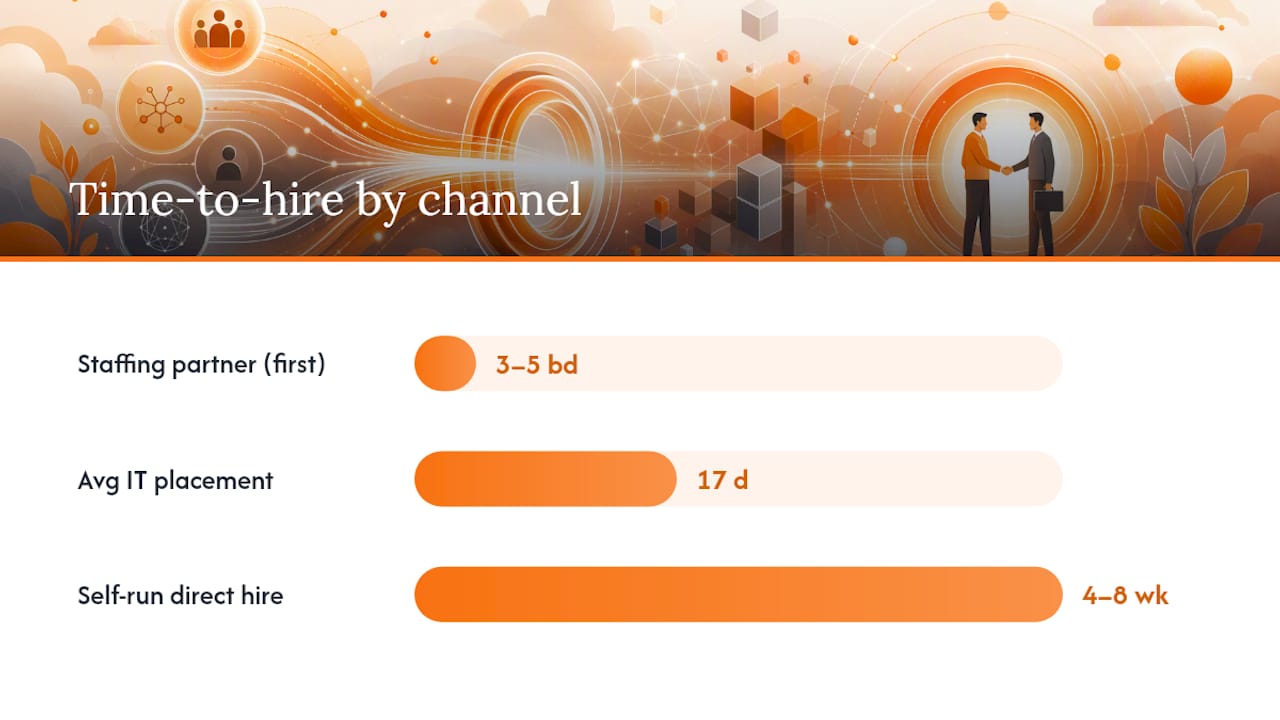
Time-to-hire varies widely by channel and role clarity. Specialist staffing partners commonly deliver first candidates within three to five business days, with average time-to-hire for IT placements landing around 17 days once the role and process are clearly defined. A self-run direct-hire search with a broad job posting frequently runs four to eight weeks, longer if the req is vague.
- Contract: fastest to staff, best for scoped or temporary work
- Contract-to-hire: middle ground, validates fit before permanent commitment
- Direct hire: slowest but best for long-term platform ownership
Compensation bands vary by level. Mid-level DevOps engineers typically land in the $120,000 to $165,000 base range, while senior engineers command $160,000 to $210,000, with total compensation running higher in competitive markets or for niche skills like multi-cloud security automation. Budget for a 90-day onboarding window with clear milestones: infrastructure familiarity by day 30, independent ownership of a workflow by day 60, and a measurable reliability or velocity contribution by day 90.
How Pluck Talent's Recruiting Experience Speeds Up Hiring
Seventeen years of IT and cybersecurity recruiting has shown one pattern over and over: the fastest hires happen when role clarity meets direct access to decision-makers, not more applicant volume. Pluck Talent connects employers with candidates whose profiles are already ATS-optimized and pre-vetted, and puts hiring managers in direct contact instead of routing everything through blind job-board queues.
Pluck Talent complements referrals rather than replacing them; it fills the gap when your network runs dry and job boards produce too much noise to sort through manually. Before engaging any vendor for this kind of search, ask:
- What's the service-level agreement for delivering a first shortlist?
- What does the vetting process actually check, technical tasks, references, portfolio review?
- What's the trial-to-hire conversion rate on contract placements?
Legal and Compliance Considerations When Hiring DevOps Engineers
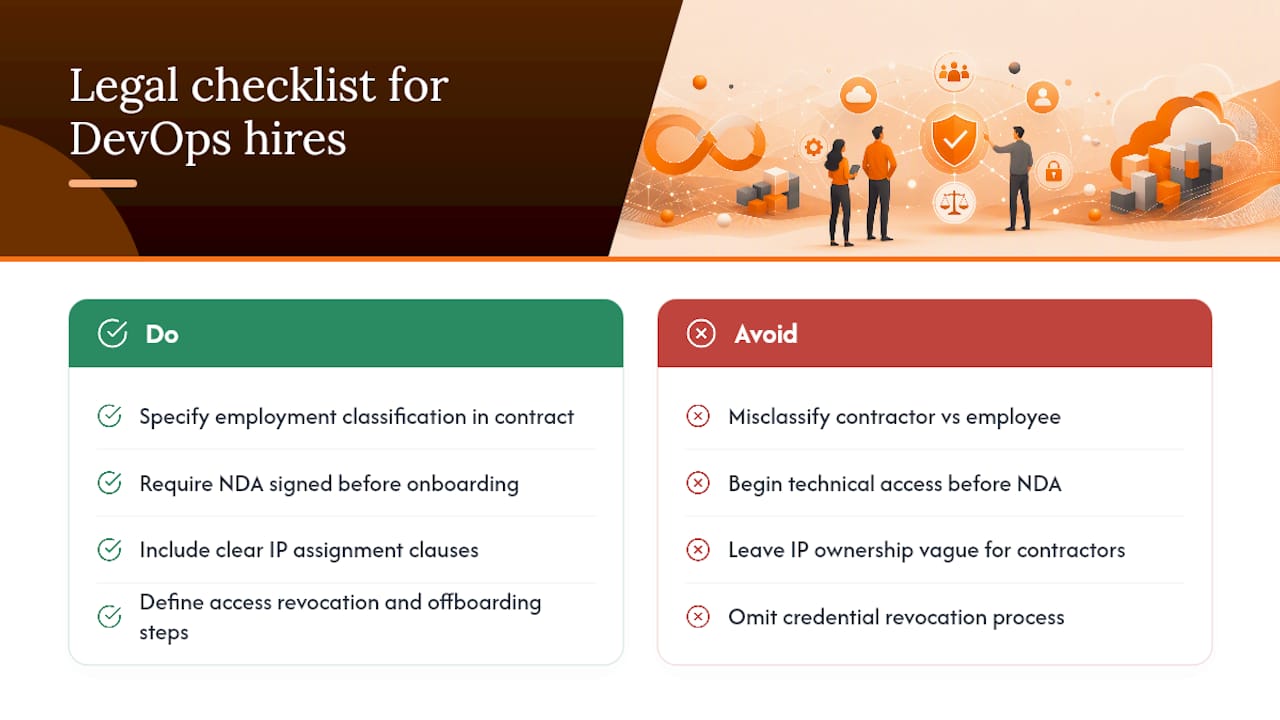
DevOps engineers touch production infrastructure, source code, credentials, and often customer data, which makes the paperwork around the hire matter more than it does for many other roles. A signed offer letter or contract should spell out employment classification clearly: contractor, contract-to-hire, or full-time employee, since misclassifying a contractor as an employee (or vice versa) carries real tax and legal exposure under U.S. labor rules.
Non-disclosure agreements are non-negotiable given the access level involved. A DevOps hire will likely see API keys, database credentials, and internal architecture diagrams within their first week, so the NDA should be signed before technical onboarding starts, not after.
Intellectual property assignment clauses need specific attention for this role. Infrastructure-as-code modules, custom automation scripts, and internal tooling built during employment should explicitly belong to the company, not the individual contributor. This matters especially for contractors and freelancers, where default IP ownership rules can be murkier than for direct employees.
Access control agreements deserve a mention too: define what happens to credentials, VPN access, and cloud console permissions the day the engagement ends. Building offboarding steps into the contract upfront avoids the scramble of revoking access after someone has already left.
For contract-to-hire arrangements, be explicit about the conversion terms: timeline, any conversion fee owed to a staffing partner, and what happens to work product created during the contract phase if the hire doesn't convert.
Author Perspective: Habits That Actually Shorten DevOps Searches
The biggest time-waster in DevOps hiring isn't a thin candidate pool, it's a job description trying to be five roles at once. Pick the single thing that must work, and write the req around that. Second, run your hands-on validation task in round one, not round four; it saves everyone weeks. Third, mobilize referrals and community outreach before you ever post publicly. Job boards should be a backup channel, not the default.
— Diego
Pluck Talent: Shorten Your DevOps Hire Without the Job-Board Guesswork
Pluck Talent is the alternative to sifting through thousands of job-board applications: instead of casting wide and filtering later, employers get direct access to pre-vetted, ATS-ready DevOps candidates and a hiring-manager connection from day one. 
For employers, that means less time reading resumes that don't match the role and more time interviewing people who've already been screened for production experience. Pluck Talent's employer services cover full-time, contract, and leadership searches specifically in IT and cybersecurity, so the vetting process is built around the same production-ownership signals covered above, incident history, IaC work, real infrastructure scale.
To get started, have your role profile ready (use the five-profile framework above to pin it down), your target compensation band, and your timeline. Most employers see a first shortlist within days of submitting a search. If you're also curious how Pluck Talent prepares candidates on the other side of the marketplace, the candidate platform shows how that vetting works before candidates ever reach your inbox. Reach out through the services page to start a search today.
Sources
- 11000+ Devops Engineer Jobs in United States
- Devops Engineer jobs in Remote
- How to Hire a DevOps Engineer: The 2026 Guide - KORE1
FAQ
Are DevOps engineers still in demand?
Yes. LinkedIn alone lists more than 11,000 active DevOps engineer postings at any given time, and demand remains strong across cloud, platform, and reliability-focused roles.
What engineer makes $500,000 a year?
Total compensation near that level is rare and typically belongs to principal or staff-level engineers at large tech companies with heavy equity components, not typical base-salary DevOps roles; standard senior DevOps base pay runs $160,000 to $210,000.
How much does it cost to hire a DevOps engineer?
Base compensation for mid-level DevOps engineers typically runs $120,000 to $165,000, with senior engineers commanding $160,000 to $210,000, plus recruiting or staffing fees if you use a specialist partner.
Is DevOps a dead-end job?
No. DevOps skills feed directly into higher-paying tracks like platform engineering, SRE, and DevSecOps leadership, and the role remains one of the more transferable paths in infrastructure careers.
What's the fastest way to find qualified DevOps candidates?
Combine referrals, targeted community outreach, and a vetted staffing partner like Pluck Talent, which can deliver a pre-screened shortlist faster than an open job-board post typically produces qualified applicants.